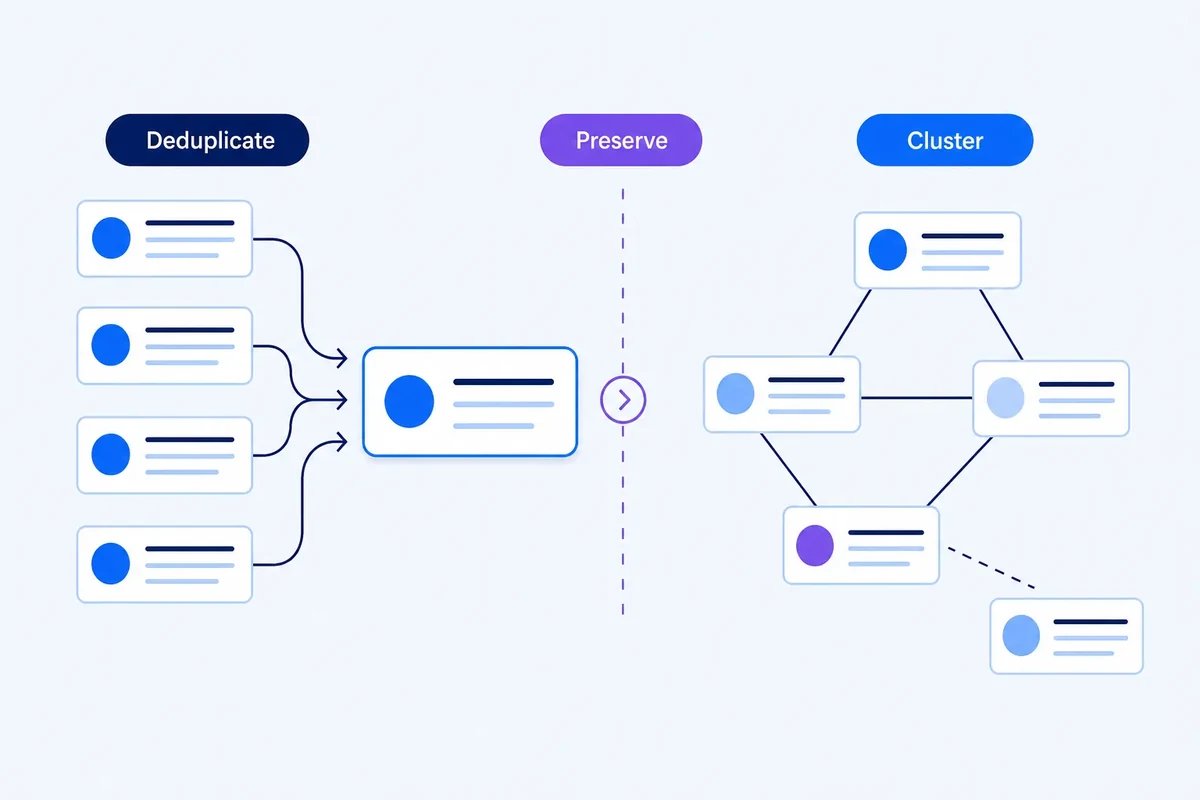
Outliers in keyword clustering: noise, niche opportunity or modelling error?
An outlier is not automatically a bad keyword. Learn how to distinguish irrelevant noise, niche topics, bridge queries and modelling failures before deleting or forcing assignments.

Farky Rafiq
Founder of ClusterIQ
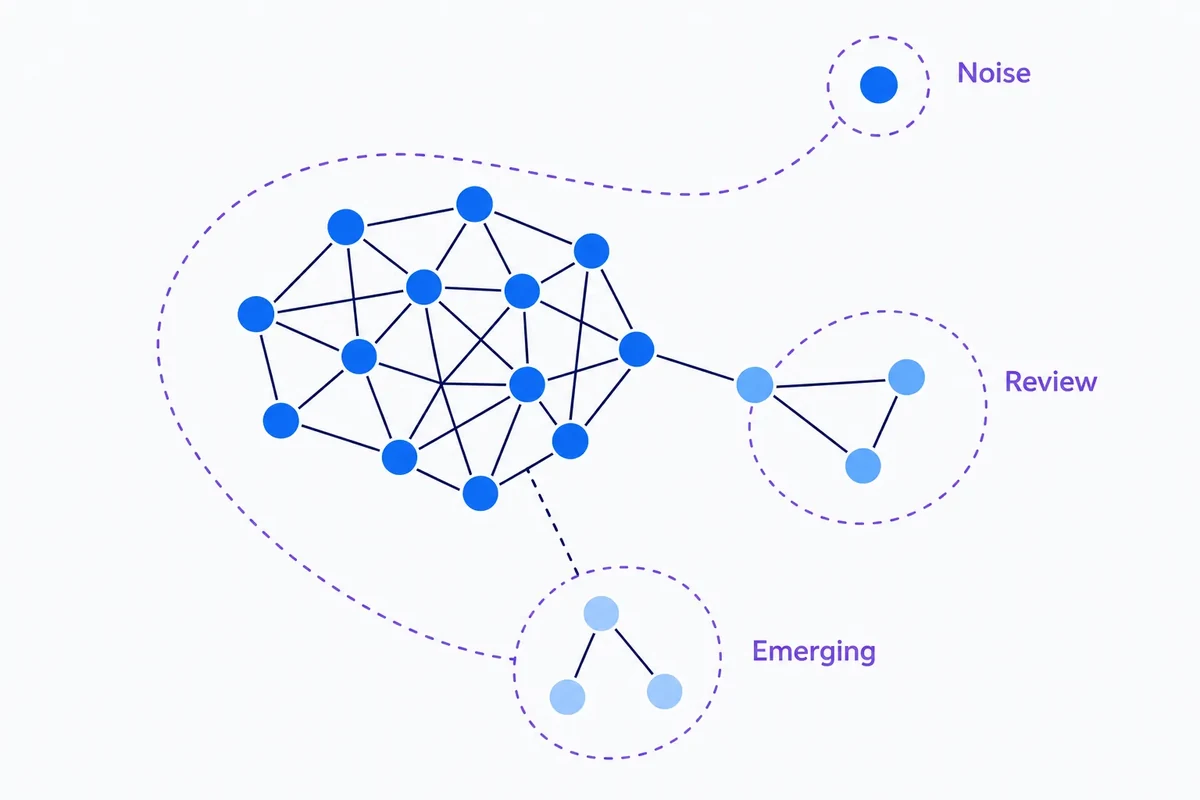
Clustering systems often treat outliers as something to clean up. For SEO, that can be a mistake. An isolated keyword might be irrelevant noise. Equally, it might be a valuable niche topic, a new product, an ambiguous query, or simply evidence that your representation is failing to understand a domain-specific term.
The useful question is not "how do we eliminate outliers?" It is: why did this observation fail to fit the dominant structure?
What counts as an outlier depends on the method
HDBSCAN can explicitly label points as noise when they do not belong strongly to a stable dense region. K-means behaves differently: every observation gets assigned to a cluster, so outliers have to be inferred afterwards from distance to the centroid or other diagnostics. Graph workflows can expose isolated nodes, low-degree nodes or weakly connected components. These are related ideas, but they are not identical definitions of an outlier.
Four kinds of outlier matter for SEO
Irrelevant noise. The query does not belong in the dataset at all.
Niche opportunity. The query is legitimate but represents a small topic with few neighbours.
Bridge or ambiguous term. The query sits between topics and has no strong single home.
Modelling error. The query should belong somewhere, but preprocessing, embeddings or entity handling failed to represent it properly.
Deleting all four categories in one go would throw away useful evidence along with the genuine noise.
Start by checking the nearest neighbours
For every outlier, look at its strongest available neighbours and their similarity values. If the neighbours are all weak and semantically unrelated, the query may genuinely be isolated. If several neighbours look obviously correct but fall just below your threshold, the issue is probably calibration rather than meaning. If the model misses relationships a human would consider obvious, check preprocessing and entity representation before anything else.
High-volume outliers deserve priority
Review effort should match consequence. A low-volume misspelling probably does not justify manual investigation. A high-volume commercial query that sits outside every cluster almost certainly does. Useful priority signals include:
- search demand;
- current ranking position;
- commercial value;
- new product or service relevance;
- strategic importance;
- distance from the nearest credible cluster.
New entities frequently masquerade as outliers
Embedding models can struggle with newly launched products, model numbers, specialist abbreviations and local terms. Entity-aware features help preserve these relationships properly. If a new product family keeps showing up as noise, the right fix is often to update the entity layer or taxonomy, rather than simply lowering the global similarity threshold for everyone. See our entity-aware clustering guide for the broader approach.
Outliers can reveal emerging topics before anyone else notices
A handful of isolated queries today can turn into a dense cluster next month. This is especially relevant around:
- new product launches;
- news-driven search;
- changing regulations;
- new technologies;
- seasonal demand.
Keep a holding area for valid but unassigned queries and monitor whether structure develops around them over time. This fits naturally with the incremental workflow described in adding new keywords to existing clusters.
Do not lower the threshold just to chase coverage
A common reaction to too many outliers is to make the clustering more permissive across the board. That might reduce the visible noise rate while quietly degrading the quality of every other cluster. Coverage is not automatically the same thing as quality. Before touching a global parameter, review a sample of outliers and check whether they are actually false negatives first.
Soft membership adds useful context
Where the algorithm supports it, membership strength can distinguish between clear noise, almost-members, and queries genuinely split between two plausible clusters. Our article on soft clustering and confidence explains why this matters for review queues.
Outlier rate is a diagnostic, not a target
A system with 0% outliers may simply be forcing every observation somewhere it does not belong. A system with 30% noise might be too conservative, or it might genuinely be analysing an extremely diverse dataset. Track the rate, but judge it alongside cluster cohesion, judgement-set performance, nearest-neighbour quality, manual review outcomes and stability across runs.
A practical outlier review workflow
- Rank outliers by business importance.
- Inspect nearest neighbours and similarity evidence.
- Check preprocessing and entity extraction.
- Classify each sample as noise, niche, bridge or modelling error.
- Adjust local rules before touching global thresholds.
- Keep valid unassigned queries for future re-evaluation.
- Track repeated outlier patterns as model feedback.
Practitioner principle: an outlier is not the system saying "delete this keyword". It is the system saying "this keyword does not fit the current structure confidently".
Worked example: the outlier that should become a cluster
Suppose a bathroom dataset contains five queries around a newly launched product type. None is dense enough to form a stable HDBSCAN cluster, so they show up as noise. A month later, twenty more related queries arrive. The original five were not bad data, they were early evidence of a topic whose density had not yet emerged. Keeping valid noise in a holding area lets the system recognise that growth instead of permanently deleting the signal.
Record the reason behind every outlier decision
When a practitioner removes or reassigns an outlier, save the reason. Repeated patterns like "new product code not recognised" or "location token lost in preprocessing" are valuable model feedback and can improve the next clustering version.
ClusterIQ Conclusion
Outliers are useful because they expose the limits of your clustering model. Some genuinely should be removed. Others represent valuable niche demand, ambiguous boundaries, or weaknesses in the representation itself. Treat them as a review surface rather than a failure count. The strongest clustering system is not the one that forces every row into a bucket. It is the one that makes uncertainty and novelty visible enough to act on.
Sources and further reading
Farky Rafiq
Founder of ClusterIQ
I've worked in digital marketing since 2005 and founded Liquid Silver in 2011. These articles are where I share the methods, experiments and practical SEO thinking behind ClusterIQ.
Put the idea into practice with your own keyword data
ClusterIQ helps turn raw SEO exports into clean, structured working datasets you can inspect, refine, report on and take into the next stage of your workflow.
Keep reading
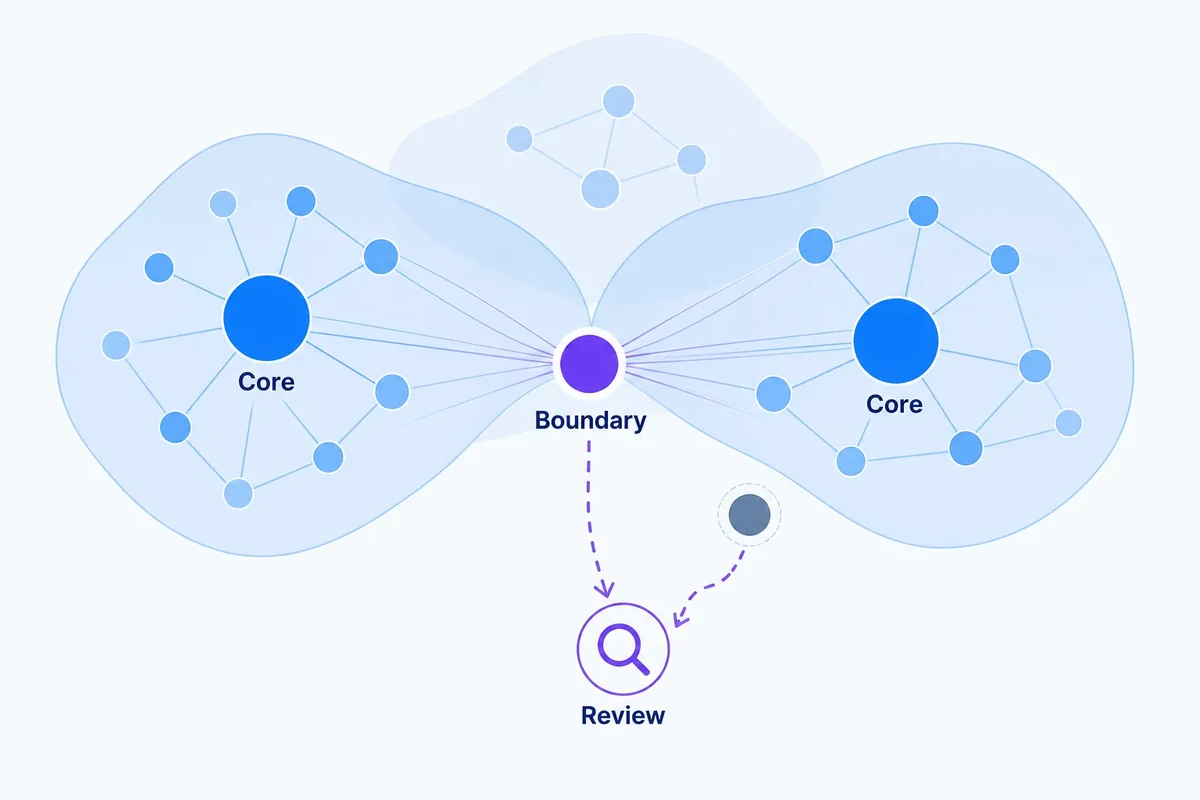
Soft clustering and confidence scores: handling ambiguous keywords honestly
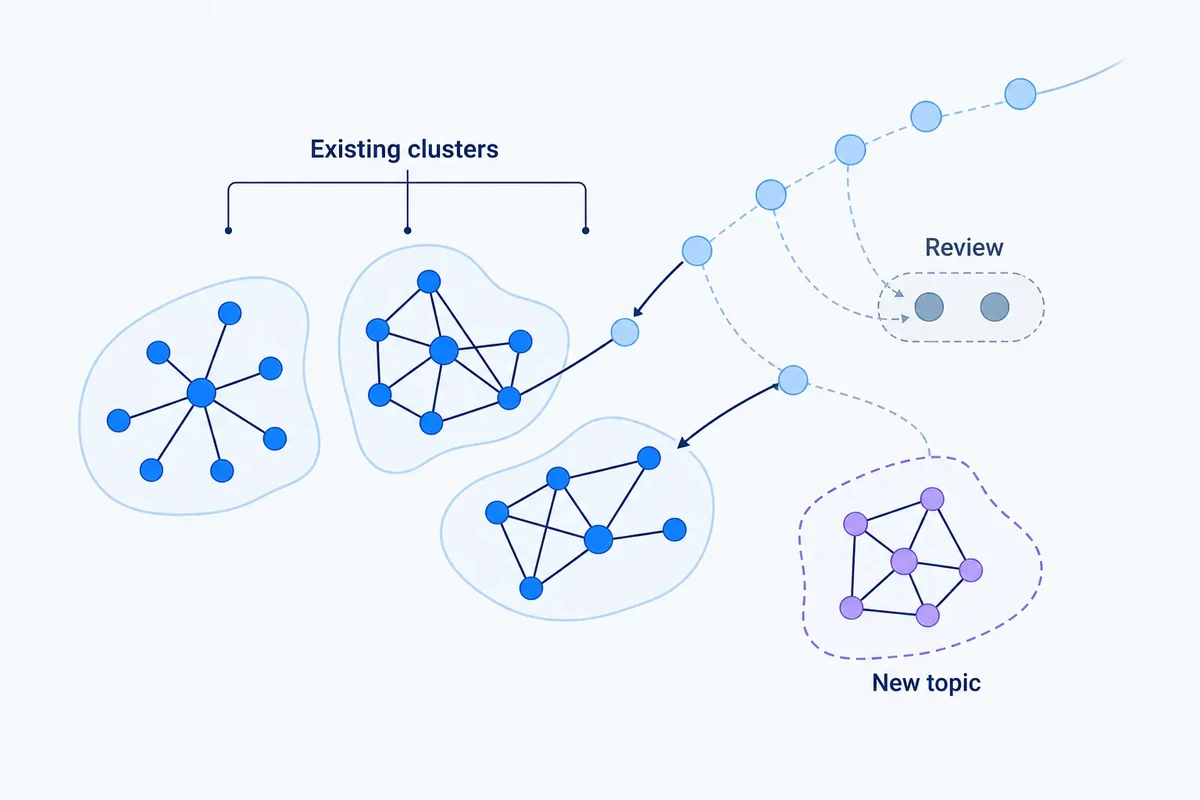
Adding new keywords to existing clusters without rebuilding everything