Keyword deduplication vs clustering: why they should stay separate
Deduplication removes repeated observations. Clustering preserves distinct queries and models their relationships. Learn why combining the two can destroy useful SEO evidence.

Farky Rafiq
Founder of ClusterIQ
Here's a mistake that's easy to make and hard to spot afterwards: treating deduplication and clustering as the same clean-up step. They solve different problems, and mixing them up is one of the quickest ways to lose useful keyword information before your analysis has even properly started.
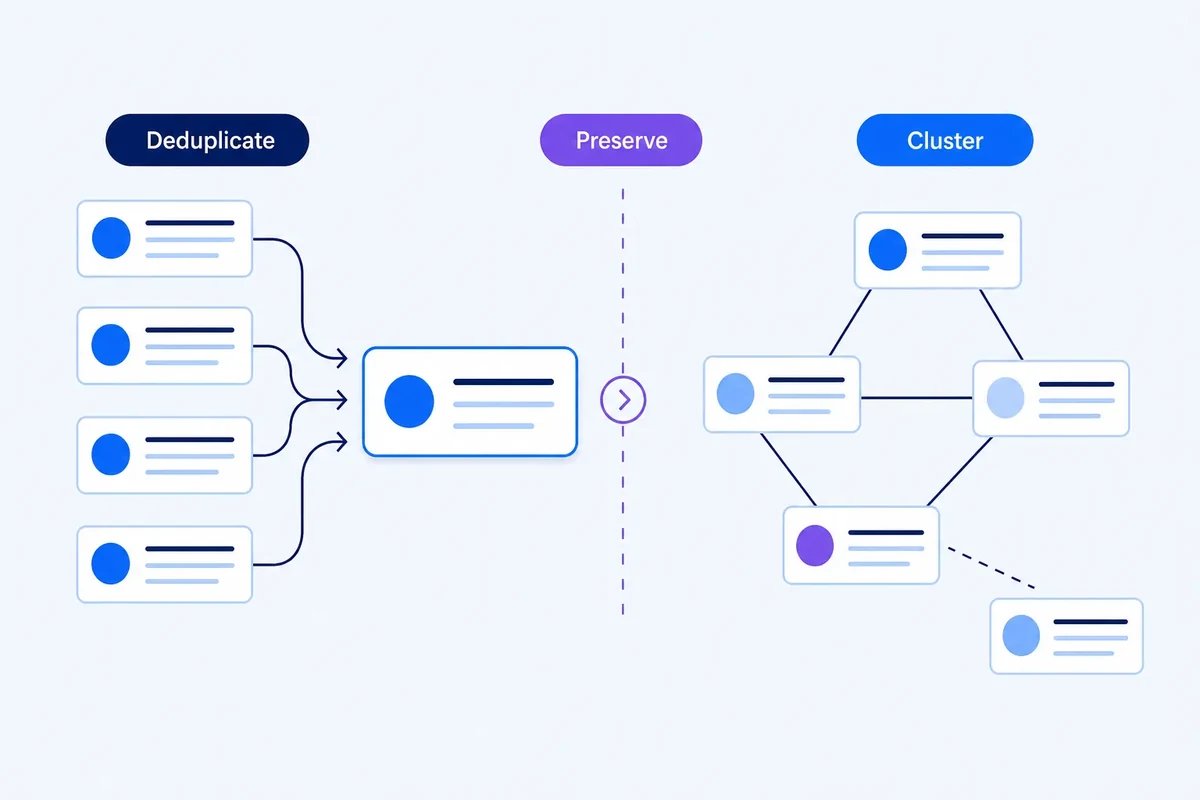
Deduplication asks a narrow question: should these two rows be treated as one record? Clustering asks a broader one: are these different queries related enough to analyse together? Once you keep those questions separate, a lot of downstream confusion simply disappears.
The distinction in one sentence
Deduplication removes repeated representations of the same observation. Clustering keeps different observations separate and models the relationships between them.
That sounds obvious written down, but plenty of keyword workflows blur the line anyway. They normalise terms aggressively, then quietly treat the shrunken list as if it were the clustered dataset.
Exact duplicates are usually straightforward
Say three source files all contain the query "keyword clustering software". After whitespace and Unicode normalisation, the string is identical across all three.
You can usually collapse those rows into one observation, as long as you handle the metrics attached to them properly first. Before you do, ask:
- Are search volumes additive, or are they just repeated measurements of the same underlying number?
- Do the ranking URLs differ?
- Do the rows come from different markets or dates?
- Should you keep a record of where each row came from?
Deleting a repeated string without thinking about its metadata can still leave you with a broken dataset.
Near-duplicates are a modelling problem, not a clean-up problem
Now look at these:
- keyword clustering software;
- software for keyword clustering;
- best keyword clustering software;
- keyword clustering tool;
- keyword grouping software.
Clearly related. Not automatically identical.
"Best" might signal a comparison task. "Tool" and "software" might be interchangeable in one market but not another. A clustering system should be free to inspect those differences rather than have them wiped out by a blanket preprocessing rule.
Why fuzzy string matching can over-deduplicate
Edit distance and token similarity are genuinely useful for catching likely duplicate records, especially where typos or formatting differ. They become risky the moment you let a similarity threshold decide what counts as the same meaning.
Take:
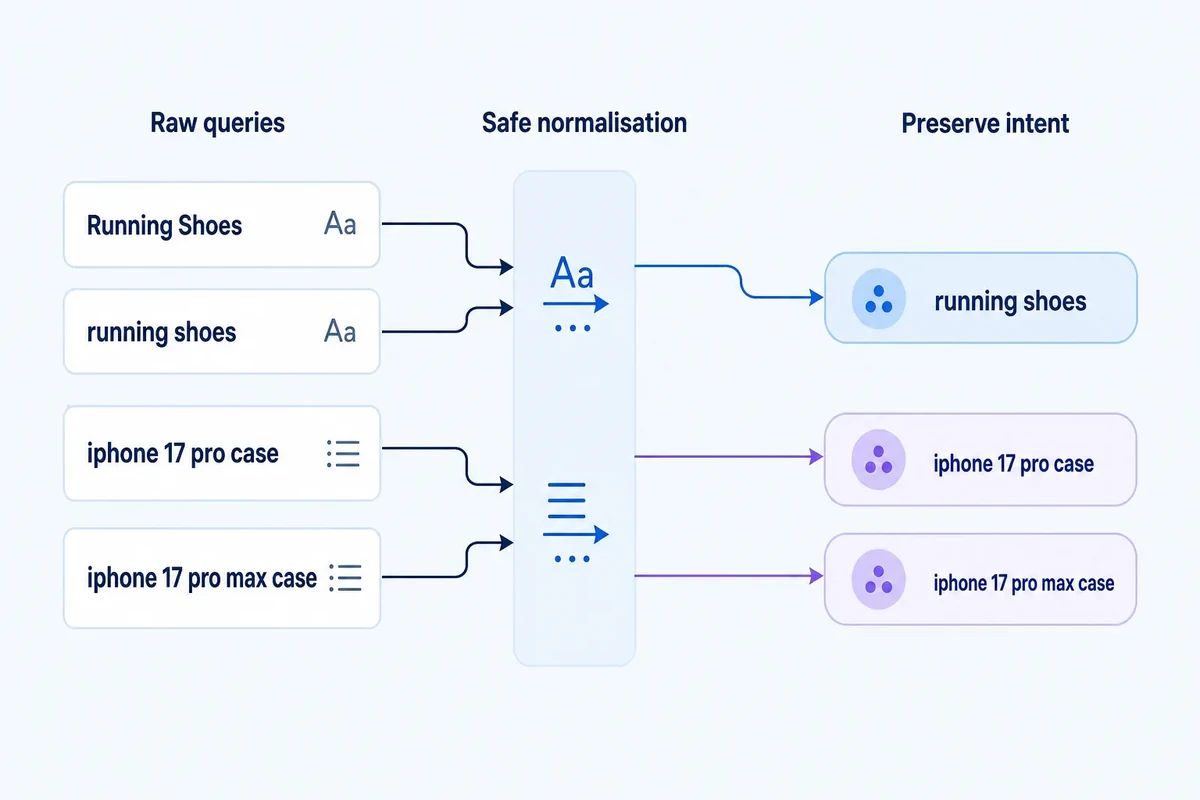
- "iphone 17 case";
- "iphone 17 pro case";
- "iphone 17 pro max case".
The strings look highly similar. The products they refer to are not interchangeable. A fuzzy-deduplication rule can end up erasing exactly the attributes that clustering and URL mapping need later.
Semantic similarity shouldn't be used as a deduplication shortcut
Embeddings make this temptation worse. If two queries score 0.94 on cosine similarity, why not just merge them?
Because that score measures how similar the model's representation thinks they are, not whether they're the same record. Our guide to cosine similarity goes into why a high score doesn't prove identical intent. That limitation matters even more here, because merging rows destroys information you can't easily get back.
Use semantic similarity to suggest relationships or flag review candidates. Don't use it to erase observations unless you've defined a separate, explicit equivalence rule.
Make canonicalisation explicit
It helps to define a canonical key that's separate from the query you actually display to people.
For example:
- raw query:
Keyword Clustering Software - canonical key:
keyword clustering software
The canonical key can normalise whitespace, Unicode and case while leaving the actual words, numbers and meaningful punctuation intact. That gives you a clean layer for exact deduplication without pretending broader linguistic variation is the same thing.
Keep provenance when rows collapse
If five rows become one canonical keyword, don't lose the fact that five rows existed in the first place. Fields worth keeping:
- source files;
- markets;
- dates;
- original spellings;
- ranking URLs;
- volume providers;
- duplicate count.
That provenance can later explain why a keyword shows conflicting metrics or turns up in several different commercial contexts.
Aggregating metrics needs its own rules
Deduplication is often done right before metrics get summed, and that's exactly where false demand creeps in. If the same third-party search-volume estimate appears in three exports, summing all three triples the apparent opportunity without adding a single new user.
On the other hand, if the rows genuinely represent separate markets, devices or time periods, summing them may well be legitimate depending on what you're analysing. The rule for aggregation should come from what the metric actually measures, not simply from the fact that the keyword strings matched.
Deduplicate first, cluster second
A clean sequence usually looks like this:
- preserve the raw data;
- create conservative canonical keys;
- collapse genuine duplicate observations;
- reconcile or retain their metadata;
- build lexical and semantic representations;
- cluster the remaining distinct queries;
- review near-duplicates inside the clustering output.
That gives the clustering system fewer redundant rows to wade through, without deleting useful linguistic variation along the way.
Near-duplicates are often useful evidence
It can feel wasteful to keep several near-identical expressions around. In practice, they're often exactly what helps pin down the centre of a topic.
If a cluster contains:
- keyword clustering tools;
- keyword clustering software;
- software for clustering keywords;
- keyword grouping tool;
the repetition itself is informative. It helps with naming the cluster, picking a representative query, and understanding the actual language people use. Deleting everything except one preferred phrase might shrink the dataset, but it also makes the cluster harder to interpret.
When should near-duplicates be collapsed?
Sometimes a later stage genuinely needs one representative record. A reporting UI, for example, might group spelling variants or paraphrases under a single canonical keyword. That's reasonable as long as the original observations stay recoverable and the grouping can be reversed.
The key is timing: collapse for presentation once the relationship has already been evaluated, rather than deleting variation before the system has had a chance to look at it.
Use a two-level identity model
A practical setup separates two questions:
- record identity: is this the same canonical observation?
- semantic relationship: how closely related is this observation to another one?
The first can be handled with deterministic rules. The second belongs to similarity, clustering, graph or review logic. Keeping these separate also makes debugging much easier. If two rows vanished, check the deduplication layer. If two distinct rows ended up in the same cluster, check the representation and clustering configuration instead.
Editorial rule for the pipeline: deduplication should be conservative because it removes evidence. Clustering can afford to be exploratory because it keeps the underlying rows intact.
A practical deduplication QA sample
Before running rules across a large corpus, test them against cases like:
- capitalisation differences;
- multiple spaces and Unicode variants;
- hyphenated versus unhyphenated wording;
- singular and plural nouns;
- brand plus model variants;
- geographic modifiers;
- "best", "cheap", "reviews" and "price" modifiers;
- common misspellings;
- word-order changes.
For each pair, ask yourself whether you're genuinely comfortable treating the rows as permanently identical. If the answer needs a discussion, it probably belongs in clustering rather than deduplication.
ClusterIQ Conclusion
Deduplication and clustering solve adjacent but different problems. Deduplication removes repeated records under a deliberately narrow equivalence rule. Clustering keeps distinct queries intact and investigates how they relate to one another.
Keeping them separate protects data integrity. You can shrink the dataset without flattening the language in it, and you can explore semantic relationships without confusing similarity with identity.
That distinction only gets more important as clustering systems become more sophisticated. The better a model gets at recognising related language, the more important it is not to mistake "related" for "the same".
Sources and further reading
Farky Rafiq
Founder of ClusterIQ
I've worked in digital marketing since 2005 and founded Liquid Silver in 2011. These articles are where I share the methods, experiments and practical SEO thinking behind ClusterIQ.
Put the idea into practice with your own keyword data
ClusterIQ helps turn raw SEO exports into clean, structured working datasets you can inspect, refine, report on and take into the next stage of your workflow.
Keep reading
Keyword preprocessing before clustering: clean the data without erasing intent

Reproducible keyword clustering: how to make every run explainable