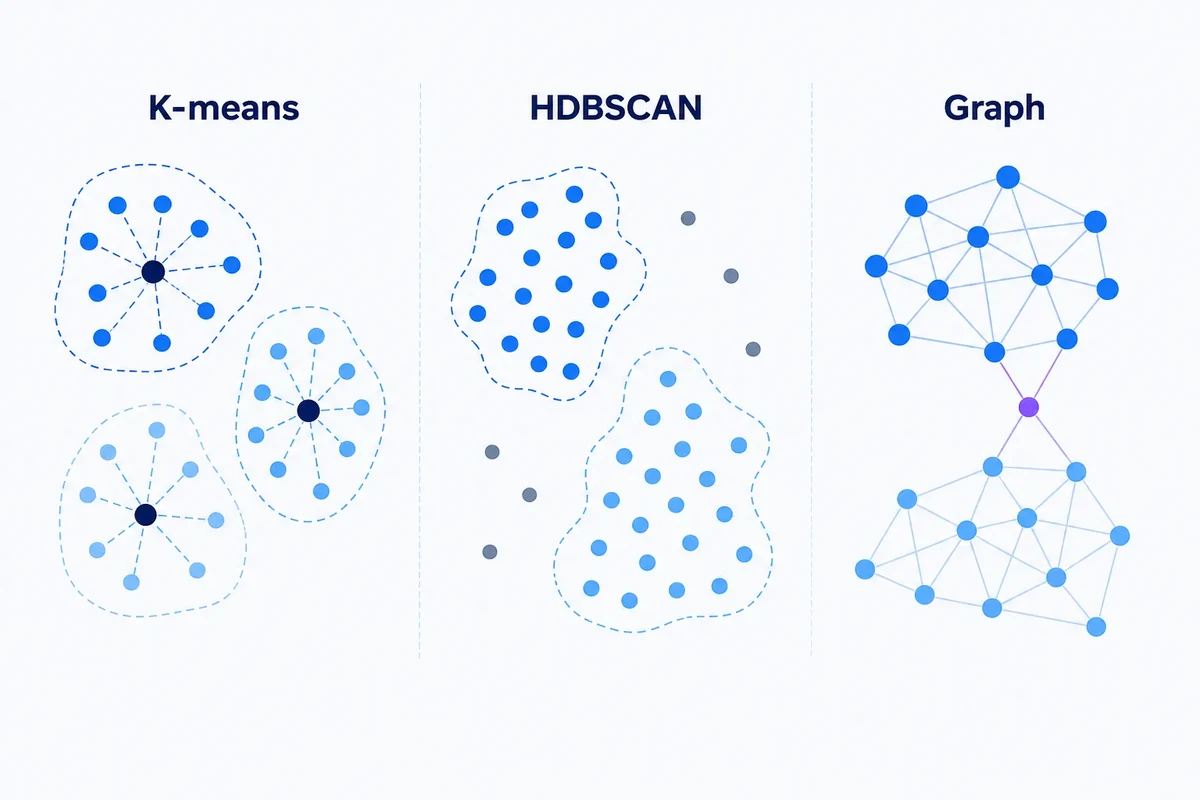
Soft clustering and confidence scores: handling ambiguous keywords honestly
Hard cluster labels can hide ambiguity. Learn how soft membership, confidence signals and targeted human review can make keyword clustering more useful and honest.

Farky Rafiq
Founder of ClusterIQ
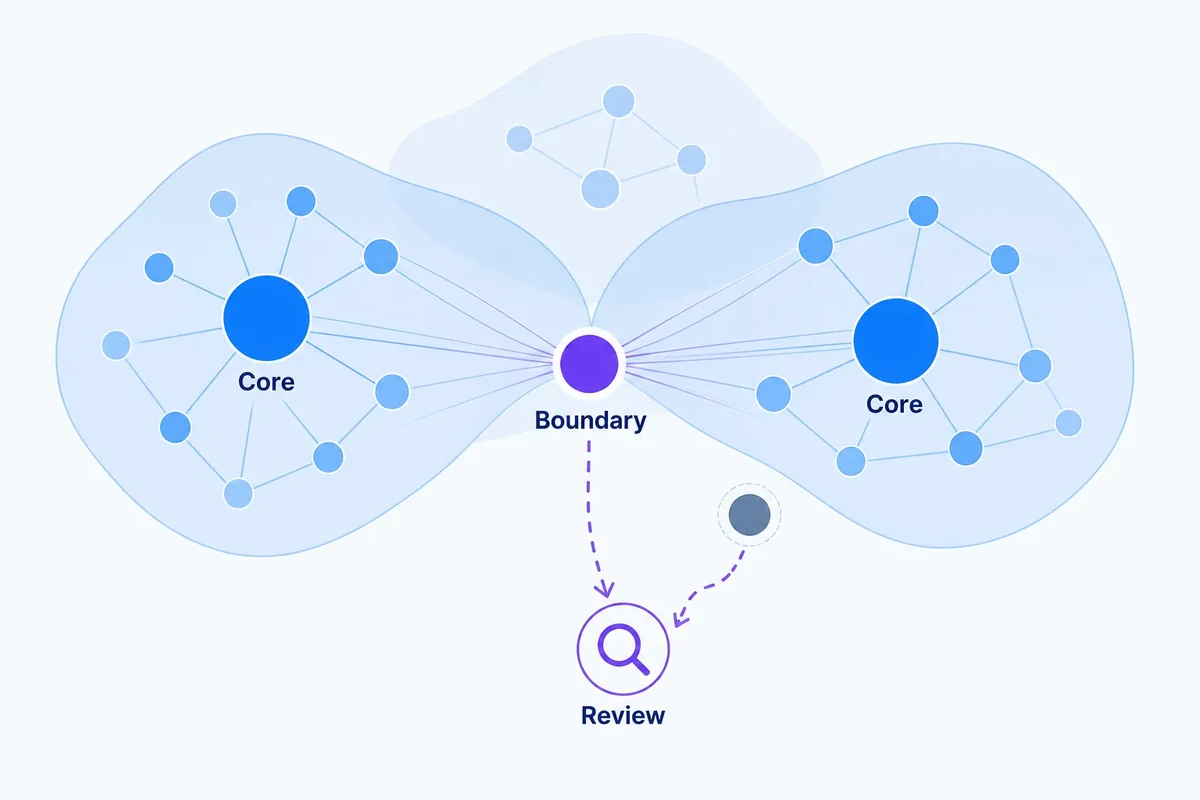
If you have ever reviewed a keyword export and found one phrase that could genuinely belong in two different groups, you have already met the problem soft clustering is trying to solve.
Most clustering tools eventually give you one answer: this keyword belongs in this cluster. That is useful because you need something you can export, turn into a plan and show to a client or manager. But search language is not always that tidy.
Some queries sit right in the middle of a topic. Others sit on the edge of two topics, mix more than one intent or do not fit strongly anywhere. Soft clustering keeps that uncertainty visible instead of pretending every keyword belongs cleanly to one group.
Why a single cluster label is useful
In day-to-day SEO work, you usually need an operational answer. A spreadsheet cannot stay theoretical forever.
- Cluster 12;
- Topic: running shoes;
- Suggested URL: /running-shoes/.
That makes the research easy to filter, export and turn into briefs or site recommendations.
The problem is that the label can make every assignment look equally certain. A keyword sitting in the centre of a very obvious group may receive exactly the same kind of label as a keyword that only just fits.
What soft clustering adds
Soft, or fuzzy, clustering adds another layer: how strongly a keyword appears to belong to one or more clusters.
HDBSCAN's soft-clustering tooling, for example, can produce membership values across the clusters it has discovered. That means a query does not have to be treated as though it has one perfectly obvious home.
For an SEO, that gives you a much more useful vocabulary:
- this keyword clearly belongs here;
- this one probably belongs here;
- this one sits between two topics;
- this one does not fit any cluster particularly well.
The hard label is still useful for the final export. The soft membership tells you where to trust the automation and where to spend a little more time looking.
Ambiguous queries are often worth reviewing
Take a query such as “shower bath screen”. Depending on the wider keyword set, it might sit close to:
- bath screens;
- shower screens;
- shower baths.
A normal clustering output has to put it somewhere. A softer representation can preserve the fact that the keyword has a relationship with more than one group.
That matters because the ambiguity may be real. It could reflect how customers describe the product, how categories overlap, or a gap in the way the site is currently structured.
Instead of treating the awkward keyword as a problem to hide, you can use it as a prompt to investigate.
Membership strength is not an SEO probability
This distinction is important.
If a clustering model gives a keyword a strong membership value, that does not mean there is an 82% chance it belongs on a particular URL. It means the keyword fits that cluster strongly under the assumptions of the model.
Those assumptions include:
- how the keywords were represented;
- the distance or similarity measure;
- the clustering algorithm;
- the dataset used to fit the model;
- the way membership was calculated.
Treat the value as model evidence, not as a calibrated business probability.
Where confidence becomes genuinely useful
The practical benefit is not that every keyword suddenly needs a confidence score in a dashboard. It is that confidence can help you decide what needs human attention.
Imagine you have exported 1,200 keywords from Semrush. A good workflow might let obvious cases pass straight through:
- high-confidence core keywords;
- clear exact and near variants;
- queries where several signals all agree.
Then it can flag the smaller set that deserves review:
- low-confidence assignments;
- keywords with similar membership across two clusters;
- noise points close to an important topic;
- commercially important queries whose assignment keeps changing.
That is a much better use of your time than manually checking every row in the spreadsheet.
Confidence can use more than one signal
Soft cluster membership is useful, but it does not have to be the only evidence you consider.
A practical SEO review layer might keep separate signals for:
- semantic membership;
- lexical similarity;
- entity compatibility;
- SERP overlap;
- search intent;
- evidence from existing pages.
Keeping those signals separate is often more useful than collapsing everything into one mysterious score.
A keyword with strong semantic membership but conflicting SERP evidence is a different problem from a keyword with weak semantic membership and no obvious existing page. The action you take should be different too.
Bridge terms can reveal something useful
Some keywords naturally connect two otherwise distinct topics.
In graph analysis, these can appear as bridge terms. In soft clustering, they can appear as mixed membership.
They might point to:
- real product overlap;
- a parent topic connecting two subtopics;
- ambiguous language;
- a missing intermediate category;
- a query whose intent changes depending on context.
Forcing every bridge term into one group can remove information you may actually need when deciding what pages or categories to create.
This is why the graph perspective in keyword graphs for SEO and the soft-clustering perspective work well together. Both help you understand what is happening around the boundaries instead of pretending those boundaries are always clean.
Noise is not automatically bad data
HDBSCAN can leave some keywords as noise when they do not belong strongly to a stable dense group.
That does not automatically mean they should be deleted. A noise keyword might be:
- irrelevant and safe to remove;
- a small but valuable niche topic;
- a new opportunity with little supporting data;
- a specialist entity;
- a query connecting several clusters.
Soft membership can help you distinguish between a term that is genuinely isolated and one that is almost part of an important cluster.
Show uncertainty only when it helps the user
The interface does not need to become a data-science dashboard just because the model contains confidence information.
Useful patterns might include:
- a primary cluster with confidence;
- a second-best cluster where the result is close;
- a “needs review” state;
- highlighting for weak assignments;
- nearest-neighbour inspection;
- manual reassignment with an audit trail.
The purpose is not to display more numbers. It is to show uncertainty when that uncertainty could change a content, taxonomy or page-mapping decision.
Human overrides are valuable data
If an SEO moves a keyword from one cluster to another, that decision should be recorded rather than silently replacing the model output.
A useful record can keep:
- the original model-assigned cluster;
- the membership strengths;
- the human-selected cluster;
- a reason or note;
- the reviewer;
- the date and model version.
Over time, repeated overrides can reveal a systematic weakness in the representation, business rules or clustering setup.
Do not optimise for confidence alone
A clustering system could make itself look more confident simply by creating broader groups or forcing more aggressive assignments.
That would miss the point.
What matters is whether high-confidence cases are genuinely reliable and low-confidence cases really are the ones that deserve more attention. Confidence should help you prioritise review, not just decorate the output.
A practical confidence workflow
- Fit the clustering model. Keep both the final labels and the underlying membership information.
- Identify strong core members. Use these to understand and label each cluster.
- Flag mixed membership. Pay particular attention where the top two cluster memberships are close.
- Review important noise. Especially commercially important or high-demand queries.
- Add SEO evidence. Check intent, entities, SERPs and existing pages where the decision affects implementation.
- Record overrides. Keep the model result and the practitioner's decision separately auditable.
Practical principle: uncertainty is not something to hide. It tells you where human judgement is most valuable.
ClusterIQ Conclusion
Soft clustering gives you a more realistic view of keyword research than a single hard label on every row.
It helps separate obvious cluster members from boundary cases, bridge queries and genuine noise. The membership values are not probabilities of SEO correctness, but they can be extremely useful for deciding where automation is enough and where a person should take a closer look.
That becomes particularly valuable when the output is going to influence content briefs, URL mapping, taxonomy or client recommendations, because those are the places where one weak assignment can create unnecessary work later.
Related ClusterIQ analysis
For another model of soft membership, see Gaussian mixture models for SEO.
Sources and further reading
Farky Rafiq
Founder of ClusterIQ
I've worked in digital marketing since 2005 and founded Liquid Silver in 2011. These articles are where I share the methods, experiments and practical SEO thinking behind ClusterIQ.
Put the idea into practice with your own keyword data
ClusterIQ helps turn raw SEO exports into clean, structured working datasets you can inspect, refine, report on and take into the next stage of your workflow.
Keep reading
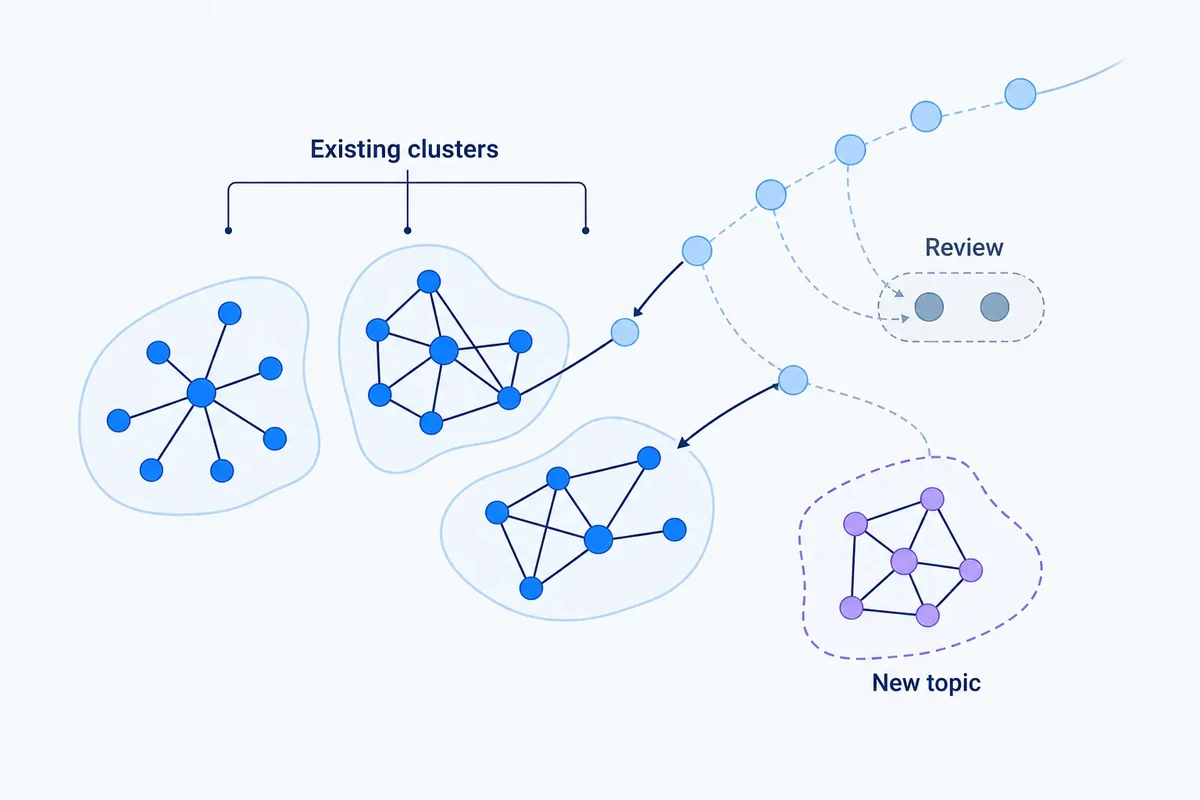
Adding new keywords to existing clusters without rebuilding everything
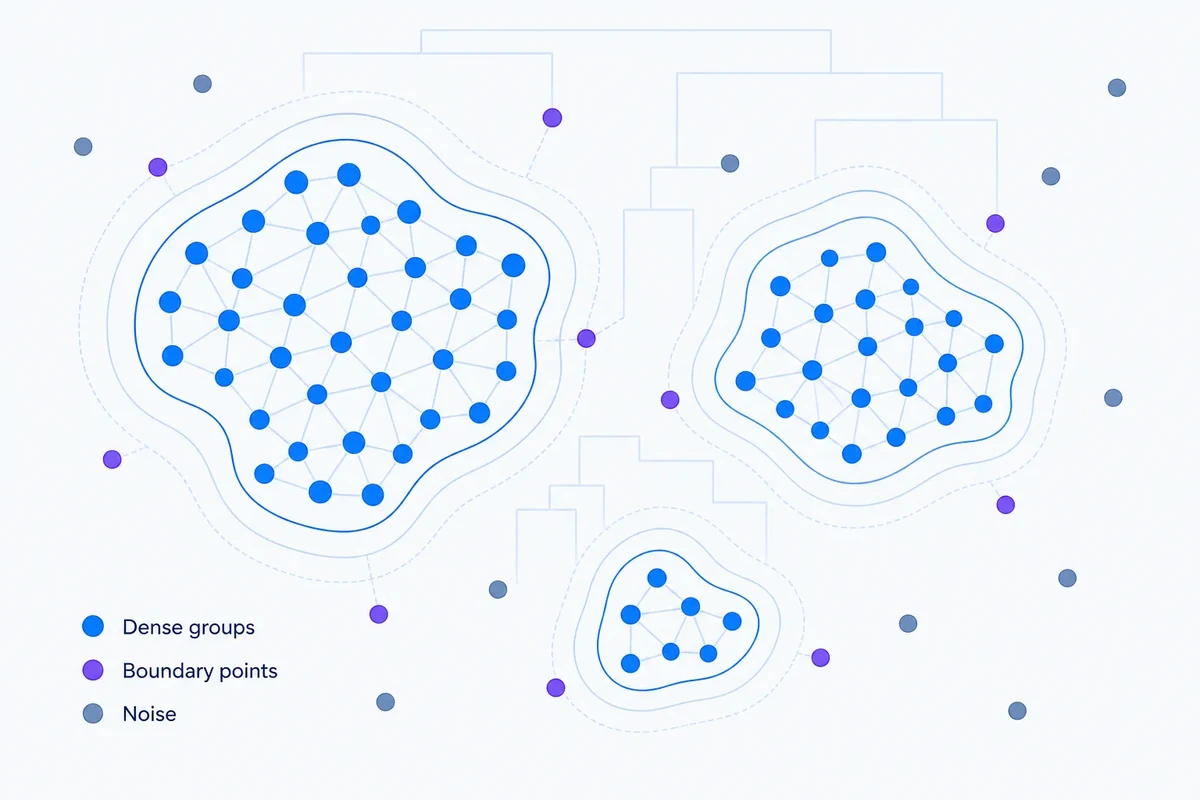
HDBSCAN for keyword clustering: density, noise and uncertain queries