Bring your data
Start with the keyword research you already have from SEO tools, exports or spreadsheets.
Part of the same working dataset
Bring the keyword research you already have. ClusterIQ cleans, structures and clusters it using reproducible analytical methods, then gives you a dataset you can inspect, refine, retain and use throughout your SEO workflow.
14 days free · 1 evaluation project · No card required · Then £99/month to continue
Sample data
The fastest way to understand ClusterIQ is to watch unstructured keyword data become an organised, inspectable working dataset.
Prepare the data, build an inspectable structure, then carry it into the SEO work that follows. The evidence stays visible, editable and reusable throughout.
Start with the keyword research you already have from SEO tools, exports or spreadsheets.
Normalise messy inputs while preserving the useful source data you need later.
Retain the working evidence around each keyword instead of reducing the upload to a black box.
Build reproducible groups from measured language and similarity relationships.
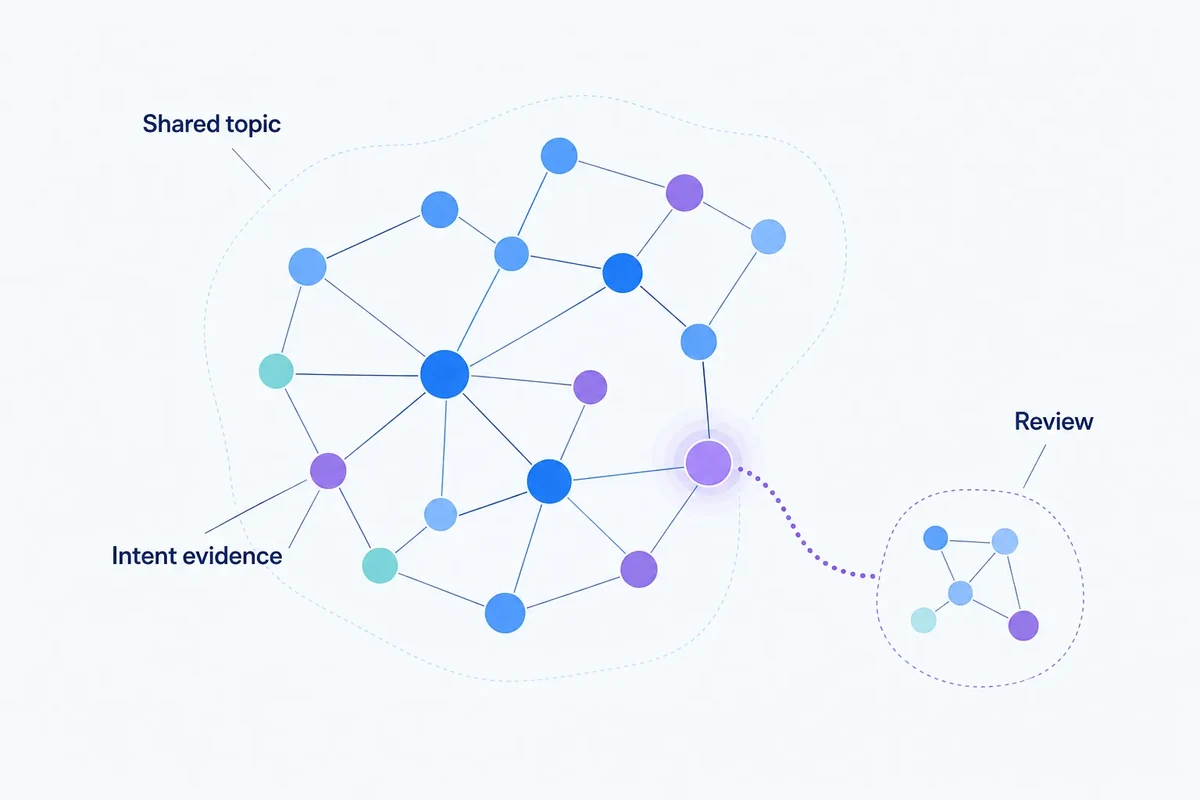
Use the underlying relationship graph to understand how keywords and topics connect.
Review the evidence, challenge the grouping and apply practitioner judgement where it matters.
Carry the structured dataset into topical analysis, reporting and prioritisation.
Move into forecasting, site intelligence and downstream SEO work without starting again.
Keep the structured data useful beyond the clustering run with reusable exports and reports.
Move from clusters into analysis, actions, site intelligence and forecasts without losing the structured dataset underneath the work.
ClusterIQ handles the analytical complexity underneath the workflow while keeping the resulting structure understandable to the SEO practitioner using it.
Why ClusterIQ works this wayClusterIQ creates the analytical structure first. Generative tools can then help downstream without becoming the source of truth for the clusters themselves.
The underlying keywords, groups and assumptions stay available so you can understand the result instead of receiving an unexplained answer.
Inspect, refine, export and reuse the structure. ClusterIQ is designed to make SEO decisions easier to make, not to pretend the practitioner is unnecessary.
CSV, TSV, XLS, or XLSX files from Ahrefs, Semrush, Google Search Console, or any spreadsheet with a keyword column.
Work from inspectable clusters and source keywords rather than an unexplained generative answer.
Export the structured work you create and remove datasets when you no longer need them.
ClusterIQ handles the analytical complexity underneath the workflow while showing enough of the process for an SEO practitioner to understand, inspect and challenge the result.
Read why ClusterIQ existsClusterIQ represents the language in your dataset before it decides what belongs together.
Weight the terms and character patterns that make each keyword distinctive.
Reduce noise while retaining the larger semantic patterns in the keyword set.
Create a reproducible numerical basis for the comparisons that follow.
The system compares keyword representations rather than asking a generative model to guess the groups.
Measure how closely keyword vectors point in the same semantic direction.
Turn those relationships into evidence that can be thresholded and inspected.
Adjust similarity thresholds to make the grouping broader or more selective.
Similarity becomes a sparse relationship graph that exposes the structure inside the dataset.
Each keyword has a place in the graph rather than disappearing into a black-box answer.
Strong measured relationships connect the keywords that genuinely belong near one another.
Weak links fall away so the stronger topical structure becomes easier to detect.
ClusterIQ uses the relationship structure to form reproducible communities of closely connected keywords.
Groups emerge from patterns in the graph instead of arbitrary labels being imposed first.
The keywords inside a cluster remain tied back to the relationships that created it.
The result becomes a structured dataset you can inspect, export and carry into later work.
Quality signals and practitioner review sit on top of the clustering rather than being hidden from you.
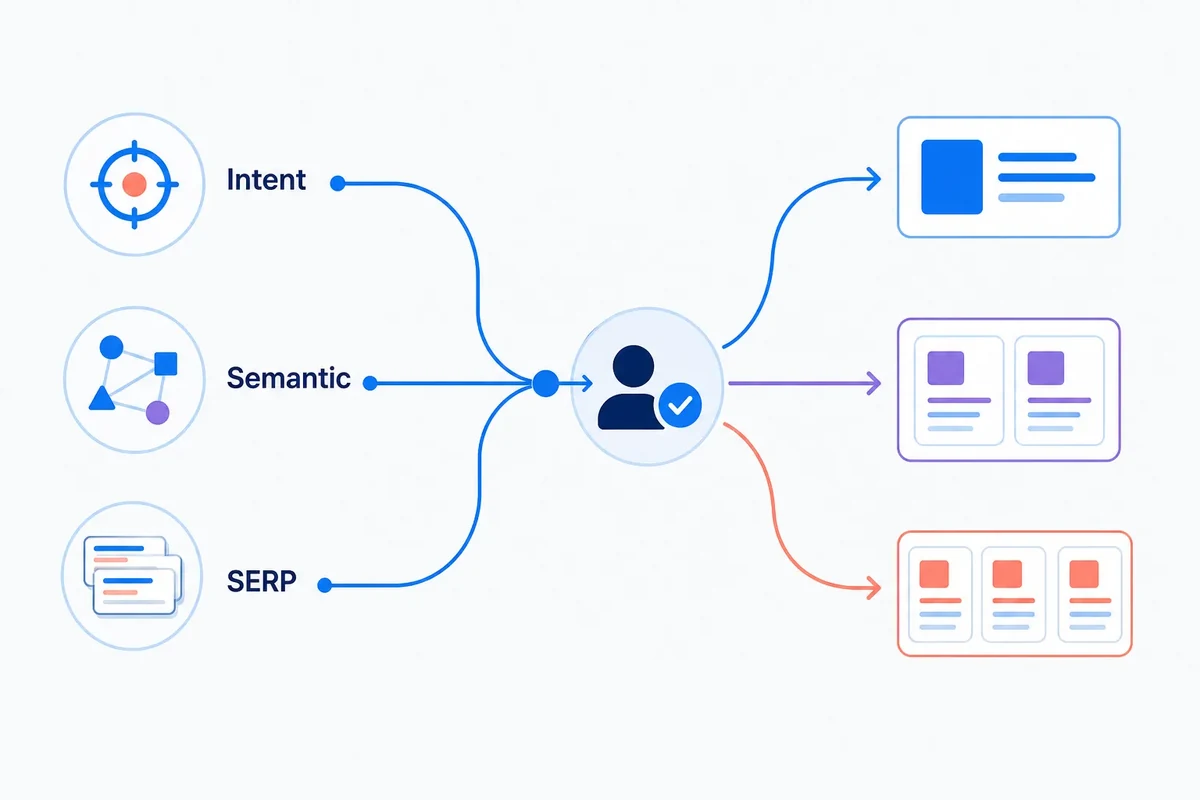
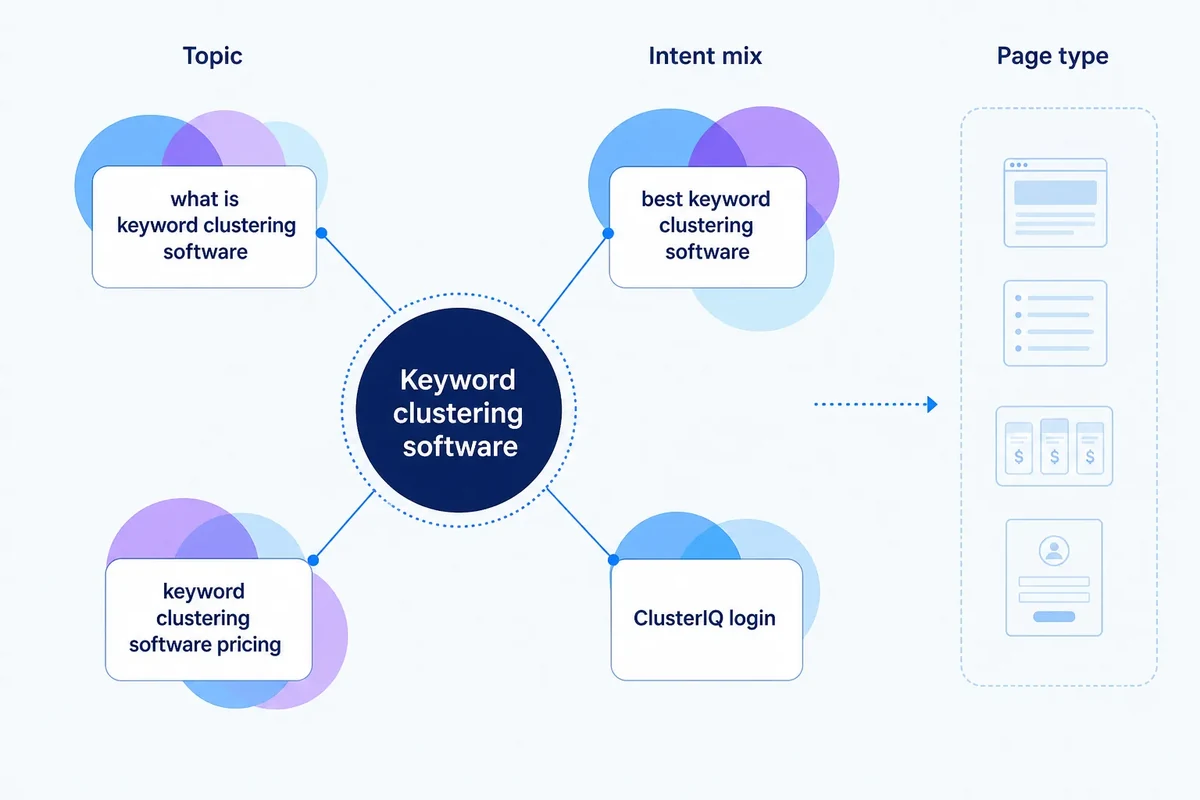
Search-intent rules help surface groups that deserve a closer look.
Use the evidence around the cluster to judge whether the structure is credible.
Inspect, refine and challenge the result when real SEO context says it should change.
ClusterIQ combines word and character TF-IDF with latent semantic analysis, cosine similarity and a sparse relationship graph to build reproducible clusters. Search-intent rules and quality signals then help you inspect the result. You can tune cluster size and similarity thresholds before every run.
LLMs can be useful for interpretation, naming and downstream work, but ClusterIQ first creates a structured, inspectable dataset using reproducible analytical methods. That gives the practitioner a clearer evidence base before generative tools are brought into the workflow.
CSV, TSV, XLS, and XLSX files are supported up to 50 MB and 100,000 rows per upload. Exports from Ahrefs, Semrush, Google Search Console, or any spreadsheet with a keyword column work out of the box; columns are detected automatically.
No. ClusterIQ is designed as a working workspace rather than an upload-and-disappear tool. You can return to project work, inspect and refine clusters, build reports and export the structured data for use elsewhere.
Use ClusterIQ free for 14 days with one evaluation project. No credit card is required. At the end of the trial, Professional at £99/month is required to continue. If it is not for you, your data can be exported and deleted at any time.
Explore more of the thinking, methodology and practical SEO workflows behind ClusterIQ.
Bring the keyword research you already have and turn it into an inspectable, reusable working dataset before the next stage of your SEO workflow.