Search intent classification in keyword clustering: useful signal, dangerous shortcut
Intent labels can improve keyword clustering, but they can also create false confidence. Learn how to use intent as evidence without forcing every query into a crude category.

Farky Rafiq
Founder of ClusterIQ
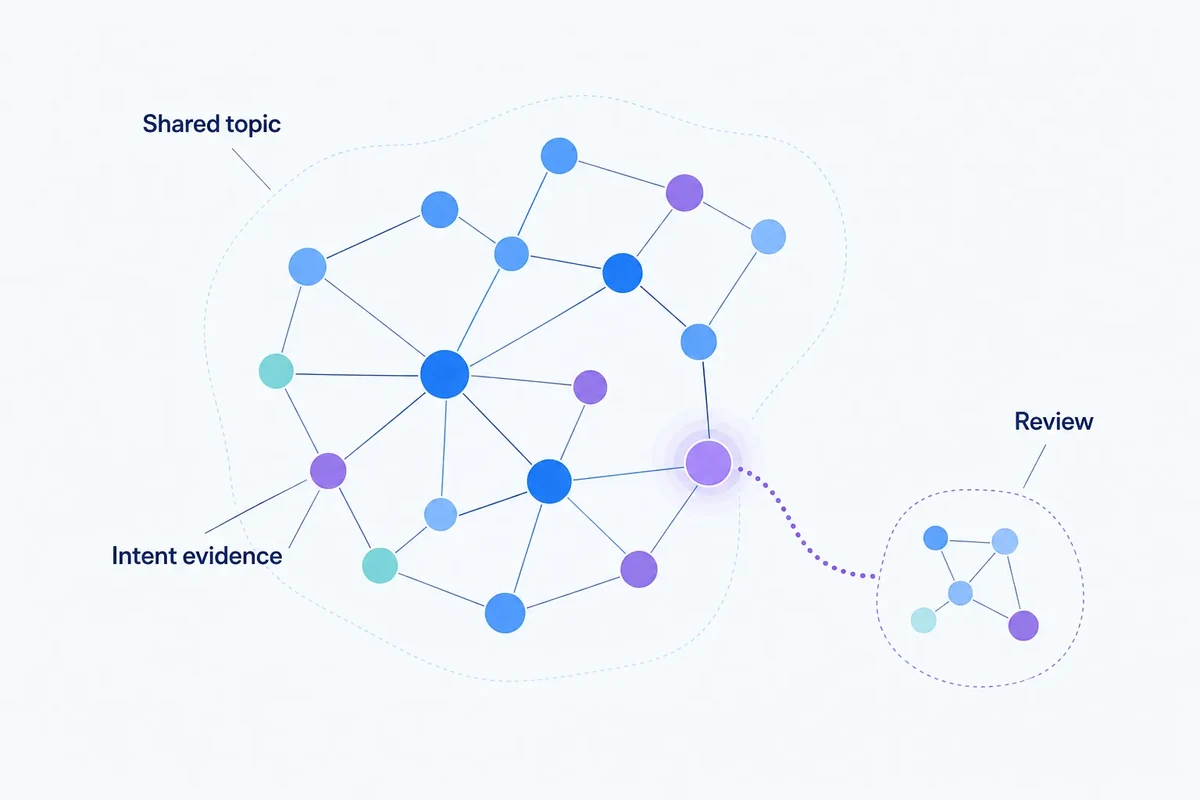
Search intent is one of the most genuinely useful signals in keyword clustering, and also one of the easiest to oversimplify.
Labels like informational, commercial, transactional and navigational can stop you making obvious mistakes. They can also give you a false sense of precision, especially when a short query could plausibly support several different tasks at once.
For clustering purposes, the question worth asking isn't "what is the intent?" It's what evidence do we actually have about the task the searcher is trying to complete, and how much should that evidence influence the grouping?
Intent labels are a model of behaviour, not a fact about a query
One of the earliest widely cited web-search taxonomies split queries into informational, navigational and transactional classes. That framework is still useful because it describes genuinely different kinds of search tasks.
But it shouldn't be mistaken for a complete map of how modern search behaves. A query like "best CRM software" could be commercial research, a comparison, category discovery, or a step in a purchase journey. "CRM pricing" might lead someone to a pricing page, a comparison page or a third-party review, depending on who's searching and what results they see.
Broad labels are helpful features to feed into a model. They're not final answers on their own.
Why intent still helps clustering
Semantic similarity is great at connecting language that's topically close but operationally quite different.
- "running shoes reviews"
- "buy running shoes"
- "how to clean running shoes"
- "running shoe size guide"
An embedding model should spot the shared subject across all four. The intent layer is what preserves the important difference between evaluation, transaction, instruction and sizing support underneath that shared subject.
That's part of why the strongest clustering workflows combine several signals rather than letting one representation dominate everything.
Intent should be multi-dimensional
Squeeze everything into one class and you throw away useful information. A stronger representation keeps several attributes separate, such as:
- task: learn, compare, buy, troubleshoot, locate;
- page type: guide, category, product, pricing, tool, location page;
- funnel stage: exploratory, evaluative, action-oriented;
- brand state: branded or non-branded;
- locality: generic or location-sensitive;
- freshness: evergreen or time-sensitive.
These dimensions aren't fully independent of each other, but keeping them as separate fields makes the whole model much easier to inspect and debug later.
Short queries deserve lower confidence
"Apple watch battery" is a good example to sit with for a moment. It could mean battery life, replacement, charging problems, or just a product specification lookup.
A classifier forced to pick one label will still confidently return something. That doesn't mean the underlying ambiguity has actually gone away.
For short or underspecified queries, store a confidence score alongside the label and allow an "ambiguous" state. If the downstream decision is expensive, such as creating or merging URLs, send those cases for human review rather than letting the model decide alone.
Use the live SERP as extra evidence
How a search result page is composed can help you test an intent hypothesis.
If the top results are predominantly product category pages, that's useful evidence about the current retrieval environment for that query. If the result set mixes guides, product pages and forum threads, the query probably doesn't support one clean page-type assumption.
Search results vary by context and time, so treat them as a useful observation from a specific market and moment, not permanent ground truth.
Our article on SERP overlap clustering covers how to use this evidence without overclaiming what it tells you.
Search Console can expose your site's existing interpretation
Google Search Console lets you inspect performance by query and page. If one query keeps appearing against a particular URL on your site, that's useful first-party evidence about the mapping that currently exists.
It's still not a clean intent label on its own. A page can rank imperfectly for a query, several pages can appear for the same one, and queries can be omitted or aggregated in the report. The real value here is that it connects the language directly to actual pages on your own site.
Intent can be a constraint, a feature, or a review trigger
There are three sensible ways to fold intent into clustering.
Constraint: stop clearly incompatible tasks from being merged automatically.
Feature: add intent agreement into a broader relationship score alongside semantic similarity, entities or SERP overlap.
Review trigger: let the semantic cluster stand, but flag mixed-intent groups for a practitioner to look at.
That third option is underrated in practice. Mixed intent isn't automatically an error. Sometimes it reveals a genuinely broad topic that needs several page types sitting underneath it.
Don't train the classifier from vague labels
If you're building your own intent model, nail down the annotation rules before you build the training set, not after.
A useful judgement guide should answer questions like:
- What counts as commercial research?
- When does a comparison become transactional?
- How are branded support queries handled?
- Can one query carry more than one label?
- When should the annotator select "uncertain"?
Skip this step and disagreement between your own reviewers just gets buried inside the model instead.
A practical intent-aware clustering workflow
- Generate semantic relationships without intent first.
- Classify task and likely page type separately.
- Store confidence, not only labels.
- Flag semantic neighbours with incompatible task evidence.
- Add SERP and existing-page evidence where the decision is page-level.
- Review ambiguous, high-value or mixed-intent clusters manually.
Practitioner principle: intent is most useful when it prevents an unjustified merge. It is least useful when one broad label is treated as a complete description of the query.
ClusterIQ Conclusion
Search intent absolutely belongs in keyword clustering, but not as a shortcut around judgement.
Use it to enrich the evidence, preserve genuine ambiguity, and distinguish page tasks that semantic similarity alone tends to blur together. Wherever you can, keep the label, its confidence and the page-type interpretation as separate pieces of information.
The aim was never to classify every query perfectly. It's to cut down the number of clustering decisions that look mathematically tidy on paper but make little sense to the person actually building the site.
Track intent mixtures at cluster level
One genuinely useful ClusterIQ output is the distribution of intent evidence inside each group, rather than one single label for the whole cluster. A topic that's 80% informational and 20% commercial behaves quite differently from one split evenly across four tasks.
Those mixtures can guide whether a group stays a broad topic, needs operational subclusters, or should be routed for page-type review. The distribution also makes it obvious when future changes shift the balance.
Related ClusterIQ analysis
For richer intent modelling, see multi-label search intent and intent entropy.
Sources and further reading
Farky Rafiq
Founder of ClusterIQ
I've worked in digital marketing since 2005 and founded Liquid Silver in 2011. These articles are where I share the methods, experiments and practical SEO thinking behind ClusterIQ.
Put the idea into practice with your own keyword data
ClusterIQ helps turn raw SEO exports into clean, structured working datasets you can inspect, refine, report on and take into the next stage of your workflow.
Keep reading
Keyword deduplication vs clustering: why they should stay separate
Keyword preprocessing before clustering: clean the data without erasing intent