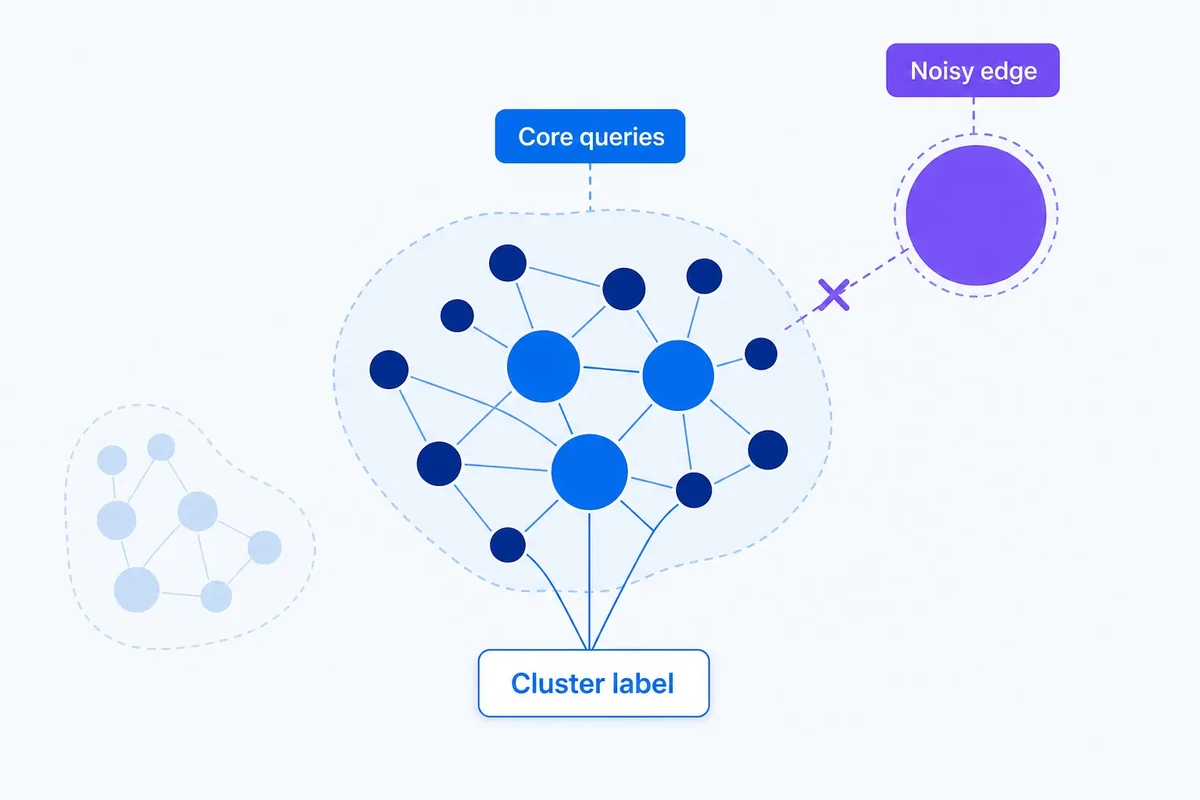
Graph centrality for SEO: finding hubs, bridges and misleadingly important keywords
Degree, betweenness and PageRank can reveal different structural roles in a keyword graph. Learn what those signals mean and why centrality is not the same as SEO value.

Farky Rafiq
Founder of ClusterIQ
You have grouped 500 keywords into topics and the clusters look sensible. The next question is less obvious: which phrases best represent each topic, and which ones connect areas that might otherwise remain separate?
That matters when you are naming clusters, planning site sections or preparing a clear explanation for a client. The highest-volume keyword is not always the best summary of a topic. A lower-volume phrase may sit at the heart of the group, while another may reveal an important overlap between two groups.
A keyword graph gives you a way to investigate those roles. In the graph, each keyword is a node and a meaningful relationship between two keywords is an edge. Graph centrality is the family of measures used to describe where each node sits in that network.
Centrality can highlight hubs, bridges and peripheral terms. It cannot tell you what a keyword is worth. Search demand, intent, commercial relevance and the pages your site can genuinely support still matter.
Why look beyond the cluster label?
Imagine a bathroom retailer has clusters for baths, showers and bathroom installation. Most phrases sit comfortably in one group. “Shower bath” connects the bath and shower areas. “Bathroom suite” may be broadly connected across several product groups. A very specific size query may sit at the edge of one cluster.
Seeing those positions can help you:
- choose a phrase that accurately represents a cluster;
- spot a genuine product or topic bridge;
- find terms that need manual review;
- question whether the planned site categories reflect search behaviour;
- detect generic wording that is distorting the analysis.
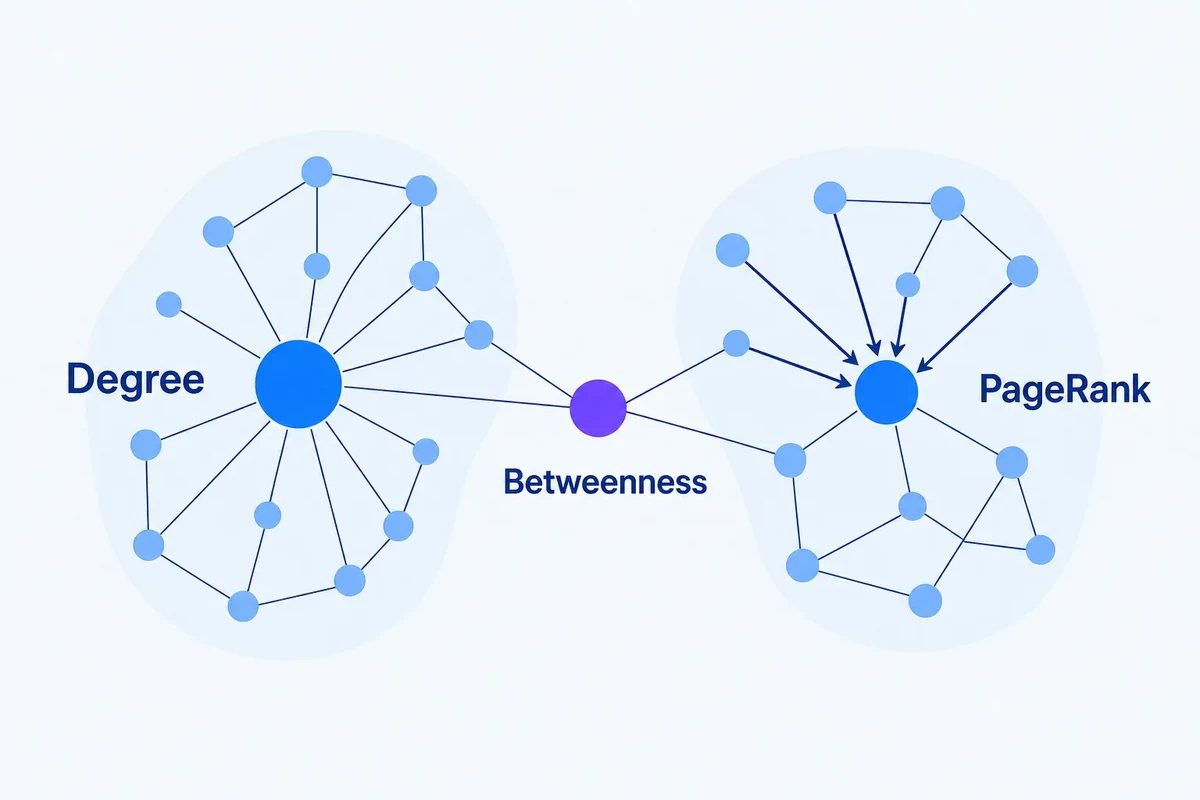
Different centrality measures answer different questions. Degree counts direct connections. Betweenness looks for nodes that sit between other areas. PageRank looks at the importance of a node's neighbours as well as the number of connections. They should not be treated as three versions of one keyword score.
Degree centrality finds local hubs
Degree centrality asks how many direct connections a node has. In a keyword similarity graph, a phrase with high degree is connected to many nearby phrases under the rules used to build that graph.
Suppose a cluster contains dozens of variations around “small business accounting software”. If that phrase connects directly with many of them, it may be a good candidate for the cluster label or a useful starting point for a content brief.
Degree can help surface:
- representative terms near the centre of a topic;
- broad phrases that connect many close variants;
- possible seed terms for summaries and reporting.
The result depends heavily on how edges were created. If you lower the similarity threshold, more relationships qualify and degrees rise. If every keyword is connected to a larger number of nearest neighbours, degrees rise again.
A high-degree term is therefore central in this particular graph configuration. It is not automatically central to the whole market, and it may not deserve the main page.
Betweenness reveals bridges
Betweenness centrality asks how often a node appears on the shortest routes between other nodes. A keyword with high betweenness may connect parts of the network that otherwise have few links.
Return to the bathroom example:
- a group of bath keywords;
- a group of shower keywords;
- “shower bath” sitting between them.
That bridge may represent a real hybrid product category, an overlapping customer task, a useful navigation route or an ambiguous phrase that deserves a closer look. The metric raises the question. It does not decide the answer.
This can be more useful than forcing the query into whichever cluster gives it a slightly higher score. A marketer can inspect the term and decide whether it needs its own page, belongs in one category, should appear in both research briefs or exposes a problem in the grouping.
A bridge is not automatically an internal-link hub
High betweenness does not mean the matching page should receive lots of internal links.
The graph may describe semantic similarity between keywords, not hyperlinks between pages. Its shortest routes are mathematical paths through that similarity network. They do not prove that users need to navigate the site in the same way.
Use a bridge term to ask an architecture question. Then check the product range, user journey, existing pages and internal-link opportunities before making a recommendation.
PageRank considers who a keyword connects to
Degree counts direct neighbours. PageRank adds another idea: a connection from a prominent node can carry more weight than a connection from an isolated one. Importance flows through the network recursively.
PageRank was originally designed to rank web pages using link structure. NetworkX can apply the general calculation to other graphs, including keyword networks. It may surface a keyword that is structurally prominent because it connects with other prominent terms, even if it does not have the largest raw number of neighbours.
This does not reveal how Google ranks the keyword. An undirected semantic graph is not the web link graph for which PageRank was created. NetworkX treats undirected edges as reciprocal directed edges for the calculation. In keyword research, PageRank is an analytical lens, not a claim about Google's ranking systems.
Weights need careful handling
Some keyword graphs give each edge a weight, perhaps a semantic similarity score. A stronger relationship might have a similarity of 0.86 and a weaker one 0.62.
This needs care because algorithms do not all interpret weight in the same way. For shortest-path measures such as betweenness, NetworkX treats the weight as a distance. A large distance means two points are farther apart, while a large similarity means two keywords are closer.
Passing raw similarity values into a shortest-path calculation as distances can reverse the intended meaning. A sound workflow converts similarity to a suitable distance where needed and records the transformation. This is a technical detail with a very practical consequence: the wrong setup can make the wrong keyword look like a bridge.
Use several signals to choose a representative keyword
When you need a cluster name or the main term for a brief, do not automatically select the phrase with the highest search volume. Compare:
- degree or weighted degree;
- closeness to other core members;
- search volume;
- clarity of wording;
- coverage of the important entity or product;
- consistency of search intent.
A structurally central phrase may describe the group better than a broad, high-volume term. Equally, a mathematically central phrase may be awkward, vague or commercially irrelevant. The final choice is an editorial and SEO decision.
Centrality can expose problems in the analysis
Unexpected hubs and bridges are useful quality checks.
If “buy online” becomes one of the most connected nodes across a 2,000-keyword ecommerce graph, generic commercial language may be carrying too much weight. If a brand term bridges unrelated categories, the cleaning, entity handling or edge rules may be creating false relationships.
Centrality can therefore help debug the graph before anybody uses it to reshape a site. An odd result is not always an insight. Sometimes it is evidence that the model needs adjustment.
Look within topics as well as across the whole graph
A global view can favour broad phrases simply because they touch several subjects. For content planning, it is often helpful to examine centrality within each cluster too.
This separates three useful roles:
- global bridges that connect topic families;
- local centres that represent one cluster well;
- peripheral terms that cover a narrow or long-tail need.
A query can be peripheral in the full network but central to a commercially valuable niche. That is one reason a single global ranking can be misleading.
Centrality is not keyword value
Search volume estimates demand under a data provider's method. Centrality describes position in a graph built from your chosen evidence and settings. They can disagree, and that disagreement can be informative:
- high volume and high centrality: a broad, prominent concept worth close review;
- high volume and low centrality: a distinct opportunity or unusual intent;
- low volume and high betweenness: a bridge that may matter to the architecture despite modest demand;
- low volume and low centrality: a peripheral or long-tail term.
These are prompts for investigation, not automatic priorities. A low-volume bridge does not become valuable merely because the graph gives it an interesting position. A high-volume keyword does not belong on the main page merely because it is popular.
Turn the network into better SEO questions
Centrality is most useful when it helps a marketer ask:
- Which concepts connect otherwise separate topic families?
- Which phrase best represents each cluster?
- Where are the unexpected bridges?
- Which nodes look central only because of generic modifiers?
- Do the current site categories match the strongest topic structures?
- Which ambiguous terms need a human decision before a brief is written?
This is the practical value of the network view described in our introduction to graph theory and keyword graphs for content architecture.
Practitioner rule: centrality tells you where a keyword sits in the network. It does not tell you what that keyword is worth.
A sensible centrality workflow
- Validate the graph first. Poor relationships produce misleading centrality.
- Choose the measure for the question. Degree, betweenness and PageRank describe different roles.
- Handle weights correctly. Shortest-path methods may expect distances rather than similarities.
- Inspect the whole network and individual clusters. Separate global bridges from local centres.
- Add SEO evidence. Compare network position with demand, intent, page type, existing URLs and business relevance.
- Review surprising extremes. They may reveal a useful anomaly or a flaw in the graph.
ClusterIQ Conclusion
Graph centrality adds a useful layer to keyword clustering once the basic groups are in place. Degree can find highly connected terms, betweenness can reveal bridges and PageRank can surface nodes connected with other prominent nodes.
Those measures help choose representative phrases, find overlaps and check whether the network behaves sensibly. They are valuable because they describe different structural roles, not because they produce a universal importance score.
Use centrality to understand the shape of the research and to decide what deserves a closer look. Keyword value still depends on demand, intent, the site, the business and practitioner judgement.
Sources and further reading
Farky Rafiq
Founder of ClusterIQ
I've worked in digital marketing since 2005 and founded Liquid Silver in 2011. These articles are where I share the methods, experiments and practical SEO thinking behind ClusterIQ.
Put the idea into practice with your own keyword data
ClusterIQ helps turn raw SEO exports into clean, structured working datasets you can inspect, refine, report on and take into the next stage of your workflow.
Keep reading
Keyword deduplication vs clustering: why they should stay separate
Keyword preprocessing before clustering: clean the data without erasing intent