How to name keyword clusters without letting the label distort the data
A good cluster can still be badly labelled. Learn how representative queries, c-TF-IDF, entities and human review produce clearer keyword cluster names.

Farky Rafiq
Founder of ClusterIQ
You can build a mathematically sound cluster and still give it a rubbish name.
That matters more than it sounds, because the label is usually the first thing anyone sees. A vague label, an over-broad one, or one built from a single noisy keyword can make a perfectly good cluster look wrong even when the actual membership is fine.
So it helps to treat labelling as its own step in the process, separate from the clustering itself. The job is simple to state: summarise the group without pretending the label is the group.
The easiest label isn't always the best one
The obvious shortcut is to pick whichever keyword in the cluster has the highest search volume and use that as the name.
Sometimes that works fine, when the highest-volume term genuinely represents everything else in the cluster. But it falls down when that term is:
- too broad;
- ambiguous;
- commercially dominant but only loosely related to the rest of the group;
- a brand term that doesn't describe the wider set;
- an outlier with unusually high demand.
Picture a cluster full of trail-running footwear queries where "shoes" happens to have the highest volume. Calling the whole cluster "shoes" is technically accurate for the parent category, but it throws away all the useful specificity underneath.
A handful of representative keywords beats one winner
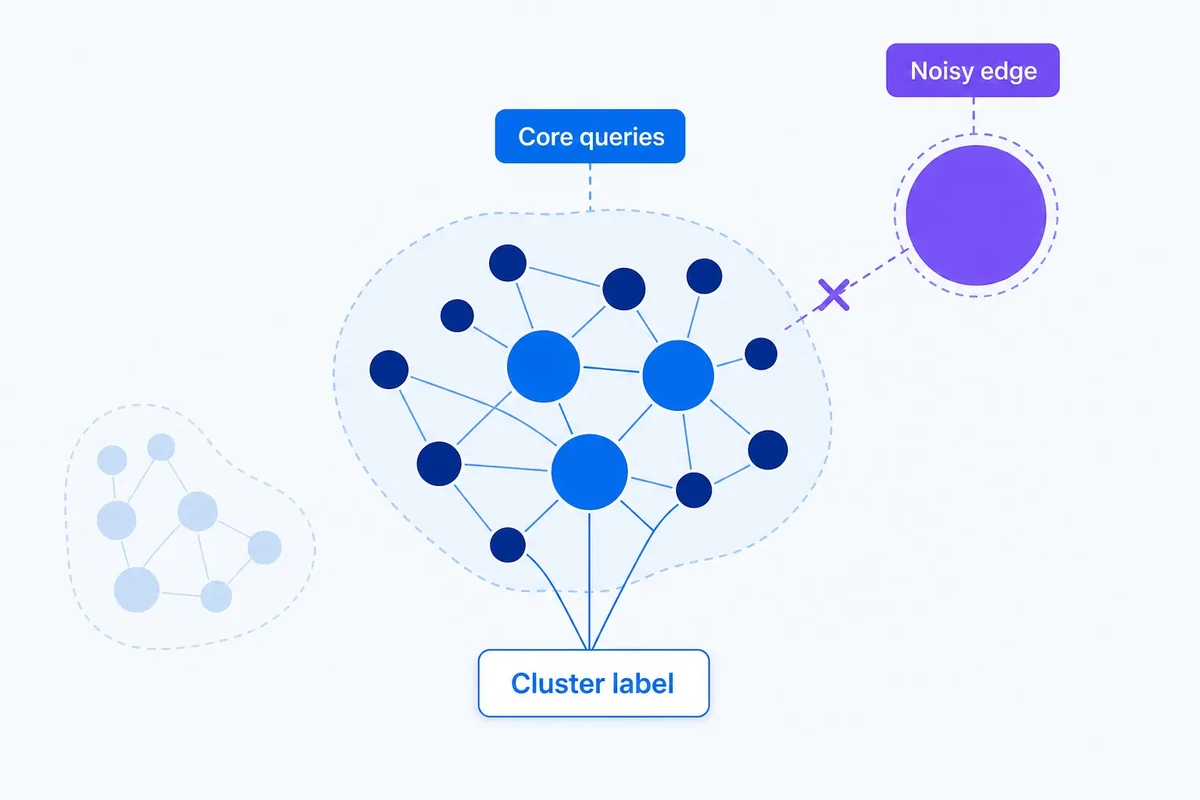
Before you generate a label at all, it's worth picking out a small set of representative members from the cluster first.
Good candidates tend to have some combination of these traits:
- high semantic centrality;
- strong cluster membership;
- high lexical distinctiveness;
- reasonable search demand;
- proximity to the cluster centroid;
- clear, human-readable wording.
A label built from five of these representative queries is generally much more robust than one built from a single term.
TF-IDF can help surface what's actually distinctive
Classic TF-IDF scores terms by how important they are in one document relative to the rest of a corpus.
You can apply the same idea at cluster level instead of document level. BERTopic's c-TF-IDF approach does exactly this: it joins together all the documents inside one class or topic, then finds the terms that set that class apart from the others.
The same principle works well for keyword clusters. Ask which words or phrases are unusually characteristic of this particular group compared with the rest of your dataset, rather than just which words appear most often.
That question tends to produce far more useful labels than raw frequency ever could.
Frequency alone tends to produce generic labels
Say almost every row in your keyword set contains the word "software".
Inside a cluster about agency project management, the most frequent terms might well be:
- software;
- project;
- management;
- agency.
"Software" appears constantly but tells you almost nothing. "Agency project management software" is a far more useful label because it combines the terms that actually distinguish this group from its neighbours.
That's why cluster-level weighting needs to think about what separates one group from the groups around it, not just what appears most.
A good label describes the centre, not every edge case
No short label can encode every single query in a broad cluster, and trying to is where things go wrong.
Attempt to include every modifier and you end up with something like:
"best cheap small business accounting software pricing reviews comparison"
That isn't a label any more. It's a compressed keyword list wearing a label's clothing.
A useful label names the dominant concept and leaves the edge cases visible in the underlying data, where they belong.
Entities make labels stronger
Pulling out named entities helps a lot when a cluster is organised around a specific brand, product, place or technical concept.
Take a cluster containing:
- mira sport shower pressure;
- mira sport shower installation;
- mira sport shower reviews;
- mira sport shower replacement parts;
The stable entity here, "Mira Sport", should stay front and centre in the label rather than getting lost.
This is one of the practical benefits of entity-aware clustering: important named concepts stay explicit instead of relying on a generated summary to rediscover them from scratch.
Keep intent labels separate
It's worth storing these as separate fields:
- cluster label: "Mira Sport showers";
- intent mix: informational / commercial;
- dominant page type: product support or category.
Try to cram all three into the cluster name itself and you end up with brittle, unreadable labels.
Topic, intent and recommended action answer different questions and can change independently of each other, so keep them as separate fields rather than mashing them together.
Generative labels need grounding
Give an LLM the right representative keywords and context, and it can write genuinely excellent cluster names. Give it too little grounding, and it can just as easily invent a level of specificity the cluster doesn't actually support.
A safe labelling prompt should include:
- representative queries;
- distinctive terms;
- entities;
- cluster size;
- nearest neighbouring cluster labels;
- a clear instruction not to introduce unsupported concepts.
Then check the output against the actual members before you trust it.
Generative labelling is a summarisation task. It isn't a source of new evidence, and it shouldn't be treated as one.
Neighbouring clusters help disambiguate labels
A label becomes far more useful once it explains how the group differs from the clusters sitting next to it.
Say two adjacent clusters contain:
- "keyword clustering software", "keyword clustering tools", "SEO clustering platform";
- "keyword clustering Python", "keyword clustering code", "semantic clustering script".
Both could loosely be called "keyword clustering tools" if you weren't paying attention.
Looking at the contrast between them points to better labels instead:
- "Keyword clustering software";
- "Keyword clustering implementation and code".
Labelling with an eye on the neighbours cuts down on accidental duplication across your whole topic map.
Labels need to stay stable enough to report on
If the same cluster gets called "semantic clustering" one run, "AI keyword groups" the next, and "embedding topics" after that, longitudinal reporting becomes almost impossible.
Store:
- cluster ID;
- generated label;
- human-approved label;
- label version;
- model or method used to create it.
That way a practitioner can rename a cluster whenever they need to without losing its analytical history.
Human editing is a feature, not a failure
Treat automated labels as first drafts, because that's what they are.
A practitioner might know the business calls a group "shower enclosures" even though the most distinctive keyword phrase is technically "shower cubicles". Nothing wrong with that. The final display label can follow the organisation's own terminology while the underlying query evidence stays completely intact.
That separation supports both data integrity and everyday usability at the same time.
A practical labelling pipeline
- Identify representative members. Favour core members over boundary cases.
- Extract distinctive terms and entities. Compare them against the wider corpus.
- Inspect neighbouring clusters. Make sure the labels actually distinguish adjacent groups.
- Generate candidate names. Use deterministic rules or a bounded generative step.
- Validate coverage. Check whether the name genuinely describes most core members.
- Allow practitioner edits. Store them separately from the model's raw output.
- Version the result. Keep labels stable enough to support reporting and comparison.
Editorial principle: a cluster label is an interface to the evidence. It should clarify the group, not hide its complexity.
ClusterIQ Conclusion
Good cluster naming takes more thought than just grabbing the most popular keyword.
The best labels combine representative members, distinctive language, important entities and an awareness of neighbouring groups. They stay concise while still describing the true centre of the cluster.
Automated methods like c-TF-IDF and generative summarisation can speed the work up considerably, but practitioner editing should always remain an option. A clear label makes a cluster easier to use. It doesn't, on its own, make the underlying grouping any more correct.
Sources and further reading
Farky Rafiq
Founder of ClusterIQ
I've worked in digital marketing since 2005 and founded Liquid Silver in 2011. These articles are where I share the methods, experiments and practical SEO thinking behind ClusterIQ.
Put the idea into practice with your own keyword data
ClusterIQ helps turn raw SEO exports into clean, structured working datasets you can inspect, refine, report on and take into the next stage of your workflow.
Keep reading
Keyword deduplication vs clustering: why they should stay separate
Keyword preprocessing before clustering: clean the data without erasing intent