SERP overlap clustering: what search-result similarity can and cannot tell you
SERP overlap can add live search evidence to keyword clustering, but shared results are not ground truth for intent. Learn how to measure, normalise and interpret the signal.

Farky Rafiq
Founder of ClusterIQ
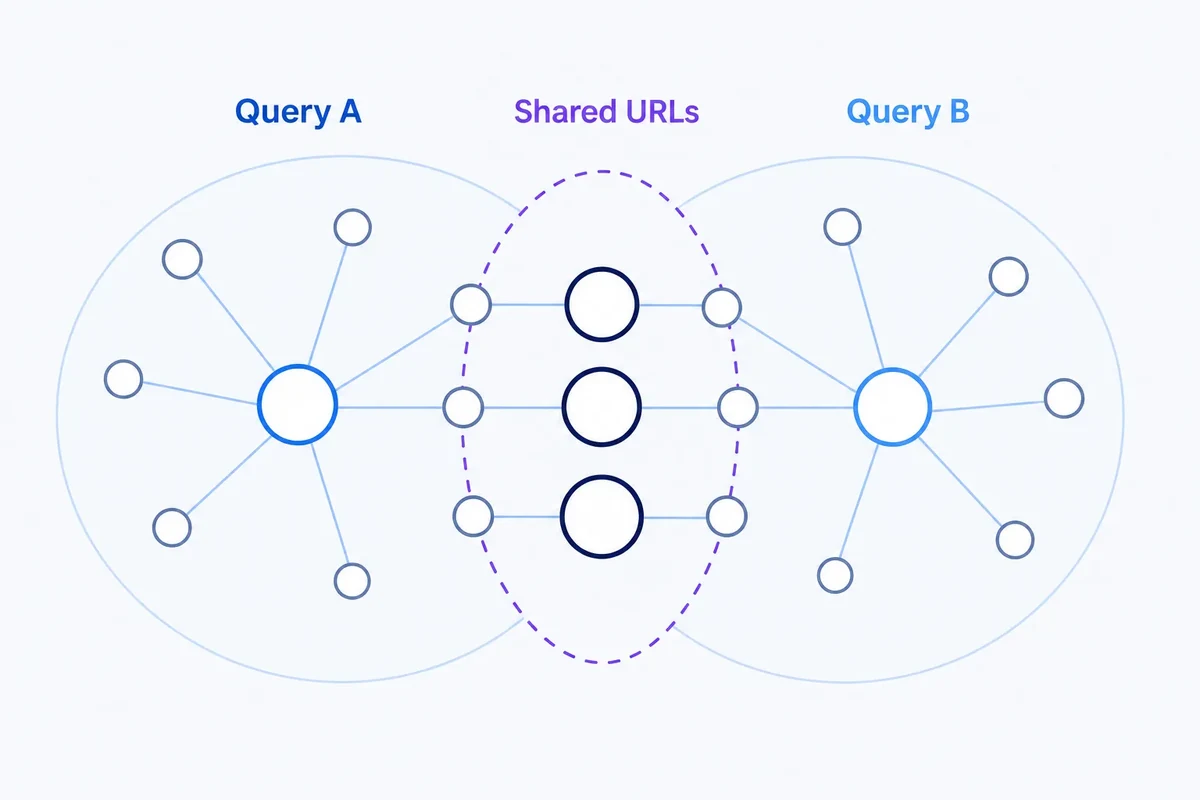
You have 800 keywords to organise and a familiar question to answer: which ones belong on the same page? Comparing the pages that already rank for those searches can give you useful evidence.
This is the idea behind SERP-overlap clustering. SERP means search engine results page. If two queries return many of the same URLs, that suggests the search engine currently treats them similarly. For SEO teams deciding which keywords to assign to which pages, this is closer to observed search behaviour than comparing wording and meaning alone.
But it is not a definitive answer about user intent. Results change, dominant sites can distort the overlap, and today’s rankings do not permanently define what one page should target.
What SERP overlap measures
The basic process has four steps:
- collect the top n organic result URLs for query A, where n is your chosen number of results;
- collect the same number of results for query B under the same conditions;
- normalise the URLs using an explicit rule, so equivalent URL versions can be compared consistently;
- measure how many results the two queries share.
You can express that relationship as a count, a proportion of the results collected or a set-similarity measure such as Jaccard similarity. Jaccard compares the number of shared URLs with the total number of distinct URLs across both sets.
For example, if two top-ten result sets share six canonical URLs, that is substantial overlap in the pages the search engine currently returns for those queries.
This measures something different from cosine similarity between embeddings, which are numerical representations of language. One compares represented meaning; the other compares observed search results.
Why overlap can be useful for URL mapping
If two queries repeatedly return many of the same pages, it is worth investigating whether one useful page on your site could satisfy both.
The reverse is useful too. When two queries have similar meanings but almost entirely different results, take a closer look before assigning them to the same page. The difference may reflect:
- different search intent;
- different preferred page formats;
- local or commercial context;
- freshness requirements;
- different entities or meanings;
- the current competitive landscape.
SERP data can therefore act as a second opinion when semantic clustering, which groups keywords by meaning, suggests that queries belong together.
Search results are observations, not fixed labels
Google explicitly notes that search results can differ because of time, context, location, language, device type and personalisation. Those differences matter when you use result overlap to group keywords.
Check a pair of queries in different markets or at different times and you may get different overlap, even though the wording has not changed.
To make the analysis reproducible, record at least:
- collection date and time;
- country or location assumptions;
- language;
- device or result mode where relevant;
- result depth, meaning how many results you collected per query;
- the data provider or collection method.
You then have an observation from a defined search environment, rather than a “SERP similarity score” with no explanation of where it came from.
Result depth changes the answer
Comparing the top three results answers a different question from comparing the top 100.
A shallow comparison focuses on the pages the search engine currently prioritises most strongly. A deeper comparison includes a wider range of candidates, but some may be weaker matches or more prone to ranking changes.
There is no universally correct depth. What matters is using the same definition across query pairs and understanding what your chosen depth tells you.
If you want to know whether two queries are likely to share a primary landing page, the top results may be more informative than a much larger collection containing marginal matches.
URL normalisation matters
Before you calculate overlap, decide what counts as the same result. URLs can look different while pointing to equivalent content, but not every variation is interchangeable.
Potential complications include:
- HTTP versus HTTPS;
- www versus non-www hosts;
- tracking parameters;
- faceted or parameterised variants, such as filtered category URLs;
- mobile or alternate URLs;
- redirecting URLs;
- canonicalised duplicates, where a preferred URL is specified for duplicate content.
Comparing URL text exactly as collected can understate overlap by counting equivalent URLs as different. Normalising too aggressively creates the opposite problem: it can merge pages that are genuinely distinct.
Make your normalisation rule explicit. Where possible, keep the original observed URL alongside its normalised version so you can check what changed.
Dominant domains can inflate apparent similarity
Imagine an authoritative site with several pages ranking across a broad subject. Two queries might return pages from that same domain without sharing an actual URL or page purpose.
For page mapping, URL-level overlap is usually more useful than domain-level overlap. You want to know whether the same pages appear, not just whether the same websites appear.
Even URL-level overlap needs care. Strong, broad-coverage pages can rank across several intents. A page ranking for both queries does not prove that it is the ideal model for your own site.
Zero overlap does not prove separate intent
It is equally risky to assume that queries need separate pages just because their results do not overlap.
Two queries can have little current overlap because:
- the results are volatile;
- the query is localised;
- the market has few strong pages;
- freshness is affecting one result set;
- the queries are newly emerging;
- ranking systems are choosing different examples of pages that serve a similar task.
SERP overlap works best as evidence you can compare and investigate, rather than a yes-or-no rule for grouping keywords.
Combine overlap with semantic evidence
Meaning-based comparisons and SERP overlap complement each other because they have different blind spots.
Embeddings can connect paraphrases and broader meanings without checking live search results. SERP overlap shows which URLs the search engine returns, but does not explain why the queries or pages are related.
A useful workflow can sort relationships into review categories:
- High semantic similarity + high SERP overlap: a strong candidate for reviewing together.
- High semantic similarity + low SERP overlap: investigate intent, page format and search context.
- Low semantic similarity + high SERP overlap: investigate shared entities, dominant pages or ambiguous language.
- Low semantic similarity + low SERP overlap: a weak candidate relationship unless another signal suggests otherwise.
These categories help you decide where to look next. They are not automatic rules for publishing, merging or separating pages.
Search Console adds first-party page evidence
Google Search Console’s Performance report lets you examine query and page data alongside clicks, impressions, click-through rate (CTR) and average position for a verified property.
That helps answer a different question: which queries have already been associated with which pages on your own site in search results?
If several related queries consistently generate impressions and clicks for the same URL, that is useful first-party evidence for the current keyword-to-page mapping. If closely related queries are spread across several competing URLs, the pattern may deserve a cannibalisation or content review to check whether those pages are competing unnecessarily.
Search Console has its own aggregation rules and data limitations. It is not a complete record of all search demand or all competitors.
Use repeated observations for important decisions
If a page-mapping decision has significant business value, a single collection of results is a weak foundation.
Where practical, collect the results more than once and check whether the relationship holds. Six shared URLs out of ten, seen repeatedly, is more persuasive than the same overlap appearing once and disappearing the following week.
This matters particularly in news-sensitive, seasonal or local markets.
A practical SERP-overlap workflow
- Generate candidate query pairs. Use semantic similarity, wording-based rules or existing clusters to identify promising comparisons. This avoids unnecessarily comparing every keyword in your list with every other keyword.
- Collect consistent result sets. Fix the market, language, device assumptions and result depth.
- Normalise URLs conservatively. Keep both the observed and normalised versions.
- Calculate overlap. Store the shared URLs as evidence, not just the final score.
- Flag disagreements. Prioritise cases where semantic similarity and SERP overlap suggest different relationships.
- Add first-party evidence. Bring in existing page mappings and Search Console data where available.
- Review before changing URLs. Check intent, format, business purpose and the quality of the pages you already have.
ClusterIQ Conclusion
SERP overlap brings evidence from live search results into keyword clustering. It can support or challenge relationships suggested by language models and similarities in wording.
Its limits matter just as much. Results vary with time and context, dominant pages can distort overlap, and current rankings are not a permanent statement of user intent.
Treat SERP overlap as observed evidence. Keep the underlying URLs, record the collection conditions and combine the results with semantic analysis and informed review before deciding which keywords belong on which pages.
Preserve the shared URLs behind the score
A SERP-overlap score is much easier to assess when ClusterIQ also shows which URLs produced it. Two query pairs can have identical scores while sharing very different types of pages.
Keeping the underlying result sets lets you check whether the overlap comes from the same commercial pages, general publishers, forums or dominant brands. That context can materially change what the relationship means for your page-mapping decision.
Sources and further reading
Farky Rafiq
Founder of ClusterIQ
I've worked in digital marketing since 2005 and founded Liquid Silver in 2011. These articles are where I share the methods, experiments and practical SEO thinking behind ClusterIQ.
Put the idea into practice with your own keyword data
ClusterIQ helps turn raw SEO exports into clean, structured working datasets you can inspect, refine, report on and take into the next stage of your workflow.
Keep reading
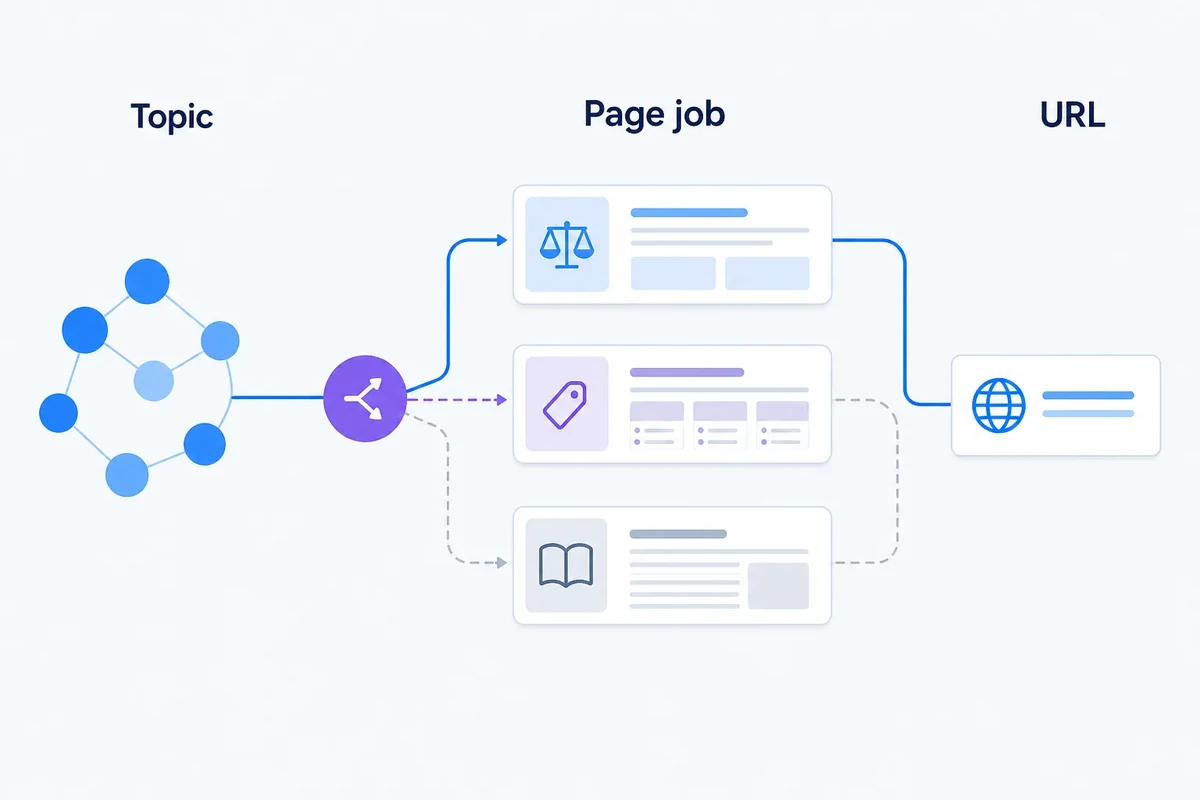
Page type classification before URL mapping: separating topic relevance from the page a user actually needs
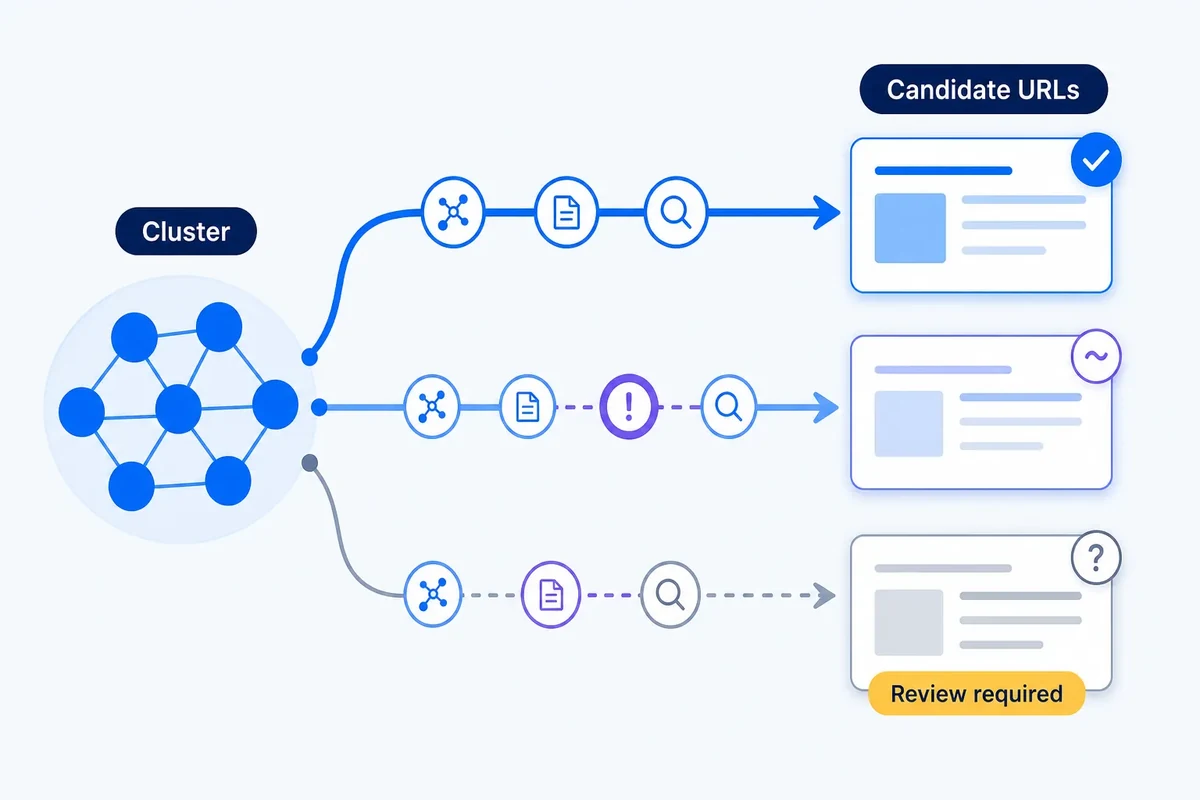
A confidence framework for mapping keyword clusters to URLs
