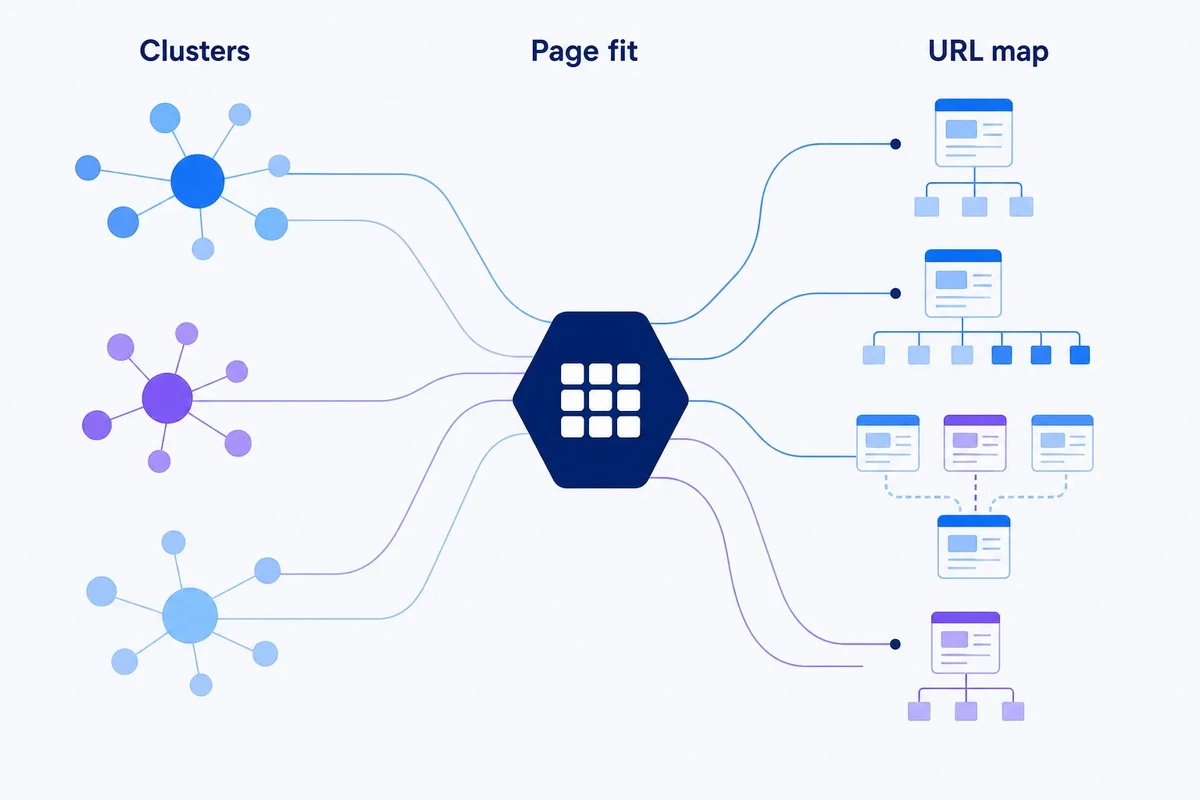
A confidence framework for mapping keyword clusters to URLs
Cluster-to-URL mapping is rarely binary. Learn how semantic fit, page type, entities, Search Console and SERP evidence can produce transparent confidence bands instead of one opaque score.

Farky Rafiq
Founder of ClusterIQ
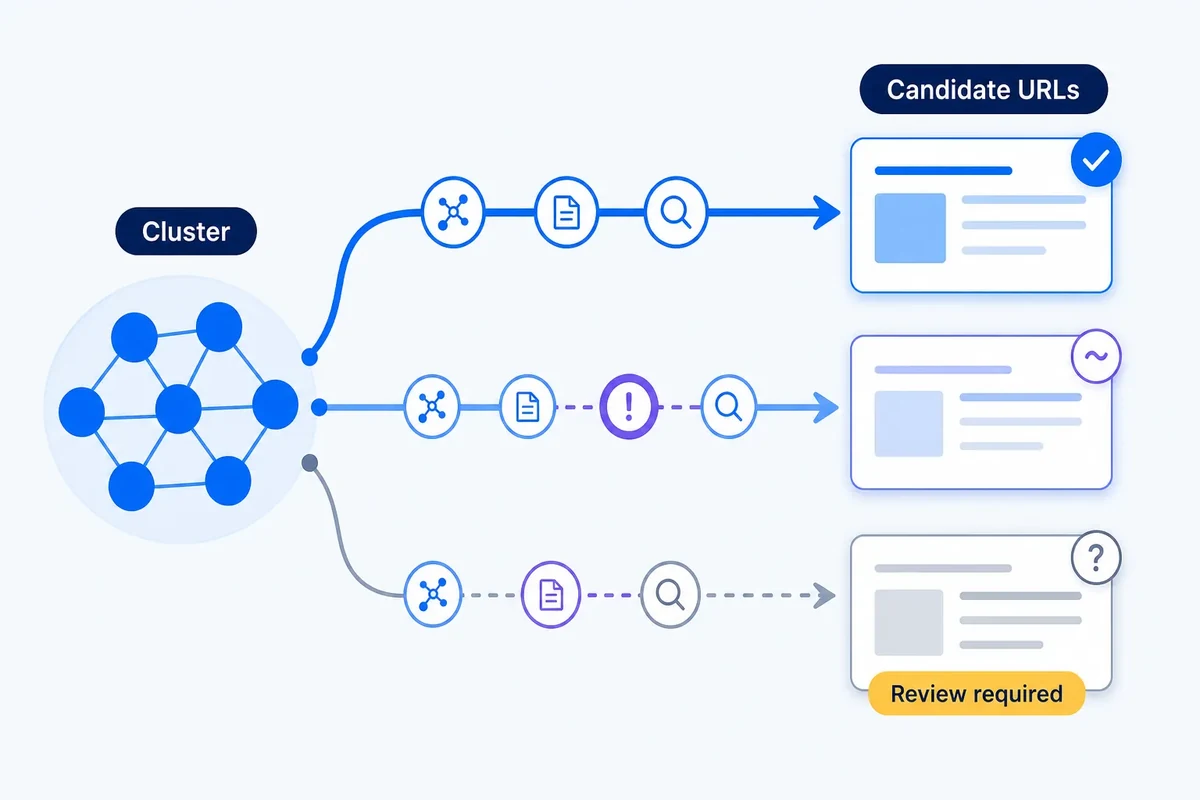
Mapping keyword clusters to specific URLs is rarely as straightforward as a simple spreadsheet lookup. In the real world, SEO data is messy. You might find a cluster that fits two different pages, a blog post that is semantically relevant but the wrong format for the intent, or Search Console data that shows traffic split across multiple URLs. Instead of forcing a single, unexplained choice, ClusterIQ uses a confidence framework to make this uncertainty visible and useful.
Start with independent evidence dimensions
To map a cluster accurately, we need to look at several distinct signals:
- Semantic similarity between the keywords and the page content;
- Compatibility of the page type (e.g., article vs category page);
- Agreement of specific entities and attributes;
- Existing ownership shown in Search Console query-to-page data;
- SERP overlap and result-type trends;
- Internal linking structure and taxonomy;
- Historical mappings approved by your team.
Keeping these signals separate allows you to see exactly why a recommendation was made.
Semantic fit answers only the topic question
Vector embeddings are excellent at identifying pages that cover the same subject matter. However, they often struggle to distinguish between an informational guide and a commercial landing page. This is why page-type classification must sit alongside semantic scores to ensure the user intent matches the destination.
Search Console adds first-party evidence
When a cluster’s main queries already drive impressions to a specific URL, it provides strong evidence of current ownership. It does not guarantee the mapping is perfect, as Google might simply be ranking the "least bad" option, but this first-party data is a vital reality check for any automated suggestion.
Entity agreement protects exact distinctions
A page can be about the right general topic but the wrong specific product, location, or model. If a cluster is about "iPhone 15 cases" and the page is about "iPhone 14 cases", that is a hard conflict. These entity mismatches should act as firm penalties rather than being buried in a slightly lower semantic score.
Use confidence bands instead of fake probability
Displaying a precise percentage like "89% match" is often misleading unless it is a true statistical probability. It is more practical to use honest operational bands:
- High confidence: All major signals agree on the destination;
- Moderate confidence: A plausible fit, but one or two signals are weak;
- Review required: Significant conflicts exist or evidence is lacking;
- Gap candidate: No existing page on the site is a suitable match.
ClusterIQ highlights the specific reasons why a mapping falls into a particular band.
Worked example: three candidate URLs
Imagine a cluster for "keyword clustering software" where we have three potential pages:
- Page A: A product landing page with high semantic and intent fit;
- Page B: A comprehensive blog guide with high semantic similarity but informational intent;
- Page C: An old landing page with existing Search Console impressions but very thin content.
A system relying solely on embeddings might pick Page B because it has more text. A confidence framework, however, recognises that Page A aligns better with the commercial intent, while flagging Page C for review due to its historical performance.
Do not simply average every signal
Different tasks require different logic. When mapping URLs, certain signals carry more weight than others:
- Page-type or entity mismatches often act as hard blockers;
- Semantic similarity helps generate the initial list of candidates;
- Search Console data validates or challenges current ownership;
- SERP evidence helps break ties in ambiguous cases.
The logic should be tailored to the specific decision rather than using a generic weighted average across all features.
Record conflicts explicitly
A helpful explanation for a practitioner might look like this:
Moderate confidence: The semantic fit and entities match, and the page type is correct, but Search Console shows this cluster is currently split across two different URLs.
This transparency tells you exactly where to focus your manual review.
Confidence can prioritise workload
By categorising mappings this way, you can automate the easy wins and focus your expertise where it matters most. You can quickly approve high-confidence sets and spend your time on:
- High-value clusters marked as "review required";
- Resolving URL conflicts or mixed intent signals;
- Identifying content gaps for new topics;
- Sensitive mappings during a site migration.
This approach turns confidence scores into a tool for operational efficiency.
Manual approval should be stored separately
When you manually override or approve a moderate-confidence suggestion, ClusterIQ stores both the original model evidence and your human decision. This ensures that if the model is updated later, your previous work is preserved and can be used to refine future suggestions.
Confidence should change when evidence changes
SEO environments are dynamic. Content updates, changes in internal links, or shifts in Search Console data should trigger a re-evaluation of your mappings. This is particularly important during migrations. Monitoring these changes is similar to how cluster drift monitoring tracks shifts in topic structure over time.
Build a known-correct mapping benchmark
Create a "gold standard" set of clusters where the target URL is undisputed. Use these to test the framework, checking if the right pages appear as candidates and ensuring the system isn't producing false certainty in complex scenarios.
Where ClusterIQ should stay conservative
High-stakes actions like setting up redirects or deleting pages require a much higher confidence threshold than simply labelling a report. The framework allows you to set different requirements based on the risk involved in the task.
Practitioner principle: Confidence should explain the strength of the evidence, not hide uncertainty behind a calculated probability.
ClusterIQ Conclusion
A robust confidence framework moves URL mapping away from guesswork and towards a scalable, transparent process. By combining semantic relevance with page types, entities, and first-party data, ClusterIQ makes conflicts visible. This allows you to process obvious mappings in bulk while ensuring human attention is directed to the most complex and valuable strategic decisions.
Sources and further reading
Farky Rafiq
Founder of ClusterIQ
I've worked in digital marketing since 2005 and founded Liquid Silver in 2011. These articles are where I share the methods, experiments and practical SEO thinking behind ClusterIQ.
Put the idea into practice with your own keyword data
ClusterIQ helps turn raw SEO exports into clean, structured working datasets you can inspect, refine, report on and take into the next stage of your workflow.
Keep reading

Clustering Search Console queries by landing page: finding what each URL actually owns
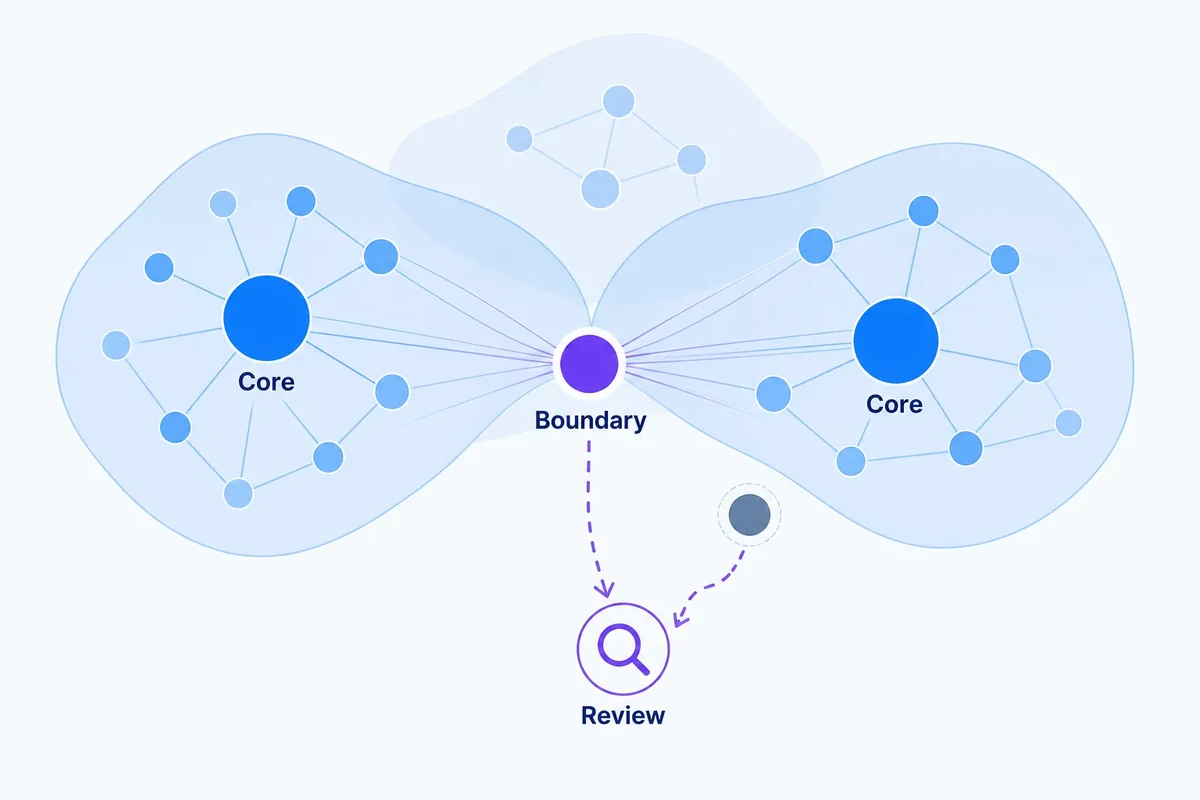
Soft clustering and confidence scores: handling ambiguous keywords honestly