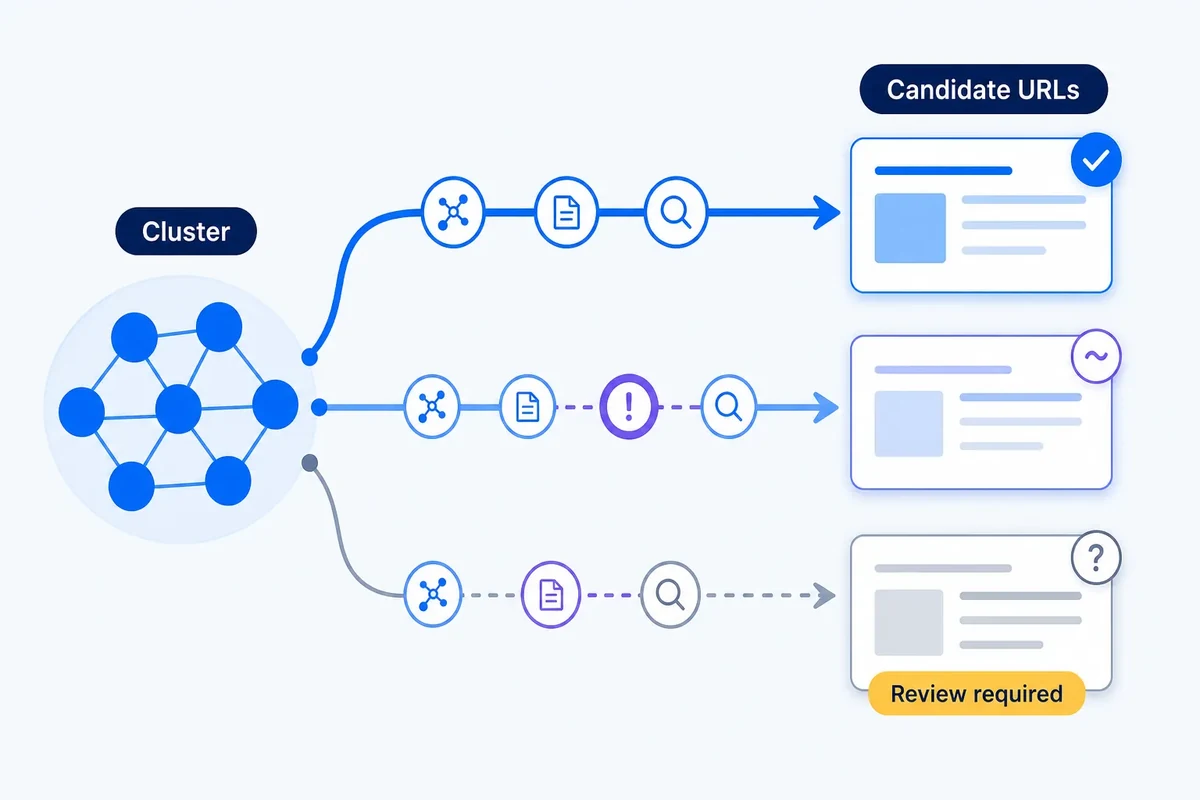
From keyword clusters to URL mapping: turning groups into site architecture
Keyword clusters are evidence, not ready-made URLs. Learn how to combine clusters with intent, page type, Search Console, SERP evidence and internal linking to build a defensible URL map.

Farky Rafiq
Founder of ClusterIQ
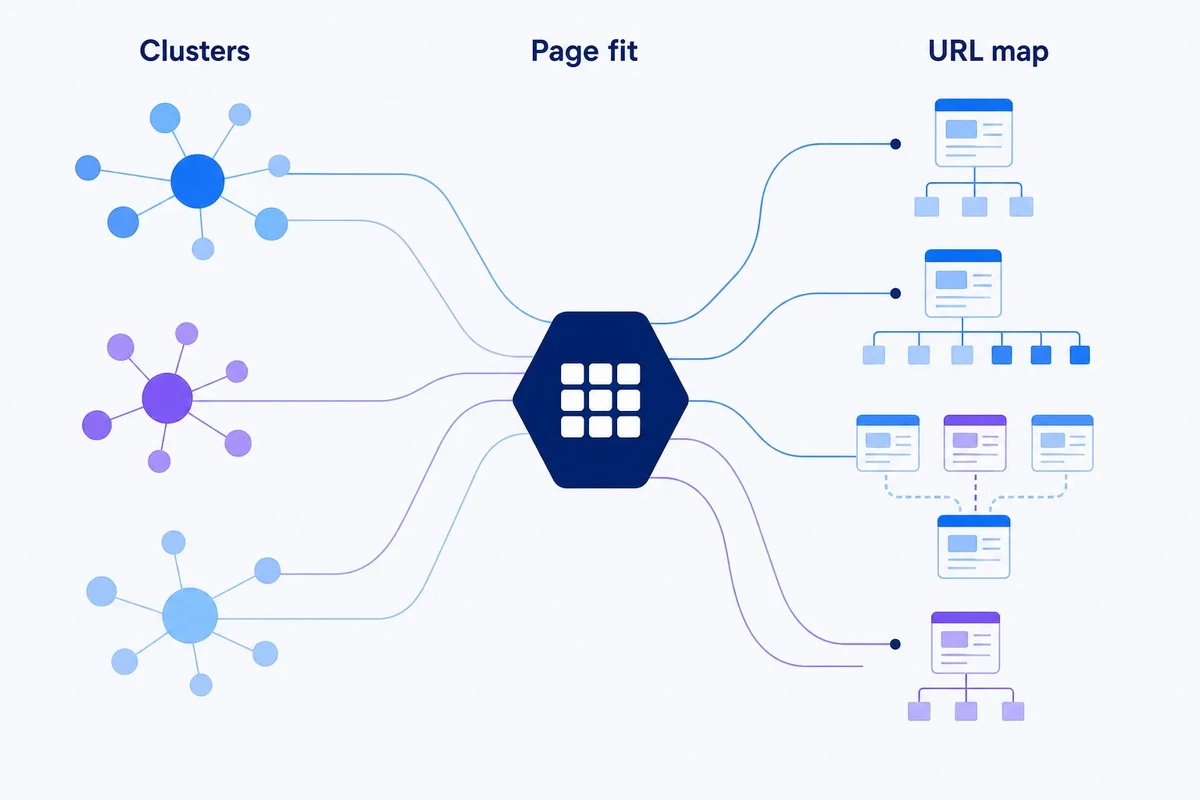
You have grouped 800 keywords into clusters. Now comes the useful part: deciding which existing pages should cover them, which pages need work and whether anything genuinely needs a new page.
This is URL mapping, and the easiest mistake is to turn every cluster label straight into a new URL.
A cluster tells you that queries are related according to the method you used. Deciding whether they belong on one page takes more judgement. You need to consider what people want to achieve, the page format they need, your existing content, the business purpose and how the pages fit together across your site.
One cluster does not automatically equal one page
Queries can be closely related without belonging on the same page. A semantic cluster, which groups queries by meaning, may contain several different user tasks. A graph community, which groups queries through their connections, may cover one broad subject but include commercially distinct subtopics. A density-based method may find a tightly grouped set of queries that still needs more than one page type.
The reverse is also true. Two smaller clusters may fit comfortably on one comprehensive page if they share the same audience, format and task.
So the useful question is not “how many clusters do we have?” It is “what page decisions does the evidence support?”
Start with the existing URL inventory
Before suggesting new pages, compare your clusters with the pages already on the site.
For each important cluster, identify:
- existing URLs receiving relevant impressions or clicks;
- pages already intended to cover the subject;
- near-duplicate pages or pages with overlapping coverage;
- the current page type and template;
- where each page sits in the site hierarchy;
- relevant internal links;
- whether each page can be indexed and is the canonical, or preferred, version.
This keeps the exercise focused on making better use of your site, rather than automatically adding to the content production queue.
Separate four possible outcomes
A practical URL-mapping review usually leads to one of four decisions.
Keep
An existing page already serves the cluster's task and has the right role on the site. It may only need small improvements to coverage, metadata, internal links or on-page structure.
Improve or expand
The right URL exists, but its content does not fully answer the related queries. Improving that page is often more efficient than creating another page that could compete with it.
Consolidate
Several weak or overlapping URLs are trying to serve the same task. The problem may be that useful content is spread across too many pages, rather than that content is missing.
Create
No suitable page exists, and the cluster points to a user need, page type and business opportunity distinct enough to justify a new URL.
“Create” should be the outcome of the review, not the assumption you start with.
Search intent is necessary but not sufficient
Search intent describes what someone is trying to achieve. Labels such as informational, commercial, transactional and navigational are useful starting points, but they are broad categories.
Two informational queries can need quite different formats. “What is keyword clustering?” suggests an explanation of the concept. “Keyword clustering Python tutorial” suggests a technical guide with steps to follow. Both are informational, but that does not make them a good fit for the same page.
Similarly, two commercial queries may differ by product type, audience, geography or the criteria people use to compare their options.
Consider intent alongside:
- the page format needed;
- entities, meaning the specific things named in a query, and modifiers that qualify it;
- funnel stage, or how close the searcher is to taking action;
- audience;
- geography;
- freshness, or how current the information needs to be;
- business purpose.
Use SERP evidence as a page-level signal
Search engine results pages, usually shortened to SERPs, provide another way to check your mapping. If two queries repeatedly return many of the same URLs under comparable search conditions, that strengthens the case for reviewing them together.
If queries with similar meanings return very different pages or result types, investigate why before assigning them to one target page.
Our guide to SERP overlap clustering explains why this evidence is useful, and why it should not be treated as a permanent answer.
Use Search Console to understand your current mapping
Google Search Console lets you view search performance by query and page, including clicks, impressions, click-through rate (CTR) and average position.
For an existing site, this is valuable because it shows which URLs Google has already displayed for your queries. You can compare that behaviour with the pages you intended to target.
Look for patterns such as:
- one strong page receiving impressions across a coherent family of queries;
- several pages alternating in the results for similar queries;
- a relevant page appearing for only a narrow part of the cluster;
- important queries receiving impressions for an unexpected URL.
These are reasons to investigate, not automatic diagnoses. Several pages appearing for similar queries does not, by itself, prove keyword cannibalisation or mean that a redirect is the right fix.
Map clusters to page types before URLs
Before choosing a destination URL, decide what kind of page would best serve the cluster.
Possible page types include:
- category or collection page;
- product or service page;
- comparison page;
- concept explainer;
- implementation guide;
- tool or calculator;
- documentation;
- case study;
- location page.
This step helps you avoid treating every keyword opportunity as a reason to write another blog article.
Mapping a commercial product cluster to an informational article can be just as much of a mismatch as spreading one informational topic across five thin posts.
Preserve the hierarchy between broad and narrow topics
Clusters often fit into a hierarchy rather than a flat list. Some describe broad subjects; others cover more specific parts of those subjects.
A broad parent topic can contain narrower subtopics that deserve their own pages. Those pages can still belong to one connected navigation and internal-linking structure.
For example:
Keyword clustering might sit above:
- semantic similarity;
- clustering algorithms;
- graph community detection;
- SERP overlap;
- cluster evaluation;
- URL mapping.
These subjects are related enough to form one connected topic area, but distinct enough to support separate, useful articles. That is the kind of site architecture this pilot batch of articles is designed to demonstrate.
Internal links turn the map into a navigable structure
Google recommends crawlable internal links with descriptive, relevant anchor text, the clickable words in a link. It also notes that every page you care about should have a link from at least one other page on your site.
For readers, the benefit is practical: links should help them take the next useful step. A page about similarity thresholds should naturally lead to explanations of cosine similarity and cluster evaluation. An article about choosing an algorithm should point to deeper explanations of HDBSCAN and community detection.
You do not need an identical block of links on every article. Add links where the relationship helps the reader continue their task.
A URL map should record evidence, not just destinations
A useful mapping table can include:
- cluster or topic ID;
- representative queries;
- intent and page type;
- existing candidate URL;
- recommended action;
- semantic evidence;
- SERP evidence;
- Search Console evidence;
- confidence or review status;
- parent topic;
- recommended internal links.
This gives you a record of why each mapping was chosen. Someone reviewing the work can follow the reasoning, rather than seeing only a spreadsheet of “keyword → URL” assignments.
Do not generate pages to match every variation
An analysis of a few thousand keywords can reveal thousands of query variations. That does not mean your site needs thousands of pages.
Google's current people-first content guidance asks whether content offers original information or analysis, substantial value and a satisfying experience. It also warns creators to reconsider extensive automation that produces content on many topics primarily to attract search traffic.
A useful safeguard is to give every proposed URL a distinct job.
If two planned pages cannot offer meaningfully different user outcomes, page formats or information, reconsider whether they should be separate before publishing them.
Validate new-page decisions against neighbouring content
Before creating a URL, review the existing pages and planned topics most closely related to it.
Ask:
- What question or task will this page be responsible for answering?
- Which neighbouring page is most likely to overlap with it?
- Why would a user need both pages?
- What should each page contain that the other should not?
- How should the pages link to one another?
- What happens if the new page is never created? Is an existing page genuinely inadequate?
If those questions are difficult to answer, the boundary between clusters may not be a good reason to create a boundary between pages.
A practical mapping workflow
- Generate and review clusters. Keep confidence levels visible and flag queries whose placement is uncertain.
- Attach the current URL inventory. Add Search Console data and existing ranking evidence where available.
- Classify the required task and page type. Go beyond a broad intent label and identify what the page needs to help someone do.
- Choose keep, improve, consolidate or create. Record a clear recommended action.
- Review neighbouring mappings. Check for likely overlap and any missing relationships between broader and narrower topics.
- Design internal links. Connect parent, child and genuinely related pages with useful anchor text.
- Record uncertainty. Flag ambiguous decisions for review by an SEO practitioner.
- Measure after implementation. Check which pages appear for which queries, rather than treating the map as permanent.
ClusterIQ Conclusion
Keyword clusters help bridge the gap between raw search data and the structure of your site. They can show which queries are related and how topics fit together, but deciding where those queries belong still needs a separate review.
Start with the pages you already have. Consider intent, page format, live search evidence and business context. Then decide whether the evidence supports keeping, improving, consolidating or creating a URL. Use internal links to make that structure useful to people and understandable to search engines.
The aim is not one page per cluster. It is a clearer site with less duplicated coverage and page decisions you can explain and support with evidence.
Sources and further reading
Farky Rafiq
Founder of ClusterIQ
I've worked in digital marketing since 2005 and founded Liquid Silver in 2011. These articles are where I share the methods, experiments and practical SEO thinking behind ClusterIQ.
Put the idea into practice with your own keyword data
ClusterIQ helps turn raw SEO exports into clean, structured working datasets you can inspect, refine, report on and take into the next stage of your workflow.
Keep reading
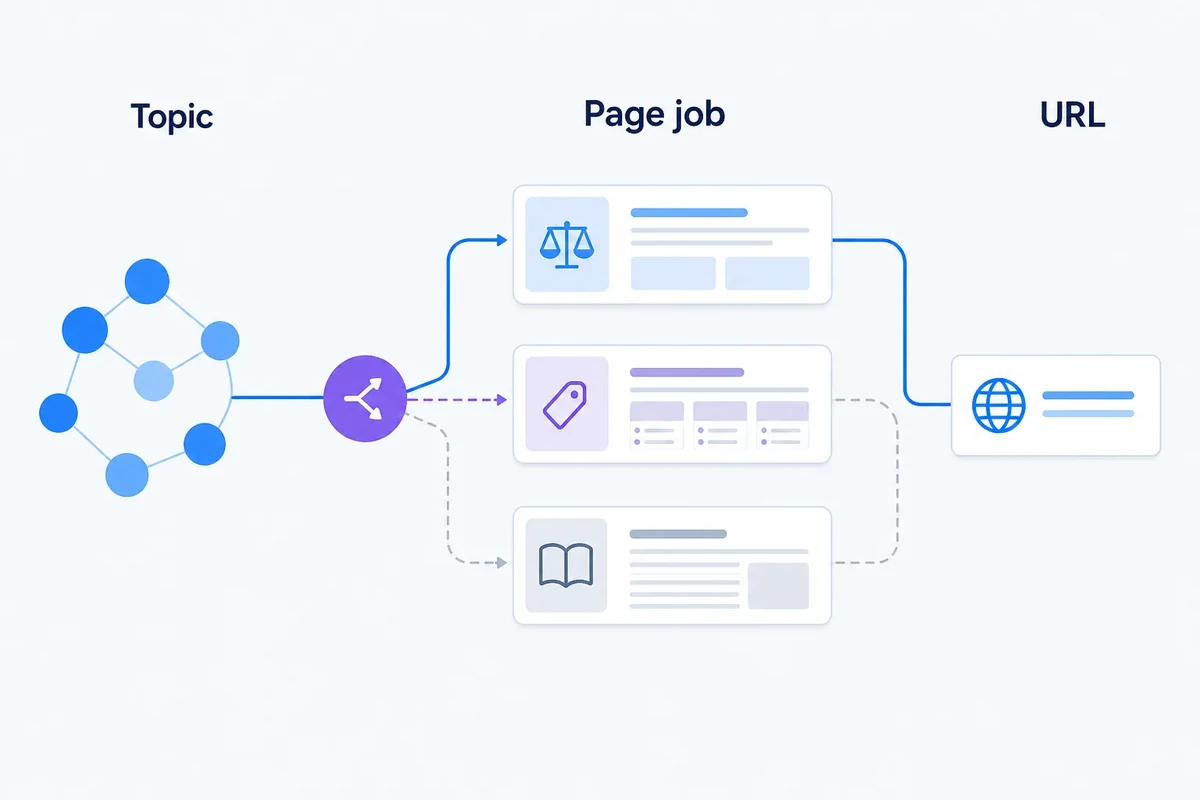
Page type classification before URL mapping: separating topic relevance from the page a user actually needs
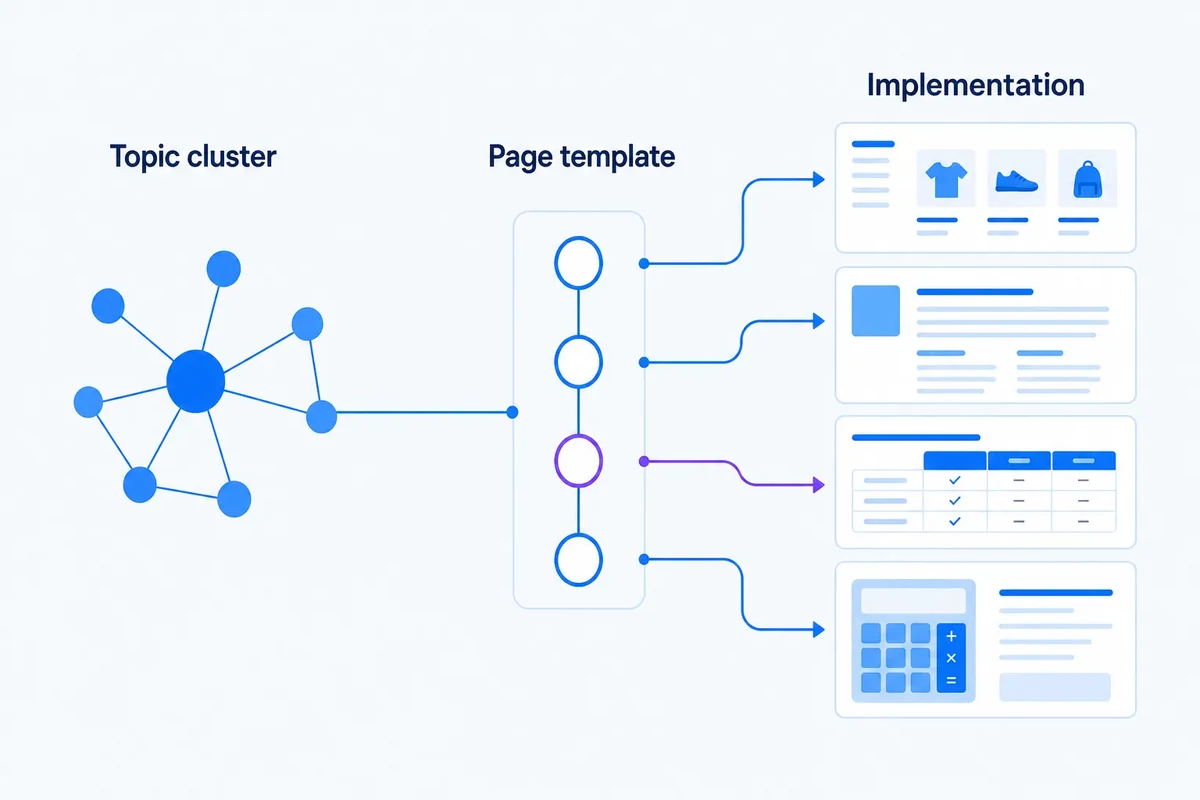
Mapping keyword clusters to page templates: from topic groups to implementation-ready recommendations