Page type classification before URL mapping: separating topic relevance from the page a user actually needs
A semantically relevant page can still be the wrong target if the format does not match the task. Learn how page type classification improves cluster-to-URL mapping.

Farky Rafiq
Founder of ClusterIQ
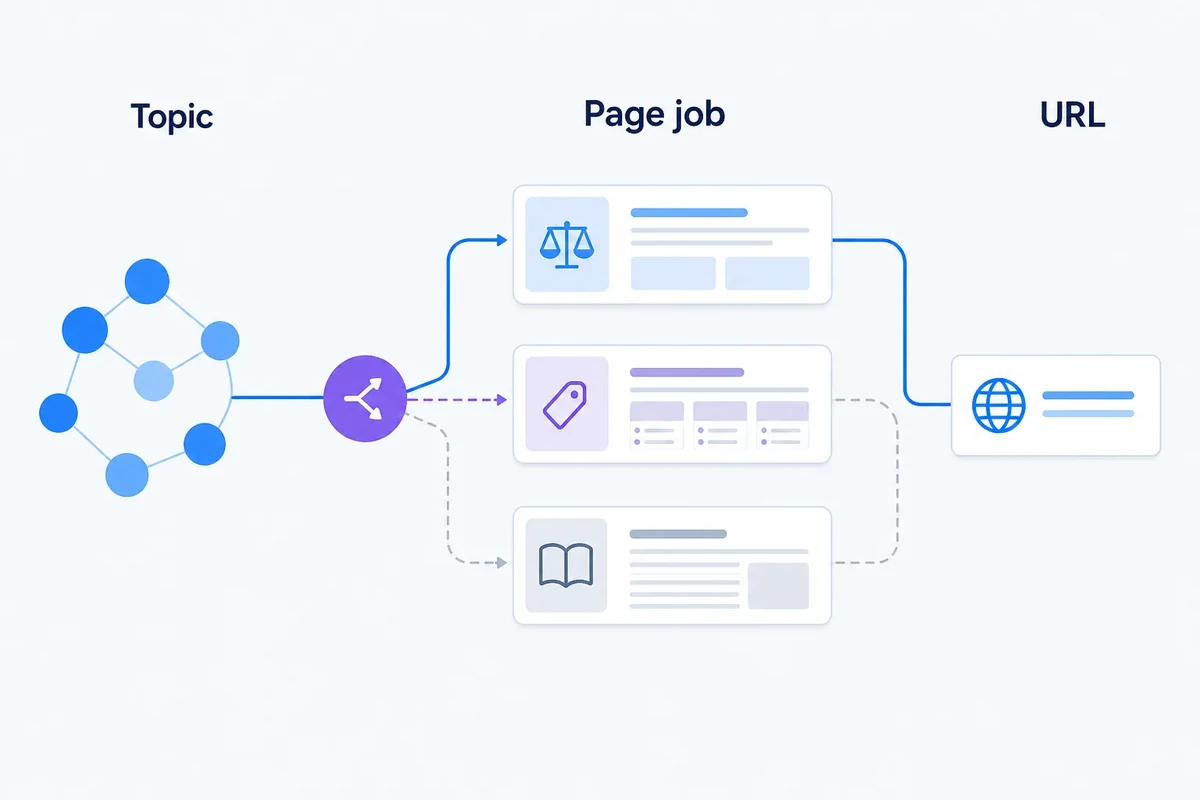
Before ClusterIQ maps your keyword clusters to specific URLs, we need to classify what kind of page the user actually expects to find. This step ensures we aren't just matching words, but matching the user's practical requirement.
Page type is more specific than broad intent
Standard intent labels like informational, commercial, and transactional are helpful starting points, but they are often too coarse for building a site map. Page type translates those broad categories into a specific content format that a developer or content writer can actually build:
- Category or collection pages;
- Individual product pages;
- Service landing pages;
- Pricing tables;
- Comparison guides;
- How-to guides;
- Technical documentation;
- Interactive tools or calculators;
- Location-specific pages;
- Support and troubleshooting hubs.
Two different queries might both have commercial intent, yet one requires a broad category list while the other demands a deep-dive comparison. Distinguishing between these prevents expensive mapping errors.
Why page type matters for cluster mapping
Modern semantic URL matching uses embeddings to find pages that discuss the right subject matter. However, without a layer of page-type logic, the system might suggest mapping a cluster of "best of" queries to a standard educational guide. While the topic matches, the format does not satisfy the user's need to compare options.
Classify the query and the page separately
To get this right, ClusterIQ looks at two distinct data points:
- The expected page type based on the keyword cluster;
- The actual page type of your existing candidate URLs.
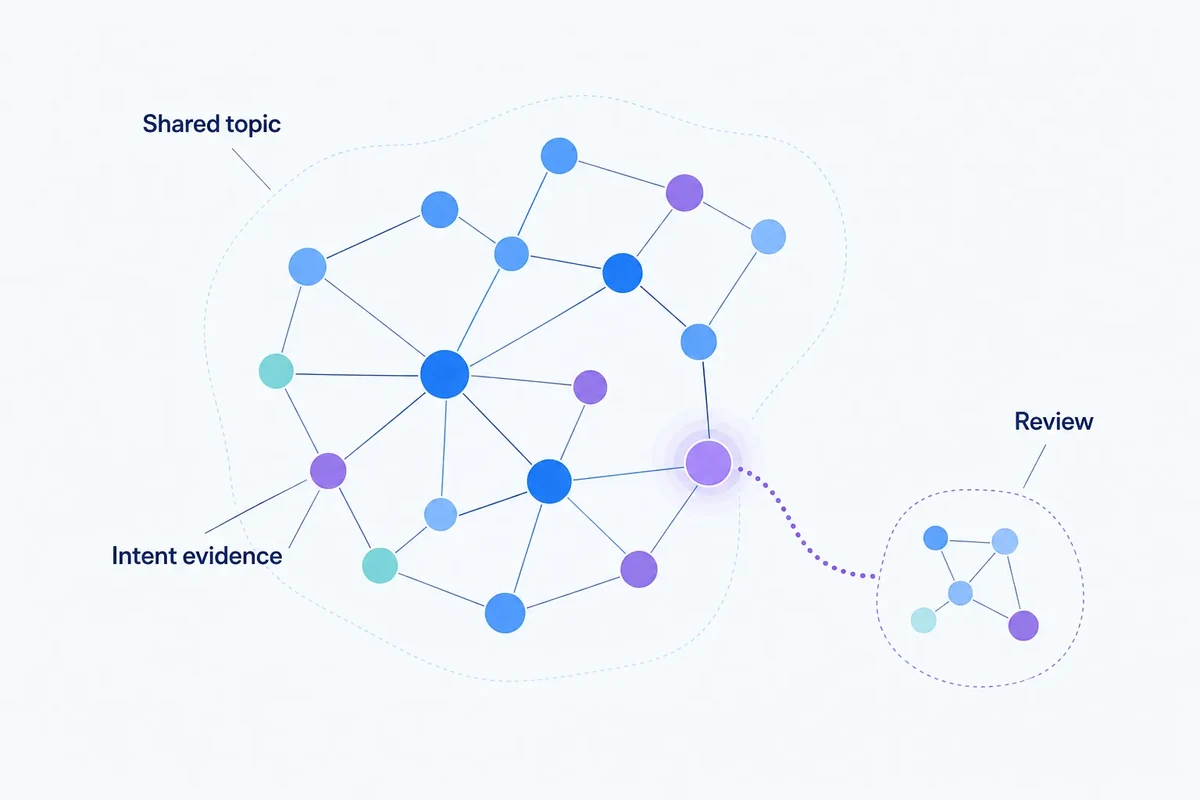
When these two align, we have a high-confidence match. When they disagree, it flags a manual review. This prevents you from accidentally burying a transactional keyword on a deep informational blog post.
How to classify existing pages
When we look at your current site, we use several signals to determine what a page is designed to do:
- The URL path structure;
- CMS template tags;
- Page titles and H1 tags;
- Schema and structured data;
- Position in the site navigation;
- The number of products listed;
- The presence of "Add to Cart" buttons or pricing;
- General content layout.
If your CMS already identifies a page as a "Product Template," that deterministic data is far more reliable than trying to guess the intent from the body text alone.
How to classify cluster requirements
We determine what a cluster needs by looking at modifiers and SERP features. For example, if you are working with a few thousand keywords from Ahrefs or Semrush, the patterns become clear:
- "Buy 800mm shower screen" implies a commercial category or product page;
- "How to measure for a shower screen" clearly needs a guide;
- "Shower screen installation cost" suggests a pricing page or a support article;
- "Shower screen installer Salisbury" requires a local service page.
Mixed page types can expose a broad cluster
Sometimes a single cluster contains evidence for three or four different page types. This usually means the topic is too broad for a single URL. ClusterIQ can maintain the parent topic for reporting while splitting the keywords into operational subgroups. This ensures you aren't trying to force one page to do too many incompatible jobs.
Worked example: CRM software
Imagine a broad cluster for "CRM software." It might include:
- "Best CRM software";
- "CRM software pricing";
- "CRM implementation guide";
- "CRM software demo".
Semantically, these are all about the same thing. However, the expected page types are a comparison, a pricing page, a guide, and a product landing page. The most effective SEO strategy here is a topic family of four distinct pages, rather than one giant, confusing CRM page.
SERP evidence can validate the classification
The current search results are a massive clue. If the top ten results for a cluster are all category pages, Google has decided that is what users want. ClusterIQ combines this SERP overlap evidence with our internal classification to increase mapping accuracy.
Keep classification confidence visible
Not every query has a definitive format. A search for "keyword clustering" could be looking for a tool, a definition, or a software product. In these cases, we avoid forcing a single label and instead present multiple candidates or a lower confidence score, allowing you to make the final call based on your business goals.
Page type as a mapping constraint
For high-confidence clusters, ClusterIQ acts as a guardrail. It prevents a local service cluster from being mapped to a national blog post just because the topics are similar. For lower-confidence matches, the page type simply becomes one part of the overall relationship score we provide in your reports.
Use page type in content-gap analysis
A site might have plenty of content on a topic but still have a "format gap." You might have ten blog posts about a product but no actual category page for users to shop from. ClusterIQ's content-gap workflow highlights these specific opportunities, showing you not just what to write about, but what kind of page to build.
Do not let competitors define the format automatically
While SERP data is useful, it isn't a rulebook. Sometimes the current results are just what is available, not what is best. We encourage you to combine search evidence with your own business model and site capabilities to decide on the final format.
Where ClusterIQ adds value
This classification layer bridges the gap between raw data and a practical content plan. Instead of just grouping related words, the system can tell you: "These keywords are related, but they actually represent two different user tasks. You should probably review these before mapping them to a single URL."
Practitioner principle: topical relevance tells you what the page is about. Page type tells you what the page is for.
ClusterIQ Conclusion
Classifying page types makes keyword clustering far more actionable for site architecture. By combining topic similarity with expected formats and existing template data, ClusterIQ ensures that your SEO efforts result in a logical, user-friendly website rather than just a collection of semantically related pages.
Sources and further reading
Farky Rafiq
Founder of ClusterIQ
I've worked in digital marketing since 2005 and founded Liquid Silver in 2011. These articles are where I share the methods, experiments and practical SEO thinking behind ClusterIQ.
Put the idea into practice with your own keyword data
ClusterIQ helps turn raw SEO exports into clean, structured working datasets you can inspect, refine, report on and take into the next stage of your workflow.
Keep reading
From keyword clusters to URL mapping: turning groups into site architecture
SERP overlap clustering: what search-result similarity can and cannot tell you