Mapping keyword clusters to page templates: from topic groups to implementation-ready recommendations
A cluster becomes easier to implement when it is mapped to a page template, not just a URL. Learn how categories, guides, comparisons, tools and location pages can be assigned deliberately.

Farky Rafiq
Founder of ClusterIQ
A keyword cluster is a great start, but it isn't an implementation plan. Even after ClusterIQ has grouped your data into a coherent topic and identified the likely intent, your team still needs to know what to actually build or fix on the site.
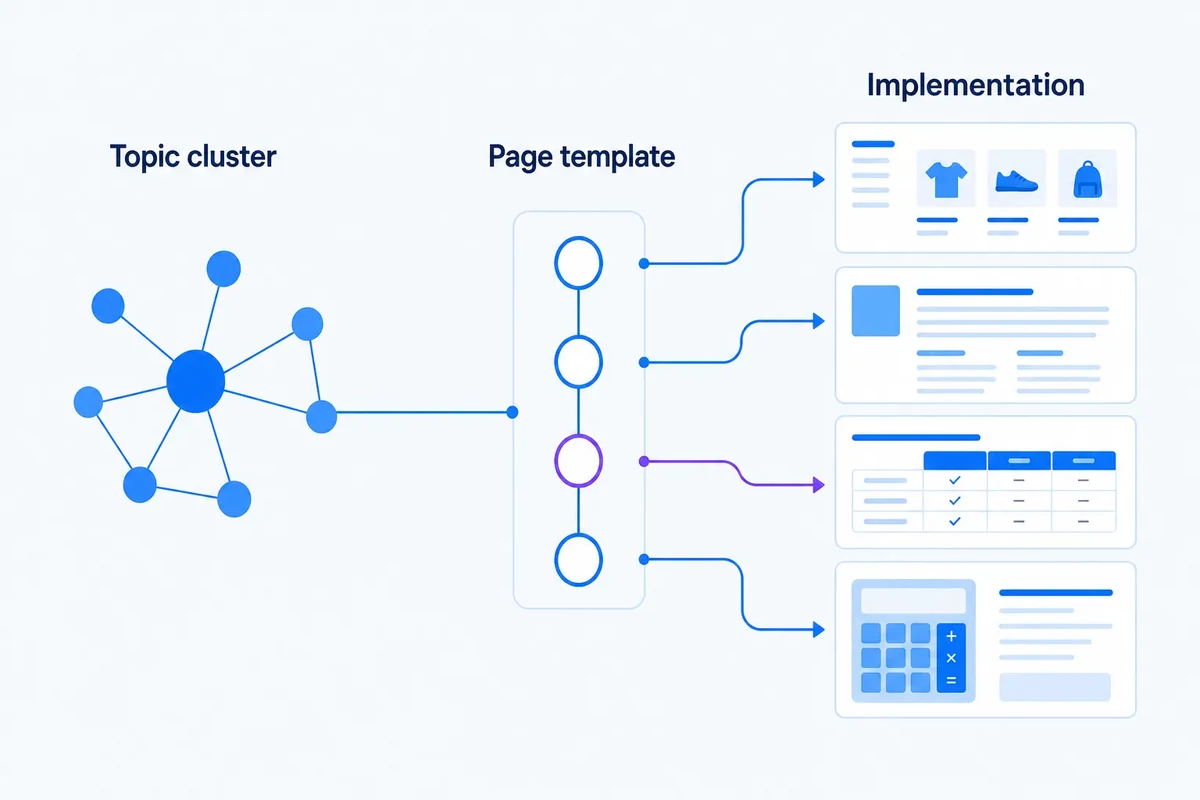
Mapping clusters to page templates provides that essential operational layer. It connects the semantic evidence found in your keyword research to the actual structures your CMS, ecommerce platform, or content team can produce. It turns a spreadsheet of ideas into a queue of work.
Why templates are useful
Templates are essentially repeatable patterns of page behaviour. An ecommerce category template usually features product grids, faceted filters, and merchandising modules. A comparison template might prioritise tables, specific criteria, and pros and cons. A local service page will likely need maps, service areas, and contact details.
When ClusterIQ identifies the likely template required for a cluster, the recommendation becomes far more actionable. Instead of a vague instruction to "create content for these keywords", you are giving the team a specific blueprint for the page's function.
Start from page purpose
Template mapping should always follow the task the user is trying to achieve. When you are looking at a few thousand rows of data from Ahrefs or Search Console, you can start to see these patterns emerge:
- Product category demand leads to a category or collection template.
- Specific product searches lead to a product detail page (PDP).
- Comparison searches require a comparison or "versus" template.
- "How-to" queries suggest a guide or documentation template.
- Calculator or data queries point toward a tool template.
- Local service searches require a location or service area template.
The logic we use in page type classification provides the necessary evidence for this mapping step.
Use existing site templates before inventing new ones
Most established sites already have a design system and a functioning CMS. Before you recommend a brand new page format, ClusterIQ can inventory your existing template types and map new opportunities to those current capabilities.
This approach reduces friction. It avoids a content strategy that stalls because every new topic requires bespoke development work. It is about finding the most efficient path from data to a live URL.
Template fit can expose architecture problems
Sometimes, mapping clusters reveals that your site is missing a fundamental tool. If you find hundreds of high-value clusters that clearly require a page type your site cannot currently produce, you have identified a product or CMS gap rather than a simple editorial one.
Common gaps include the inability to create:
- Side-by-side comparison pages.
- Indexable filtered collections for long-tail search.
- Dedicated location pages for regional services.
- Interactive tools or calculators.
- Structured support documentation.
ClusterIQ helps surface these patterns at a portfolio level, giving you the evidence needed to request technical site improvements.
Worked example: one topic, four templates
Imagine you are working on a content plan for a keyword family centred on "keyword clustering". The topic is the same, but the user's job changes, requiring different templates:
- "Keyword clustering software" suggests a product or platform landing page.
- "What is keyword clustering" fits a conceptual guide or blog post.
- "Keyword clustering vs topic clustering" needs a comparison article.
- "Keyword clustering tool free" is best served by a tool or trial page.
This is why ClusterIQ recommends linking between these different pieces rather than trying to force one single page to rank for every expression in the family.
Templates can carry structured requirements
A template recommendation can also act as a brief for your writers or designers by including required modules. For example, a comparison template might mandate a criteria table, a clear methodology, and links to deeper product pages. A category template might require specific breadcrumbs and filter sets.
This turns your clustering evidence into a set of acceptance criteria for the final implementation.
Do not let the template override the topic
A common mistake is forcing every opportunity into the templates you already have, even when the format is a poor fit. A blog article is not the solution for every cluster just because the blog is the easiest part of the site to update.
ClusterIQ is designed to flag these format mismatches. It is better to know you lack the right template than to waste resources building a page that will never satisfy the user's intent.
Map existing URLs and templates together
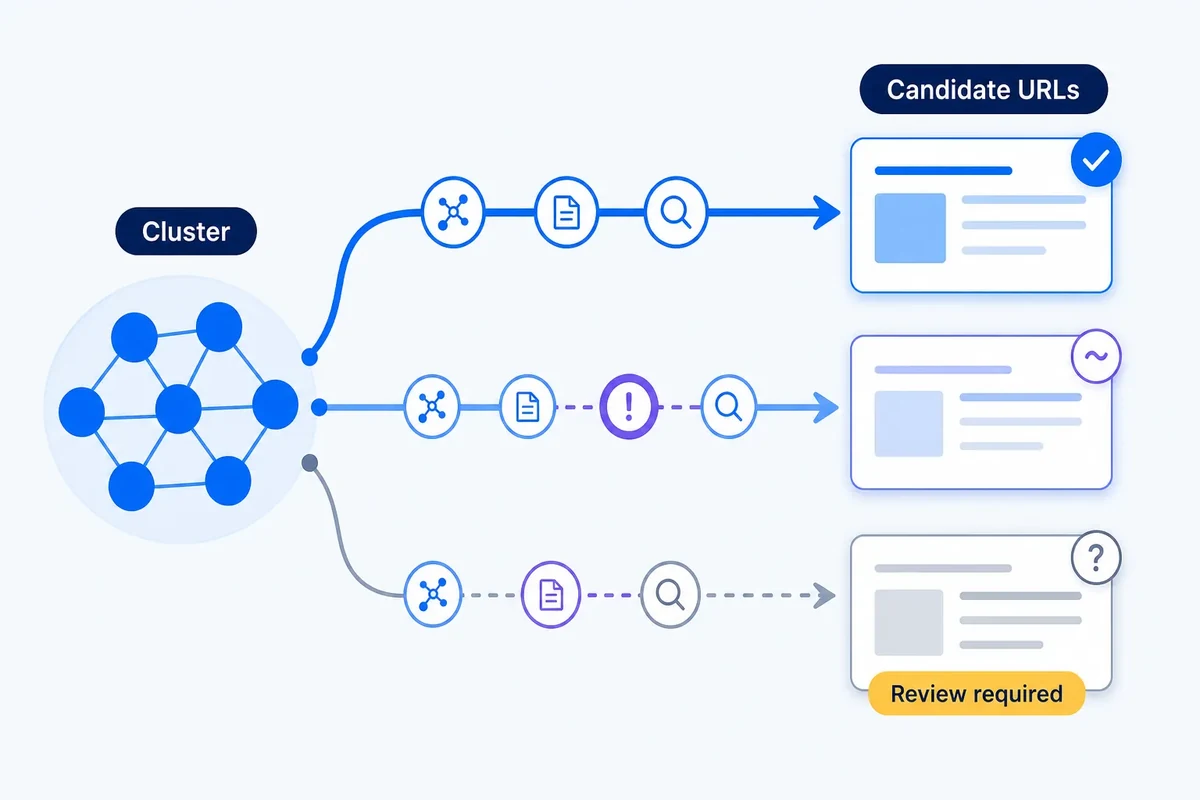
When auditing an existing site, every candidate URL should be evaluated against several factors:
- The current template in use.
- The expected template based on the cluster intent.
- The semantic fit of the content.
- Query-to-page evidence from Search Console.
- A recommended action (e.g., "Switch template" or "Update copy").
If a URL is topically relevant but uses the wrong template, "improving" the page might mean changing the layout and functionality rather than just writing more text.
Use template evidence in gap analysis
A site can have topic coverage without having format coverage. If your only page for a high-value commercial cluster is an informational blog post, you have a commercial gap. The topic exists on the site, but the experience doesn't lead to a conversion. This makes content-gap analysis much more precise and useful for business owners.
Templates support scaled governance
When you are reviewing hundreds of clusters at once, template mapping creates a repeatable decision-making system. SEO teams can quickly filter their to-do lists by work type: new category opportunities, guide improvements, or tool development. This transforms ClusterIQ from a pure analysis tool into a practical implementation planning surface.
Keep manual overrides possible
Automated classification isn't perfect, and business priorities often shift. It is important to store the model's recommendation alongside the final approved implementation. This allows you to track why certain decisions were made and helps future analysis learn from those manual overrides.
Internal linking becomes easier
Template types naturally imply relationships. A guide should link to a commercial category; a category should link to a sizing guide; a comparison should link to the specific products being discussed. By using the topic graph and the template map together, ClusterIQ can recommend internal links that actually make sense for the user journey.
Do not create a template for every edge case
The value of a template lies in its repeatability. If a specific keyword cluster requires a completely bespoke format but offers limited strategic value, the cost of building it might outweigh the potential search traffic. Always weigh the implementation effort against the opportunity.
Practitioner principle: A cluster tells you what demand is related. A template recommendation tells the team what kind of experience is required to serve that demand.
ClusterIQ Conclusion
Mapping clusters to page templates bridges the gap between SEO analysis and real-world execution. ClusterIQ moves beyond simply grouping keywords to providing evidence-based recommendations for categories, comparisons, guides, or tools. This makes the data far more valuable to the developers, designers, and stakeholders who actually have to build the site.
Sources and further reading
Farky Rafiq
Founder of ClusterIQ
I've worked in digital marketing since 2005 and founded Liquid Silver in 2011. These articles are where I share the methods, experiments and practical SEO thinking behind ClusterIQ.
Put the idea into practice with your own keyword data
ClusterIQ helps turn raw SEO exports into clean, structured working datasets you can inspect, refine, report on and take into the next stage of your workflow.
Keep reading
From keyword clusters to URL mapping: turning groups into site architecture
Page type classification before URL mapping: separating topic relevance from the page a user actually needs