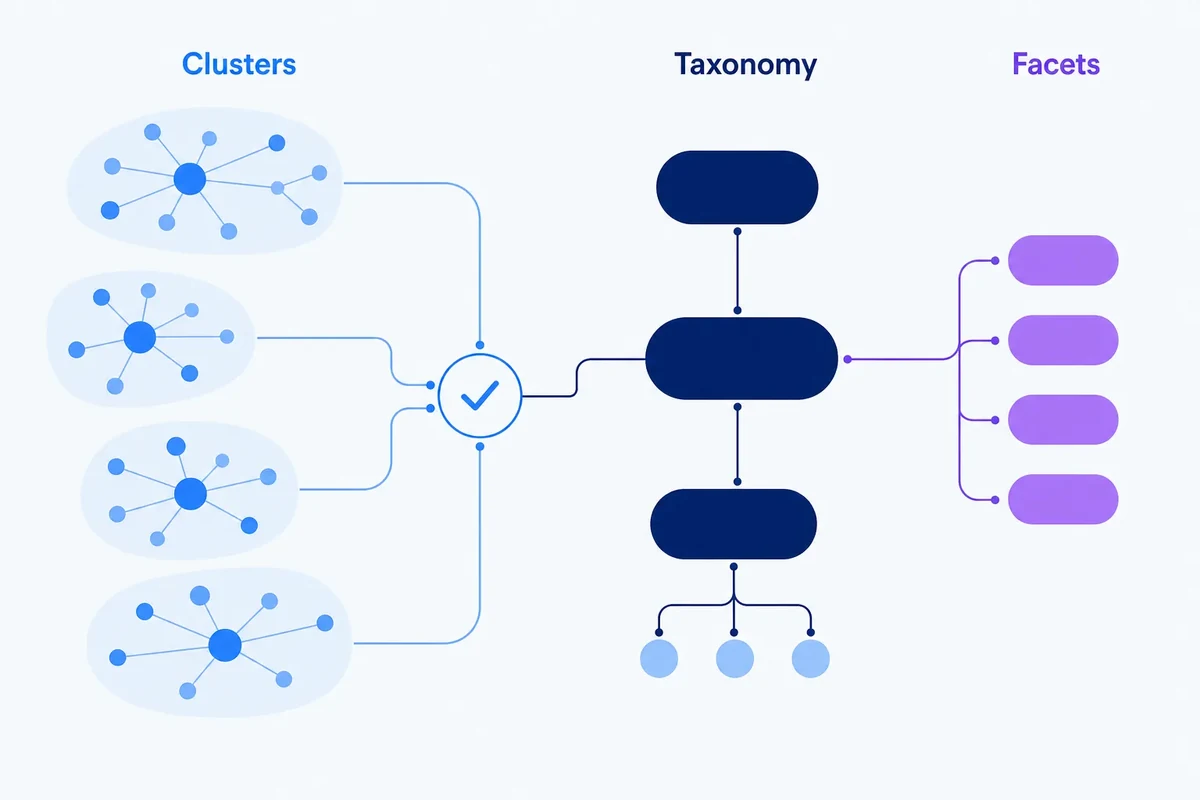
Keyword cluster drift: detecting when the search landscape has actually changed
Clusters evolve as new queries, products and language emerge. Learn how to distinguish genuine topic drift from model noise and decide when a clustering system needs rebuilding.

Farky Rafiq
Founder of ClusterIQ
Your keyword groups still look tidy, but new queries are getting harder to place. Perhaps you grouped 1,500 keywords a year ago, and the categories that made sense then no longer quite match what customers search for now.
Nothing has visibly broken. New queries still get assigned, labels remain readable and dashboards still load. Yet the relationships between topics may have changed enough to make the old structure less useful.
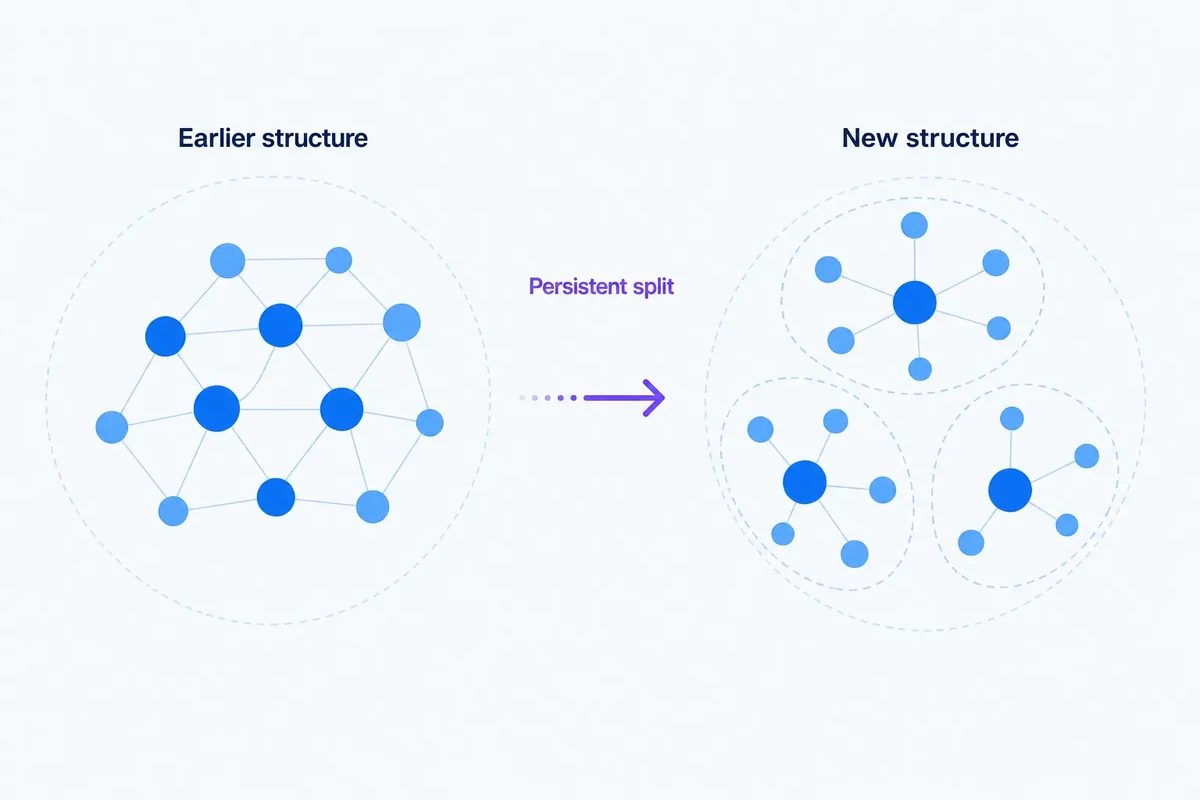
That persistent structural change is called cluster drift. Monitoring it helps you decide when your keyword groups need a rethink, rather than just another update.
Drift is not the same as seasonality
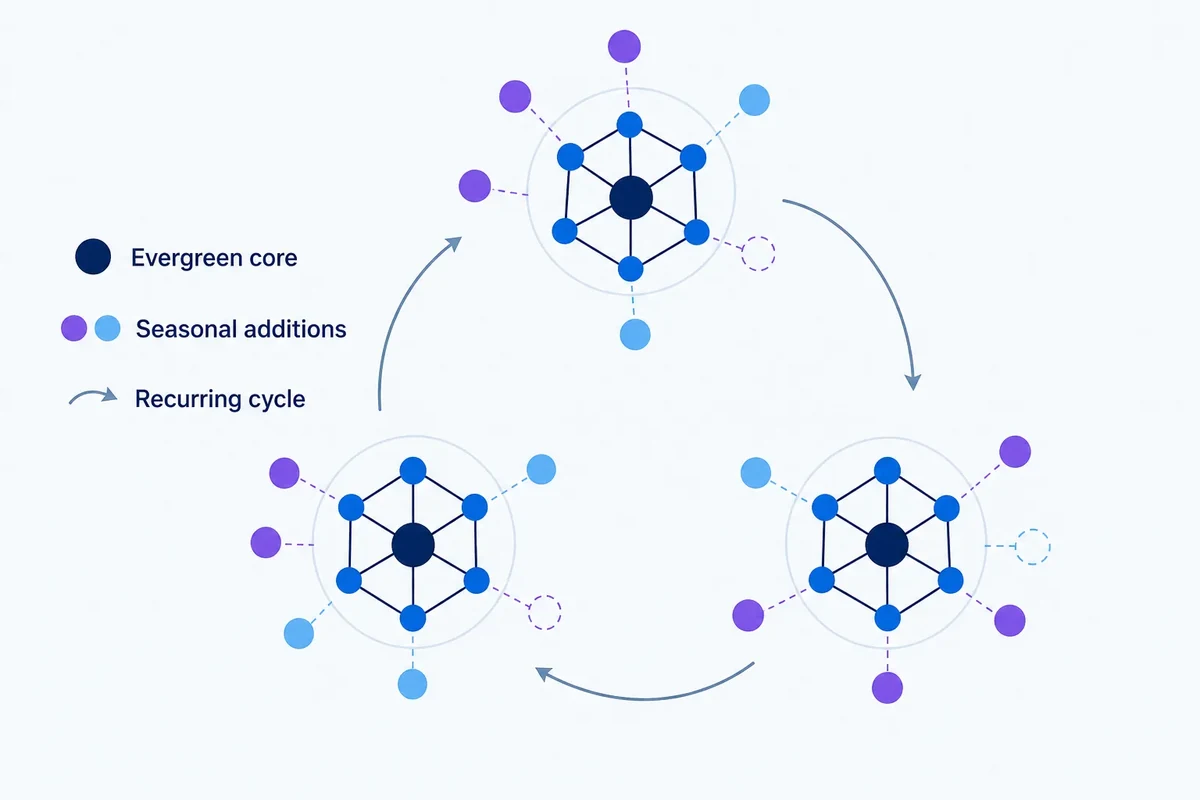
Seasonality is a recurring change in demand or vocabulary, such as searches that return each Christmas.
Drift is a more lasting change in how queries and topics relate to one another.
Examples include:
- a new product category becoming established;
- new terminology replacing older language;
- one topic splitting into distinct subtopics;
- two previously separate concepts converging;
- search behaviour moving towards a different page type.
Monitor assignment quality first
An early warning is that new queries no longer fit comfortably into your existing groups.
Track:
- unassigned rate: the proportion of queries that cannot be placed;
- review rate: the proportion flagged for someone to check;
- average assignment confidence: how confidently the system places queries;
- the number of new entities, such as brands, products or named technologies;
- clusters receiving unusually large numbers of new members.
If assignment quality keeps getting worse across several periods, it may be time to review the structure itself.
Track representative vectors over time
A cluster may have a numerical representation of its meaning: a centroid, or average position; a medoid, or representative member; or a set of representative queries. Compare these across periods.
A large movement may suggest that the topic’s language or membership has changed.
Do not treat centroid movement as proof on its own, though. Temporary differences in the queries sampled can also shift the average.
Membership overlap shows structural change
When you compare old and new clustering runs, look at which queries stay together, not just what each group is called. Useful checks include:
- Jaccard overlap: shared cluster members divided by all distinct members across the two groups;
- pairwise co-membership: whether pairs of queries remain in the same group;
- split and merge events: whether one group becomes several, or several become one;
- stable core size: how many members consistently stay together.
These checks tell you more than comparing cluster IDs, which do not describe the relationships between members.
Entities can reveal meaningful drift
A topic can keep a familiar label while the names that matter within it change.
For example, an “AI software” cluster may move from one set of vendors and model names to another.
Tracking which entities appear, and how often, can reveal a substantial change that the broad topic label hides.
Page ownership can drift too
Search Console can help you track whether the URLs appearing for queries in a cluster change over time.
If a previously stable topic starts surfacing a different page type, that may indicate a change in what searchers are trying to do, or in how your site is organised.
Set rebuild triggers before you need them
For a clustering system you use regularly, agree in advance what should prompt a review or rebuild. Triggers might include:
- an unassigned rate above a chosen threshold for several periods;
- strong growth in queries that appear to need new topics;
- significant membership changes in high-value clusters;
- the arrival of major new families of entities;
- planned changes to your category structure or products.
Set the thresholds around your own keyword dataset. What counts as unusual movement will depend on the queries it contains.
Do not rebuild on every movement
Some variation is normal in clustering. Not every change means the market has moved.
Use the methods in our cluster-stability guide to separate expected sensitivity to model settings from persistent market change.
Keep cluster lineage when rebuilding
When a rebuild is justified, keep a record of how the new groups relate to the old ones. This history, often called cluster lineage, should identify each as a:
- continued cluster;
- split cluster;
- merged cluster;
- new cluster;
- retired cluster.
That makes it much easier to maintain reporting continuity and keep clear responsibility for content as topics change.
Drift is useful product intelligence
Changes in your topic structure can tell you more than where your SEO setup needs attention.
They can point to:
- new product demand;
- changing customer language;
- new competitors;
- new support needs;
- shifts in buying behaviour.
Tracking drift can therefore make your clustering system a useful way to observe changes in your market.
Practitioner principle: do not rebuild just because the model can produce different groups. Rebuild when the evidence shows that the structure you are modelling has changed enough to matter.
ClusterIQ Conclusion
Monitoring keyword cluster drift turns a one-off grouping exercise into an analytical system that stays useful over time.
Track assignment quality, membership, entities, representative vectors and page ownership. Keep a clear history of how clusters relate across rebuilds, so you can explain changes rather than merely notice them.
This gives you a reason to rebuild when the market changes, and a reason to leave things alone when the movement is only noise.
Worked example: a topic that genuinely split
Imagine a broad “AI writing tools” cluster within a dataset of 2,000 keywords. It may initially behave as one topic. Over time, distinct groups could emerge around video generation, agentic workflows and enterprise governance.
If those subgroups remain stable, develop their own entities and start returning different page types, the change is structural rather than seasonal. That is the sort of evidence that can justify a new topic hierarchy.
Keep a drift log
Whenever a rebuild is triggered, record the evidence behind the decision. Over time, this log helps you distinguish normal churn from the kinds of market change that repeatedly call for structural updates.
Compare drift with business changes
Not every structural change starts with search behaviour. A new product range, site category structure or campaign can change the mix of queries you observe. Record important business events alongside your drift timeline, so analysts can separate market changes from changes your organisation introduced.
Set different drift tolerances by cluster value
Topics that drive core revenue deserve earlier review when their structure changes. Peripheral informational topics can usually tolerate more movement before triggering a rebuild. Different monitoring thresholds for different levels of business value may therefore be more useful than one rule for every cluster.
Drift should trigger investigation before automation
A detected structural change is a reason to review your topic map. It should not automatically create pages, rename categories or rewrite internal links. A practitioner should first check what changed and what, if anything, needs to happen next.
Sources and further reading
Farky Rafiq
Founder of ClusterIQ
I've worked in digital marketing since 2005 and founded Liquid Silver in 2011. These articles are where I share the methods, experiments and practical SEO thinking behind ClusterIQ.
Put the idea into practice with your own keyword data
ClusterIQ helps turn raw SEO exports into clean, structured working datasets you can inspect, refine, report on and take into the next stage of your workflow.
Keep reading
Seasonal keyword clustering: separating recurring demand from temporary noise
Keyword cannibalisation: how clustering helps find overlap without inventing a problem