Keyword cannibalisation: how clustering helps find overlap without inventing a problem
Multiple pages ranking for related queries do not automatically mean cannibalisation. Learn how clustering can identify genuine overlap, competing URLs and consolidation opportunities.

Farky Rafiq
Founder of ClusterIQ
Keyword cannibalisation gets diagnosed far too quickly, far too often.
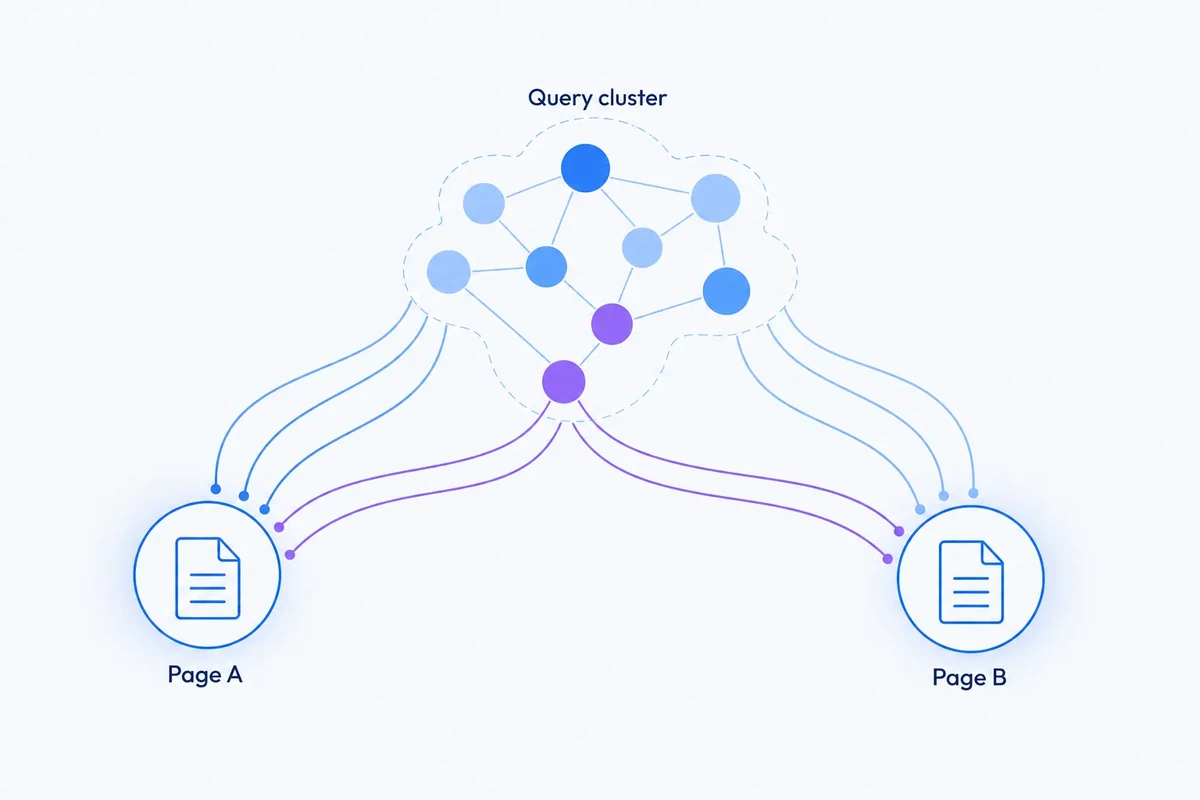
Two URLs turning up for related queries can be completely normal. A category page and a buying guide might both be relevant to the same topic while doing very different jobs for the reader. The real problem only starts when several pages are competing for essentially the same task and the site has no clear reason to keep them apart.
Keyword clustering can help you find those genuine cases, but only if you combine query relationships with actual page-level evidence rather than relying on the clusters alone.
Start with a better definition
Here's a definition that actually holds up in practice:
cannibalisation is harmful overlap between pages competing for the same or substantially similar search task, when the site would be better served by clearer page ownership.
That framing stops you treating every shared keyword as a problem to be fixed.
Why ranking overlap alone is weak evidence
A site can quite legitimately have several pages linked to one broad subject.
For "mortgages", you might reasonably have:
- a mortgage product page;
- a mortgage calculator;
- a first-time buyer guide;
- a remortgaging page;
- a location-specific adviser page.
Some semantic overlap between these is expected and fine. They only become a problem once their intended jobs are unclear or needlessly duplicate each other.
Clustering creates the investigation set
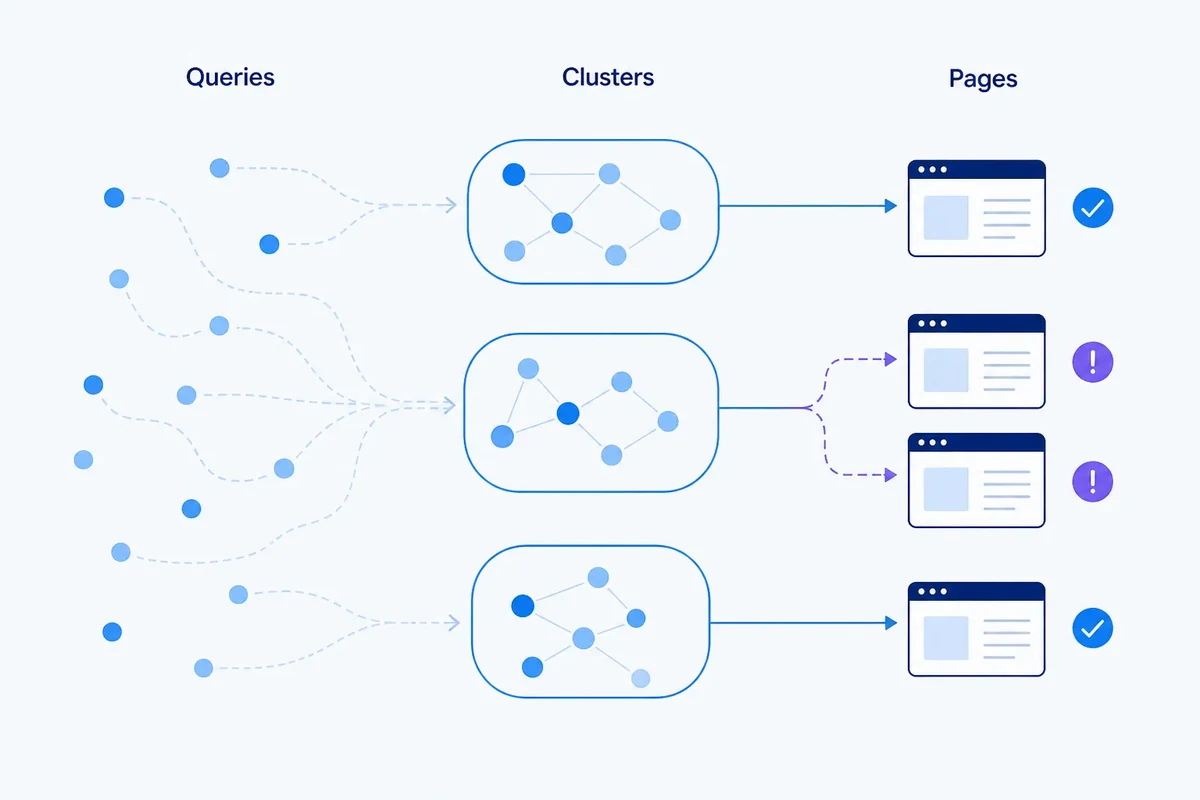
Rather than hunting for duplicate keywords row by row, cluster the related queries first.
For each cluster, attach:
- ranking URL or URLs;
- impressions and clicks;
- page type;
- canonical state;
- intent or task;
- current target page, if one exists.
Now you're asking a much sharper question: how many URLs are sharing this coherent query neighbourhood, and should they be?
The query-page matrix is particularly useful
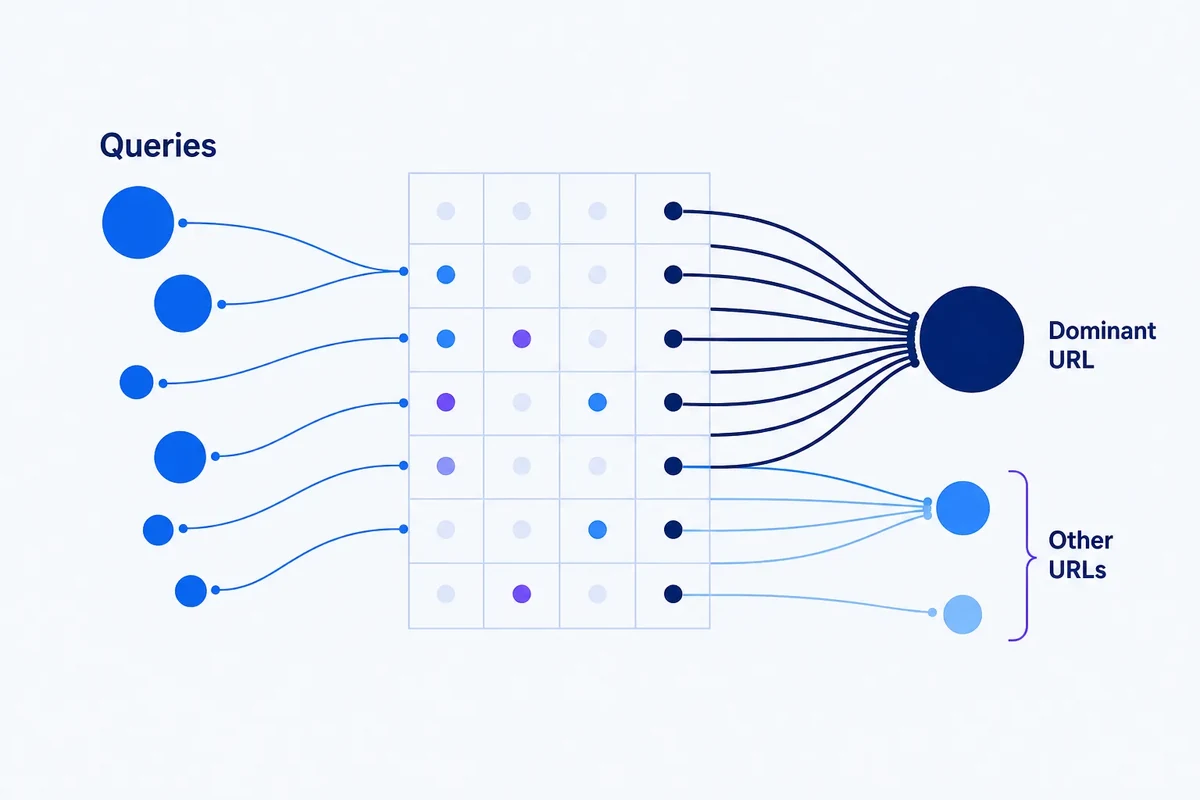
Search Console's Performance report exposes queries and pages as separate dimensions. You can see which pages Google has actually shown for a specific query, and how that traffic shifts over time.
Turning that into a query-page matrix can reveal patterns like:
- one dominant URL with occasional secondary appearances;
- two URLs repeatedly sharing the same query set;
- a topic that splits cleanly by intent;
- many weak URLs with no stable owner.
The second and fourth patterns are the ones that deserve your attention first.
Cluster-level overlap is stronger evidence than single-query overlap
A single query on its own can be noisy. A whole cluster tells you a much more reliable story.
If two pages share dozens of semantically related queries, have similar page formats and keep alternating visibility over time, the case for investigating cannibalisation gets a lot stronger.
But if two pages only share one broad query while otherwise serving distinct clusters, forcing them together could well make the site worse, not better.
Look for instability, not just coexistence
One useful signal to watch for is URL switching.
If the same cluster keeps changing which page is its primary ranking page, that can point to unclear ownership. The pattern means more when it persists across time rather than just showing up once in a single snapshot.
Track:
- dominant URL by week or month;
- share of cluster impressions by URL;
- number of URLs receiving material visibility;
- whether visibility gains for one page line up with losses for another.
None of this proves causation on its own, but it gives your review a useful time dimension.
Check page purpose before you consolidate
Before merging any pages, ask yourself:
- Do they serve the same user task?
- Do they use the same page format?
- Do they target the same market and audience?
- Could one page satisfy both query sets without becoming unfocused?
- Are there links, conversions or business reasons to keep both?
If the honest answers point to two legitimate jobs, improve the differentiation between them instead of forcing a consolidation that doesn't fit.
Four common outcomes
Keep both: the pages overlap topically but serve genuinely different tasks.
Clarify ownership: adjust content, internal links and targeting so each page has a clearer role.
Consolidate: merge genuinely duplicative pages and redirect appropriately.
Create a hierarchy: keep several pages but introduce a stronger parent-child structure between them.
Internal links can expose the intended hierarchy
If your site has a broad parent page and narrower supporting pages beneath it, internal links should help both users and crawlers understand that relationship clearly.
Google recommends crawlable links with descriptive anchor text, and says important pages should be linked from at least one other page on the site.
Clusters can help you spot where those relationships are missing. A broad group may not need consolidating at all if its internal architecture already makes each page's role clear.
Canonicalisation isn't a substitute for information architecture
Canonical tags exist to signal a preferred URL among duplicate or near-identical pages. They aren't a general-purpose fix for two pages that both need to exist but currently have unclear targeting between them.
If the pages are genuinely different, fixing the content and the linking relationship usually matters more than trying to use a canonical tag to pick a winner.
A practical cannibalisation workflow
- Cluster the relevant query set.
- Attach Search Console page data.
- Calculate how many URLs materially participate in each cluster.
- Inspect URL switching over time.
- Classify the page types and intended tasks.
- Review high-overlap, low-differentiation cases first.
- Choose keep, clarify, consolidate or hierarchy.
- Measure query-page behaviour again after implementation.
Practitioner principle: cannibalisation is not "two pages rank for the same keyword". It is a page-ownership problem that clustering can help make visible.
ClusterIQ Conclusion
Keyword clustering improves cannibalisation analysis by shifting the conversation away from isolated keywords and towards coherent groups of related demand.
Combine those clusters with query-page data, page purpose and how things behave over time. That's what lets you separate legitimate topical overlap from pages that are genuinely fighting over the same job.
The goal was never fewer URLs for their own sake. It's clearer ownership and a site structure that actually makes sense to users, editors and search engines alike.
Sources and further reading
Farky Rafiq
Founder of ClusterIQ
I've worked in digital marketing since 2005 and founded Liquid Silver in 2011. These articles are where I share the methods, experiments and practical SEO thinking behind ClusterIQ.
Put the idea into practice with your own keyword data
ClusterIQ helps turn raw SEO exports into clean, structured working datasets you can inspect, refine, report on and take into the next stage of your workflow.
Keep reading
Building a Search Console query-page matrix for cluster analysis
Mapping keyword clusters to existing URLs with embeddings