Using keyword clusters to design an SEO taxonomy without letting search volume run the site
Keyword data can inform taxonomy design, but a site hierarchy must serve users, products and maintenance as well as search demand. Here is a practical way to combine them.

Farky Rafiq
Founder of ClusterIQ
Keyword research is brilliant at showing you how people actually describe products and problems. That doesn't mean the keyword export should become your site hierarchy.
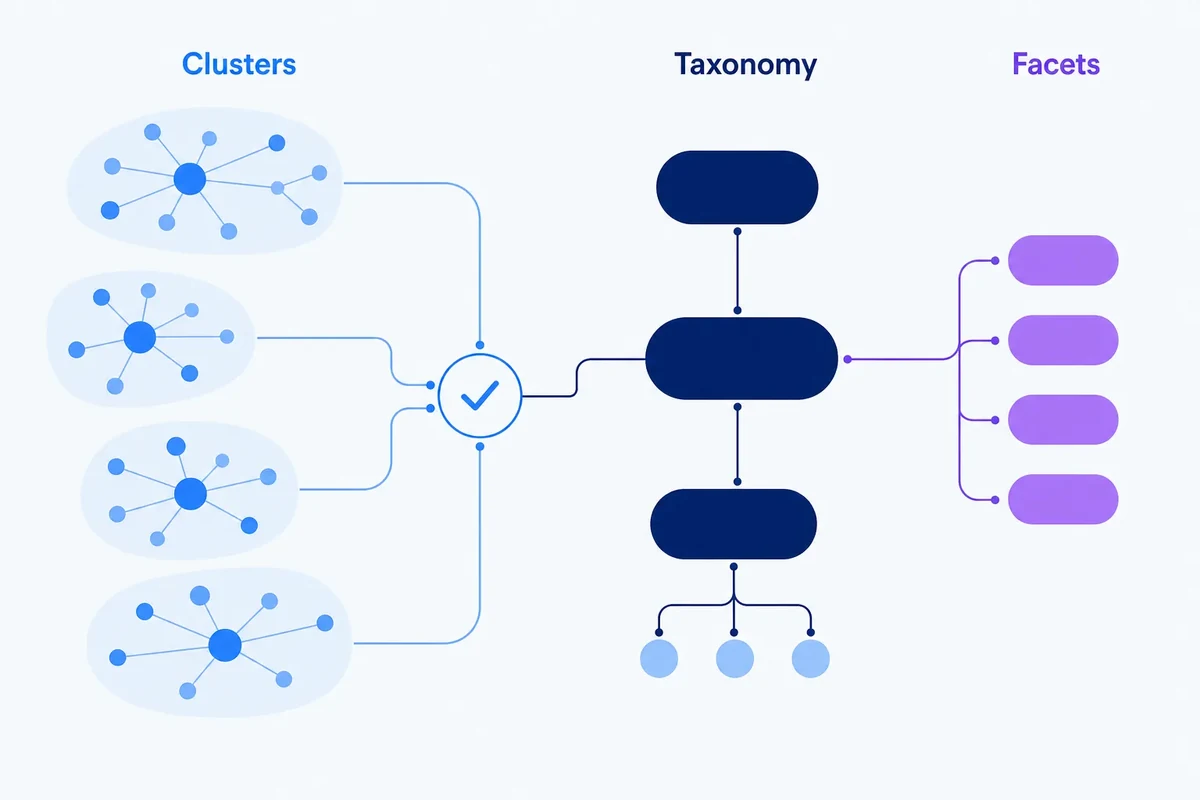
A taxonomy has several jobs to do at once: help users navigate, reflect how the organisation's products or knowledge are actually organised, support internal linking, and stay maintainable as the site grows and changes.
Keyword clusters are valuable input here because they surface recurring language and relationships. They become dangerous the moment search demand is allowed to override everything else.
A taxonomy is a product decision
Search volume is evidence of demand. It is not evidence that a dedicated category should exist.
A good taxonomy also weighs up:
- how products or services are actually organised;
- what users need to compare;
- inventory depth;
- business ownership;
- navigation complexity;
- URL stability;
- maintenance cost.
SEO adds the most value when it contributes demand evidence to those decisions, rather than trying to override them.
Clusters reveal natural candidate groupings
A large keyword dataset tends to show repeated patterns such as:
- product type;
- material;
- size;
- brand;
- use case;
- audience;
- location;
- problem or need.
Those are all potential facets or taxonomy dimensions, but whether they're actually suitable depends on whether the site can support them coherently.
Tell hierarchy apart from facets
A common mistake is turning every meaningful modifier into a nested category.
Some attributes genuinely belong in the core hierarchy. Others work better as filters.
For example, "running shoes" can reasonably sit beneath "shoes", while colour is usually a facet rather than another permanent level of taxonomy.
Keyword clustering can show you that colour terms get real search demand. It can't tell you whether they deserve their own indexable URLs.
Use entities to protect product logic
Entity-aware clustering can separate out brands, product families, models and attributes even when the surrounding language looks similar.
That's especially useful in ecommerce, where a single semantic cluster can span:
- category concepts;
- specific products;
- replacement parts;
- support queries;
- comparison searches.
Our guide to entity-aware keyword clustering explains why those distinctions need to stay explicit.
Build candidate taxonomy nodes from stable clusters
A candidate node becomes more convincing when:
- the cluster stays stable across reasonable changes to model settings;
- the concept has a clear name;
- it differs meaningfully from neighbouring clusters;
- there's enough product or content depth behind it;
- the page would serve a genuinely distinct user need;
- the organisation can actually maintain it.
Volume can help you prioritise among the viable options. It shouldn't be what makes something viable in the first place.
Parent-child relationships need evidence
Just because one cluster is broader than another doesn't automatically make it the parent.
A solid hierarchy is usually backed by:
- shared entities;
- graph relationships;
- existing product families;
- navigation logic;
- user expectations;
- internal-link patterns.
Graph centrality and community structure can help identify broad hubs and narrower subtopics, but the final hierarchy still needs product and UX judgement layered on top.
Google's ecommerce guidance backs up the structural point
Google's documentation for ecommerce sites stresses linking from menus to categories, from categories to subcategories, and from subcategories to products. It also notes that products which aren't reachable through links can be harder for Google to discover.
That's a useful reminder: taxonomy isn't just labels in a spreadsheet. It only becomes real through crawlable paths and internal links.
Watch out for the long-tail category explosion
A large cluster set can easily generate hundreds or even thousands of plausible category combinations.
For example:
- black wall-hung vanity units;
- small black wall-hung vanity units;
- 600mm black wall-hung vanity units;
- 600mm black wall-hung vanity units with basin.
There might be demand for every single phrase. But creating a permanent indexable category for each one can leave you with thin inventory, crawl bloat and a navigation system nobody actually wants to use.
Clusters should help you surface these combinations. Governance decides which of them become real pages.
Use a taxonomy decision table
For each candidate node, record:
- cluster ID and label;
- parent concept;
- representative queries;
- product or content count;
- search demand;
- distinct user job;
- existing URL;
- proposed treatment: category, facet, content page or no page;
- review status.
That keeps the taxonomy auditable and stops one attractive keyword from turning into a permanent structural commitment nobody signed off on.
Test the hierarchy against real journeys
Before you implement anything, try out common user tasks:
- Can someone move from a broad category to a specific product efficiently?
- Can they tell where they are at any point?
- Are sibling categories genuinely comparable?
- Does the structure still work without a search box?
- Can the business add new products without redesigning the whole hierarchy?
A taxonomy that exists only to mirror keyword clusters is usually brittle in practice.
Practitioner principle: use keyword clusters to discover how demand is structured. Use product, UX and maintenance evidence to decide how the site itself should be structured.
ClusterIQ Conclusion
Keyword clusters are powerful taxonomy evidence because they reveal recurring language, entities and topic relationships at scale.
The strongest approach is collaborative. SEO brings demand and search-behaviour evidence to the table, while product and UX constraints decide which relationships become permanent navigation and URLs.
The end result should be a site that reflects how people actually search, without becoming a literal copy of the keyword export.
Related ClusterIQ analysis
For implementation detail, see taxonomy depth, category naming and breadcrumb design.
Sources and further reading
Farky Rafiq
Founder of ClusterIQ
I've worked in digital marketing since 2005 and founded Liquid Silver in 2011. These articles are where I share the methods, experiments and practical SEO thinking behind ClusterIQ.
Put the idea into practice with your own keyword data
ClusterIQ helps turn raw SEO exports into clean, structured working datasets you can inspect, refine, report on and take into the next stage of your workflow.
Keep reading
Keyword clustering for faceted navigation: deciding which filter combinations deserve pages
How deep should an SEO taxonomy be? Using keyword clusters without building endless category levels