Keyword clustering for faceted navigation: deciding which filter combinations deserve pages
Faceted navigation can create useful landing pages or millions of low-value URL combinations. Learn how clusters help identify demand while technical controls protect crawl and index quality.

Farky Rafiq
Founder of ClusterIQ
Faceted navigation is where keyword opportunity and technical SEO risk collide head-on.
Users want to filter products by attributes such as brand, size, colour, price, material and use case. Search demand often exists for the very same combinations.
The problem is combinatorics. A modest set of filters can generate an enormous number of URL combinations, and most of them should never become search landing pages.
Clusters can show you which combinations have real demand
Keyword data can reveal repeated combinations such as:
- black shower screens;
- 800mm shower screens;
- black 800mm shower screens;
- frameless black shower screens.
Clustering helps you group those variations into candidate attribute combinations instead of treating every phrase as its own separate thing.
Demand is only the first gate
A facet combination shouldn't become indexable purely because search volume exists for it.
Also check:
- inventory depth;
- stable product availability;
- a distinct user task;
- difference from the parent category;
- ability to offer genuinely unique, useful content;
- long-term maintenance.
Google warns about faceted URL expansion
Google's current faceted-navigation guidance explains that faceted URLs can create very large crawl spaces, and recommends controlling URLs that don't need to be crawled.
That makes governance essential before an SEO team starts creating indexable filter pages.
Separate navigational filters from SEO landing pages
Users may need a filter that search engines don't need as an indexable page.
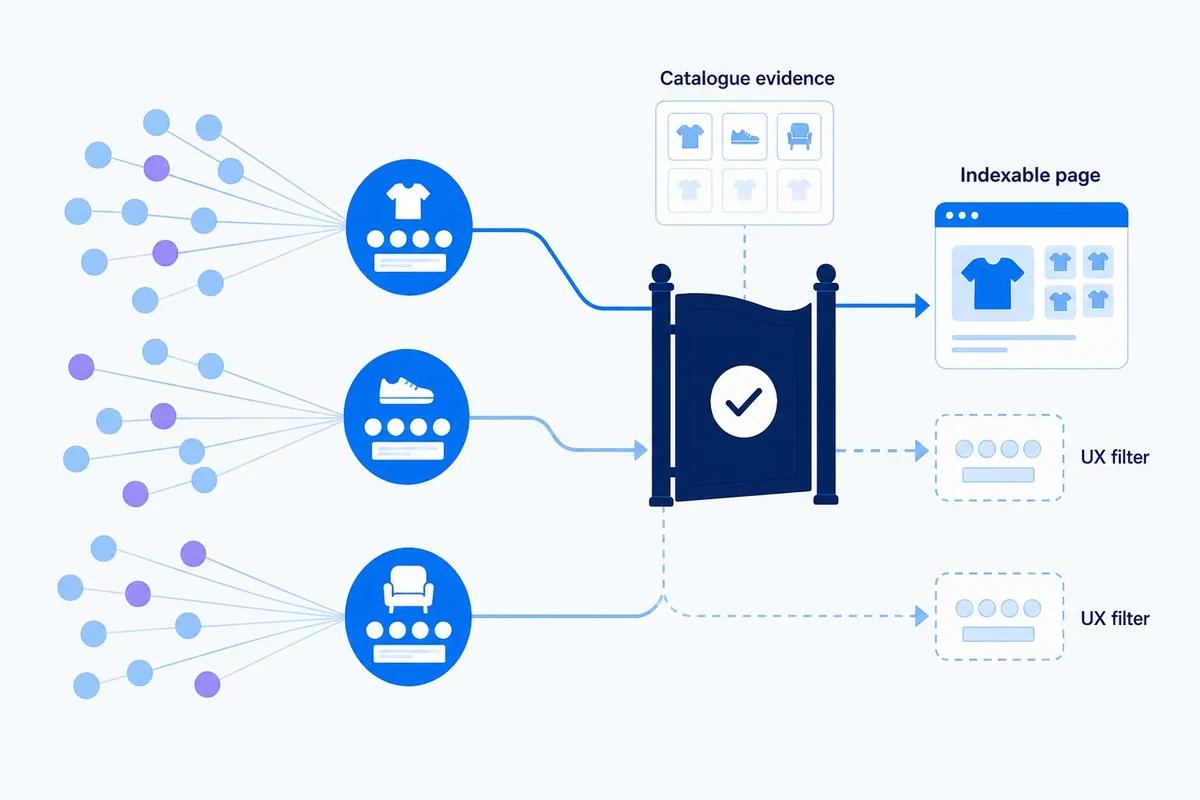
For each facet combination, classify it as one of:
- a UX-only filter;
- an indexable landing page;
- a canonicalised or consolidated variation;
- a blocked or non-crawlable state, according to your technical design.
The exact implementation depends on your platform and crawl strategy.
Entity and attribute extraction helps
Clusters become far easier to govern once modifiers are represented explicitly, for example:
- category = shower screens;
- colour = black;
- width = 800mm;
- style = frameless.
That makes it possible to compare search demand against the product catalogue and work out whether the combination is stable enough to support its own page.
Don't create every intersection
If black, frameless and 800mm each have their own demand, that doesn't mean the three-way combination automatically deserves its own landing page.
Use a minimum evidence rule that combines:
- cluster demand;
- inventory count;
- distinctiveness;
- business value;
- overlap with existing pages.
Check hierarchy and internal links
An indexable facet should sit logically beneath a parent category and receive crawlable internal links.
Don't rely on search engines discovering useful landing pages only through parameter combinations generated by JavaScript.
Watch out for thin inventory over time
A page with 40 products today might have three next month.
Keep monitoring indexable facet pages for:
- inventory collapse;
- zero-result states;
- duplicate product sets;
- changes in demand;
- overlap with sibling facets.
Clusters can also tell you when to consolidate
If two facet combinations have almost identical query groups, product sets and page purpose, keeping both may add very little value.
The right call can be one stronger landing page with filters available for UX purposes.
A practical facet governance workflow
- Extract recurring attribute patterns from keyword clusters.
- Match them to catalogue attributes.
- Check demand, inventory and distinctiveness.
- Map against existing categories and facets.
- Approve only combinations with a clear page job.
- Apply crawl and canonical rules to the remaining filter space.
- Monitor approved facets for inventory and overlap changes.
Practitioner principle: keyword demand can nominate a facet page. It should not be allowed to create one without inventory, differentiation and crawl governance.
ClusterIQ Conclusion
Keyword clustering helps faceted navigation by turning thousands of modifier queries into understandable attribute combinations.
The technical SEO work starts after that. Decide which combinations deserve stable, indexable pages, and control the rest of the crawl space deliberately.
The goal is useful landing-page coverage, without turning every filter interaction into a permanent URL.
Worked example: useful facet, dangerous combination
"Black shower screens" might have stable inventory, clear demand and a distinct merchandising experience. "800mm black frameless shower screens with hinged door" might have occasional search demand but only two qualifying products.
The second combination can stay as a filter state without becoming a permanent search landing page. Clustering helps you identify the language; catalogue evidence decides whether the page can stay useful over time.
Keep an allowlist of indexable facet patterns
For large ecommerce sites, governance is easier when indexable combinations follow approved patterns rather than being created ad hoc. The allowlist can specify which attribute types may generate landing pages, minimum inventory requirements and required internal-link routes.
Model crawl cost as part of the decision
An indexable facet isn't only a content decision. It creates additional URLs that search engines may crawl repeatedly as inventory changes.
For very large catalogues, include estimated URL expansion and crawl exposure in the approval process. A pattern that produces 40 strong landing pages is a very different technical decision from one that produces 40,000 parameter combinations.
Review approved facets against real performance
After launch, keep an eye on whether approved facet pages attract the intended queries and remain distinct from parent categories. If demand, inventory or ownership collapses, the indexation decision should be reversible.
Sources and further reading
Farky Rafiq
Founder of ClusterIQ
I've worked in digital marketing since 2005 and founded Liquid Silver in 2011. These articles are where I share the methods, experiments and practical SEO thinking behind ClusterIQ.
Put the idea into practice with your own keyword data
ClusterIQ helps turn raw SEO exports into clean, structured working datasets you can inspect, refine, report on and take into the next stage of your workflow.
Keep reading
Using keyword clusters to design an SEO taxonomy without letting search volume run the site
Using keyword clusters in an SEO migration: protecting topic ownership before URLs move