Sitemap coverage by keyword cluster: connecting XML discovery with the topics a site is meant to own
An XML sitemap can list URLs without showing whether important topic clusters have valid indexable pages. Learn how ClusterIQ can connect sitemap coverage to page ownership and content gaps.

Farky Rafiq
Founder of ClusterIQ
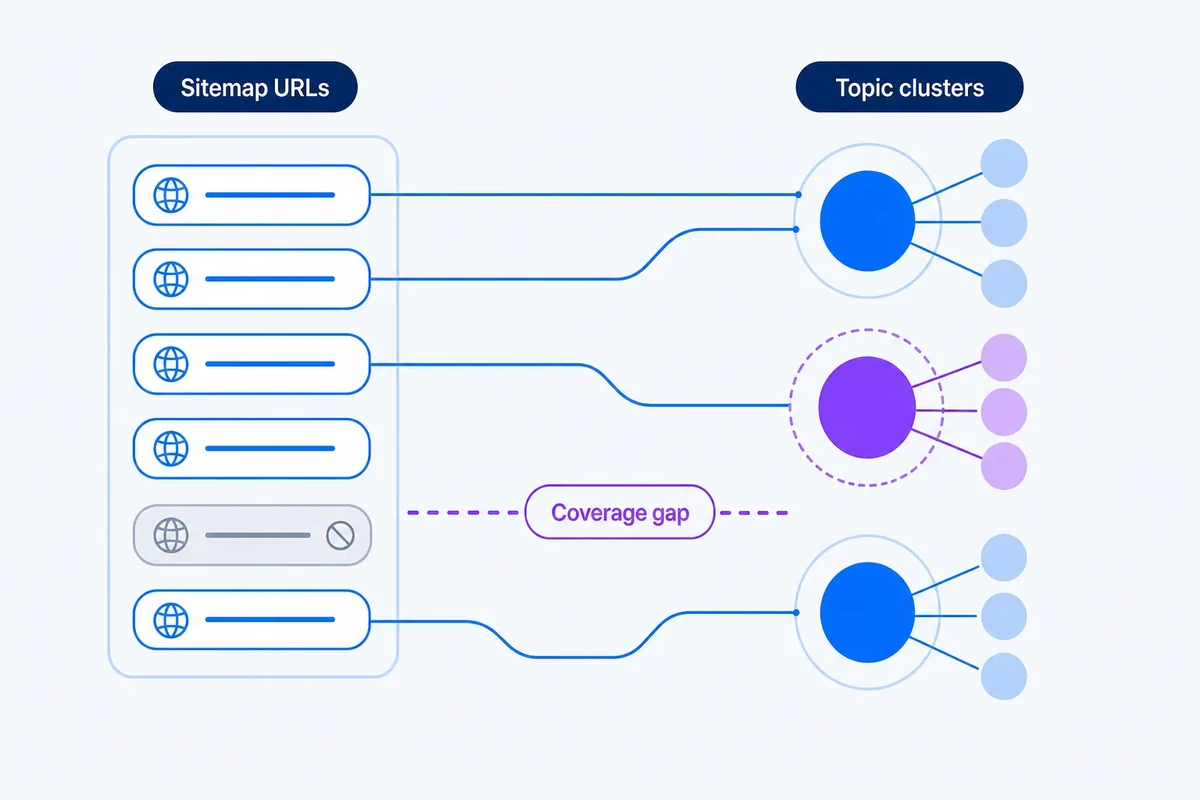
An XML sitemap acts as a formal invitation for search engines to visit specific URLs. It tells bots which pages you want them to discover, but it says nothing about whether those pages actually satisfy the search demand your business needs to capture. You can have a technically perfect sitemap that still fails to represent your most important commercial topics.
ClusterIQ bridges this gap by layering keyword clusters over your sitemap data. By comparing your URL inventory against topic ownership and indexation evidence, you can see exactly where your technical setup and your content strategy are out of sync.
Sitemaps are URL inventories, not topic maps
It is common to find a sitemap containing 10,000 valid URLs while the site simultaneously suffers from massive topic gaps or duplicate page roles. Conversely, a high-performing page might be missing from the sitemap entirely yet remain perfectly discoverable through a strong internal linking structure. Technical inclusion and topical coverage are related, but they are not the same thing. A sitemap confirms a URL exists; a cluster map confirms a topic is served.
Map sitemap URLs to clusters
To get a clear view of how your technical inventory supports your strategy, ClusterIQ can store and cross-reference several data points for every sitemap URL:
- Page type and template;
- Indexability status;
- Canonical URL declarations;
- Mapped keyword clusters;
- Search Console ownership data;
- Internal link status.
This creates a comprehensive view of which topic groups are actually represented within your submitted URL inventory, highlighting where your technical focus is being spent.
Reverse the question too
Instead of just looking at what is in the sitemap, look at what your clusters require. For every high-priority topic, you should ask a series of diagnostic questions:
- Is there a specific page mapped to this cluster?
- Is that page set to be indexable?
- Is it the canonical version?
- Is it included in the XML sitemap?
- Is it supported by internal links?
- Does Search Console show that this page currently owns the topic?
This approach transforms sitemap QA from a dry technical chore into a strategic cluster-level implementation check.
Worked example: a missing commercial topic
Imagine you are working with a few thousand keywords from Ahrefs and identify a high-value cluster for "black shower enclosures". The site already has a relevant category page, but a quick audit reveals it is missing from the XML sitemap and buried deep in the site architecture. Search Console shows almost no impressions.
In this scenario, the fix isn't "write more content". The technical recommendation is to improve discovery by adding the URL to the sitemap and strengthening its internal link position. The cluster data tells you the page exists; the sitemap data tells you why it is failing.
Sitemap presence does not guarantee indexing
Google is clear that sitemaps are hints, not commands. Submitting a URL does not guarantee it will be crawled or indexed. For this reason, ClusterIQ avoids treating "in sitemap" as a synonym for "indexed". To get the full picture, you must use sitemap status alongside URL Inspection reports, Search Console performance data, crawl logs, and canonical tags.
Non-indexable URLs in sitemaps are a quality problem
When a sitemap is cluttered with redirects, canonicalised URLs, or pages blocked by robots.txt, it sends mixed signals. The inventory no longer accurately represents the pages you actually want search engines to show. ClusterIQ flags these inconsistencies, specifically highlighting when important topic clusters are being undermined by technical errors in the sitemap.
Multiple sitemaps can support reporting
Large-scale sites often split sitemaps by language, product category, or content section. ClusterIQ can compare topic distribution across these different sitemaps. This helps identify if one technical section is carrying too many unrelated topics, or if a single topic is fragmented across multiple unexpected templates, which can dilute your ranking potential.
Use sitemap dates carefully
The lastmod attribute is only valuable if it reflects genuine, significant changes to the page. Automatically updating these dates without material changes to the content is a hollow tactic. For content refresh workflows, ClusterIQ connects editorial updates with topic drift and page history, providing a more reliable measure of freshness than sitemap dates alone.
Sitemap coverage can support migration QA
During a site migration, your primary goal is ensuring that important clusters map correctly to new canonical URLs. ClusterIQ's migration workflow uses your topic map as the ultimate checklist, while the sitemap serves as the technical verification that those new URLs are being surfaced correctly to search engines.
Do not reward sitemap size
A bigger sitemap is not inherently better. The real value lies in whether the submitted URLs are canonical, indexable, and necessary for your search goals. ClusterIQ exposes instances where thousands of low-value URLs are bloating the sitemap while strategically vital clusters remain underserved and technically neglected.
Build a cluster coverage table
To make technical SEO easier to prioritise for stakeholders, create a report for priority clusters that includes:
- The target URL;
- Sitemap and canonical status;
- Indexability and internal link count;
- Search Console impressions;
- Required actions.
This ties technical fixes directly to business relevance, making it clear why a specific sitemap error matters.
Use the topic layer to prioritise technical fixes
A sitemap error on a high-revenue category page is a priority; the same error on an old archive page is not. ClusterIQ doesn't replace your existing technical tools; it adds the necessary context of demand and topic importance to their findings.
Sitemaps can reveal orphan-like patterns
If a URL is only found in the sitemap and has no meaningful internal links, it is effectively an orphan. Google prefers to see a natural, crawlable internal link path. A sitemap should be a supplement to a healthy site architecture, not a replacement for it.
Keep technical evidence separate
It is vital to distinguish between "missing from sitemap", "not indexed", and "no target page exists". ClusterIQ keeps these states separate so you can diagnose whether you have a discovery problem, a technical barrier, or a content gap.
Practitioner principle: a sitemap lists URLs. Cluster coverage tells you whether those URLs represent the search needs the site intends to serve.
ClusterIQ Conclusion
Sitemap analysis is far more powerful when connected to keyword clusters. By mapping your technical inventory to your topical goals, ClusterIQ shows whether your most important topics are canonical, indexable, and discoverable. This moves technical QA away from simple "pass/fail" checks and aligns it with your overall search architecture.
Use sitemap coverage as an implementation acceptance check
When you roll out new content or categories, use the sitemap state as part of your completion criteria. If a page is meant to be a primary search target, confirm it appears correctly in your submitted URL inventory. This ensures that your strategy doesn't get lost between the planning phase and the technical implementation in your CMS.
Sources and further reading
Farky Rafiq
Founder of ClusterIQ
I've worked in digital marketing since 2005 and founded Liquid Silver in 2011. These articles are where I share the methods, experiments and practical SEO thinking behind ClusterIQ.
Put the idea into practice with your own keyword data
ClusterIQ helps turn raw SEO exports into clean, structured working datasets you can inspect, refine, report on and take into the next stage of your workflow.
Keep reading
Indexation QA by topic cluster: finding technical gaps that matter to search demand
Keyword clustering for faceted navigation: deciding which filter combinations deserve pages