Indexation QA by topic cluster: finding technical gaps that matter to search demand
Indexation reports can contain thousands of URLs. Learn how ClusterIQ can group technical states by topic so missing, excluded or conflicting pages are prioritised by the demand they serve.

Farky Rafiq
Founder of ClusterIQ
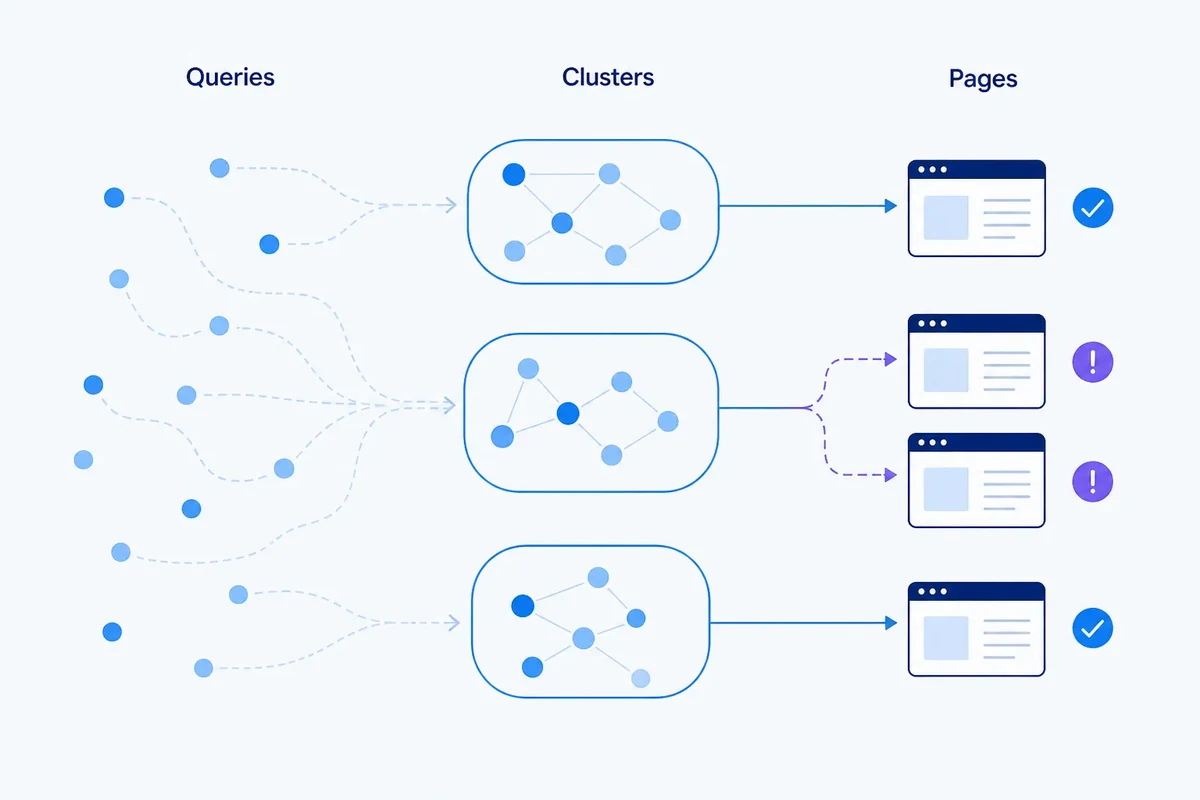
Standard indexation reports are often technically exhaustive but strategically hollow. When you are looking at a spreadsheet of thousands of URLs flagged as excluded, redirected, or canonicalised, the data tells you what happened to the file, but not whether you should care. It treats a vital product category page and a random tracking parameter with the same level of urgency. The report lacks the context of search demand.
ClusterIQ bridges this gap by mapping indexation data directly to your topic clusters. By grouping technical evidence around the topics you actually want to own, you can see which technical hurdles are blocking your most important revenue drivers.
Start with your target pages
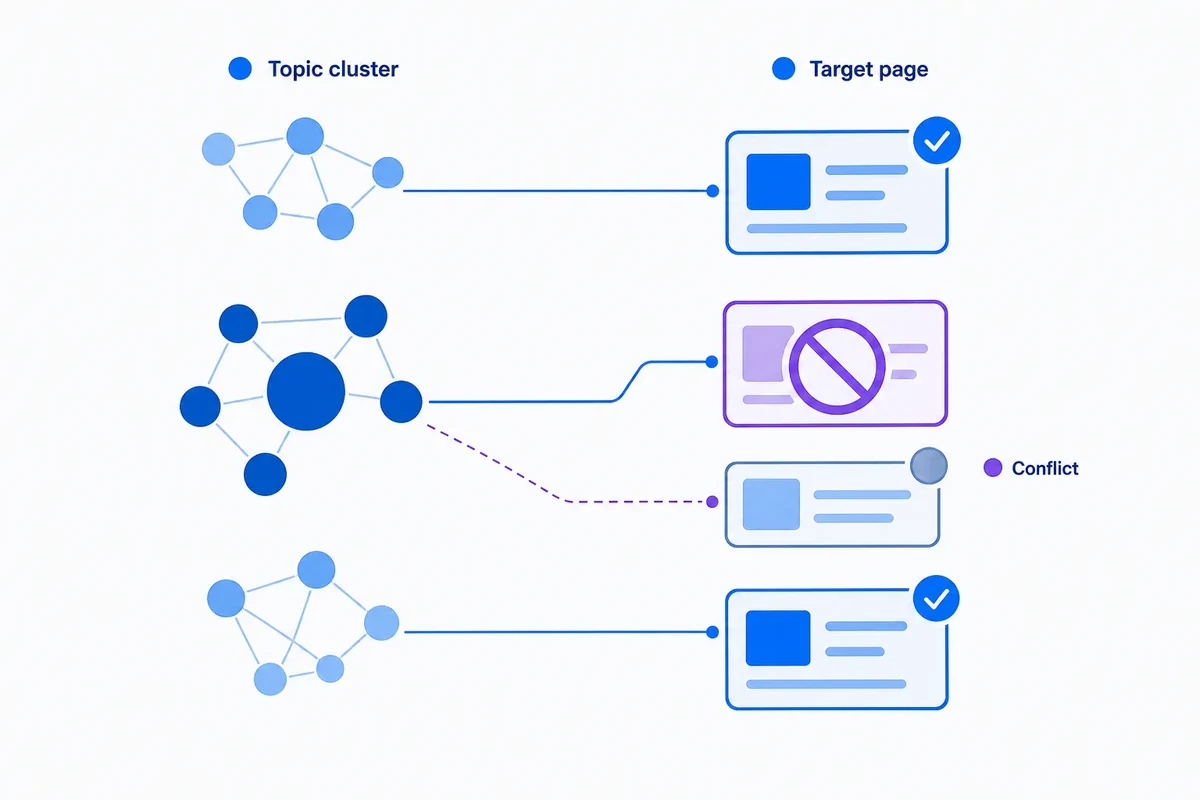
Instead of treating every URL as an equal, start by identifying the specific pages intended to rank for your high-value clusters. Once you have defined these targets, you can run a focused QA checklist: is the page actually indexable? Is it set as the canonical version? Can users and bots find it through internal links? Is it present in your sitemap, and is Search Console reporting any impressions? Crucially, you should also check if other URLs are accidentally competing for that same cluster.
Interpreting indexation states
It is important to remember that an excluded status in Search Console isn't always a mistake. We often want to keep certain things out of the index, such as duplicate parameters, internal search results, or checkout pages. The real issue arises when the specific URL that ClusterIQ expects to lead a topic becomes unavailable or is swapped out for an irrelevant page. That is the signal you need to find in the noise.
A practical example: the missing category
Imagine you have a keyword cluster for 800mm shower screens with a dedicated category page. If a recent site update accidentally adds a noindex tag to that template, a standard dashboard might just show one more excluded URL among thousands. However, ClusterIQ would flag that a high-value cluster now has no indexable target. This immediately shifts the task from a routine check to a high-priority fix because you know exactly which area of search demand is at risk.
The hidden impact of canonical conflicts
A page might look fine on the surface, but if it points its canonical tag to a URL that doesn't serve the same topic, you effectively lose your search presence for that cluster. This is why Canonical and query-ownership analysis is a vital companion to basic indexability checks. It ensures your technical setup aligns with your keyword strategy.
Validating by page type
Sometimes a cluster remains visible, but the wrong page is doing the work. If your main category page is excluded and a blog post starts ranking instead, your site architecture isn't functioning as intended. ClusterIQ helps you distinguish between having no indexable owner, having the wrong page type in charge, or having multiple pages diluting each other's authority.
Summarising indexation by cluster
For large-scale ecommerce sites, reporting by cluster is far more efficient than handing a developer a list of ten thousand URLs. You can provide a clean summary showing which targets are indexed, which have canonical conflicts, and which are at risk of becoming orphans. This creates a logical remediation queue based on business value rather than just file status.
Prioritising the crawl queue
When Search Console shows pages that are discovered but not yet indexed, topic importance helps you decide where to investigate first. A unique page with high search demand deserves immediate attention, whereas a low-value duplicate can wait. Using clusters allows you to focus your technical resources where they will have the most impact on traffic.
Indexation is not a quality metric
Just because a page is indexed doesn't mean it is performing well, and just because it is excluded doesn't mean it is broken. ClusterIQ treats indexation as just one part of the puzzle, alongside content depth and ownership. It is a technical foundation, not a final score of page quality.
Using sitemaps and logs as evidence
If a target page is missing from your sitemap, it might still be crawled, but the inconsistency suggests a potential issue. Reviewing Sitemap coverage by keyword cluster helps ensure your most important pages are being explicitly served to search engines. Similarly, Crawl-log analysis by cluster can confirm if bots are actually reaching those pages, providing a deeper layer of technical reassurance.
Setting alert severity
ClusterIQ allows you to categorise technical issues by their strategic impact. A critical alert might be triggered when a high-value cluster loses its only indexable page. A high-priority alert might flag a wrong canonical, while a medium-priority alert could highlight fragmented ownership. This ensures your team isn't overwhelmed by minor technical noise.
Monitoring releases
Site updates can often cause systemic changes to how pages are indexed. By comparing cluster-level indexability before and after a release, you can quickly spot if a template change has caused a drop in coverage across an entire product line.
The role of manual inspection
While clustering provides the map, you still need to do the legwork. ClusterIQ tells you which URLs to look at first, but a full diagnosis might still require checking headers or using the Search Console URL Inspection tool. The goal is to make sure you are spending that time on the pages that actually move the needle.
Maintaining a historical record
If you retire a page, it is useful to know what it used to own and what replaced it. Keeping this historical record turns your QA process into a map of your site's evolution, ensuring that no important search topics are lost during migrations or redesigns.
Practitioner principle: Technical SEO becomes far more effective when you connect the indexation status of a URL to the specific search demand it is meant to capture.
ClusterIQ Conclusion
Mapping indexation to topic clusters transforms a dry technical task into a strategic priority system. It allows you to see exactly where technical gaps are hurting your visibility, helping you focus on the fixes that matter most to your bottom line while keeping the raw data available for deep-dive troubleshooting.
Sources and further reading
Farky Rafiq
Founder of ClusterIQ
I've worked in digital marketing since 2005 and founded Liquid Silver in 2011. These articles are where I share the methods, experiments and practical SEO thinking behind ClusterIQ.
Put the idea into practice with your own keyword data
ClusterIQ helps turn raw SEO exports into clean, structured working datasets you can inspect, refine, report on and take into the next stage of your workflow.
Keep reading
Keyword cannibalisation: how clustering helps find overlap without inventing a problem
Building a Search Console query-page matrix for cluster analysis