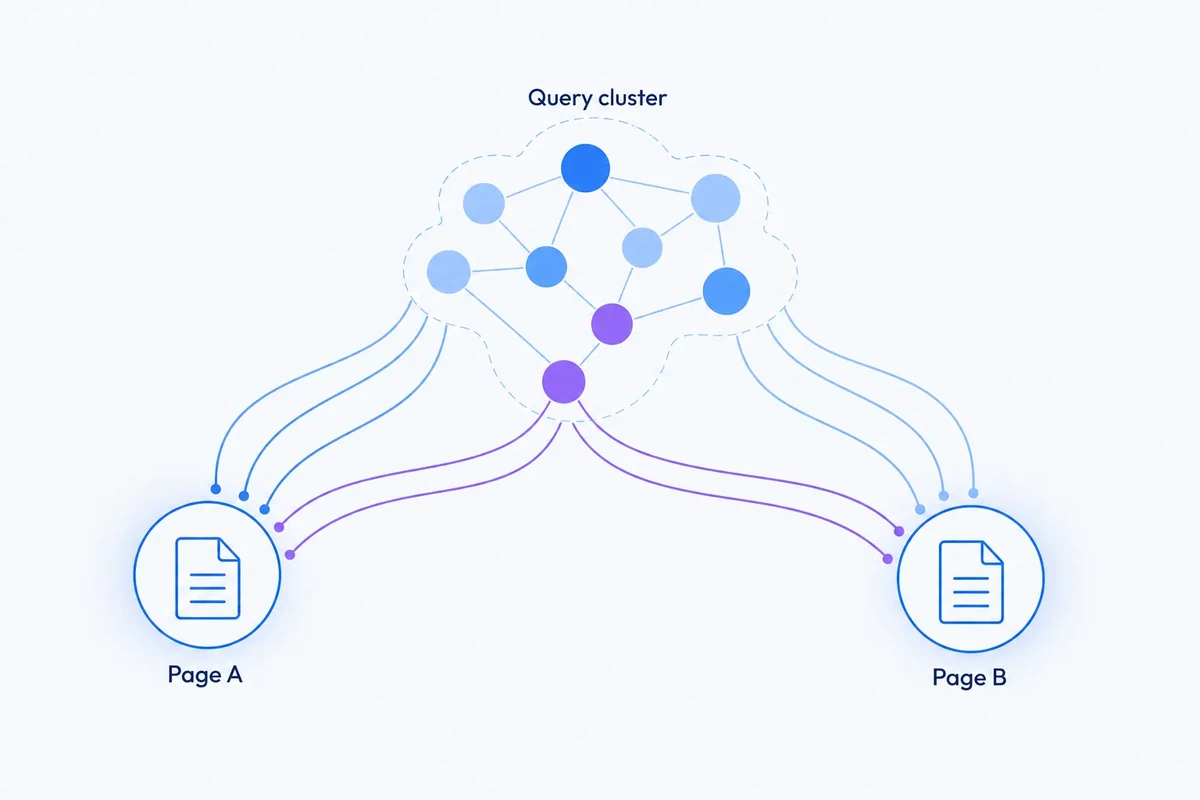
Canonical URLs and query ownership: using clusters to spot when the preferred page does not match the search task
Canonical tags consolidate duplicate or very similar URLs, but they do not solve unclear page strategy. Learn how ClusterIQ can compare canonical choices with keyword and page ownership.

Farky Rafiq
Founder of ClusterIQ
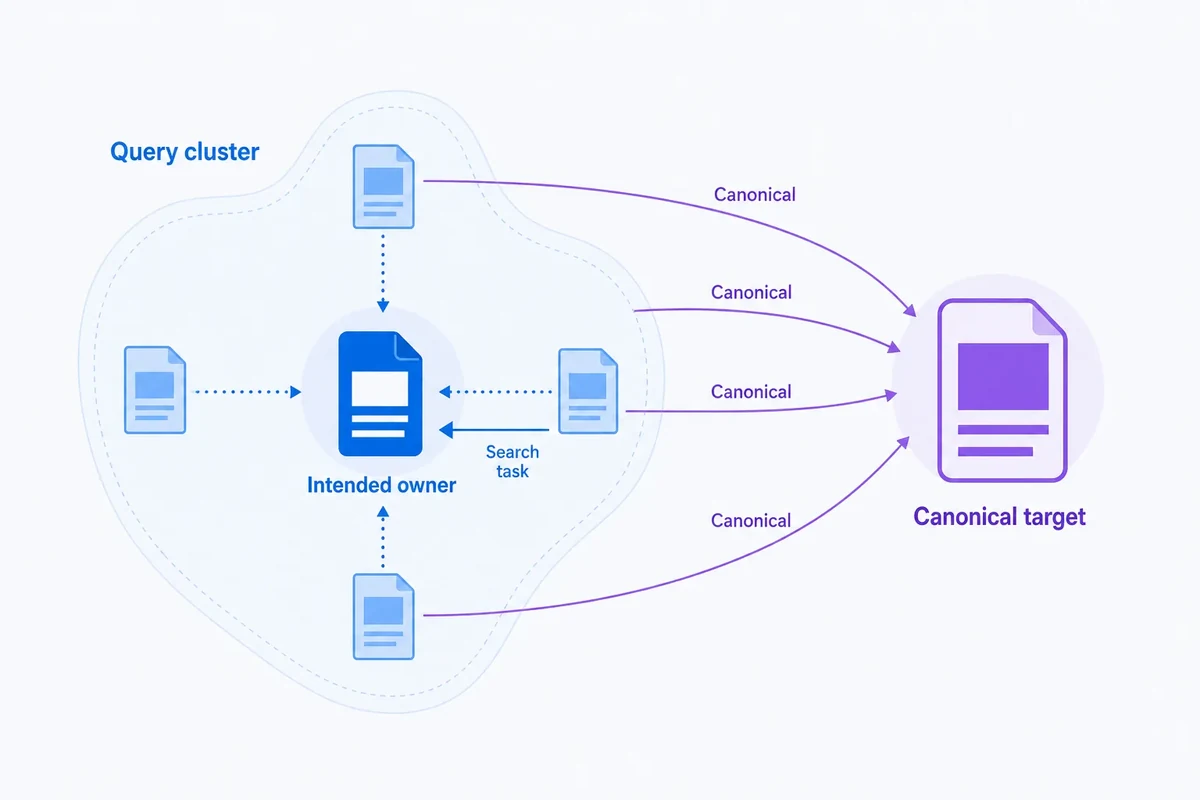
It is easy to conflate canonicalisation with keyword ownership because both tasks involve picking a preferred URL. However, they solve fundamentally different problems.
A canonical signal is a technical hint that helps search engines identify which URL should represent a group of duplicate or near-identical pages. Query ownership is a strategic decision about which specific page is the best destination for a particular search intent. ClusterIQ connects these two concepts, allowing you to spot instances where your technical settings and your intended search experience are working against each other.
Canonicalisation is primarily a duplication signal
Google recognizes several ways to signal a canonical preference, including 301 redirects, the rel="canonical" tag, and sitemap inclusion. Each carries a different weight. Crucially, the canonical tag is not a catch-all tool for deciding which of two distinct pages should rank for a keyword. It is designed to manage technical duplication, not to force Google to ignore a relevant, unique page in favour of another.
Query ownership is an information-architecture decision
When you look at a cluster of keywords from a tool like Ahrefs or Semrush, that group usually maps to a specific place in your architecture. A cluster might belong to a single category, a specific product, a long-form guide, or perhaps several legitimate page types. In some cases, you might find you have no adequate page at all. ClusterIQ uses semantic data, entities, and intent to model this ownership, helping you decide where a topic should live before you worry about the tags.
Worked example: filtered category duplicates
Imagine you have an ecommerce site where various parameter-heavy URLs show almost the same product set as the main category page. Setting a canonical to the main category is sensible here because the pages are near-duplicates and the main category is your intended indexed version.
However, if a specific combination of filters corresponds to a stable, high-demand search term with its own distinct inventory, canonicalising it away might be a mistake. You could be deleting a legitimate landing page from the index. This is why facet analysis should happen before you make final canonical decisions.
Canonical targets should fit the cluster
For your most important pages, ClusterIQ allows you to compare the source URL topic against the target URL topic. You can check for entity compatibility, page type consistency, and product-set overlap. If a canonical points to an unrelated or overly broad page, it deserves a manual review, even if the code itself is technically valid. A "valid" tag that points to the wrong topic is still a SEO failure.
Canonical signals can conflict
Technical conflicts are common. A page might declare one canonical URL in the HTML, while your internal links, redirects, or sitemaps point somewhere else entirely. While standard crawlers can flag these discrepancies, ClusterIQ adds necessary context by showing you which URL is actually supposed to own the topic based on your search strategy.
Do not use canonical tags to resolve true cannibalisation
If you have two different articles or landing pages competing for the same search task, a canonical tag is often a sticking plaster rather than a cure. In these cases, the better fix is usually consolidation, clearer content differentiation, or redirecting an outdated URL. A canonical is for duplicates; it should not be a shortcut to avoid making tough content decisions.
Search Console ownership can challenge the intended canonical
When Google Search Console shows that a different URL is consistently surfacing for your target queries instead of your preferred page, you need to investigate. Check the content relevance, internal linking structure, and page types. While the observed URL doesn't automatically override your planned architecture, the disagreement is a strong signal that Google views the "wrong" page as more helpful for that cluster.
Canonical clusters can expose template problems
If you find thousands of URLs within a specific topic family canonicalising to unexpected targets, you likely have a template or logic issue rather than a series of individual page errors. By grouping these technical findings by topic and page type, ClusterIQ makes the scale and source of the problem much easier to diagnose for your dev team.
Sitemaps should reinforce the preferred structure
Google’s advice is clear: only include canonical URLs in your sitemaps. If a non-canonical version appears in a sitemap while the preferred target is missing, your technical signals are inconsistent. ClusterIQ's sitemap coverage view helps surface these inconsistencies across your most valuable keyword clusters.
Canonical choice can affect reporting
When multiple URL variants represent a single logical page, your reporting needs to reflect that. You should normalise the data so that query performance isn't fragmented across several duplicate URLs. It is best practice to keep the observed ranking URL and the canonical URL as separate data points so your reporting remains auditable and transparent.
Use product-set overlap in ecommerce
For faceted navigation, looking at product-set overlap is incredibly useful. It tells you whether two URLs are genuine near-duplicates or if one represents a materially different collection of products. This data provides a practical layer of evidence that complements standard text and keyword clustering.
Migration QA should include canonicals
During a site migration, ensuring your new destination pages self-canonicalise correctly is vital. Old URLs should redirect to the new ones rather than hanging around and sending contradictory signals. You should always perform redirect validation with clusters alongside your canonical QA to ensure the transition is seamless.
Keep the layers separate in ClusterIQ
To maintain a clear view of your site health, the interface distinguishes between the intended target, the declared canonical, the observed ranking URL, the sitemap URL, and the redirect destination. When these layers disagree, you can see exactly where the breakdown is happening.
Practitioner principle: canonicalisation tells search engines which duplicate URL should represent content. It does not replace the decision about which page should exist for the user's task.
ClusterIQ Conclusion
Keyword clusters make canonical audits more meaningful because they add the "why" to the technical "what". By viewing these signals through the lens of query ownership, you can identify canonicals that point to weak destinations or spot cases where a deeper architectural problem is being masked by a technical tag.
Audit canonical families by cluster
Canonical issues are far easier to resolve when you review related URLs together. ClusterIQ groups variants by topic, showing the declared canonical, ranking URL, and sitemap status side by side. If variants point to multiple different targets, the problem is structural. This family-based view is particularly effective for managing complex ecommerce parameters and legacy URL patterns at scale.
Sources and further reading
Farky Rafiq
Founder of ClusterIQ
I've worked in digital marketing since 2005 and founded Liquid Silver in 2011. These articles are where I share the methods, experiments and practical SEO thinking behind ClusterIQ.
Put the idea into practice with your own keyword data
ClusterIQ helps turn raw SEO exports into clean, structured working datasets you can inspect, refine, report on and take into the next stage of your workflow.
Keep reading
Crawl logs and keyword clusters: prioritising crawl analysis by the topics that matter
Indexation QA by topic cluster: finding technical gaps that matter to search demand