Redirect validation with keyword clusters: checking whether old topics still have the right destination
A redirect can be technically valid and semantically wrong. Learn how keyword clusters can validate whether migrated or retired URLs point to destinations that preserve the original page's topic and task.

Farky Rafiq
Founder of ClusterIQ
ClusterIQ adds a semantic validation layer to your redirect maps. Instead of just checking if a link works, we compare what the old page actually owned with what the new destination is designed to serve. This ensures your hard-earned rankings actually move with the URL.
Technical validation is only the first layer
Standard SEO tools are great at the basics. For every redirect in your map, you naturally confirm that the status code is correct, it is a single-hop destination, the final URL returns a 200, it is indexable, and the canonical tag points where it should. These checks prove the redirect functions. They do not prove it is the right destination for your traffic.
Attach topic ownership to the old URL
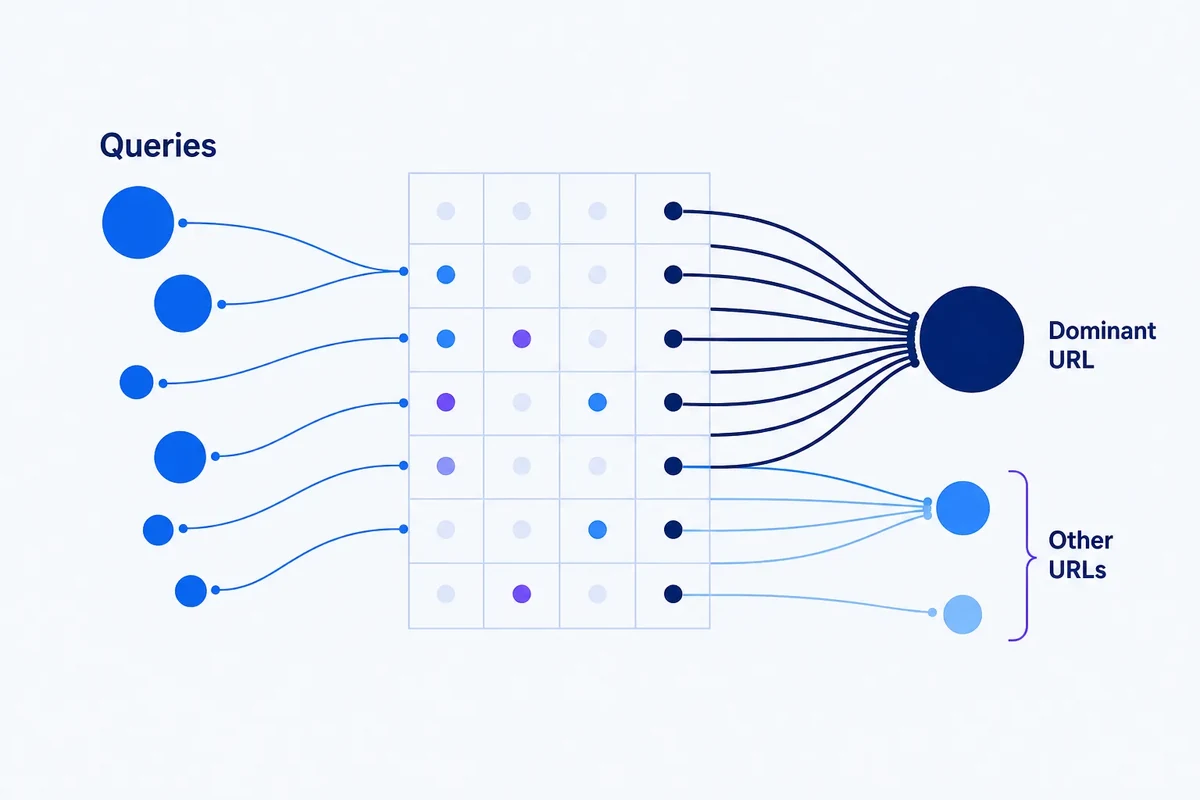
Before you start a migration or a content consolidation project, you need an evidence record of what the old URL was responsible for. You can do this by mapping the old page to its keyword clusters, Search Console queries, page type, and its role in your internal linking structure. By looking at a few thousand keywords from Ahrefs or Semrush, you can see exactly which topics that page was "hired" by Google to answer.
Compare the destination against that evidence
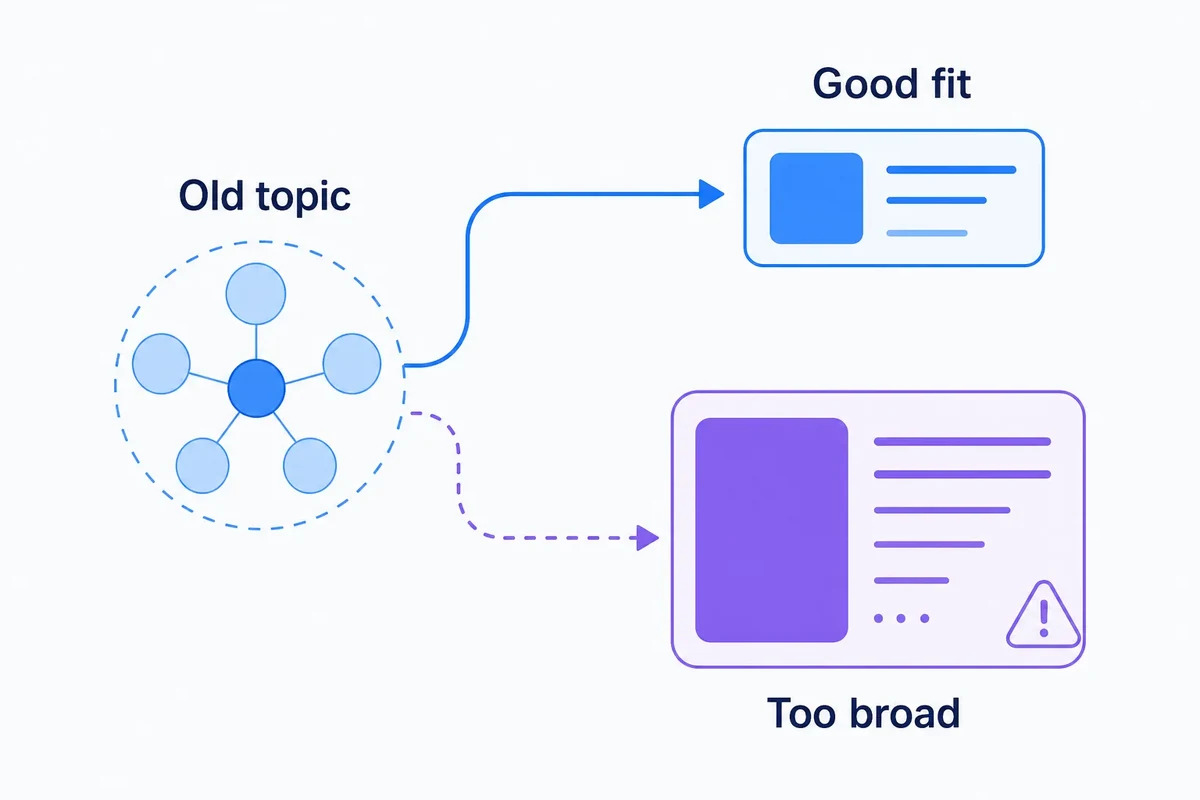
Once you have that baseline, ClusterIQ can score the proposed destination. We look at semantic fit, entity compatibility, and whether the page type matches. If an old page was a specific product and the new one is a broad category, the system flags it. You can then categorise destinations as high-confidence, review-required, or fundamentally incompatible.
Worked example: an over-broad redirect
Imagine an old URL targeting "800mm black shower screens". During a migration, this specific category is removed, so the redirect is pointed to the top-level "bathrooms" page. Technically, the redirect is fine. Commercially, it is a failure. The destination is far too broad for the user's specific intent. ClusterIQ might identify a closer "shower screens" category or suggest that the search volume justifies keeping a specific landing page alive.
Do not redirect everything to a parent by default
Using broad parent pages as a catch-all is a common migration shortcut, but it often leads to a loss in keyword rankings. If an equivalent page doesn't exist, you have better options than just the homepage. You might choose the closest relevant parent, create a new consolidated page that covers multiple retired topics, or even choose not to redirect if the content is truly obsolete. The right choice depends on the content's purpose, not just where it sits in the URL hierarchy.
Consolidation redirects need cluster overlap
When you merge two articles, the surviving page must be robust enough to cover the meaningful query clusters of both. Using cluster-based consolidation gives you the editorial evidence you need. Redirect validation then ensures that your technical implementation actually preserves that topical depth.
Redirect chains can obscure ownership
Complexity is the enemy of a clean migration. An old URL redirecting to a retired URL, which then points to a final page, makes it harder for search engines to understand topic lineage. You should always update your mapping to point directly to the final relevant destination and update your internal links to match.
Use high-value clusters as migration acceptance tests
For your most important topics, treat them as QA cases. Before you sign off, ensure the destination is approved, the redirect is valid, the page type is correct, and the internal link path is preserved. This turns ClusterIQ data into a checklist for your most valuable assets.
Validate at scale with embeddings, then review conflicts
When you are dealing with thousands of redirects from a large Search Console export, semantic similarity helps you spot poor mappings fast. However, a high similarity score can be deceptive if the pages serve different tasks. Always combine semantic data with page-type evidence before you auto-approve a bulk redirect list.
Post-launch data closes the loop
The work doesn't end at launch. You need to monitor whether your old query clusters start appearing against the new URLs in Search Console. Using ownership-change monitoring allows you to see if your topical authority transferred cleanly or if your traffic has fragmented across irrelevant pages.
Keep historical redirects tied to topic lineage
A professional migration record should include the old URL, its cluster IDs, the new URL, the date of the change, and the validation status. This prevents guesswork during future site updates and ensures you always know why a specific redirect exists.
Do not optimise only for redirect coverage percentage
A migration can have 99.9% redirect coverage and still be a failure if the topics are lost. Don't just report on technical completion; report on topic preservation. ClusterIQ is designed specifically to measure that second, more important metric.
Page type can be a hard warning
If a commercial category page is redirected to an informational blog post, it might be topically related, but it is operationally wrong for your conversion goals. Your validation system should flag these mismatches even if the semantic similarity score is high.
Prioritise by consequence
You don't need to manually check every single URL. Focus your energy on high-traffic pages, revenue-driving clusters, and any many-to-one redirects where several pages are being collapsed into one. Long-tail redirects with low risk can be handled by automated semantic checks.
Practitioner principle: a redirect should preserve the user's destination, not merely move the browser to a live URL.
ClusterIQ Conclusion
Keyword clusters make redirect validation more meaningful because they protect the specific topics an old page used to own. By using ClusterIQ to compare your redirect map against semantic evidence, you can flag weak mappings before they go live and monitor your topical authority after launch. This adds a necessary layer of quality assurance to the technical checks every migration requires.
Review redirect groups, not only individual rows
Errors often become visible only when you group redirects by topic. If a whole cluster of product pages is being pointed to one generic parent page, the loss of specificity becomes obvious. ClusterIQ helps you see these patterns, highlighting where semantic coverage drops sharply. This allows your team to inspect the structural impact of a migration rather than just grinding through a spreadsheet row by row. For your most important clusters, saving the approved mapping before launch ensures you can accurately track whether your query ownership has successfully moved to the new destination.
Sources and further reading
Farky Rafiq
Founder of ClusterIQ
I've worked in digital marketing since 2005 and founded Liquid Silver in 2011. These articles are where I share the methods, experiments and practical SEO thinking behind ClusterIQ.
Put the idea into practice with your own keyword data
ClusterIQ helps turn raw SEO exports into clean, structured working datasets you can inspect, refine, report on and take into the next stage of your workflow.
Keep reading
Using keyword clusters in an SEO migration: protecting topic ownership before URLs move
Keyword cannibalisation: how clustering helps find overlap without inventing a problem