When to consolidate two articles: using cluster evidence instead of title similarity
Two articles can have similar titles and different jobs, or different titles and the same job. Learn how keyword clusters, page type and query ownership support safer consolidation decisions.

Farky Rafiq
Founder of ClusterIQ
We have all been there: you are auditing a site with hundreds of blog posts and you spot two titles that look almost identical. The immediate instinct is to reach for the 301 redirect. However, making consolidation decisions based solely on surface-level wording is a risky shortcut.
Two articles can share a similar title but serve entirely different user needs. Conversely, two pages with wildly different names might be fighting tooth and nail for the exact same set of search queries. ClusterIQ helps you move past guesswork by basing consolidation on actual demand, page ownership, and content purpose.
Start with query-cluster overlap
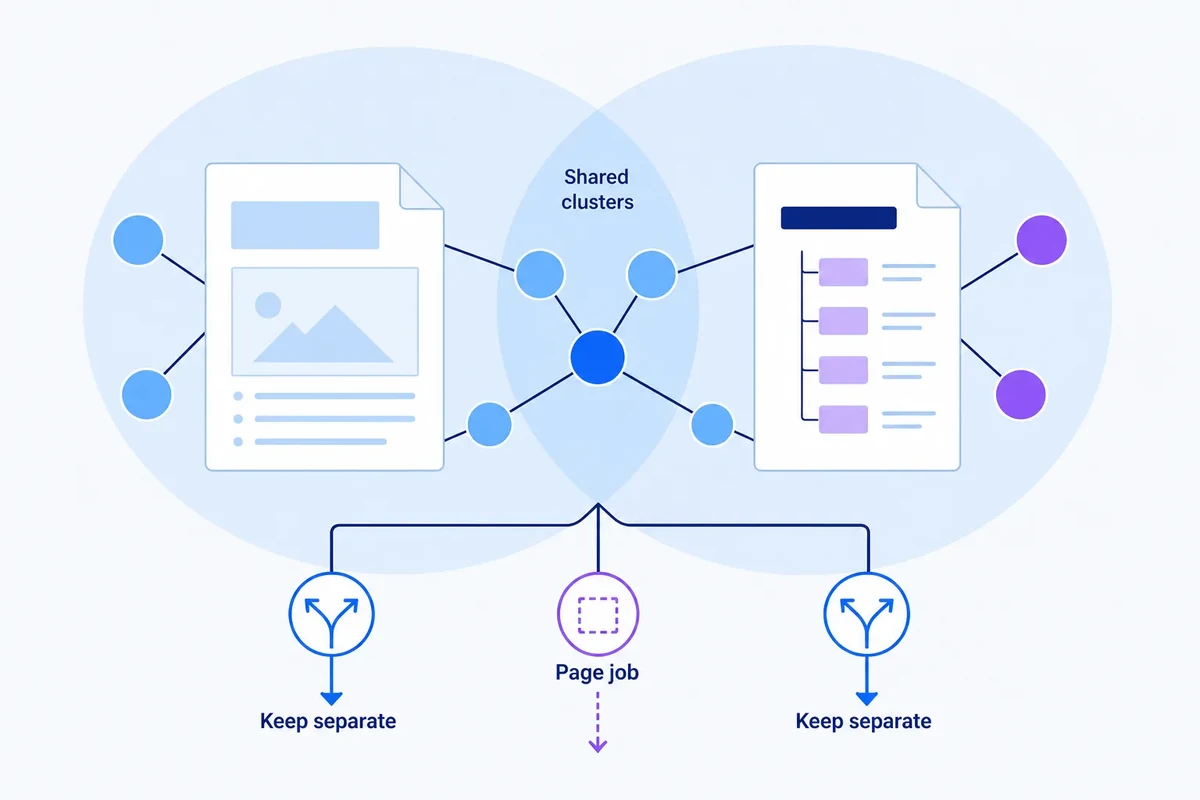
Before merging anything, look at the keyword clusters each page actually attracts. If you export a few thousand rows from Ahrefs or Search Console, you can see where these pages overlap. High overlap is a signal to investigate, but it is not an automatic instruction to merge.
Jaccard similarity is a brilliant way to quantify this. It gives you a score for how much the query sets overlap while letting you see the specific terms they share. If the overlap is 80 percent, you likely have a duplication problem. If it is 10 percent, they are probably distinct enough to coexist.
Compare page jobs
Ask yourself: what is the user trying to achieve on this page? We call this the page job. For example:
- What is keyword clustering? (An introductory explainer)
- How to cluster keywords in Python (A technical implementation guide)
The subject matter is identical, but the jobs are worlds apart. One user wants a definition; the other wants code. Merging these would likely frustrate both audiences. If the jobs differ, keep the pages separate.
Look at Search Console ownership
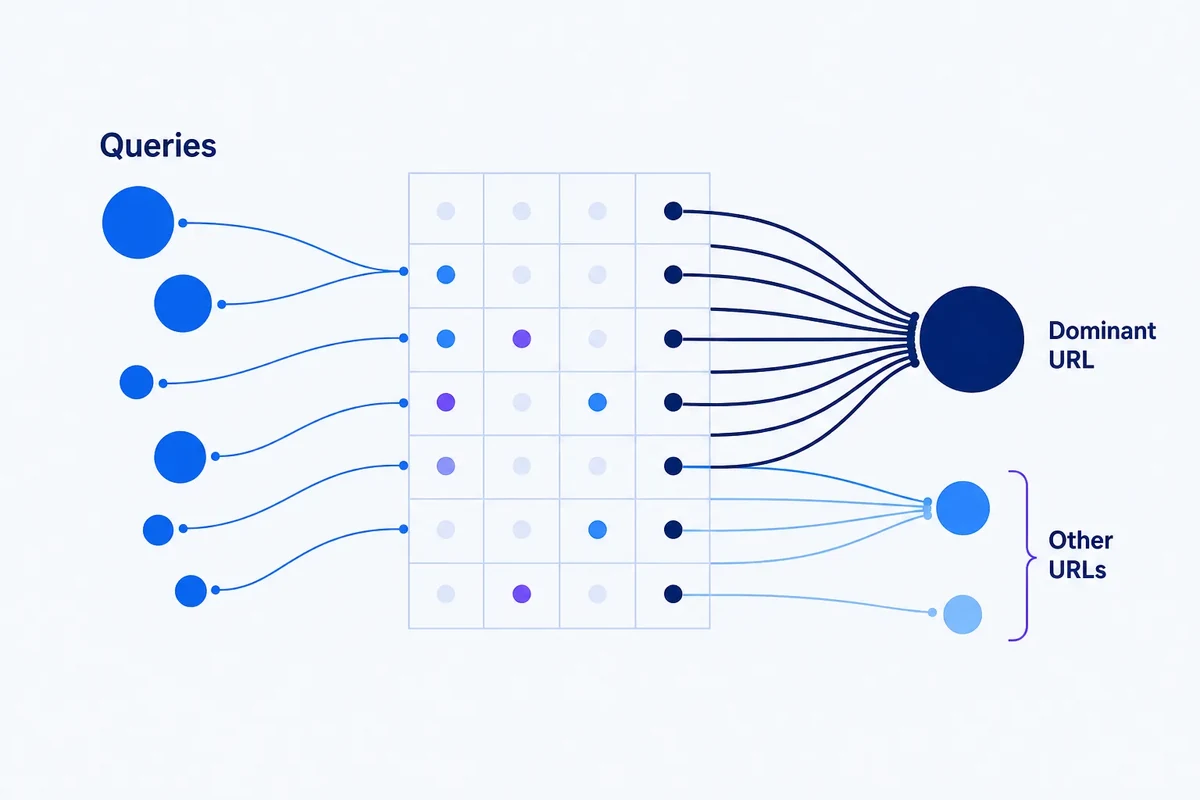
Check your performance data to see if the pages are swapping places in the SERPs. If Google cannot decide which URL to rank for a specific cluster and they keep flip-flopping, the case for consolidation is strong. However, if each page consistently owns a distinct sub-topic, keeping both is usually healthier for your overall visibility.
ClusterIQ uses ownership-change analysis to highlight these conflicts over time, showing you exactly where the search engine is confused.
Compare page type and depth
Consider the intent and the audience level. You might have a high-level overview for beginners and a deep-dive methodology piece for experts. Even if they share a few head terms, the depth of content justifies the separation. Make sure you document these differences in your content plan so future writers do not accidentally drift back into overlapping territory.
Worked example: three semantic-similarity articles
Imagine a site has three pieces of content:
- What is semantic similarity?
- Cosine similarity for keyword clustering
- When semantic similarity helps keyword clustering
At first glance, these seem like candidates for a merge. But look closer: the first defines the concept, the second explains a specific mathematical metric, and the third evaluates practical use cases. These can live happily in the same topic family as long as their query clusters and editorial goals remain distinct.
When consolidation becomes persuasive
You should lean towards merging when you see several of these signals together:
- Very high query-cluster overlap
- Identical page types and user tasks
- The same target audience
- Nearly identical section structures
- Unstable query ownership in Search Console
- One page adds no unique value or data
- Internal links use the same anchor text for both pages
No single signal should trigger a redirect, but a combination of three or four is a smoking gun.
Choose the surviving URL deliberately
When you decide to merge, do not just pick the oldest URL or the one with the most traffic. Look at the full picture: link equity, current query ownership, URL slugs, and how well the page fits into your internal linking structure. Sometimes the lower-traffic page has a better URL structure for the long term.
Merge the useful material, not the word count
Consolidation is not just about sticking two articles together to make one long one. It is about refinement. Take the unique, valuable sections from the retiring page and integrate them into the survivor. Delete the fluff, remove duplicate introductions, and ensure the final result has one clear, cohesive purpose.
Redirect and update internal links
Once the new version is live, implement a permanent 301 redirect. Crucially, do not just rely on the redirect: go back into your CMS and update internal links in your templates and other articles to point directly to the new survivor. This prevents redirect chains and keeps your site architecture clean.
Measure the cluster after consolidation
Success is not just having one fewer URL. You need to track the results. Monitor whether the surviving URL now owns a larger share of the cluster, check if total impressions and clicks have stayed stable or grown, and ensure you have not opened up a gap that a competitor could fill.
When not to consolidate
Keep both pages if the user tasks are different, the queries separate cleanly into distinct groups, or one page serves a very specific niche audience. If you decide to keep both, take the time to improve their titles and internal linking so that both users and search engines can see the distinction clearly.
Use ClusterIQ as the evidence layer
ClusterIQ simplifies this by putting all the evidence in one view. You can see shared versus unique clusters, ownership history, and semantic similarity side by side. This allows you to make a professional, data-backed decision rather than relying on a gut feeling about a page title.
Practitioner principle: consolidate duplicate page jobs, not pages that merely share a subject.
ClusterIQ Conclusion
Content consolidation is far safer when it is driven by query evidence rather than title similarity. By using ClusterIQ to see where articles genuinely compete, you can build a leaner, more authoritative site without accidentally deleting valuable content that serves a unique purpose.
Add a pre-merge evidence check
Before you hit the redirect button, do a final side-by-side check. Look at the unique query groups for each page. If you delete one, will that specific information be lost? Sometimes a poor-performing article contains a brilliant specialist section. In that case, move that section to the surviving page before you retire the old URL. This ensures the survivor inherits the full utility of the retired page, not just its link juice.
Sources and further reading
Farky Rafiq
Founder of ClusterIQ
I've worked in digital marketing since 2005 and founded Liquid Silver in 2011. These articles are where I share the methods, experiments and practical SEO thinking behind ClusterIQ.
Put the idea into practice with your own keyword data
ClusterIQ helps turn raw SEO exports into clean, structured working datasets you can inspect, refine, report on and take into the next stage of your workflow.
Keep reading
Content pruning with keyword clusters: deciding what to keep, improve, merge or remove
Keyword cannibalisation: how clustering helps find overlap without inventing a problem