Content pruning with keyword clusters: deciding what to keep, improve, merge or remove
Content pruning should not start with traffic thresholds alone. Learn how keyword clusters, page ownership and topical coverage can support safer keep, improve, merge and remove decisions.

Farky Rafiq
Founder of ClusterIQ

Most content pruning exercises start with a spreadsheet sorted by traffic. It feels efficient to draw a line and mark everything below it for deletion. However, this blunt approach is risky. A page with low traffic might still own a strategically vital niche, support your internal linking structure, or contain unique information that should be merged rather than discarded. To prune effectively, we need to look beyond raw clicks and understand each page's role within its topic system.
Pruning has more than two outcomes
When we evaluate content, we should choose from a broader range of actions than just keep or delete. A practical framework for your inventory includes:
- Keep: The page serves a distinct, useful purpose and performs well.
- Improve: You have the right page for the topic, but the coverage is thin or the performance is lagging.
- Merge: Valuable information is fragmented across several overlapping pages that should be one.
- Redirect: An old or redundant URL should consolidate its authority into a clear successor.
- Remove: The content has no useful role, no SEO value, and no need for a replacement.
Deletion is only the final option when no other value remains.
Map every page to clusters before pruning
Before making a decision on a specific URL, you need to see how it fits into your wider keyword landscape. Using data from Ahrefs, Semrush, or Search Console, identify:
- The specific query clusters the page currently owns.
- The broader topic clusters its content covers.
- Any nearby pages that overlap with these keywords.
- Internal links flowing in and out of the page.
- The specific business purpose, such as lead generation or support.
- Long-term performance trends.
This context reveals whether a quiet page is truly redundant or simply an underperformer that needs a refresh.
Low traffic does not equal low value
In B2B or specialist sectors, a page might only get fifty visits a year and still be commercially essential. A technical support article might solve a niche problem that prevents a high-value customer from churning. ClusterIQ treats traffic as just one signal, allowing you to preserve the page's role and business value even when the numbers look small.
Worked example: three overlapping guides
Imagine your site has three separate articles: "What is keyword clustering?", "Keyword clustering explained", and "Beginner's guide to keyword clustering". When you look at your keyword data, you will likely find all three are competing for the same primary cluster and serving the same intent.
Instead of deleting two, the better move is usually to identify which URL has the strongest links and rankings. You then consolidate the best sections from the other two into that primary guide and redirect the old URLs. This is where cluster-based cannibalisation analysis becomes a practical tool for site cleanup.
Clusters can protect niche content from deletion
Sometimes a low-traffic page is the only piece of content you have for a specific, stable niche. Deleting it would create a genuine content gap in your topical authority, even if the page currently attracts few clicks. ClusterIQ can flag these instances as "low performance, unique topic ownership," which should trigger a content improvement review rather than a removal.
Use page ownership evidence
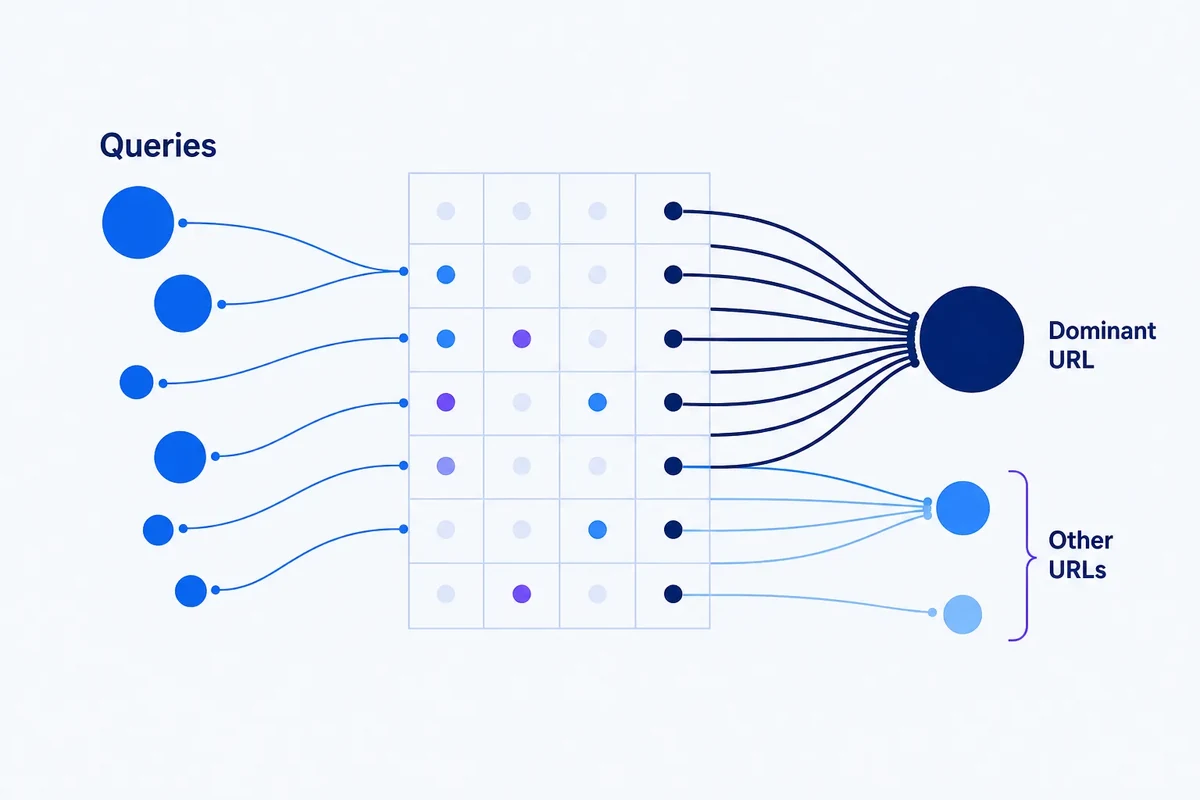
If a page has lost its keyword ownership to a newer or stronger URL, its original role may have become redundant. You should track whether another URL now owns the same queries, if the pages share the same intent, and if the older page still contributes any conversions or referral traffic before you let it go.
Pruning can improve topical clarity
Having too many near-duplicate pages makes your site architecture difficult for users to navigate and dilutes your internal link signals. Consolidation creates clearer ownership for your main pages. The goal here is not just to have fewer URLs, but to ensure every page has a distinct, identifiable job to do.
Internal links need a migration plan
Before you remove or redirect a page, you must identify the internal links pointing to it. You should update these contextual links to point directly to the new destination. Relying on permanent redirect chains can slow down users and search crawlers. ClusterIQ's internal-link graph helps you map these relationships so nothing breaks during the transition.
Check external-link and business value too
A page might have poor search performance but still hold valuable backlinks or historical authority. ClusterIQ provides the topical layer of data, but you should combine this with your backlink tools and analytics to ensure you aren't accidentally deleting a page that provides significant "link juice" to the rest of the site.
Use a cluster-aware pruning table
When preparing your plan, include these columns in your spreadsheet:
- URL and page type.
- Primary and secondary keyword clusters.
- Unique topic ownership status.
- Overlap percentage with the nearest page.
- Performance metrics and internal link counts.
- Recommended action and the approved destination URL.
Do not prune from one time period
Seasonal content or pages you have recently updated can look weak if you only look at the last thirty days. Always compare year-on-year data. Seasonal cluster evidence ensures that a temporary dip in demand doesn't lead to a permanent loss of valuable content.
Measure the result after pruning
Once the changes are live, monitor your clusters to see if the strategy worked. Did the keyword ownership consolidate into the target pages? Did the impressions transfer successfully? A successful pruning project is measured by the health and growth of the surviving topic structure, not by how many pages you managed to delete.
Keep the decision auditable
Document why each page was pruned and where the content was moved. If a topic becomes a priority again in a year, your team will understand the historical context rather than having to guess why the content disappeared.
Practitioner principle: prune redundant page roles, not merely low traffic.
ClusterIQ Conclusion
Keyword clusters make content pruning safer by showing exactly what each page contributes to your topical authority. By using ClusterIQ to distinguish between weak unique content and genuine duplication, you can make informed decisions to keep, improve, merge, or remove pages while ensuring your site remains helpful and authoritative.
Sources and further reading
Farky Rafiq
Founder of ClusterIQ
I've worked in digital marketing since 2005 and founded Liquid Silver in 2011. These articles are where I share the methods, experiments and practical SEO thinking behind ClusterIQ.
Put the idea into practice with your own keyword data
ClusterIQ helps turn raw SEO exports into clean, structured working datasets you can inspect, refine, report on and take into the next stage of your workflow.
Keep reading
When to consolidate two articles: using cluster evidence instead of title similarity
Keyword cannibalisation: how clustering helps find overlap without inventing a problem