Detecting query-page ownership changes with keyword clusters
A cluster can keep the same demand while the ranking URL changes underneath it. Learn how to track ownership shifts, URL switching and emerging cannibalisation over time.

Farky Rafiq
Founder of ClusterIQ
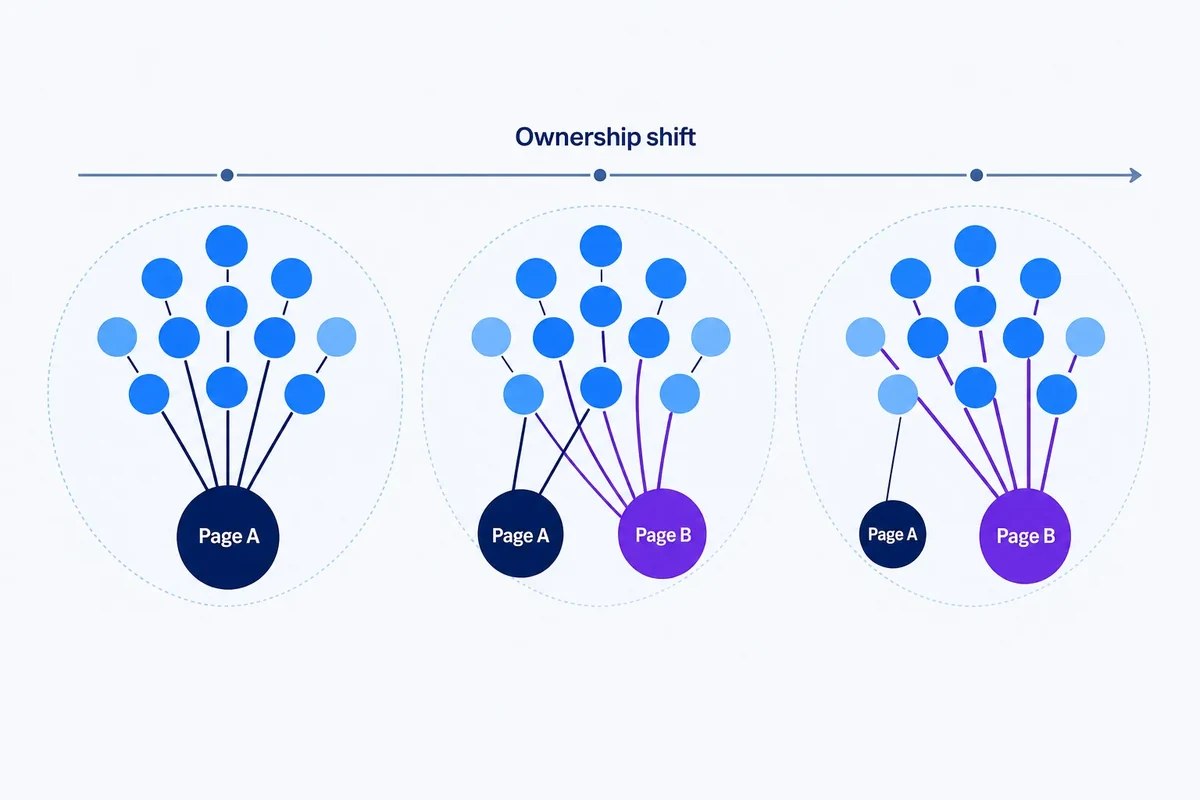
Your traffic report looks steady, but is the right page still appearing for each topic? A keyword cluster that belonged to one URL last quarter may now be split between pages or appearing through an unexpected URL.
Tracking ownership by cluster helps you spot these changes without checking hundreds of keywords individually.
Define page ownership at cluster level
For each cluster, calculate how its Search Console impressions or clicks are shared across URLs. With, say, 1,500 queries, this turns a long export into a manageable topic-to-page report.
Useful fields include:
- dominant URL;
- dominant URL share;
- secondary URL share;
- number of materially visible URLs;
- query count by URL.
This builds on ClusterIQ's query-page matrix.
Ownership is not always binary
More than one page can legitimately serve a cluster. An ecommerce category and a buying guide may cover the same broad topic while helping people complete different tasks.
Check page types and search intent before calling every split “cannibalisation”.
Track the dominant URL over time
Keep a historical table with:
- month;
- cluster ID;
- dominant URL;
- share of impressions;
- share of clicks;
- secondary URLs.
Repeated changes in the leading URL tell you more than one temporary switch.
Worked example: stable demand, unstable owner
Suppose a cluster receives roughly 50,000 impressions each month. In April, Page A receives 82% of impressions. In May, its share drops to 55%, while Page B reaches 40%. By June, Page B leads with 68%.
Demand stayed similar, but the page serving it changed materially. ClusterIQ can flag that ownership change even when site-wide traffic barely moves.
Possible explanations for a shift
Ownership changes can follow:
- content updates;
- internal-link changes;
- new pages;
- canonical changes;
- redirects;
- template redesigns;
- product availability;
- search-result changes.
The cluster signal tells you when to investigate. It does not automatically tell you what caused the shift.
Use page type to distinguish healthy redistribution
If informational queries move to a new guide while transactional queries stay with the category page, the split may better serve those different tasks.
If the same commercial queries alternate between near-duplicate landing pages, there is more reason for concern. Use ClusterIQ's cannibalisation framework to assess the pattern.
Migration monitoring is a strong use case
After a site move, topics should transfer from old URLs to their intended destinations. Cluster-level reporting can show:
- topic retained by the correct destination;
- topic split unexpectedly;
- topic moved to the wrong template;
- topic losing visibility;
- old URL still participating.
This goes beyond checking that redirects return 301s: it checks whether the intended pages actually inherit topic visibility.
New content can steal or clarify ownership
A new article may pick up queries previously served by an older page. That can be healthy when it serves a more specific task, or harmful when both pages compete for the same intent.
ClusterIQ can compare ownership before and after publication to show the effect.
Use thresholds for material change
A one-percentage-point shift should not trigger an alert every time. A useful rule considers:
- absolute change in dominant share;
- how long the change lasts;
- the cluster's business importance;
- a new URL entering the leading ownership group;
- changes in clicks or impressions.
Set thresholds around the likely consequence, rather than applying one universal percentage.
Ownership confidence should be visible
One page receiving 95% of impressions has clearer ownership than a 45/40/15 split. ClusterIQ can describe ownership as:
- clear owner;
- shared but explainable;
- fragmented;
- unstable;
- insufficient data.
Low-data clusters need caution
When a cluster has only a handful of impressions, small numbers can produce dramatic-looking ownership changes. Require a minimum amount of data or use longer reporting windows before treating movement as meaningful.
Combine structural and performance change
A cluster's topic meaning and URL ownership can change together. Cluster drift identifies changes in topic structure; ownership monitoring shows changes in how your site serves that structure.
Together, they give you a stronger historical picture than either view alone.
Make the output actionable
An alert should explain what needs reviewing:
This cluster's dominant URL changed from A to B over two periods. Both pages use the same commercial template and share 70% of the cluster's high-value queries. Review ownership.
That gives a marketer a clearer next step than “ranking volatility detected”.
Practitioner principle: track the topic and its owner separately. Demand can stay stable while the page serving it changes materially.
ClusterIQ Conclusion
Keyword clusters provide a stable unit for monitoring page ownership over time. ClusterIQ can use Search Console query-page data to detect URL switching, fragmentation and healthy task separation that individual keyword tracking misses.
That makes clustering useful after implementation, not just during research: it helps you check whether your page decisions are working.
Sources and further reading
Farky Rafiq
Founder of ClusterIQ
I've worked in digital marketing since 2005 and founded Liquid Silver in 2011. These articles are where I share the methods, experiments and practical SEO thinking behind ClusterIQ.
Put the idea into practice with your own keyword data
ClusterIQ helps turn raw SEO exports into clean, structured working datasets you can inspect, refine, report on and take into the next stage of your workflow.
Keep reading
A confidence framework for mapping keyword clusters to URLs
What Search Console aggregation means for keyword cluster analysis
