Crawl logs and keyword clusters: prioritising crawl analysis by the topics that matter
Server logs show what search bots actually request. Keyword clusters show which topics matter to the business. Learn how ClusterIQ can connect the two for more useful crawl analysis.

Farky Rafiq
Founder of ClusterIQ
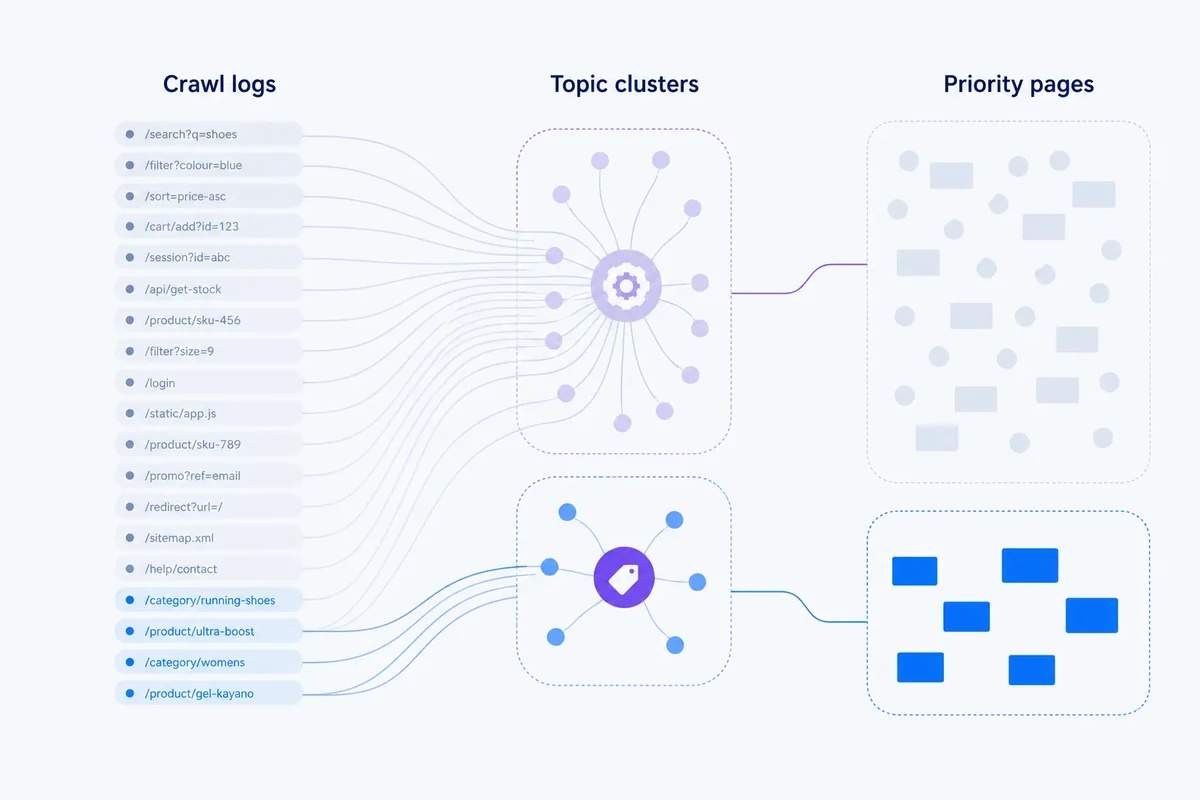
Server logs provide a definitive record of what search engine crawlers actually requested from your server. On the other hand, keyword clusters reveal the specific topics your site is trying to dominate. By merging these two datasets, ClusterIQ allows you to move beyond counting raw URL hits and address a more strategic question: is Googlebot spending its time on the pages and topics that actually drive your business?
What log files add
Server access logs offer a level of precision that simulated crawls cannot match. They reveal exactly how bots behave in the wild, including:
- The specific URL requested;
- The precise timestamp of the visit;
- The user agent (identifying which bot is visiting);
- HTTP status codes (200s, 404s, 500s);
- Response sizes;
- Crawl frequency over time;
- Redirect chains and error requests.
This data represents observed reality rather than an estimation of how a bot might navigate your site.
Map URLs to topic clusters
The real power comes from context. ClusterIQ can associate every significant URL with its:
- Primary topic cluster;
- Page type (e.g., product, blog, category);
- Business priority level;
- Indexability status;
- Canonical state;
- Search Console ownership.
Once this mapping is in place, you can summarise log metrics at the cluster level, making technical data much easier to digest for stakeholders.
Worked example: high-value category, low crawl frequency
Imagine an e-commerce site where a strategically vital cluster contains 60 high-margin product and category pages. When you look at the logs, you might find that these important pages are rarely visited. Meanwhile, thousands of low-value URLs with tracking parameters are being crawled repeatedly.
Without clustering, the report says "Googlebot crawled 2 million URLs." With clustering, the insight becomes actionable: your highest-value topics are being ignored in favour of technical noise. This makes it far easier to justify technical fixes to developers or clients.
Crawl frequency is not a ranking metric
It is important to remember that a high crawl rate does not guarantee better rankings. You should use log data to understand discovery, resource allocation, and technical health. ClusterIQ adds business context to these logs so you can ensure your "crawl budget" is spent on the right things, rather than treating crawl volume as an end goal in itself.
Find crawl waste by topic and pattern
Crawl waste often hides in plain sight. Common culprits include:
- Faceted navigation URLs;
- Internal search result pages;
- Marketing tracking parameters;
- Unnecessary redirect chains;
- Persistent 404 errors;
- Duplicate URL paths;
- Infinite spaces like calendars or paginated archives.
If these URLs sit outside your meaningful topic clusters, the case for blocking them via robots.txt or improving your internal linking becomes much stronger.
Technical incidents can be measured structurally
When a deployment goes wrong, a routing error or canonical mishap can generate millions of junk URLs. Log analysis shows the scale of the surge, but ClusterIQ shows the impact. It can tell you if your core clusters lost crawl attention or if internal link equity became diluted during the incident. This provides a clearer picture of the potential SEO damage than a simple count of server requests.
Use page type as another dimension
Analysing crawl behaviour by page type often reveals hidden issues. You might compare:
- Category pages;
- Individual products;
- Editorial articles;
- Faceted filters;
- Redirects;
- Non-indexable utility pages.
A site-wide average for crawl frequency can easily mask the fact that an entire category of products is effectively invisible to search engines.
Clusters can help prioritise 404s
Not all 404 errors are created equal. A broken URL that used to be a cornerstone of an important topic, or one that still receives frequent crawler hits, is a priority. An obsolete URL with no backlinks or historical demand is not. ClusterIQ allows you to attach topic history to technical errors, ensuring you fix the most damaging breaks first.
Compare internal links with crawl activity
If a page is theoretically central to a topic but receives very little crawl activity, it is time to look at your site architecture. Internal-link analysis from topic graphs can help you identify where the link equity is failing to reach your important pages, allowing you to build better contextual paths.
Sitemap and log evidence complement each other
A URL might be in your sitemap but rarely crawled, while another might be missing from the sitemap yet crawled constantly via internal links. Sitemap coverage by cluster and log data provide two different perspectives on your site's health; using them together gives you the full picture.
Use crawl trends over time
Monitoring trends allows you to spot trouble early. Keep an eye on:
- Requests per cluster;
- Requests per page type;
- The percentage of crawl spent on non-indexable URLs;
- Spikes in error or redirect requests.
Sudden shifts in these metrics often signal a deployment issue before you even see a drop in rankings or traffic.
Be careful with bot identification
It is easy for malicious bots to spoof their identity by using a Googlebot user-agent string. For accurate analysis, you should ideally use cleaned logs where IPs have been validated. ClusterIQ is designed to work with these refined datasets to ensure your decisions are based on genuine search engine activity.
Do not optimise crawl in isolation
For smaller sites with a few hundred pages, crawl budget is rarely a bottleneck. Technical changes should always aim to solve real problems like duplication or discovery issues. By keeping the topic layer at the forefront, you ensure that your technical SEO work remains tied to meaningful business outcomes.
Where ClusterIQ adds value
While standard tools tell you which URLs are being hit, ClusterIQ adds the "why" and the "so what." It identifies:
- The topic each URL serves;
- The commercial importance of that topic;
- Whether the site's ownership of that topic is clear;
- Whether the URL is correctly configured for indexing.
Practitioner principle: crawl logs tell you what bots request. Topic clusters help you judge whether that activity is aligned with the site's intended search architecture.
ClusterIQ Conclusion
Integrating crawl logs with keyword clusters transforms technical SEO from a list of errors into a strategic roadmap. It allows you to see exactly where Google is spending its energy and ensures that your most important content is getting the attention it deserves. By identifying waste and prioritising high-value clusters, you can make your site more efficient and easier for search engines to understand.
Connect crawl anomalies to site changes
Crawl patterns rarely change without a reason. They often shift following updates to templates, URL routing, or canonical tags. By tracking implementation dates alongside cluster-level crawl metrics, you can quickly see if a new feature has caused a spike in parameter crawling or a drop in category visits. On large-scale sites, this structural view helps you catch systemic problems before they impact your bottom line.
Sources and further reading
Farky Rafiq
Founder of ClusterIQ
I've worked in digital marketing since 2005 and founded Liquid Silver in 2011. These articles are where I share the methods, experiments and practical SEO thinking behind ClusterIQ.
Put the idea into practice with your own keyword data
ClusterIQ helps turn raw SEO exports into clean, structured working datasets you can inspect, refine, report on and take into the next stage of your workflow.
Keep reading
Indexation QA by topic cluster: finding technical gaps that matter to search demand