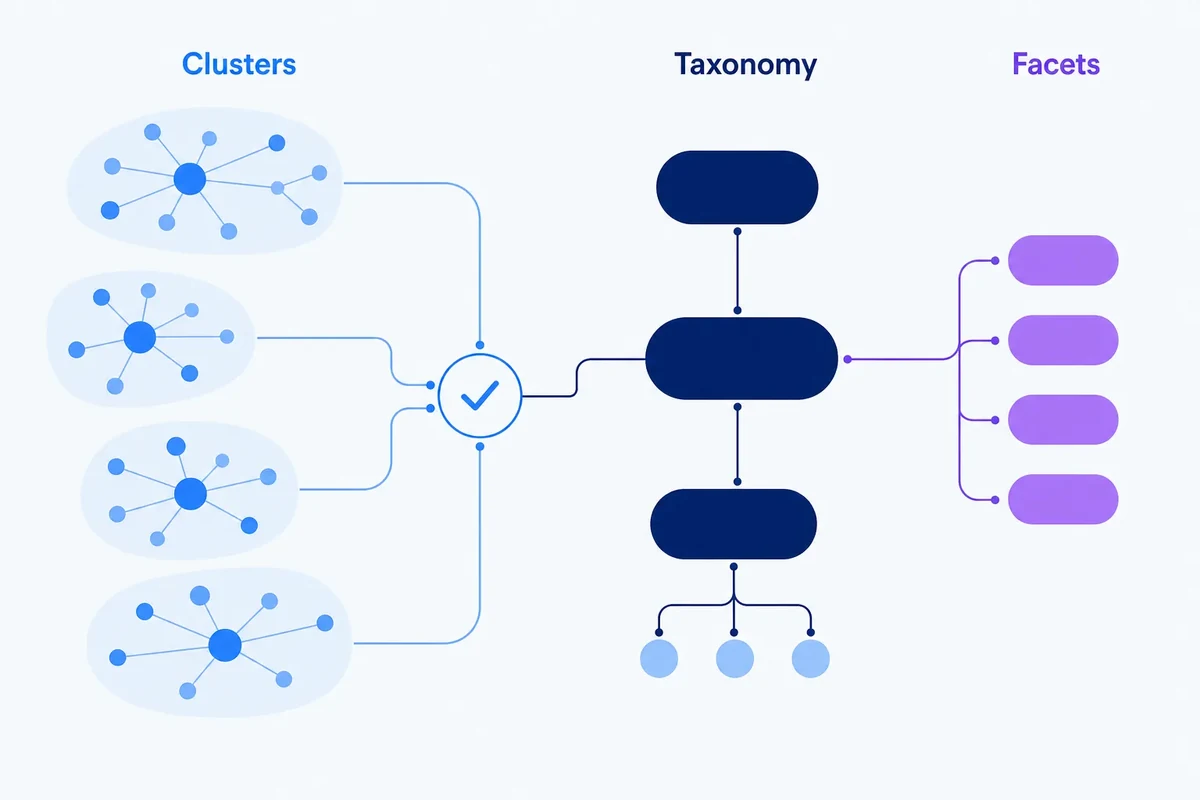
Naming SEO categories from keyword clusters without turning navigation into keyword stuffing
Search data can reveal the language people use, but category names still need to be clear, concise and durable. Learn how ClusterIQ separates demand evidence from navigation labels.

Farky Rafiq
Founder of ClusterIQ
You have grouped 1,500 keywords from Ahrefs, Semrush or Search Console and now need category names for a content plan or navigation update. Each cluster contains several ways to describe the same thing. Which phrase belongs in the menu?
The highest-volume keyword is a starting point, not an automatic winner. It may be awkward, too specific or unlike the language customers use when browsing. ClusterIQ can use search language to inform labels without turning navigation into a list of target keywords.
Start with what the category label needs to do
A useful label helps someone understand their options quickly. It should be:
- understandable to users;
- consistent with neighbouring categories;
- broad enough for the products or content it covers;
- specific enough to distinguish the page;
- durable as demand changes.
Search demand contributes evidence, but it cannot settle all these questions. A popular phrase might be informal, ambiguous, seasonal, brand-specific or simply too long for navigation. ClusterIQ can show the dominant user language while keeping the approved navigation term separate.
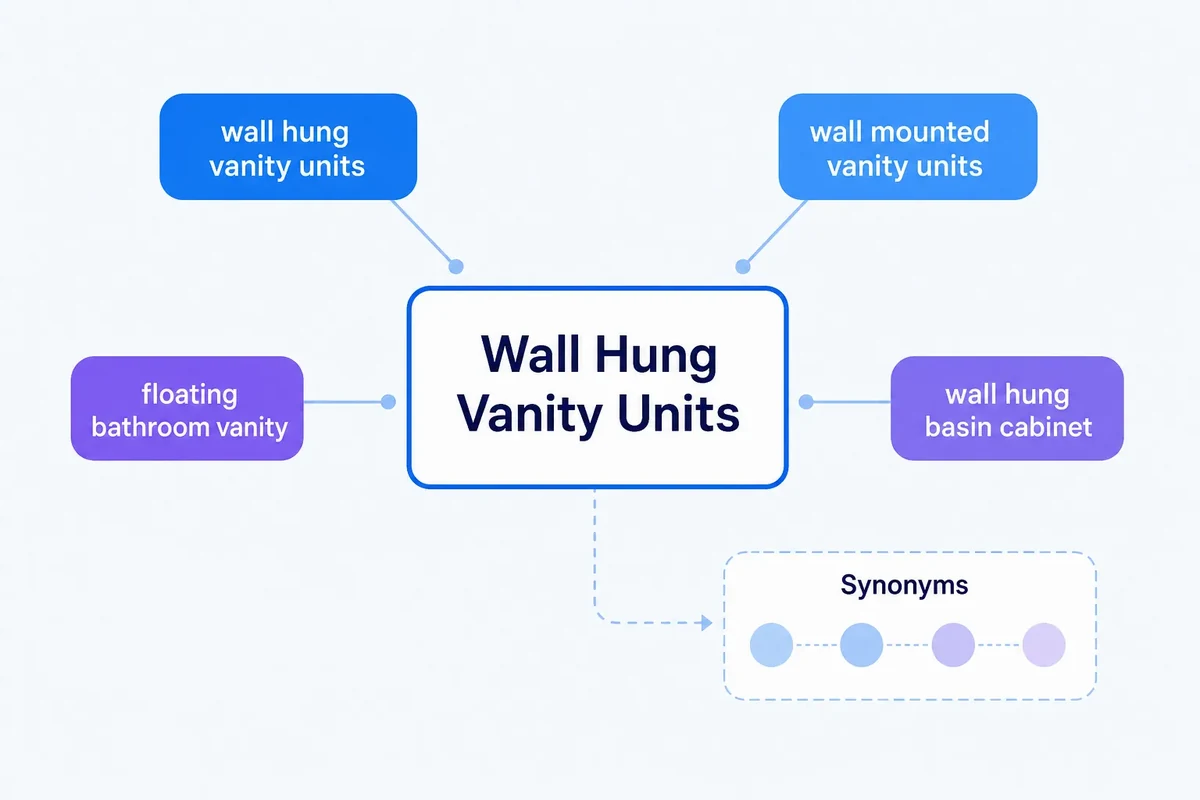
Worked example: wall-hung vanity units
Suppose a bathroom retailer has a cluster containing:
- wall hung vanity units;
- wall mounted vanity units;
- floating bathroom vanity;
- wall hung basin cabinet.
The business already uses “Wall Hung Vanity Units”. This accurately describes the product set and matches substantial user language, so there is no need to squeeze every synonym into the label.
The useful deliverable is an approved category name with supporting queries attached. The other phrases can inform the page brief rather than lengthening the menu.
Look beyond the head term
Check representative queries before approving a name. A broad head term can hide subtopics or attributes that make the actual group narrower than the proposed label suggests.
Look at the distribution of entities and attributes: which products, topics and characteristics appear across the group? If one product type dominates but colours vary, the label should probably describe the product type, not one colour. If 90% of the group shares a mounting style, that attribute may belong in the name.
Keep approved labels stable
Cluster membership can shift slightly between model runs without requiring monthly navigation changes. Keep a stable, approved display label and retain model-generated labels for analysis.
This separates changes in your keyword data from decisions about the site. A reporting update can flag new language for review without becoming an instruction to rename a page.
Give synonyms a useful home
Variants that do not become the category name still belong in your working material. They can support:
- natural on-page wording;
- internal search synonyms;
- filters;
- content briefs;
- query analysis.
That gives writers and implementation teams useful language without asking the navigation to carry the whole query list.
Treat renaming and URL changes as separate decisions
Renaming an established category can affect user familiarity, navigation and internal links. It may also affect URLs if your implementation ties the slug to the label. Require evidence that the current name is genuinely unclear or misaligned before recommending a change.
A readable navigation label does not need a mechanically identical URL slug. URL changes have migration consequences, so ClusterIQ should not infer them automatically from label updates. Make the scope of any approved change explicit for whoever implements it.
Balance customer language with business terminology
Search evidence can challenge internal jargon. Where the keyword dataset consistently uses a clearer alternative, ClusterIQ can give the team evidence for a UX naming review.
But customer language is not always suitable for permanent navigation. Short-lived slang or social-media phrases may have search demand without being durable category names. If the business term is clearer and already understood, keep it and use alternatives in copy or internal search synonyms.
Get local approval for international labels
Literal translations can miss the category language people actually use in a market. Use local keyword clusters alongside local business terminology to choose the display label. Retain one shared global topic ID underneath, so local naming choices do not lose their connection to the same topic.
Review the name separately from the cluster
A well-grouped cluster can still have a poor label. Cluster naming and site category naming draw on shared evidence, but serve different interfaces.
Then test the proposed label beside its siblings. ClusterIQ can review names across the taxonomy, checking whether one uses a product type, another a use case and another a marketing phrase. Also check pluralisation, attribute use, brand inclusion and specificity. Individually accurate names can still make the full menu difficult to scan.
For important changes, compare Search Console queries, internal site search language and the product or service catalogue. Keep the approved display label a human decision, with the evidence attached.
Practitioner principle: keyword clusters reveal the language around a category. The navigation label should summarise the user's choice, not reproduce the query list.
ClusterIQ Conclusion
ClusterIQ can make category naming more evidence-led without turning navigation into SEO copy. Combine representative search language, product or content scope and clear business terminology. Keep synonyms available elsewhere, and give the team an approved label rather than an automatically generated keyword list.
Sources and further reading
Farky Rafiq
Founder of ClusterIQ
I've worked in digital marketing since 2005 and founded Liquid Silver in 2011. These articles are where I share the methods, experiments and practical SEO thinking behind ClusterIQ.
Put the idea into practice with your own keyword data
ClusterIQ helps turn raw SEO exports into clean, structured working datasets you can inspect, refine, report on and take into the next stage of your workflow.
Keep reading
How deep should an SEO taxonomy be? Using keyword clusters without building endless category levels
Programmatic SEO with keyword clusters: scaling useful pages without scaling thin content