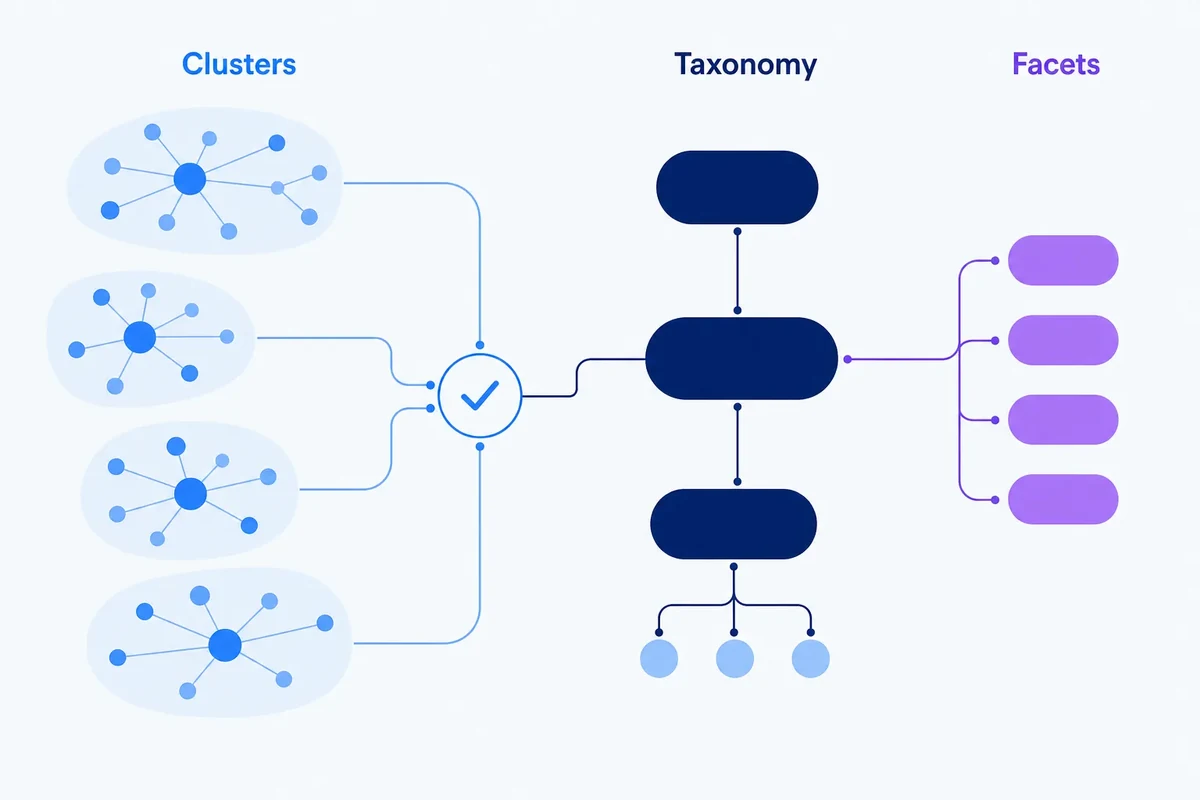
Programmatic SEO with keyword clusters: scaling useful pages without scaling thin content
Keyword clusters can identify repeatable landing-page opportunities, but a scalable template is not proof that every combination deserves a page. Learn the guardrails.

Farky Rafiq
Founder of ClusterIQ
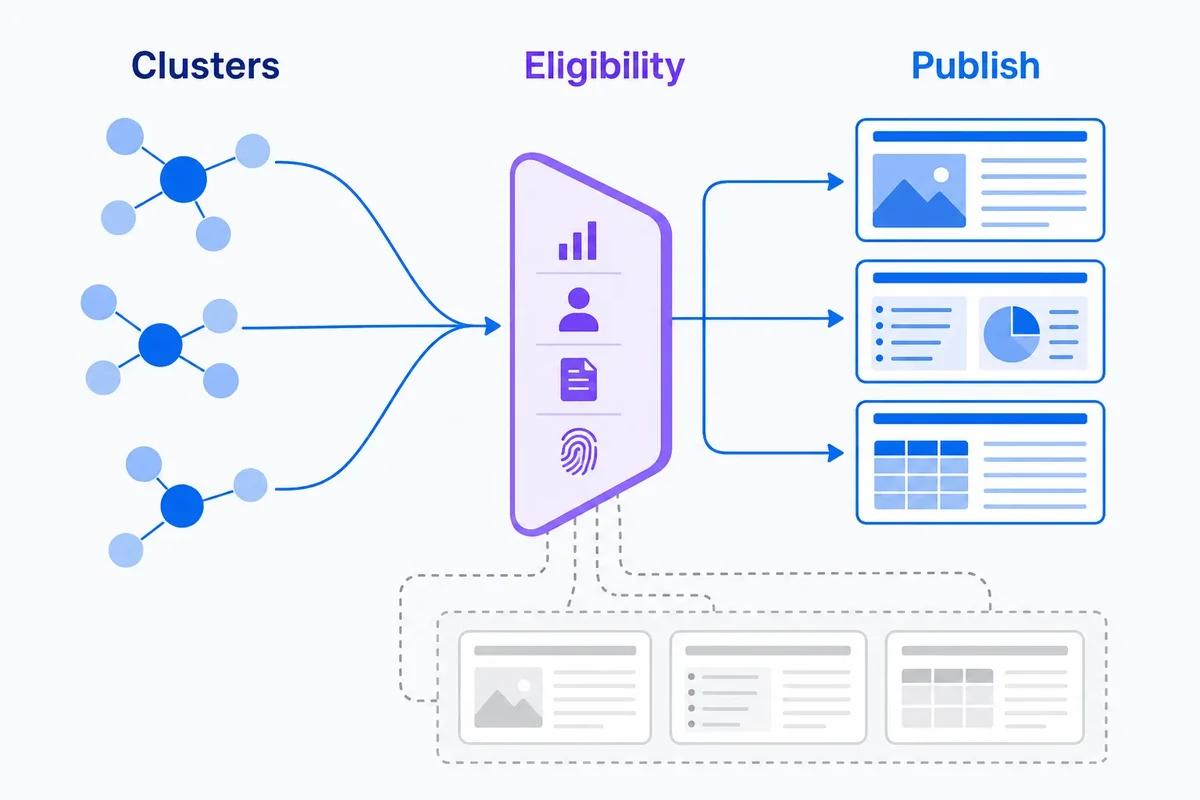
Programmatic SEO is an incredibly tempting prospect for any growing site. When you have a database of structured information and a solid template, the ability to serve thousands of repeatable search needs at the click of a button feels like a superpower. However, the risk is just as significant. Once the cost of publishing a new page drops to near zero, the internal threshold for deciding whether that page actually should exist often collapses along with it.
This is where ClusterIQ provides a vital layer of governance. It allows you to separate the analytical opportunity from the technical permission to publish. Just because your CMS can generate a page doesn't mean it should; ClusterIQ helps you nominate page candidates based on evidence rather than just technical capability.
Start with a repeatable user need
A scalable page family should only be built if users have a genuine, recurring need for a specific type of experience. You aren't just filling space; you are providing a utility. Common examples include:
- Product category or faceted search pages;
- Location-service combinations (e.g., "Plumbers in Bristol");
- Comparison pages for software or hardware;
- Data-driven directories or registries;
- Interactive tool outputs that provide persistent value.
In these cases, the template is simply the delivery mechanism. The real value lies in the data or service the user finds once they arrive.
Use clusters to identify demand families
When you are looking at thousands of keywords exported from Ahrefs or Semrush, it is easy to get lost in the noise. ClusterIQ helps by revealing which combinations of attributes actually have a coherent family of search demand, and which are merely theoretical possibilities that no one is actually searching for. This is essential when your database could technically generate tens of thousands of combinations, most of which would result in "thin" content.
Worked example: location pages
Imagine a service business that operates across 30 major regions. Technically, their CMS could generate 5,000 individual town pages. However, by looking at Search Console and keyword data, we might find that there is only meaningful, recurring demand in 60 specific locations. The other 4,940 towns have no distinct search evidence.
ClusterIQ allows you to nominate only those 60 locations with real demand for your publishing plan, keeping the rest out of the Google index and protecting your site's overall quality score.
Google's scaled-content policy is a quality constraint
Google's spam policies are quite clear about "scaled content abuse." This refers to generating large volumes of pages primarily to manipulate search rankings without providing any real utility to the user. It doesn't matter if the content was written by a human, a bot, or a database; if it doesn't add value, it is a risk. The takeaway for marketers is simple: scale the useful experience, not just the number of URLs.
Define page eligibility before generation
Before you hit "publish" on a programmatic rollout, every page should meet a set of eligibility criteria:
- It belongs to a coherent query cluster;
- It serves a distinct user task;
- There is enough underlying data or inventory to make the page useful;
- It is meaningfully different from its parent and sibling pages;
- It has a clear internal-linking path;
- The business can actually fulfil the service or need described.
Use hard gates for impossible pages
If you don't have the inventory, the local staff, or the data to populate a page, search volume shouldn't be enough to trigger its creation. ClusterIQ can keep these topics in your "market research" bucket while blocking them from your live publishing environment until the business requirements are met.
Measure sibling-page distinctiveness
Programmatic families are prone to "near-duplication," where hundreds of pages look almost identical to a search engine. To avoid this, you need to compare:
- Query clusters and intent;
- Entity density;
- The specific product or record sets displayed;
- Unique content modules;
- Overall similarity of the main content.
Near-duplicate detection should be a mandatory step in your release gate to ensure each page earns its place.
Templates need room for genuinely variable evidence
Simply swapping out the H1 and the city name is no longer enough to satisfy modern SEO requirements. A high-quality template should present data that actually changes a user's decision-making process. This might include local pricing, specific product availability, regional statistics, or contextual guidance that is unique to that specific cluster.
Do not create text variation for its own sake
Using AI to paraphrase the same introductory paragraph 500 times is a waste of resources. It doesn't create 500 unique experiences; it creates 500 versions of the same experience. Content variation should always be driven by different underlying evidence, not just a thesaurus.
Internal linking should follow the hierarchy
A programmatic page shouldn't be an island that only exists in a sitemap. ClusterIQ helps define the relationship between parent categories, siblings, and related guides. This ensures that every new URL has a logical home within your site architecture, making it easier for both users and crawlers to navigate.
Use indexation as a controlled state
Just because a page exists in your staging environment or database doesn't mean it should be indexable. You can set up a workflow where pages only move to "index, follow" status once they have passed your quality and QA gates. This keeps your SEO strategy separate from your technical product capabilities.
Monitor page families, not only individual URLs
When dealing with scale, you need to look at the health of the entire family. Keep an eye on:
- Overall indexation rates;
- Query ownership across the group;
- Near-duplicate flags;
- Inventory depth (are pages becoming empty?);
- Traffic distribution;
- The number of pages providing zero value.
If a family of 500 pages only sees traffic on two of them, your template or your eligibility rules need a rethink.
Retirement rules matter from day one
Data is rarely static. Locations close, products go out of stock, and datasets become obsolete. You need a plan for when a page should be kept live, temporarily hidden with a noindex tag, redirected, merged into a parent, or removed entirely. ClusterIQ helps link these lifecycle decisions to the actual ownership of the topic.
Use a pilot before scaling
Before launching 2,000 pages, launch 20. Monitor how they perform, how Google indexes them, and whether users find them helpful. This is the core principle of the ClusterIQ workflow: prove the model works at a small scale before you multiply it.
Practitioner principle: programmatic SEO should scale a repeatable useful experience. The ability to generate a URL is not evidence that the URL should exist.
ClusterIQ Conclusion
Keyword clustering makes programmatic SEO more selective and much easier to defend. By using ClusterIQ to identify demand, enforce quality gates, and monitor performance, you ensure that your site's growth is driven by user value rather than just your technical capacity to publish.
Score the template family before expanding the inventory
Once your pilot pages are live, use ClusterIQ to evaluate the family as a whole. You want to see what percentage of pages are earning their own distinct queries and whether any parent pages are "cannibalising" the rest of the cluster. If the results are weak, tighten your eligibility gates. If the family is stable and distinct, you have the green light to expand into more approved clusters.
This transforms programmatic SEO into a controlled product rollout. Your engine might be capable of thousands of pages, but your SEO governance ensures only the best ones make it to the web.
A controlled release lifecycle for programmatic page families
Think of a page family like a software release. The lifecycle should move from candidate to evidence-approved, through to a preview, a QA check, a pilot, and finally a scaled release. Each stage acts as a gate. If a pilot shows high overlap or poor inventory, you can stop the project at 50 pages instead of discovering a massive quality issue after 5,000 pages are already indexed.
Separate template quality from topic eligibility
It is important to distinguish between a bad topic and a bad template. Topic eligibility asks: "Is there enough demand for this page?" Template QA asks: "Does this page actually serve that demand well?" By scoring these separately, you can diagnose exactly why a project might be underperforming and fix the right part of the process.
Sources and further reading
Farky Rafiq
Founder of ClusterIQ
I've worked in digital marketing since 2005 and founded Liquid Silver in 2011. These articles are where I share the methods, experiments and practical SEO thinking behind ClusterIQ.
Put the idea into practice with your own keyword data
ClusterIQ helps turn raw SEO exports into clean, structured working datasets you can inspect, refine, report on and take into the next stage of your workflow.
Keep reading
How deep should an SEO taxonomy be? Using keyword clusters without building endless category levels
Naming SEO categories from keyword clusters without turning navigation into keyword stuffing