How deep should an SEO taxonomy be? Using keyword clusters without building endless category levels
Keyword research can justify dozens of nested distinctions, but deeper taxonomy is not always better. Learn how ClusterIQ can balance demand, usability, inventory and crawl depth.

Farky Rafiq
Founder of ClusterIQ
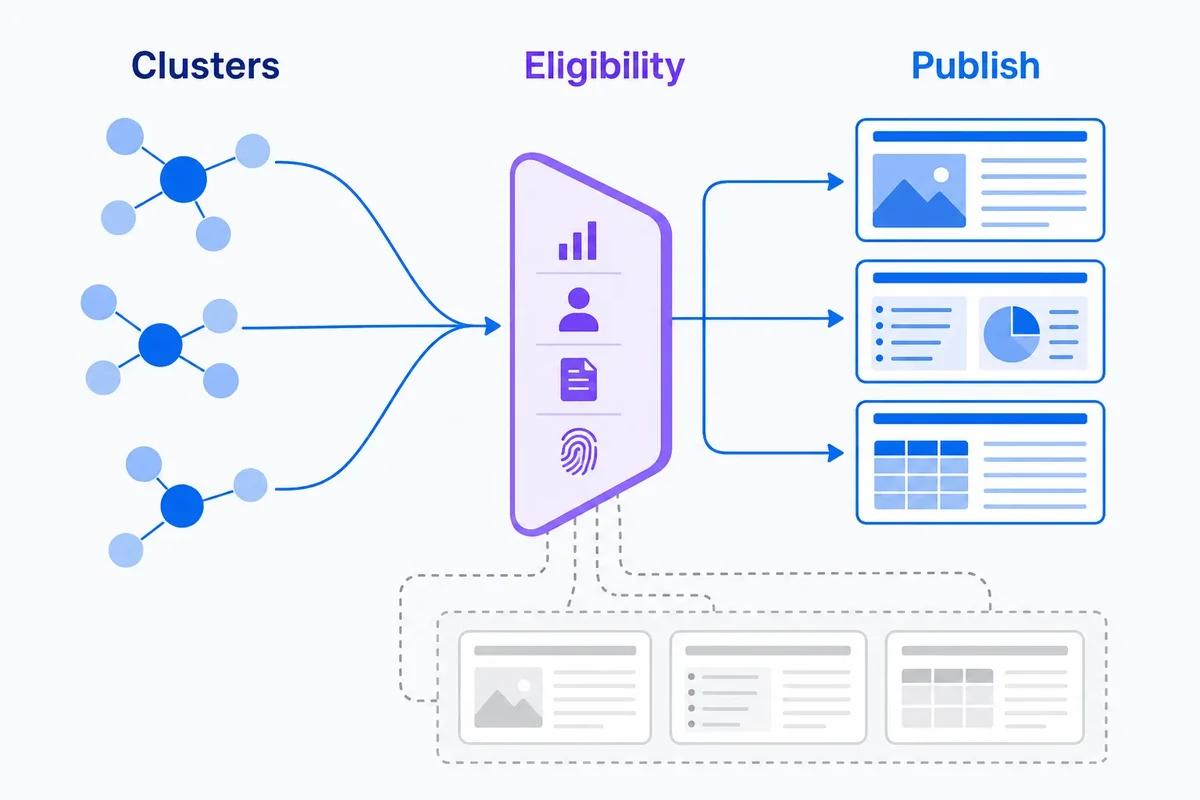
Keyword clustering is a brilliant way to uncover the hidden layers of a topic, but it often reveals more distinctions than a website should actually show in its navigation. When you pull a few thousand keywords from Ahrefs or Search Console, you might see demand split by brand, size, colour, material and use case. If you turn every one of those analytical subgroups into a new category level, your site structure quickly becomes deep, brittle and frustrating for users to navigate.
The goal is to use tools like ClusterIQ to reveal the underlying structure of your data while applying a separate set of rules to decide which of those levels deserve a permanent home in your site architecture.
Analytical depth and navigational depth are different
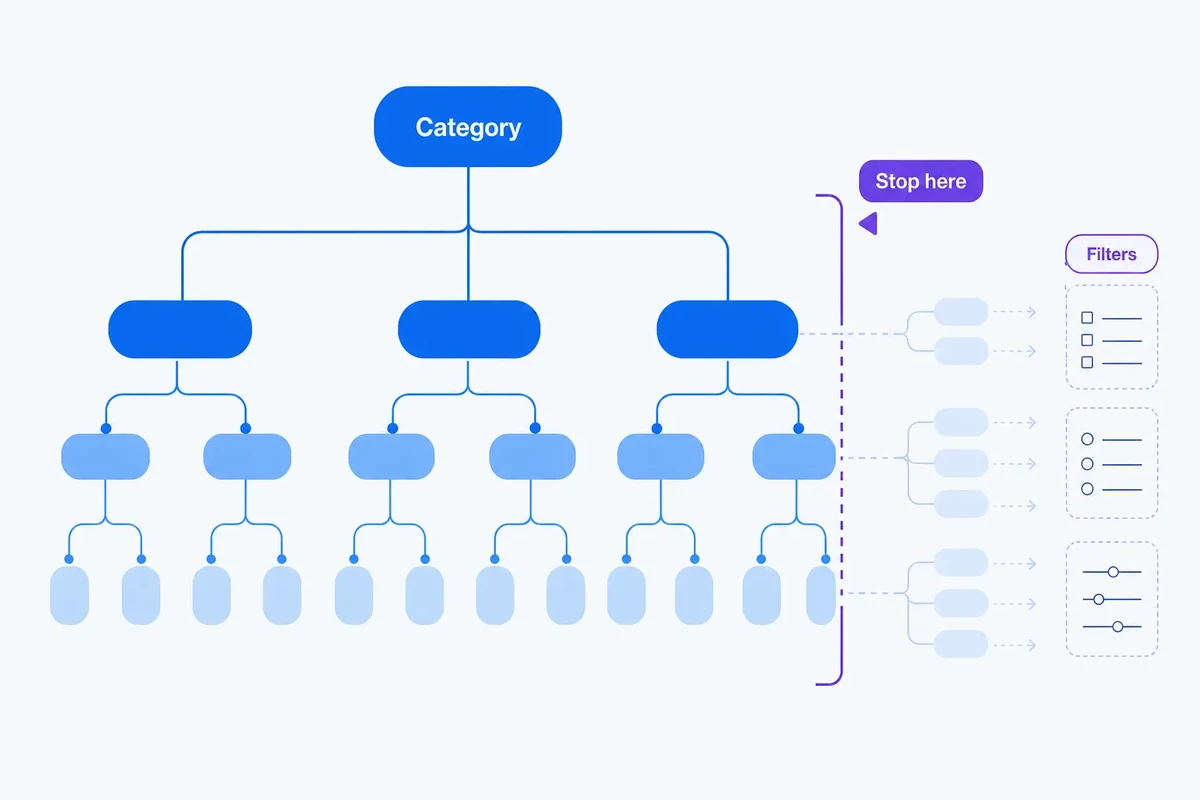
When you are building a topic model, it is perfectly normal to see a hierarchy that looks like this:
- Macro topic
- Community
- Sub-community
- Attribute group
- Individual query
However, your website does not need a dedicated navigation level for every single one of those layers. Just because a data point exists does not mean it needs a folder in your URL structure.
Start with user choice
A category level is only truly useful when it represents a meaningful decision a user wants to make. In an ecommerce setting, this usually means choosing a product type before worrying about size or style. For a B2B service provider, it might mean selecting a service family before looking at sector-specific variants. Search demand can highlight that a distinction exists, but it cannot prove that the distinction belongs in your main navigation.
Practical example: bathroom furniture
Imagine you are mapping out a content plan for a bathroom retailer. Your keyword research might reveal five distinct layers:
- Bathroom furniture
- Vanity units
- Wall-hung vanity units
- 600mm wall-hung vanity units
- 600mm black wall-hung vanity units
All five levels will likely show search volume in Semrush. However, building a five-level permanent hierarchy is almost certainly overkill. While the top three might work as categories, the deepest combinations are often better handled as filters, indexable facets or specific merchandising views rather than hard-coded navigation links.
Inventory depth constrains taxonomy depth
A deep category that only contains two products is rarely a good user experience, regardless of what the keyword data says. Before committing to a new level, you should evaluate inventory depth at every proposed commercial stage. If the cupboard is bare, the category probably shouldn't exist yet.
Page distinctiveness matters
If a child category looks and feels exactly like its parent, with the same products and similar copy, that extra level adds very little value. When deciding whether to go deeper, compare these factors:
- Product-set overlap
- Query-cluster overlap
- Difference in page purpose
- Specific filter requirements
Deeper is not automatically harder to crawl
It is important to distinguish between URL directory depth and click depth. Google cares more about whether your important pages are accessible through a sensible internal linking structure than how many slashes are in the URL. That said, an unnecessarily deep navigation path makes both users and search engine spiders work harder than they need to.
Broad categories need useful scope
Shallow taxonomies have their own problems. If a top-level category like Bathrooms contains thousands of products with no sub-categories, the user is faced with an overwhelming choice. Furthermore, you lose the ability to create highly relevant landing pages for specific search intents. The sweet spot is the point where groups remain distinct and easy to browse.
Use cluster stability before creating permanent levels
If a subgroup only appears when you tweak your clustering settings to an extreme degree, it is weak evidence for a permanent taxonomy change. You should look for stable groups that appear consistently across different methods and timeframes before changing your site structure.
Use page type to stop the hierarchy
Often, the next analytical layer shifts from category-level demand (e.g., "buy vanity units") to informational questions (e.g., "how to install a vanity unit"). This is usually where your taxonomy should stop. Those informational topics are better suited for guides or support content, connected via internal links rather than deeper category levels.
Market and language can change depth
Inventory and demand vary by region. One country might have enough stock to justify a dedicated sub-category, while another market does not. International ClusterIQ analysis allows you to maintain a consistent global topic structure while letting local taxonomy depth vary based on local reality.
Taxonomy levels should be explainable
To keep your architecture deliberate rather than accidental, record these points for every parent-child relationship:
- Evidence of search demand
- Inventory or service coverage
- Distinctiveness of the page
- Value to the user navigation
- Existing URL relationships
Facets can absorb high-dimensional detail
Details like size, colour and material are often better handled through faceted navigation. ClusterIQ's facet workflow helps you decide which of these combinations should become indexable pages to capture search traffic and which should remain as simple filters for users already on the site.
Internal links can represent non-hierarchical relationships
Not everything needs to be a parent or a child. Comparisons, how-to guides and related categories can be linked contextually. This builds a robust topic graph without cluttering your main navigation menus.
Monitor depth after implementation
Once your structure is live, keep an eye on Search Console performance, internal crawl depth and changes in inventory. A good taxonomy is not static; it should evolve as your business and your customers' search habits change.
Practitioner principle: clustering shows you how deep the subject goes. Your website should only expose the levels that create a useful, stable choice for the person using it.
ClusterIQ Conclusion
Keyword clusters are a fantastic source of evidence for taxonomy design, but they are not a direct blueprint. ClusterIQ helps you combine topic hierarchies with real-world data like inventory and page types. This ensures your site is specific enough to capture demand without becoming a labyrinth for your visitors.
Use a hierarchy review to find unnecessary intermediate levels
ClusterIQ can help you spot category levels that don't actually need to exist. If a parent category has only one child with nearly identical products and no unique search traffic, it is likely an unnecessary intermediate step. Removing these levels simplifies the journey for the user.
This doesn't mean you should flatten everything. It means every level must earn its place. A hierarchy review can also find the opposite problem: a broad category that is hiding several high-value clusters that users can't easily find. By comparing set overlap and search ownership, you can build a site that reflects how people actually search and shop.
Sources and further reading
Farky Rafiq
Founder of ClusterIQ
I've worked in digital marketing since 2005 and founded Liquid Silver in 2011. These articles are where I share the methods, experiments and practical SEO thinking behind ClusterIQ.
Put the idea into practice with your own keyword data
ClusterIQ helps turn raw SEO exports into clean, structured working datasets you can inspect, refine, report on and take into the next stage of your workflow.
Keep reading
Using keyword clusters to design an SEO taxonomy without letting search volume run the site
Naming SEO categories from keyword clusters without turning navigation into keyword stuffing