Clustering size, material and style modifiers in ecommerce SEO
Ecommerce modifiers such as 800mm, oak, black and wall-hung can define meaningful demand. Learn how to cluster them without creating a landing page for every combination.

Farky Rafiq
Founder of ClusterIQ
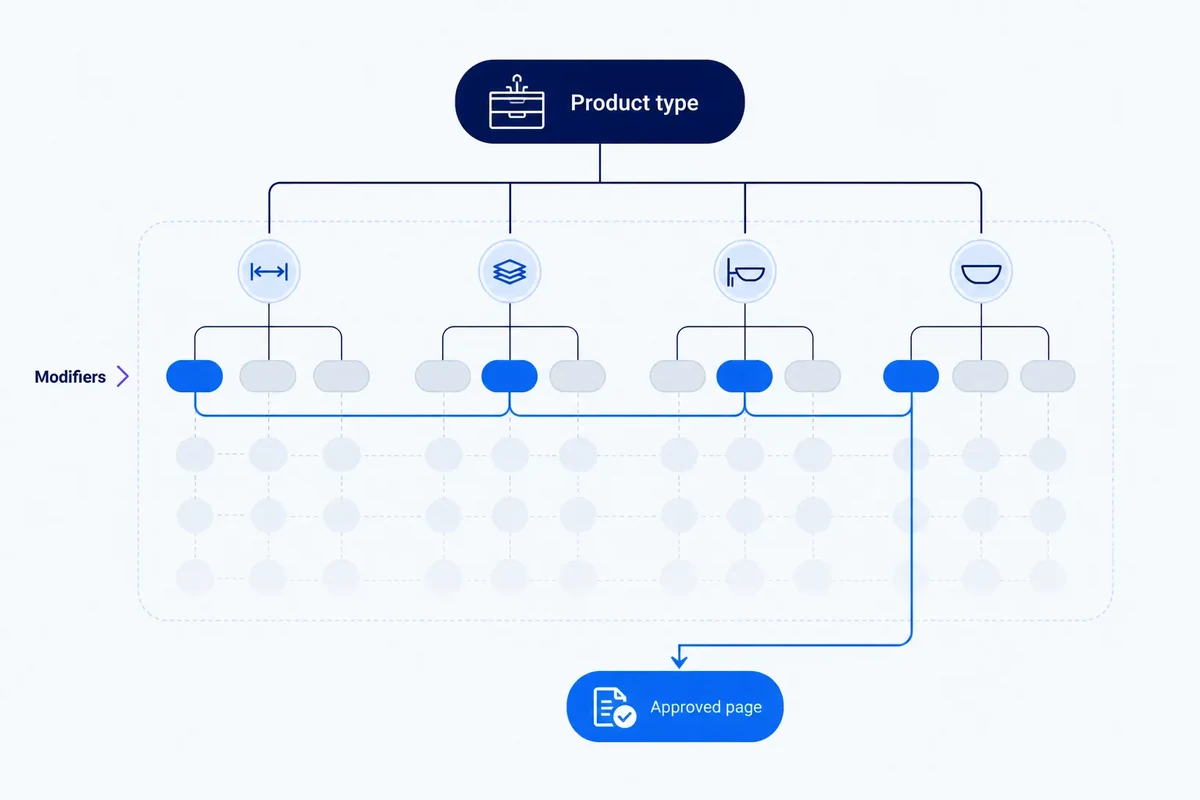
Ecommerce search demand is almost always built around modifiers. When someone looks for a product, they rarely stop at the broad category level. They refine their intent by size, material, colour, style, or compatibility. For us as SEOs, these modifiers are the building blocks of a site's architecture, often dictating which filters or subcategories we decide to index.
The practical challenge when using ClusterIQ is maintaining this meaningful structure without falling into the trap of creating a permanent landing page for every conceivable combination of words. We want to capture the intent without bloating the index.
Modifiers represent real user choices
If you are working with a dataset of a few thousand keywords for bathroom furniture, you will see patterns emerge. Users do not just search for "vanity units"; they search by:
- Width: 600mm, 800mm, 1200mm;
- Mounting: wall-hung, floor-standing;
- Finish: oak, white, black;
- Configuration: single basin, double basin;
- Style: traditional, modern.
These are not merely "long-tail" filler words. They represent concrete requirements. If a customer needs a 600mm unit to fit a specific gap, an 800mm result is useless to them. Our clustering needs to respect these distinctions.
Extract the attributes explicitly
Rather than relying solely on vector embeddings to "understand" these differences, ClusterIQ can parse these modifiers into structured fields. This moves the data from a messy list of strings into a structured format that allows for:
- Attribute-aware clustering that respects physical constraints;
- Matching keyword demand against actual live inventory;
- Analysing which facets are most popular;
- Informing logical category naming conventions.
Product attribute extraction is the technical step that makes this level of detail manageable at scale.
One attribute does not automatically equal one category
Just because you see significant search volume for "black vanity units" does not mean you should immediately spin up a new subcategory. Before committing to a new URL, you should also consider:
- Inventory depth: do you have enough products to fill the page?
- Stock stability: will these items be gone in two weeks?
- Page purpose: does this offer a distinct experience from the parent category?
- Internal linking: can you actually support this page in your site navigation?
Worked example: the combinatorial explosion
Imagine a single category that has five widths, four colours, three mounting styles, and two basin configurations. Mathematically, that creates 120 possible combinations before you even consider brands or materials.
While there might be a handful of searches for "black wall-hung 800mm double basin vanity units", indexing all 120 variations creates a massive, thin crawl space that can dilute your site's authority. ClusterIQ helps you use demand data to nominate which combinations are worth a URL, rather than approving them all by default.
Cluster at several levels
A sophisticated SEO plan should look at demand through a hierarchy:
- The broad product type (e.g., Vanity Units);
- Single-attribute subclusters (e.g., Oak Vanity Units);
- High-value combinations (e.g., Slimline Cloakroom Units);
- Exact product entities for specific SKU-level intent.
This allows you to see the full shape of the market without feeling pressured to turn every analytical group into a public-facing URL.
Use attribute co-occurrence
When "800mm" and "black" frequently appear together in your Search Console or Ahrefs data, it is a strong signal of combined demand. However, you must verify if your catalogue supports this. If a user filters for 800mm and then selects black, and the result is the same as your proposed landing page, you need to decide if the dedicated URL adds enough SEO value to justify the maintenance.
Facet pages need stronger governance
Google has long warned about the crawl risks associated with faceted navigation. ClusterIQ connects your query evidence directly to facet governance. This ensures that the SEO opportunity is always weighed against the technical cost of crawling and indexing those extra pages.
Modifiers can change page titles without changing the architecture
Not every useful attribute group needs to be a category. They can be incredibly effective for:
- Dynamic on-page filtering;
- Merchandising modules on broader pages;
- Optimising internal search results;
- Dedicated landing pages for PPC campaigns;
- Segmenting your organic performance reporting.
Use a minimum evidence rule
To keep your site lean, set a threshold for new landing pages. A proposed page could require a coherent query cluster, a minimum level of search demand, and a stable count of unique products. These thresholds should be specific to the category; what works for "Socks" won't necessarily work for "Sofas".
Attribute conflicts help prevent false merges
From a purely semantic perspective, queries for "600mm unit" and "1200mm unit" look very similar. However, they represent different physical needs. ClusterIQ can recognise these as "conflicting" attributes, preventing the tool from merging them into a single generic cluster and helping you maintain the necessary distinction in your content plan.
Use modifier distributions to describe a cluster
A ClusterIQ report can show you the "shape" of a cluster. For example, a cluster might be 60% focused on 800mm sizes and 45% on black finishes. This data helps you write better category copy and create more relevant meta tags, even if you don't create new sub-pages.
Do not confuse long-tail specificity with page necessity
A very specific search can often be perfectly satisfied by a broader category page that has clear filters. The question isn't just "does this keyword exist?" but "will a dedicated page provide a better experience than the current one?"
Monitor approved combinations
Demand shifts and stock levels fluctuate. A facet page that made sense last year might be "thin" today. ClusterIQ allows you to monitor inventory counts and traffic trends for these specific clusters, making your SEO architecture reversible and data-driven rather than a "set and forget" task.
Practitioner principle: Modifiers describe demand at useful levels of detail. The site should expose that detail only where products, users, and crawl governance justify it.
ClusterIQ Conclusion
Size, material, and style modifiers are the heartbeat of ecommerce SEO. By extracting these attributes and mapping them against real-world inventory and technical constraints, you can build a site structure that reflects how people actually shop. This structured approach ensures you capture high-intent traffic without creating a technical debt of thousands of thin, useless URLs.
Test modifier groups against real product journeys
Before turning an attribute cluster into an indexable page, try the journey yourself. Does the product set feel distinct? Can a shopper easily navigate back to the main category? The best modifier-led pages are not just keyword targets; they are stable, helpful entry points into your catalogue.
Sources and further reading
Farky Rafiq
Founder of ClusterIQ
I've worked in digital marketing since 2005 and founded Liquid Silver in 2011. These articles are where I share the methods, experiments and practical SEO thinking behind ClusterIQ.
Put the idea into practice with your own keyword data
ClusterIQ helps turn raw SEO exports into clean, structured working datasets you can inspect, refine, report on and take into the next stage of your workflow.
Keep reading
Combining product feed data with keyword clusters: where ecommerce SEO becomes operational
Product attribute extraction for SEO: turning keyword modifiers into structured ecommerce evidence