Category page vs product page queries: clustering ecommerce demand at the right level
Ecommerce queries can share the same product language while requiring category or product pages. Learn how entity specificity, modifiers and SERPs help ClusterIQ separate them.

Farky Rafiq
Founder of ClusterIQ
Imagine you are looking at a spreadsheet of three thousand keywords exported from Ahrefs or Search Console. You see "running shoes" and "Nike Pegasus 41" appearing near each other. While they clearly belong to the same product universe, they represent two very different stages of a customer's journey. If you group them onto the same page, you risk confusing both your users and search engines.
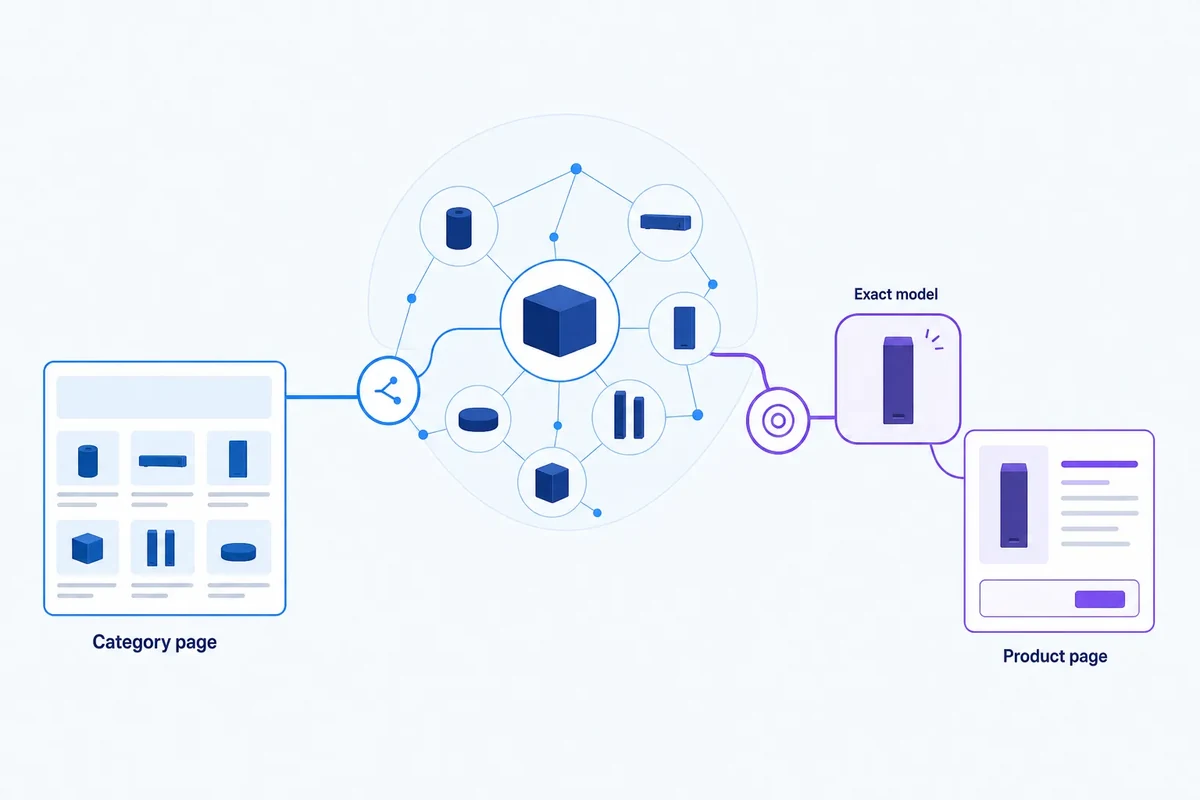
Effective ecommerce keyword clustering needs to distinguish between category-level demand and product-level demand, even when the vocabulary and entities are closely related. ClusterIQ makes this distinction explicit by combining semantic similarity with entity specificity, modifiers, page type, and current search evidence.
Category queries describe a set
When a user searches for a category, they are usually looking for a range of options to compare. These searches commonly express a product type, a brand range, a broad attribute combination, an audience, or a specific use case.
Practical examples include "trail running shoes", "Bosch dishwashers", or "black vanity units". In these instances, the user generally needs a choice set rather than one exact item. They are still in the consideration phase, weighing up features, prices, and styles across multiple products.
Product queries identify a specific item or model
Product-oriented queries are much more granular. They often contain an exact model name, a SKU or manufacturer code, a very specific configuration, or a product name paired with a "review" or "specification" modifier.
These signals map more naturally to a product detail page (PDP) or product-specific support content. The user has likely moved past the broad comparison stage and is now looking for technical details, the best price for a specific model, or confirmation that this exact item meets their needs.
Entity specificity is a strong signal
Entity extraction is a core part of how ClusterIQ recognises these nuances. It helps the system distinguish between different levels of the product hierarchy:
- Brand: Bosch
- Range: Series 6
- Model: SMS6ZCI49G
The more specific the resolved entity, the stronger the case for product-level treatment. By identifying these layers, we can ensure that a search for a specific dishwasher model doesn't get buried in a generic brand category. Product attribute extraction provides the structured layer for this analysis, allowing for much cleaner automated mapping.
Modifiers can change the page level
Modifiers act as signposts for intent. Consider how the following three queries require different landing page strategies:
- "Bosch Series 6 dishwashers"
- "Bosch Series 6 SMS6ZCI49G price"
- "Bosch Series 6 dishwasher reviews"
The first query supports a range or category page. The second is a clear signal for an exact product page. The third might support either a product page or perhaps a broader comparison guide, depending on what the current search results are showing. Recognising these modifiers prevents us from misallocating high-intent traffic to pages that don't answer the specific question being asked.
SERP composition can challenge the initial classification
Sometimes, the way Google interprets a query surprises us. If a seemingly generic query consistently returns individual product pages in the top results, that is useful evidence about the current search task. Conversely, if a specific model-name query returns categories and buying guides, the market may not have one clear, exact product interpretation yet.
Search results vary by context and location, so ClusterIQ uses SERP evidence as a supporting signal rather than a fixed, immutable rule. It allows the data to reflect how search engines are actually behaving in the wild.
Worked example: vanity units
Let's look at a practical dataset involving bathroom furniture. Suppose your list includes:
- 600mm vanity units
- 600mm wall-hung vanity units
- Acme Oslo 600 vanity unit
- Acme Oslo 600 vanity unit oak
The first two are likely category or facet-level demand. They describe a type of product. The final two identify a specific range or a specific SKU. While semantic similarity connects all four, the product attributes and entity specificity help preserve the appropriate page level in your content plan.
Existing page ownership is valuable evidence
Your own Search Console data is a goldmine for this. It may show generic product-family queries already landing on a category page, while exact model queries land on product pages. This existing pattern can become part of the confidence model.
However, we must be careful. If one broad category currently ranks for everything simply because your product pages are weak or non-existent, we should treat that existing mapping as evidence of current performance rather than an ideal truth. It might actually be a signal that you need to improve your PDPs.
Inventory depth affects category viability
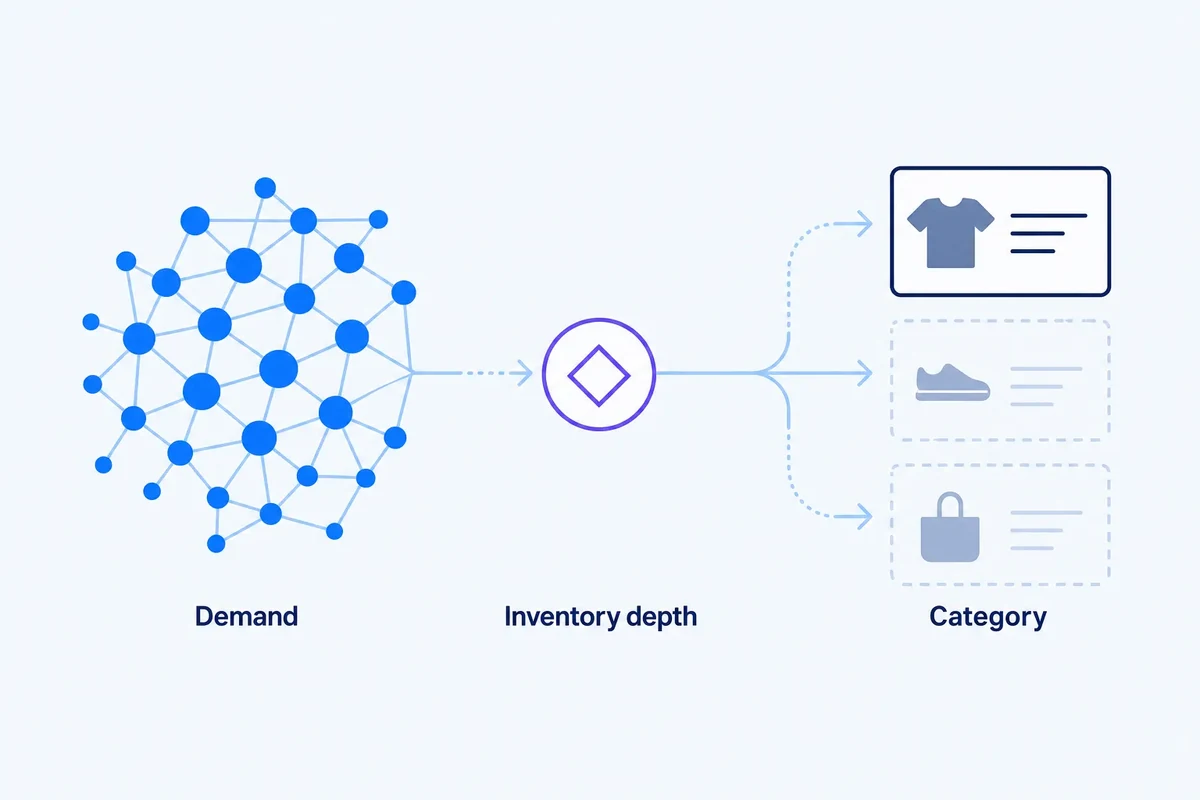
Just because there is search volume for a category query doesn't always mean you should build a new page. If a site only has one qualifying product for a specific niche, a dedicated category page might feel "thin" to both users and search engines.
ClusterIQ can combine query demand with your actual inventory depth before recommending permanent landing pages. This prevents the creation of "ghost" categories that frustrate shoppers.
Product pages can own informational queries too
It is a common mistake to think all informational queries belong on a blog. An exact product page is often the best place to rank for:
- Dimensions and weight
- Technical specifications
- Compatibility and parts
- Warranty details
- Installation manuals
Do not feel forced to move every informational modifier into a separate article. The correct page depends on whether the information is specific to that one product or generally useful across a whole range.
Category pages should not become generic articles
When a cluster clearly reflects choice-set demand, the solution is rarely to add more introductory prose to a weak category page. The page needs useful product inventory, smart filtering, clear navigation, and relevant supporting information. Content can strengthen the experience, but it should not be used to disguise the fact that the user is on the wrong template.
Use a page-level field in the cluster
To make these insights actionable for a development or content team, ClusterIQ can record specific fields for each cluster, including the main topic, entity specificity, expected page level, and expected page type. We also include candidate existing URLs and a confidence score. This turns a theoretical clustering exercise into a practical, implementation-ready brief.
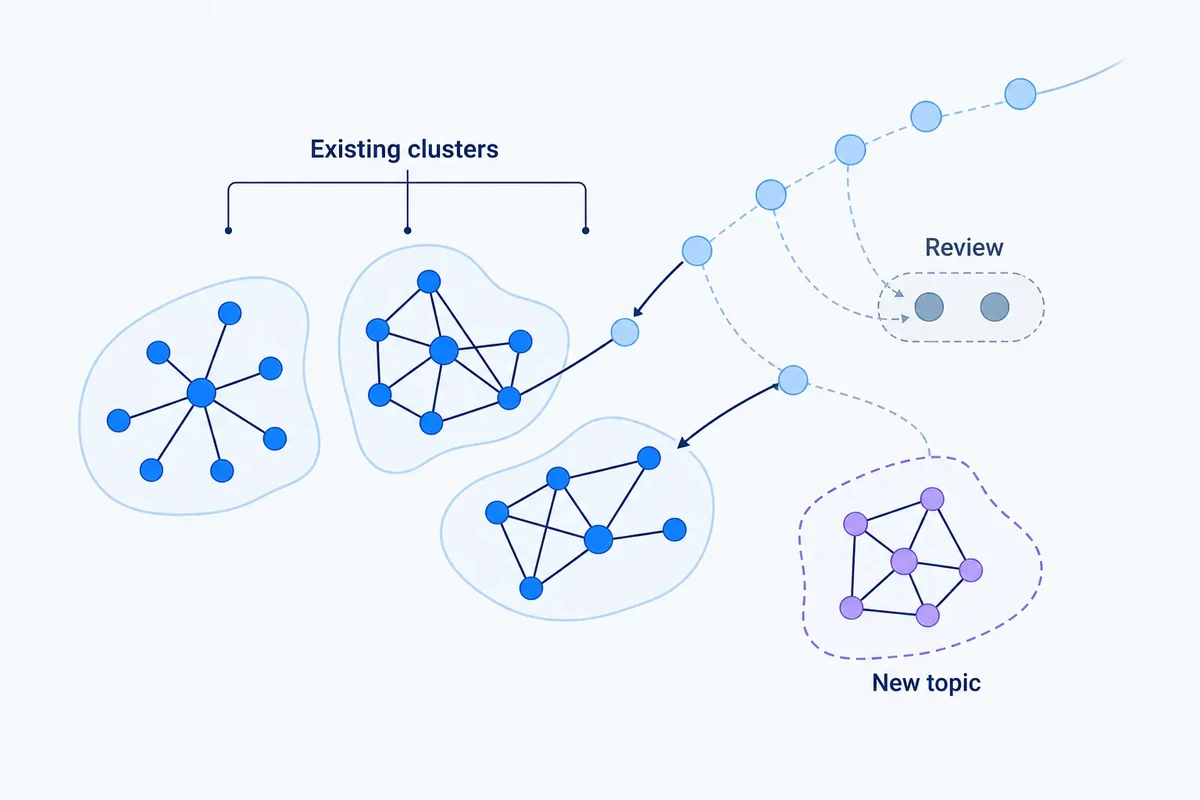
Review mixed-level clusters
If you find a cluster that contains both broad category terms and dozens of exact model terms, it might be a useful "topic family", but it is likely too broad for a single URL mapping. In these cases, it is best to split the operational level while preserving the parent-child relationship in your site architecture. This ensures your internal linking remains logical.
Internal links should reflect the level
A healthy ecommerce site uses its hierarchy to pass authority. Category pages should link to relevant products, and product pages should link back to their parent category and to genuinely useful guides. The topic graph helps identify these supporting relationships without flattening the hierarchy into a confusing mess.
Practitioner principle: semantic relatedness tells you that queries belong to one product world. Entity specificity helps tell you whether the user needs a set of products or one product.
ClusterIQ Conclusion
Separating category and product queries is essential for any serious ecommerce clustering project. By combining semantic similarity with entity resolution, modifiers, and real-world SERP evidence, we can preserve broad topical relationships while mapping demand to the correct level of the commercial architecture. This approach ensures that your site structure matches how people actually search and buy.
Use category-to-product transitions as another signal
User journeys can help validate the page level. If a query group enters through a category and users then choose among several products, the category role is coherent. If users land on one exact product and rarely need a choice set, product-level ownership is more persuasive.
ClusterIQ can keep behavioural evidence separate from the clustering while using it to review ambiguous mappings. The aim is to confirm whether the proposed page level matches the experience the site is designed to provide.
Sources and further reading
Farky Rafiq
Founder of ClusterIQ
I've worked in digital marketing since 2005 and founded Liquid Silver in 2011. These articles are where I share the methods, experiments and practical SEO thinking behind ClusterIQ.
Put the idea into practice with your own keyword data
ClusterIQ helps turn raw SEO exports into clean, structured working datasets you can inspect, refine, report on and take into the next stage of your workflow.
Keep reading
Inventory depth as an SEO signal: when keyword demand should not create a category page
Soft clustering and confidence scores: handling ambiguous keywords honestly