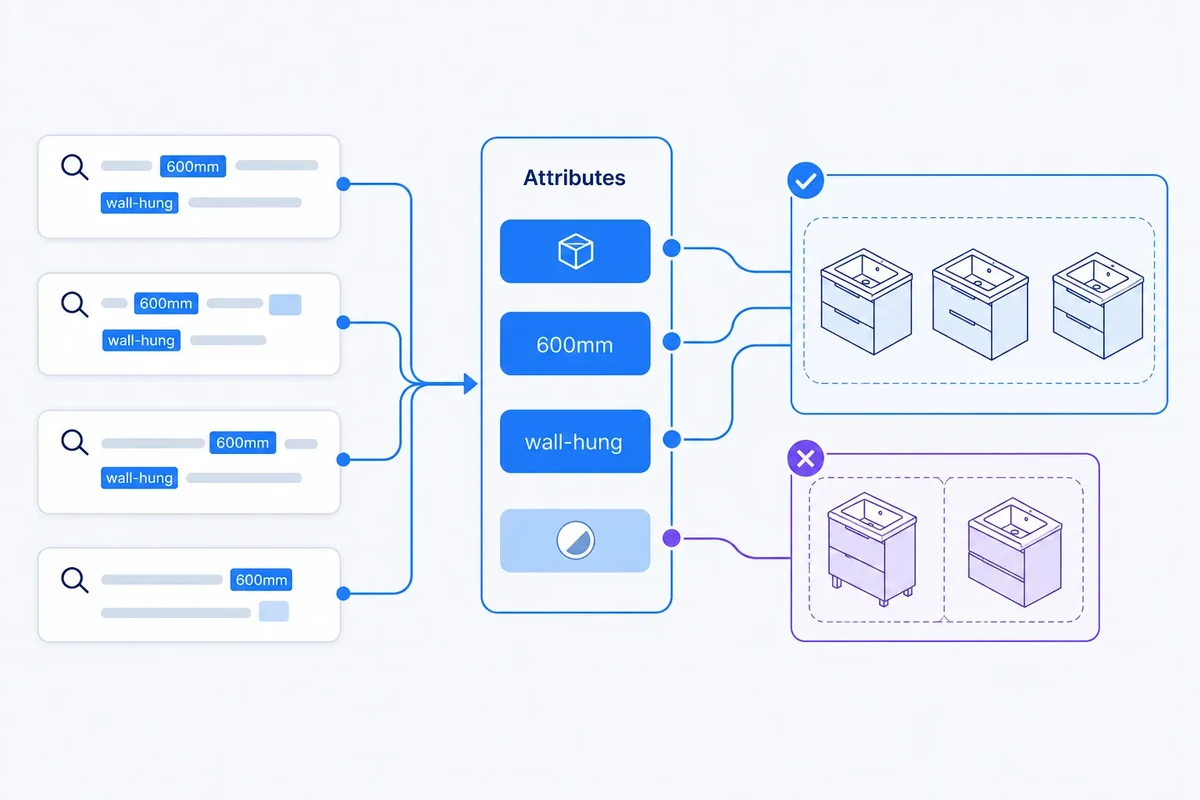
Combining product feed data with keyword clusters: where ecommerce SEO becomes operational
Keyword clusters describe search demand; product feeds describe what the business actually sells. Learn how joining the two improves category, facet and content decisions.

Farky Rafiq
Founder of ClusterIQ
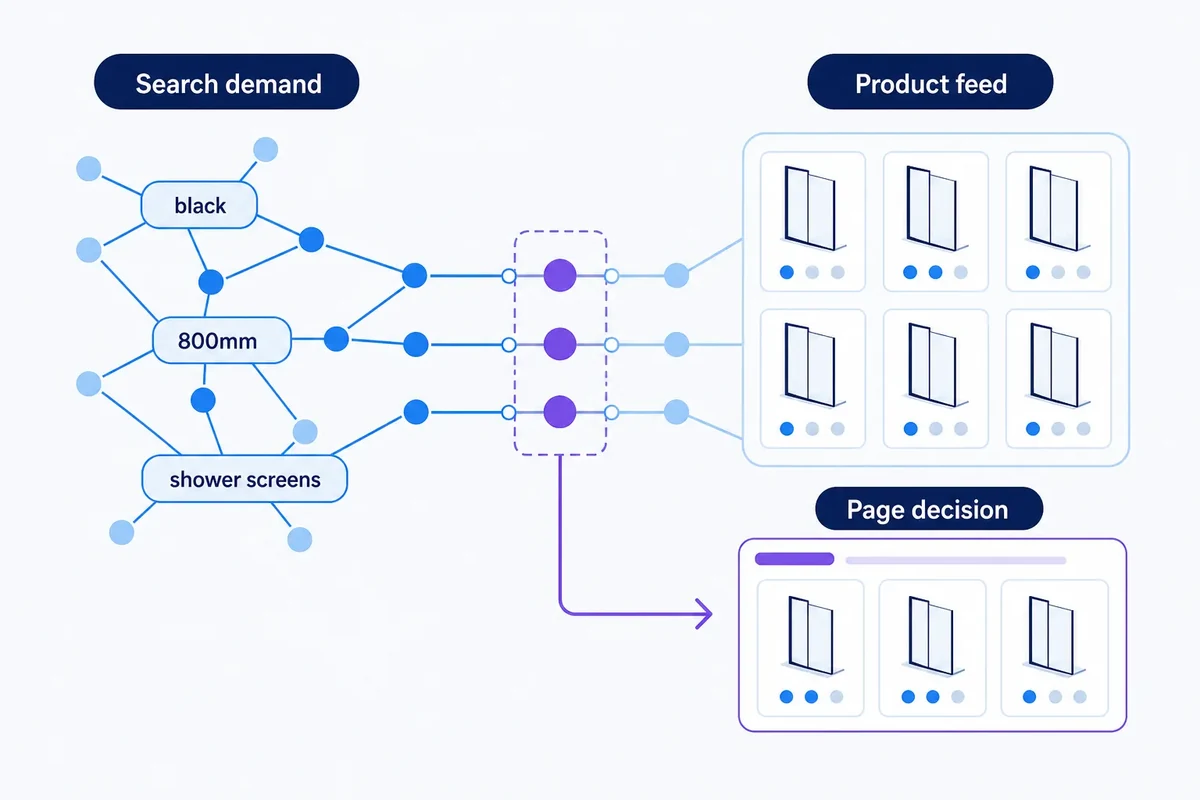
Keyword clusters show us how search demand is organised, but product feeds reveal what a business actually has on the shelves. When you join these two datasets, ecommerce SEO moves from theoretical research into something much more operational.
Instead of just identifying that there is demand for a specific concept, ClusterIQ can show you that the demand exists, your catalogue contains specific matching products, and a particular existing page is currently trying to serve that need. It bridges the gap between what people type and what you sell.
What a product feed contributes
A standard feed provides the structural backbone of the business. Useful fields often include:
- Product ID or SKU;
- Brand and category;
- Price and current availability;
- Attributes like colour, size, and material;
- Product type and custom labels.
The schema you use should reflect the actual catalogue rather than a generic template, as this ensures the data remains relevant to your specific niche.
Keyword data contributes the demand layer
From the search side, ClusterIQ adds the layer of human intent. This includes:
- Topic clusters and query modifiers;
- Entities and estimated search volumes;
- Search intent and current URL ownership;
- SERP evidence and competitor landscapes.
Merging the catalogue with demand makes decisions about category pages far more concrete and less reliant on guesswork.
Use canonical product entities
Search language is messy and varied, but a product ID is stable. A customer might search for a "Bosch series six dishwasher", "Bosch Series 6", or a specific model code. All of these should point to the same catalogue entity. By using these entities, ClusterIQ creates a reliable bridge between natural language queries and your structured data.
Worked example: proposed new category
Imagine ClusterIQ finds a tight cluster of keywords around "black 800mm shower screens". By looking at the product feed, we can see:
- 18 matching products are currently in stock;
- Four different brands are represented;
- Availability is stable over time;
- The product set is distinct from the broader parent category.
This data makes a very strong case for a dedicated landing page. However, if the feed showed only two near-identical products with flaky stock levels, that same keyword cluster would be better served by simple filters on an existing page rather than a new URL.
Product feeds help validate modifier extraction
Attribute extraction is much easier to verify when you have the site's controlled catalogue values to hand. If ClusterIQ pulls "matt black" from search queries but your feed uses "Black Matt", an alias layer can link them both to one canonical value, ensuring your reporting stays clean.
Inventory depth can be computed automatically
Once you match cluster attributes to products, you can start reporting on metrics that actually matter for rankings, such as:
- Matching and available SKU counts;
- Brand diversity and price spreads;
- Stock stability and overlap with parent categories.
This provides the necessary evidence for inventory-aware category decisions, helping you avoid launching thin pages that frustrate users and search engines alike.
Feed categories can be challenged by search structure
Often, a catalogue taxonomy reflects internal merchandising logic rather than how people actually search. ClusterIQ can compare your current feed categories against search-derived topic groups and attribute patterns. If there is a consistent mismatch, it usually points to a taxonomy opportunity or a data quality issue that needs fixing.
Search clusters can reveal missing feed attributes
If users are consistently searching for a property that isn't in your feed, you have found a merchandising gap. For example, if you see high demand for "pet friendly" or "low profile" items but those aren't attributes in your system, it is time to move that data out of the product descriptions and into a structured field.
Use feed data to prevent impossible recommendations
A keyword model might suggest a new category based on high search volume, but if your business doesn't actually sell those products in that specific market, the recommendation is useless. Feed availability acts as a hard constraint, ensuring you don't waste time planning pages you cannot fulfill.
Product feeds also support page matching
We can represent an existing category page by the products it contains, not just the text on the page. If a cluster's extracted attributes strongly match the product set of a specific URL, that provides independent evidence for mapping. ClusterIQ combines semantic similarity with product-set similarity for much higher accuracy.
Keep product-set overlap visible
If two proposed landing pages contain nearly identical products, you might be looking at unnecessary duplication. This could suggest that a specific facet should remain non-indexable, or that one page needs much clearer differentiation to avoid cannibalisation. Metrics like Jaccard similarity help make this overlap transparent.
Use update timestamps
Inventory changes much faster than keyword trends. It is vital to store the feed version or import timestamp used for your analysis. This ensures that any practitioner looking at the data knows whether the recommendations reflect what is currently in the warehouse.
Feed health becomes part of SEO confidence
If your feed is missing important attributes, the system should flag this. We want to lower the confidence score for recommendations rather than letting the system guess. Data quality must be visible to the person making the final call.
The join creates better commercial CTAs
For ClusterIQ users, integrating the product feed is where the magic happens. You move from a list of keywords to a full workflow: identifying the opportunity, checking the stock, finding the right products, and deciding on the page treatment. This is far more valuable than just exporting a CSV of coloured keyword groups.
Practitioner principle: search demand tells you what users want. Product data tells you whether the business can serve it. Ecommerce SEO needs both.
ClusterIQ Conclusion
Combining product feeds with keyword clusters creates a sophisticated decision layer for ecommerce sites. By connecting search language to real inventory and page structures, ClusterIQ makes category and facet recommendations more accurate, easier to explain, and grounded in commercial reality.
Sources and further reading
Farky Rafiq
Founder of ClusterIQ
I've worked in digital marketing since 2005 and founded Liquid Silver in 2011. These articles are where I share the methods, experiments and practical SEO thinking behind ClusterIQ.
Put the idea into practice with your own keyword data
ClusterIQ helps turn raw SEO exports into clean, structured working datasets you can inspect, refine, report on and take into the next stage of your workflow.
Keep reading
Clustering size, material and style modifiers in ecommerce SEO
Inventory depth as an SEO signal: when keyword demand should not create a category page