Multi-label search intent for keyword clustering: when one query is doing more than one job
Queries can be informational, commercial and transactional at the same time. Learn how multi-label intent preserves that overlap instead of forcing one simplistic class.

Farky Rafiq
Founder of ClusterIQ
We often talk about search intent as if it were a simple choice between four boxes: informational, commercial, transactional or navigational. In reality, users rarely stick to one lane. If you are looking at a list of a few thousand keywords from Ahrefs or Search Console, you will quickly spot queries that refuse to be pigeonholed. A search like "best CRM software pricing" is doing three things at once: it is comparing options, it is commercial in nature, and it is highly price-sensitive. If you force that into a single label, you lose the very detail you need to build a proper content brief.
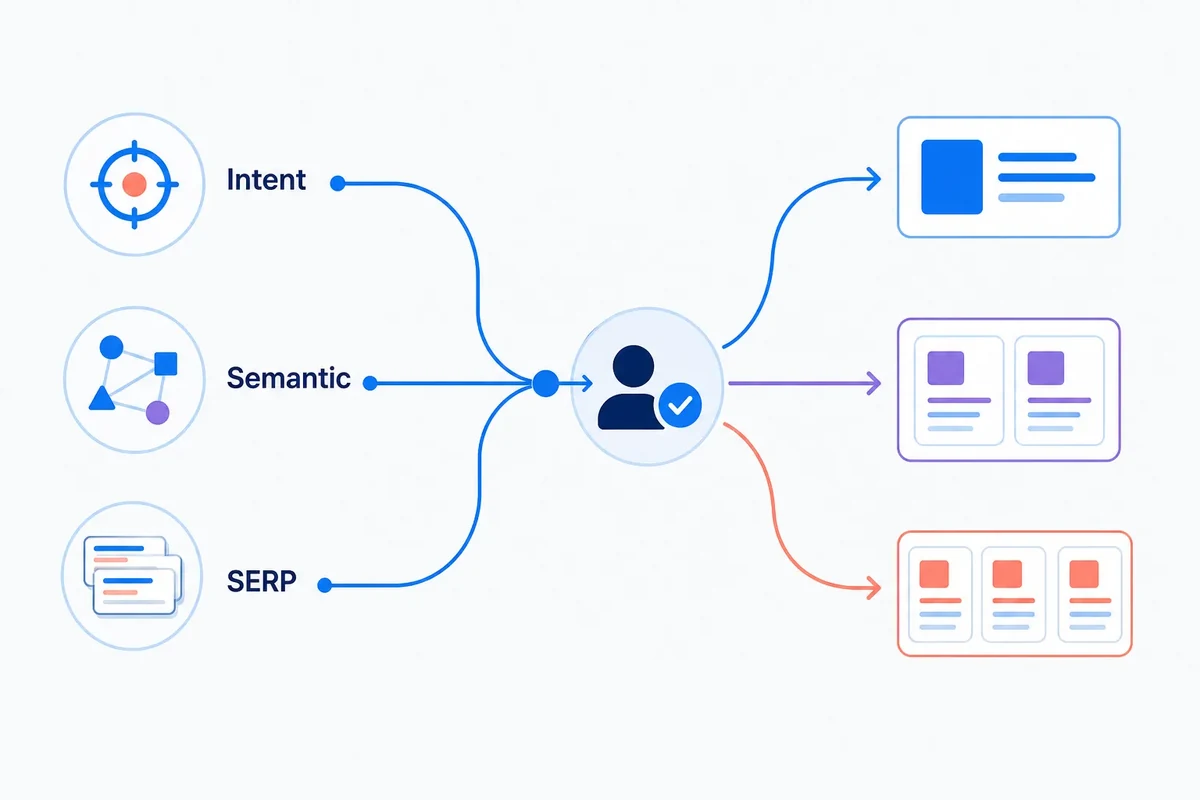
Multi-label intent is a way of acknowledging that one query can serve several motives. Instead of making a tool pick just one, ClusterIQ can store multiple dimensions or probabilities. This means a single keyword might be flagged as high for comparison and pricing, but moderate for transactional. This approach keeps the nuance intact, ensuring your page-level decisions are based on the full picture rather than a simplified guess.
Intent and page type are not the same thing
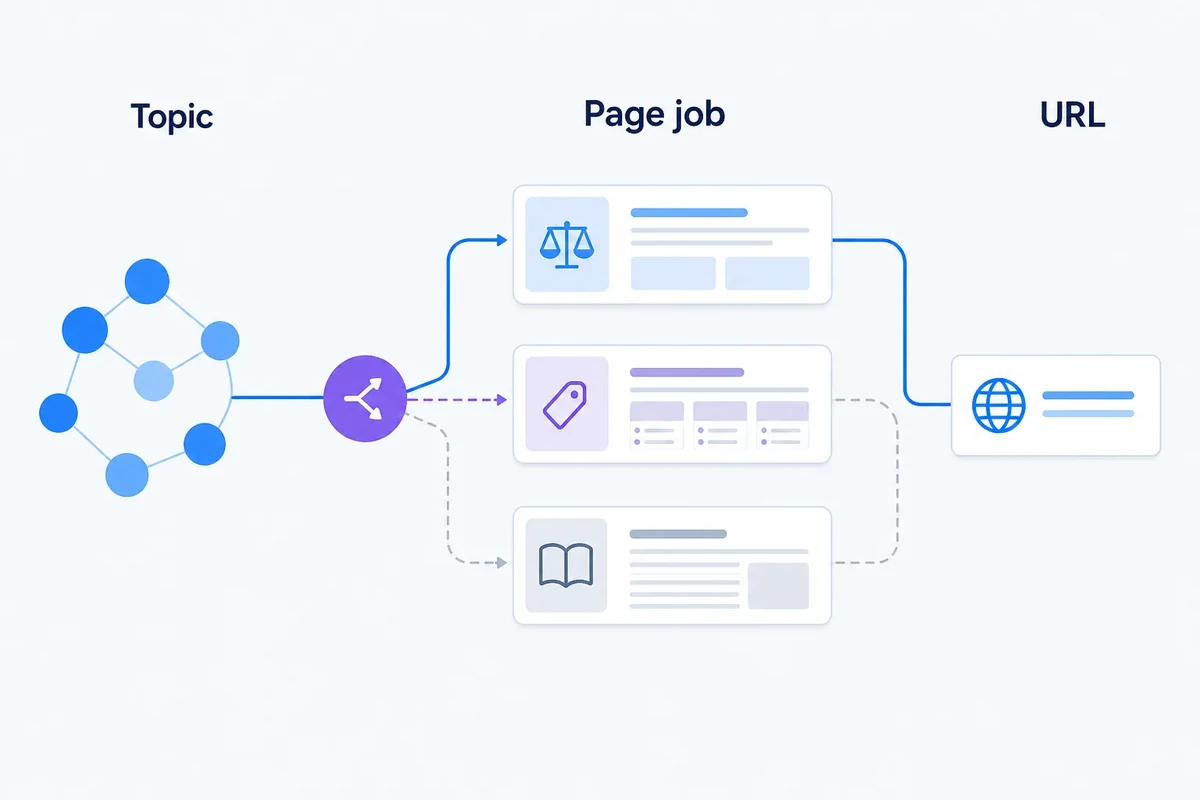
It is easy to confuse what a user wants with the format we use to give it to them. A commercial query could be satisfied by a category page, a product page, a comparison article, or even a calculator tool. Intent describes the user's task; page type describes the solution. Keeping these separate allows you to map keywords to the right URL without being blinded by generic industry labels.
A practical look at keyword clustering software
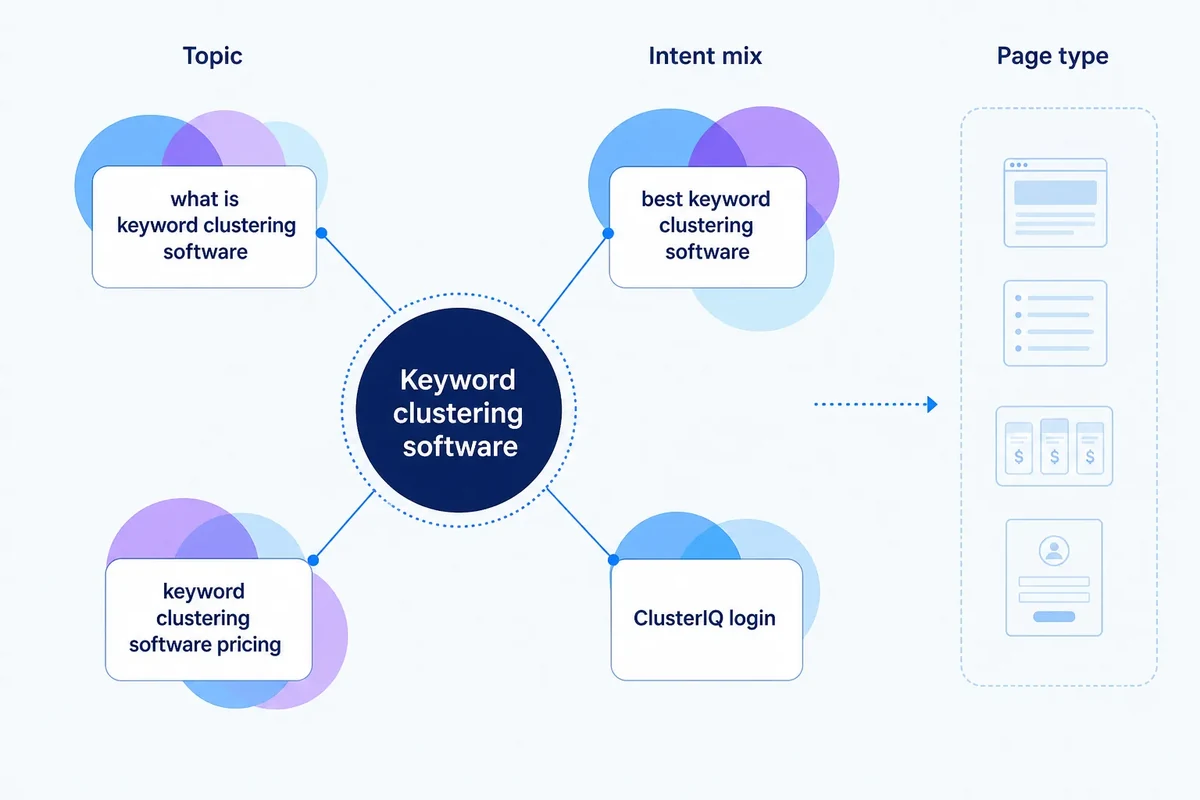
Imagine you are mapping a cluster for "keyword clustering software". Your list includes queries like "what is keyword clustering software", "best keyword clustering software", "keyword clustering software pricing", and "ClusterIQ login". All of these belong to the same broad topic, but they represent different stages of the journey. By using multi-label intent, ClusterIQ can keep these under one parent topic while creating subgroups for learning, evaluation, and account management. This makes your content plan much more actionable.
Why binary labels often work better
Rather than asking a model to choose one category from a list, it is often more effective to ask separate, specific questions. Does the query ask for an explanation? Does it compare different brands? Is there a clear purchase action? Does price define the search? By treating these as independent "yes or no" questions, you end up with a set of features that are much easier for an SEO lead to interpret and act upon.
Setting thresholds for your data
When a model scores intent, it usually returns a range of values. You need to decide at what point a signal becomes "active". These thresholds should not be arbitrary; they work best when calibrated against real examples that your team has labelled by hand. Keeping the underlying scores visible allows for a proper audit if a particular cluster looks slightly off.
Describing clusters through intent mixtures
One of the most useful deliverables is an intent profile for an entire cluster. If a group of 500 keywords shows a profile of 70% comparison, 45% pricing, and 20% transactional, you know exactly what that page needs to do. Because these labels are not mutually exclusive, the percentages can overlap, providing a far more realistic view of the search landscape than a single "Commercial" tag ever could.
Identifying when to split a topic
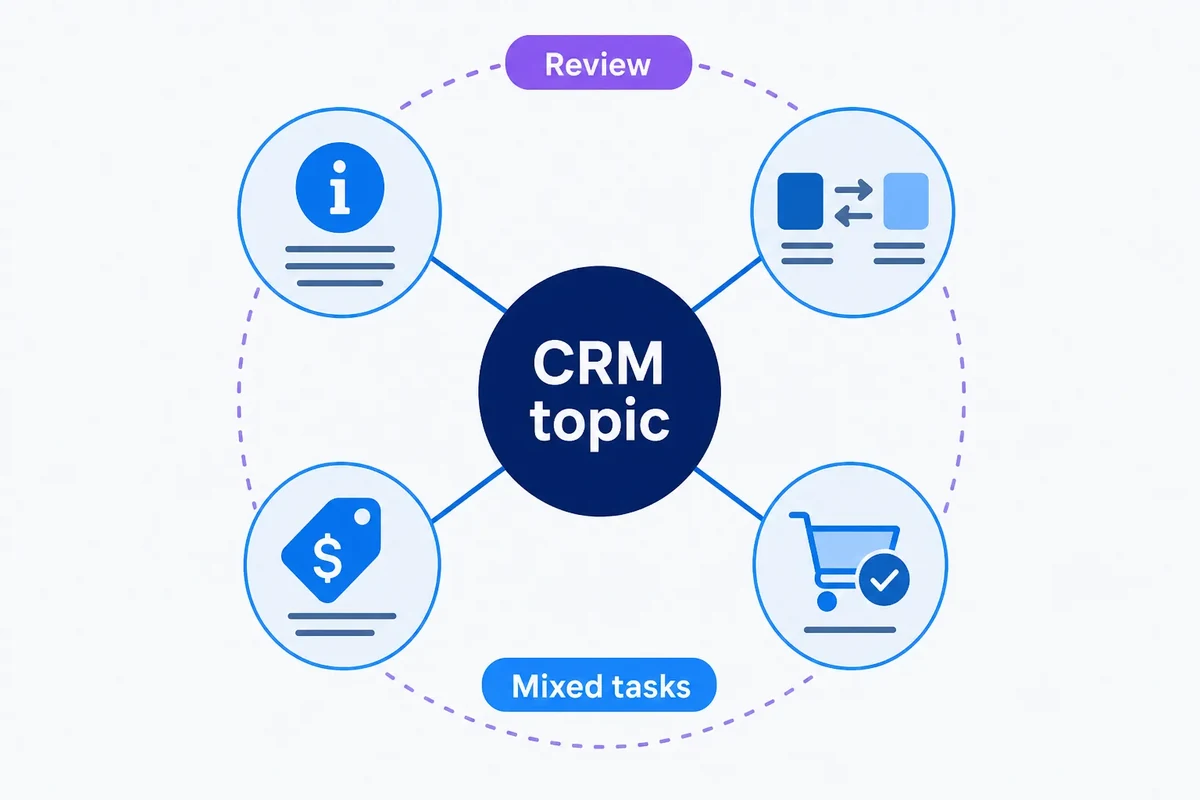
Sometimes a cluster will show two very strong, distinct intent populations. This is a signal that you might need separate pages or distinct sections within a single long-form piece. However, you should always check the SERPs and your existing page types before making an automatic split. Our ClusterIQ's intent guide explains why intent should be treated as evidence to support your strategy, not a shortcut to replace it.
The limits of SERP-only data
It is tempting to define intent solely by what is currently ranking, but search results are a reflection of what is available as much as what is desired. Use SERP data as supporting evidence, but do not let it be the only factor. Similarly, extracting modifiers like "best", "vs", "price", or "how to" provides transparent signals that help verify what a semantic classifier is telling you.
Handling the ambiguity of short queries
A broad term like "keyword clustering" is inherently uncertain. Does the user want a definition, a tool, or a tutorial? Rather than forcing the most common interpretation, ClusterIQ can leave several intents as plausible. This uncertainty is valuable when you are deciding whether to target a high-volume head term with a comprehensive pillar page or a specific tool landing page.
Mapping intent to your URLs
When you are mapping thousands of keywords to a site structure, multi-label intent acts as a safety net. If a keyword has a strong topic match with a URL but a major intent mismatch, it gets flagged for review. This prevents you from accidentally mapping transactional keywords to a purely informational blog post, or vice versa, which is a massive time-saver during large-scale migrations or content audits.
Monitoring intent drift
Search behaviour is not static. Over time, the mix of modifiers and the types of pages Google prefers can shift, even if the core topic remains the same. ClusterIQ can help you track whether a topic is becoming more commercial or perhaps more support-oriented, allowing you to update your content before your rankings start to slip.
ClusterIQ Conclusion
Multi-label intent provides a more sophisticated way to handle the messiness of real-world search data. By moving away from forced, single-label classifications, you can build content plans and URL maps that actually reflect how people search. It keeps your topic membership, page types, and user motives as distinct pieces of the puzzle, leading to better decisions and more effective SEO implementation.
Validate combinations, not only individual labels
A model might score individual intents accurately but still produce a combination that doesn't make sense. A query that looks like it is simultaneously a brand login and a local transactional search probably needs a human eye. We recommend building benchmark families around combinations that change your page-level decisions, such as "comparison plus pricing". This ensures the data is useful at the exact point where intent becomes site architecture.
Preserve the primary decision signal
Even with multiple labels active, you can still identify which one is the "primary" driver for your strategy. A strong pricing signal might be the deciding factor when choosing between a general guide and a dedicated pricing page, but keeping the secondary informational labels visible ensures you don't strip away the context that makes the content helpful.
Sources and further reading
Farky Rafiq
Founder of ClusterIQ
I've worked in digital marketing since 2005 and founded Liquid Silver in 2011. These articles are where I share the methods, experiments and practical SEO thinking behind ClusterIQ.
Put the idea into practice with your own keyword data
ClusterIQ helps turn raw SEO exports into clean, structured working datasets you can inspect, refine, report on and take into the next stage of your workflow.
Keep reading
Page type classification before URL mapping: separating topic relevance from the page a user actually needs
Intent entropy for SEO: measuring when a keyword cluster contains too many different tasks