Intent entropy for SEO: measuring when a keyword cluster contains too many different tasks
A cluster can look topically coherent while containing a messy mix of user tasks. Learn how intent entropy can describe that mixture without pretending one number decides the page.

Farky Rafiq
Founder of ClusterIQ
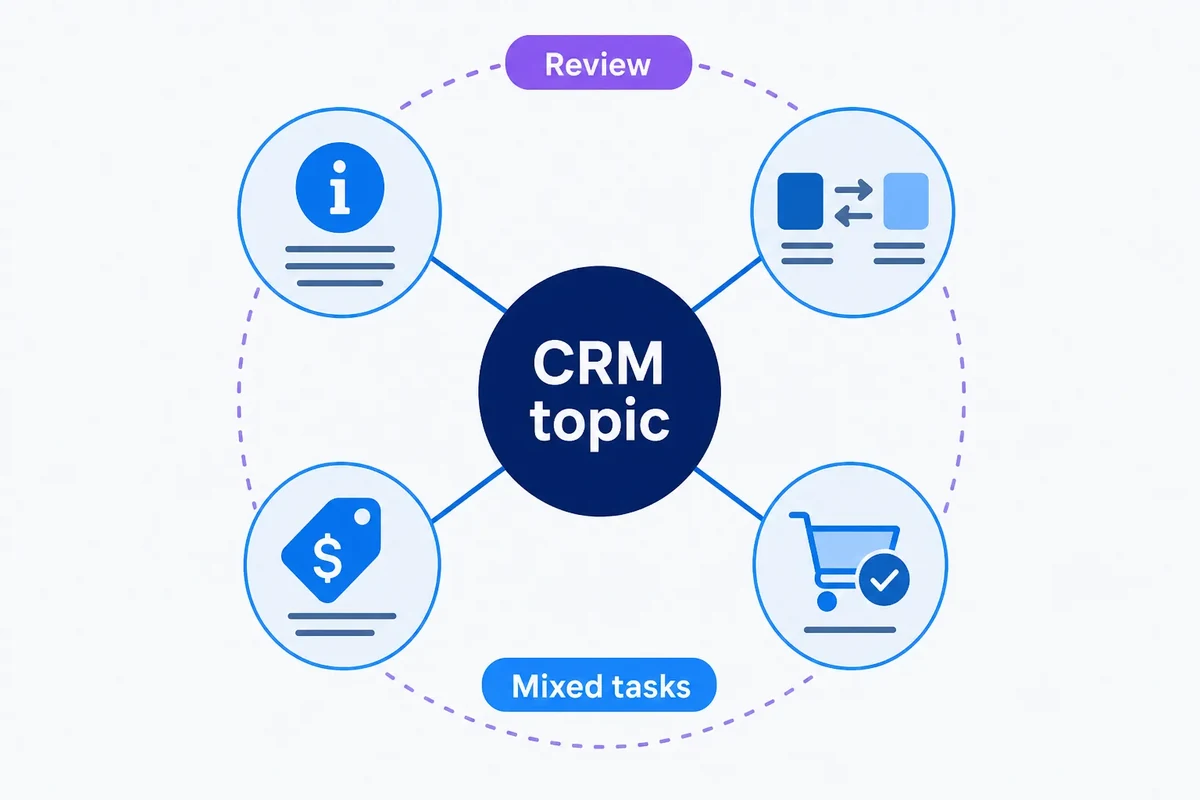
A keyword cluster can be perfectly coherent in terms of its subject matter while remaining an operational mess. You might have a group of a thousand keywords from Ahrefs that all relate to a single product, but the proportions of informational, comparison, pricing, and transactional queries within that group vary wildly. If we only look at a single dominant intent label, we miss how mixed the group actually is.
This is where entropy comes in. It provides a compact way to describe that distribution. Within ClusterIQ, we use it as a diagnostic tool for identifying mixed-task clusters rather than a rigid rule for making decisions.
What entropy measures
In the world of information theory, entropy describes the level of uncertainty or diversity within a probability distribution. If one specific intent dominates a cluster almost entirely, the entropy is low. If several different intent categories are represented equally, the entropy is much higher. The exact figure depends on the specific label set being used and how those probabilities are calculated.
Why this helps cluster review
Imagine you are looking at two clusters, each containing 100 queries. Cluster A is 90 percent comparison and 10 percent pricing. Cluster B is an even split: 25 percent informational, 25 percent comparison, 25 percent pricing, and 25 percent transactional. Both might be assigned the same broad topic label, but Cluster B contains a far more diverse mix of tasks. It deserves a much closer look before you decide to assign all those keywords to a single URL.
Entropy does not tell you whether the mixture is bad
It is important to remember that a broad hub page can legitimately serve several different tasks. A support page might naturally cover setup, troubleshooting, and maintenance. An ecommerce category page can support both browsing and purchase-oriented searches. Therefore, high entropy is a signal that a cluster has diverse intent, not definitive proof that it must be split up.
Worked example: CRM software
Consider a cluster that contains the following:
- best CRM software
- CRM software pricing
- how CRM software works
- CRM demo
- CRM login
The topic is entirely coherent, but the jobs those pages need to do are not. ClusterIQ can use high intent diversity to suggest operational subgroups while still preserving the parent CRM topic for your reporting.
Multi-label intent complicates the calculation
When a single query carries several intent labels, the distribution is no longer a simple partition. One way to handle this is to calculate entropy for each intent dimension separately or use a normalised distribution of all active labels. We believe the method should be documented clearly rather than hiding the statistic behind a vague mixed intent score.
Use intent entropy beside semantic cohesion
A useful view of cluster quality should show several metrics at once. You might see high semantic cohesion and high entity consistency, but also high intent entropy and low page-type consistency. That profile tells a clear story: one topic, but several distinct tasks. This is far more useful than a single, opaque quality number.
Page type can confirm whether entropy matters
If all the queries in a cluster map to the same page type despite having several different intent labels, the mixture is likely manageable. However, if high entropy coincides with a mix of guide, category, pricing, and login page types, the case for an operational split becomes much more persuasive.
Do not compare entropy across incompatible taxonomies
A system with five intent labels will naturally have a different maximum entropy than a system with ten. If you are comparing data across different versions, you must normalise the figures and keep the label taxonomy version in your run metadata.
Small clusters are unstable
A small cluster of just six queries can swing from low to high entropy just by adding one or two new observations from Search Console. It is best to use minimum sample rules or confidence bands before you start escalating these small groups for manual review.
Track intent entropy over time
A stable topic can change its task composition as a market matures. For instance, an emerging product category might start with purely informational queries and later become dominated by pricing and comparison searches. ClusterIQ can track these shifts without claiming that the topic itself has drifted.
Use the statistic for prioritisation
High-value clusters with high intent entropy should move to the front of your review queue. The cost of a simplistic page mapping is much higher for these groups. Conversely, low-value exploratory clusters can be left alone until you have stronger evidence to act on.
Explain it in plain language
Most people in a marketing team do not need to see the entropy formula. ClusterIQ can simply display a note: This topic contains a broad mix of informational, comparison, and pricing tasks. Review whether one page should serve all of them. The underlying statistical value remains available for those who need the advanced diagnostics.
Combine with modifier evidence
Intent diversity usually has a visible explanation in the words themselves, such as best, price, how to, buy, or login. Using modifier extraction helps explain exactly why the entropy is high in the first place.
Do not optimise for low entropy everywhere
If ClusterIQ were to blindly split groups until every cluster contained only one intent, it would fragment coherent topics into dozens of artificial, tiny groups. The goal is to create a useful structure for your page plans, not to achieve minimum entropy for its own sake.
Practitioner principle: intent entropy describes how mixed the tasks are. It does not decide whether those tasks should share a page.
ClusterIQ Conclusion
Intent entropy provides a vital diagnostic for topic groups that contain several competing user tasks. When combined with semantic cohesion, page type, and modifier evidence, it highlights where a broad cluster needs operational review without turning a statistical measure into an automated, and potentially damaging, split rule.
Compare intent diversity before and after operational splitting
If a high-entropy topic is split into candidate page groups, ClusterIQ can recalculate the intent distribution for each new child group. A split is successful when the children become clearer in their purpose without fragmenting the semantic topic into trivial variations.
For example, separating pricing and tutorial queries from a broad software cluster may create two lower-entropy groups that map cleanly to a pricing page and a guide. However, splitting every comparison modifier into its own group might reduce entropy further while producing an impossible site architecture. This gives the statistic a concrete role in quality assurance. We are not looking for the lowest possible entropy, but a meaningful reduction in task conflict at the point where a single URL must serve the group.
Sources and further reading
Farky Rafiq
Founder of ClusterIQ
I've worked in digital marketing since 2005 and founded Liquid Silver in 2011. These articles are where I share the methods, experiments and practical SEO thinking behind ClusterIQ.
Put the idea into practice with your own keyword data
ClusterIQ helps turn raw SEO exports into clean, structured working datasets you can inspect, refine, report on and take into the next stage of your workflow.
Keep reading
Multi-label search intent for keyword clustering: when one query is doing more than one job
How to evaluate keyword cluster quality: metrics, stability and human review