Query modifiers as structured clustering features: preserving the words that change SEO intent
Words such as best, price, reviews, near me and 600mm can change the page a query needs. Learn how to model modifiers explicitly instead of hoping embeddings preserve them.

Farky Rafiq
Founder of ClusterIQ
When you are staring at a spreadsheet of three thousand keywords from Ahrefs or Search Console, it is easy to focus on the big nouns. However, some of the smallest words in that dataset actually carry the heaviest SEO consequences.
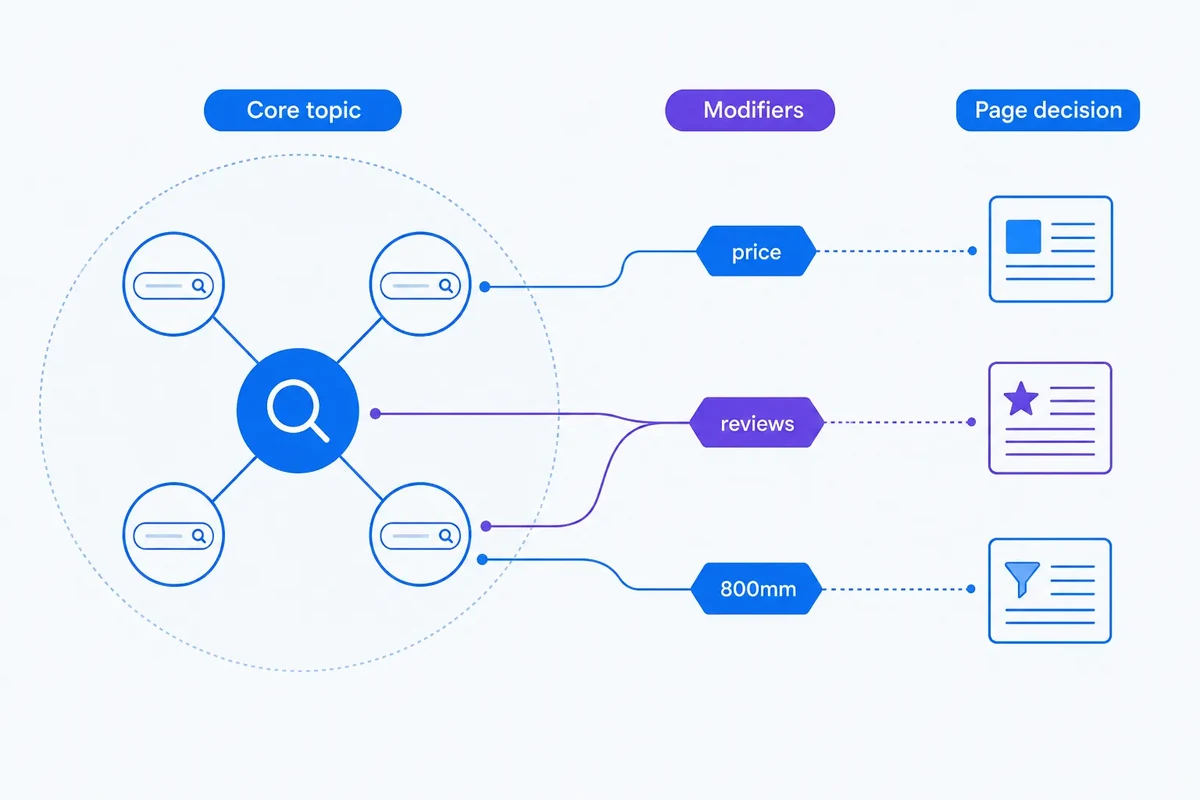
Terms like CRM software, best CRM software, CRM software pricing and CRM software reviews share almost all their DNA. Yet those tiny modifiers completely change what the user wants to do. If a clustering tool only looks at the broad topic, it might suggest one single page for all of them, which would be a mistake for your content plan.
Modern semantic embeddings are brilliant at recognising that these queries belong together, but as a practitioner, you need those modifiers preserved. You need to know if a cluster is actually three different pages masquerading as one topic.
What counts as a modifier?
In a practical workflow, we look for specific families of words that signal a shift in intent:
- Commercial: best, cheap, premium, deals;
- Transactional: buy, order, book, download;
- Comparison: vs, alternatives, reviews;
- Price: cost, pricing, quote;
- Location: London, near me, postcode;
- Product attributes: size, colour, material, model;
- Task: how to, fix, install, replace;
- Audience: for agencies, for beginners, for enterprise.
These categories are not set in stone. ClusterIQ allows these feature sets to be domain-aware, because what matters to a software buyer is very different from what matters to someone buying bathroom tiles.
Why embeddings may smooth modifiers over
Embedding models are built to understand broad meaning. To a mathematical model, CRM pricing and CRM reviews are almost identical because they occupy the same conceptual space. For high-level topic discovery, this is a feature. For mapping specific URLs, it is a bug.
This is precisely why intent-aware clustering should never rely on embeddings in isolation. You need a layer that respects the specific vocabulary of the searcher.
Extract modifiers before clustering
A smart preprocessing step identifies these features while keeping the original query intact. When processing a list, ClusterIQ can store specific fields alongside the keyword, such as the core topic, brand, location, or audience. This extraction uses a mix of fixed dictionaries, regular expressions, and entity recognition to make sure nothing important is missed.
Do not strip the modifier from the embedding automatically
Just because we have extracted a modifier into a separate data column does not mean we should delete it from the text the AI sees. We keep the original query for the semantic encoding but attach the structured features as extra context. This ensures the model understands the full language while you, the human reviewer, have the hard evidence needed to make a final call.
Worked example: ecommerce dimensions
Imagine you are categorising keywords for a home improvement site:
- black shower screen;
- 800mm shower screen;
- 800mm black shower screen;
- 900mm black shower screen.
The core entity is the same, but the width and colour modifiers dictate whether these should be separate landing pages, simple filters, or product facets. ClusterIQ keeps these in a semantic group but highlights the attributes so you can decide how to structure the site navigation.
Modifiers can be hard constraints
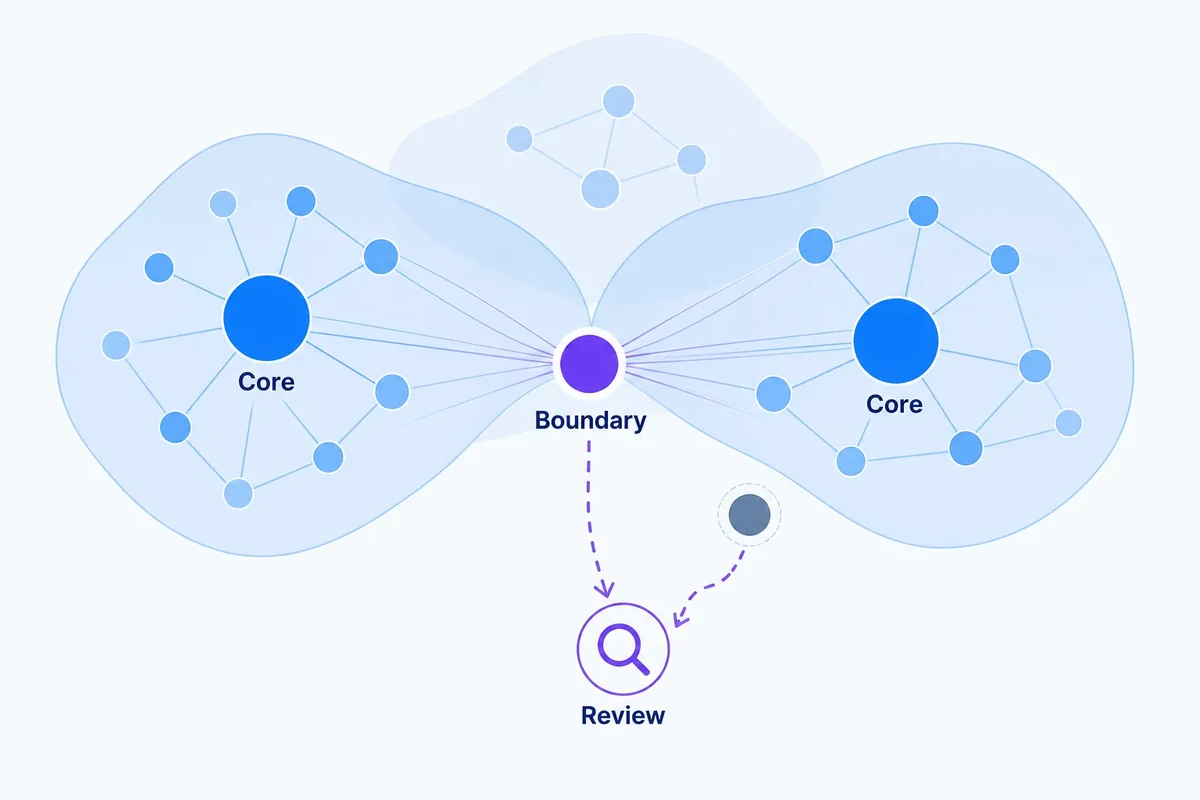
Sometimes a modifier is so important it should act as a barrier. A country name might mean the query belongs to a different market entirely. A specific part number might map to a unique SKU. In these cases, ClusterIQ can apply a hard incompatibility rule. Instead of just slightly lowering a similarity score, it can prevent these keywords from merging and tell you exactly why it kept them apart.
Other modifiers are softer
Not every modifier requires a new page. Words like best and reviews often overlap in the SERPs for commercial research. They do not always need to trigger a new cluster. The goal is to store the feature and then look at the search results to see if the distinction actually changes the page type required.
Modifier distributions help label clusters
Rather than giving a cluster a single, often inaccurate binary label, it is more useful to see a distribution. A group of keywords might be 70% comparison-led, 20% pricing, and 10% generic. ClusterIQ surfaces these patterns, giving you a much clearer picture of what the content should actually focus on.
Modifiers can explain mixed clusters
If you find a cluster that seems semantically related but has a messy mix of different page types in the SERPs, look at the modifiers. A split between how to, buy, and reviews usually explains why one topic is pulling in several different user tasks. Identifying this early saves hours of manual cleanup later.
Use modifiers in content briefs
These modifiers are the building blocks of a great content brief. Pricing modifiers tell the writer to include cost tables; comparison modifiers signal a need for decision criteria; and task modifiers suggest a step-by-step guide. This makes ClusterIQ-generated content briefs far more actionable without resorting to old-fashioned keyword stuffing in headings.
Do not over-classify every word
It is tempting to try and label every single word, but a massive ontology is a nightmare to maintain. Start with the modifiers that actually change your SEO decisions. You can always expand the feature set later when you notice a recurring pattern that the system is missing.
Use practitioner overrides as feedback
The best way to refine the system is through real-world use. If you find yourself manually separating queries because of a specific modifier, that is your signal to create a new rule. The tool gets smarter by learning which distinctions you actually care about in your day-to-day work.
Practitioner principle: modifiers are small pieces of language with disproportionate decision value. Preserve them explicitly when they change the page, market or task.
ClusterIQ Conclusion
Query modifiers provide the precision that raw semantic clustering often lacks. By modelling price, location, and task modifiers alongside broad semantic relationships, ClusterIQ protects the nuances of search intent. This ensures you get the efficiency of automation without losing the tactical detail that makes an SEO strategy successful.
Maintain modifier rules by domain
Context is everything. The word commercial might refer to an audience in the insurance sector, but it is just a generic descriptor in others. Similarly, a dimension like 600mm is vital for a kitchen retailer but irrelevant for a consultant. ClusterIQ allows you to configure these rules by workspace, ensuring your data stays clean and focused on the distinctions that actually move the needle for your specific project.
Sources and further reading
Farky Rafiq
Founder of ClusterIQ
I've worked in digital marketing since 2005 and founded Liquid Silver in 2011. These articles are where I share the methods, experiments and practical SEO thinking behind ClusterIQ.
Put the idea into practice with your own keyword data
ClusterIQ helps turn raw SEO exports into clean, structured working datasets you can inspect, refine, report on and take into the next stage of your workflow.
Keep reading
Search intent classification in keyword clustering: useful signal, dangerous shortcut

Page type classification before URL mapping: separating topic relevance from the page a user actually needs