Gaussian mixture models for SEO: when soft probability beats a hard cluster label
Gaussian mixture models assign probabilities across components rather than forcing one hard label. Learn where that helps ambiguous keyword analysis and where the assumptions break down.

Farky Rafiq
Founder of ClusterIQ
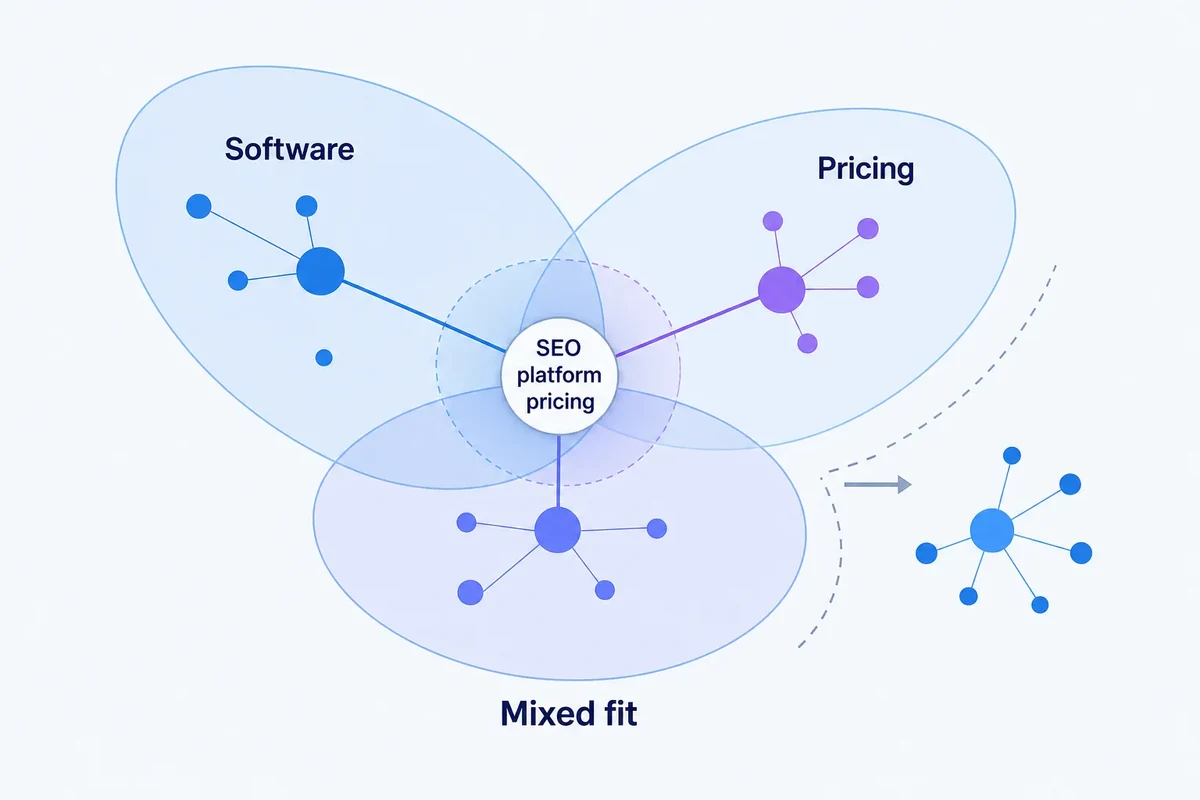
When you are working through a few thousand keywords from Ahrefs or Search Console, most clustering tools force every query into a single bucket. It is tidy, but it often feels wrong. You might have a keyword like "enterprise SEO platform pricing" that clearly belongs to a commercial software group, but also shares a strong connection with your pricing-specific content plan. By forcing it into one box, you lose the nuance of how that search term actually behaves.
Gaussian mixture models (GMMs) offer a different way forward. Instead of giving a query a single hard label, they treat your data as a blend of different probability distributions. This allows a keyword to be, for example, 70% associated with one topic and 30% with another. For ClusterIQ, this is a powerful way to handle the natural ambiguity of search intent rather than pretending it does not exist.
What a Gaussian mixture model does
At its heart, a GMM assumes that your keyword data was created by several different underlying groups, each following a Gaussian (or normal) distribution. The model looks at your dataset and estimates the parameters for these groups, returning the probability that a specific keyword belongs to each one.
These groups act as soft clusters. While the mathematical assumptions behind them are quite rigid, they provide a flexible way to see how keywords sit between different topics.
Soft membership is the main practical benefit
The real value for a busy SEO is in preserving relationships. If you are building a content brief for a technical SEO tool, you want to know if a keyword also has a strong commercial research intent. A hard clustering algorithm might hide that secondary relationship to keep the spreadsheet clean. A mixture model keeps that data visible, showing you exactly where a keyword straddles two different content pillars.
Probability is only meaningful under the model
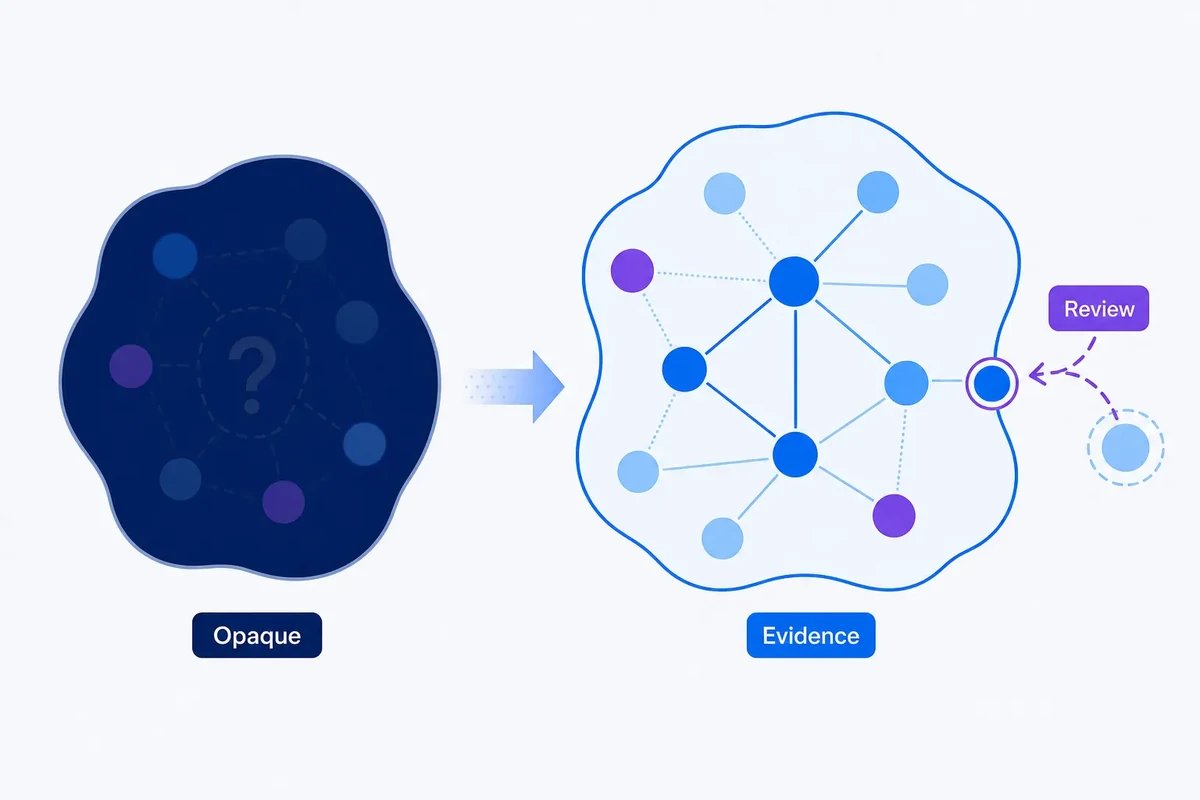
It is important to stay grounded here. The probability score you see is a mathematical value based on how the model was fitted. It is not a literal "probability that this is the perfect page for this keyword". ClusterIQ treats these values as evidence of relationship strength, keeping them distinct from other signals like page type, entities or live SERP features.
Gaussian geometry can be a poor fit for embeddings
Keywords turned into vector embeddings do not always behave like neat, symmetrical blobs. They can be curved, irregular or grouped in odd shapes. Because GMMs expect these groups to look like ellipses in your data space, they are not always a perfect fit. This is why we treat them as one useful lens for analysis rather than a single source of truth.
Covariance controls cluster flexibility
If you are using Scikit-learn's GaussianMixture, you will encounter covariance settings like full, tied, diagonal or spherical. These determine how much freedom each cluster has to change its shape and orientation. A full covariance setting lets the model be very precise, but it requires more data and can sometimes overfit smaller lists. Spherical covariance is simpler and faster but can miss the subtle shapes in your keyword landscape.
Worked example: commercial research queries
Let's say you have a list of 500 keywords focused on SEO software, including terms like:
- best SEO software;
- enterprise SEO platform;
- SEO software pricing;
- SEO platform reviews;
- technical SEO tool;
- keyword clustering software.
A mixture model might show that "SEO software pricing" has a primary home in a commercial intent group, but also retains a secondary membership in a "pricing and comparison" group. This helps you decide whether to create a dedicated pricing page or include that information on a main product tour. However, the final call still relies on the evidence found in ClusterIQ's page-type workflow.
Choose component count with care
Just like with K-means, you usually have to tell the model how many clusters you want. Statistical tools like AIC and BIC can suggest a number that fits the data well, but they do not know your business goals. Use these metrics as a guide, but always check if the resulting topics actually make sense for your site architecture.
Initialisation can change the solution
Because these models can settle on different results depending on where they start, it is vital to run them multiple times. We look for stable memberships to ensure the clusters are reliable. This focus on consistency is a core part of other ClusterIQ models as well.
Compare soft membership with HDBSCAN evidence
Other methods like HDBSCAN also offer membership strengths, but they calculate them based on how dense the data is. Comparing a GMM's probabilistic approach with HDBSCAN's density approach is a great way to find keywords that are truly ambiguous regardless of the math used. If both models are unsure, that keyword definitely needs a human eye.
Mixture models can support review prioritisation
This is a huge time saver. A keyword with a 96% match to one group is an easy "yes" for your automation. A keyword split 38% / 34% / 28% across three groups is a red flag. ClusterIQ can flag these messy cases for manual review, letting you focus your energy on the difficult decisions while the obvious ones get processed instantly.
Do not expose five decimals of false confidence
We avoid cluttering your reports with long strings of numbers that imply more precision than actually exists. Instead, we focus on clear states:
- clear primary membership;
- mixed membership;
- weak fit to all components.
The goal is to help you make a decision, not to make the interface look like a lab report.
Use mixture models where overlap matters
These models are at their best when your keywords naturally span multiple themes, when you need to see the "grey areas" between topics, and when your dataset is small enough to test a few different configurations.
Where ClusterIQ should remain cautious
If the data does not fit the Gaussian shape or the clusters keep shifting every time you run the model, a probabilistic output can be misleading. It might look authoritative, but it could be built on shaky ground. We always keep the underlying assumptions and alternative views visible so you can trust the results.
Practitioner principle: soft probabilities can preserve ambiguity, but they are probabilities inside a statistical model, not probabilities that an SEO decision is correct.
ClusterIQ Conclusion
Gaussian mixture models are a sophisticated alternative to standard clustering. By exposing mixed memberships and boundary cases, they help you understand the messy reality of search intent. When used alongside density and graph based methods, they ensure your final page and business decisions are based on the full picture, not just a simplified label.
Sources and further reading
Farky Rafiq
Founder of ClusterIQ
I've worked in digital marketing since 2005 and founded Liquid Silver in 2011. These articles are where I share the methods, experiments and practical SEO thinking behind ClusterIQ.
Put the idea into practice with your own keyword data
ClusterIQ helps turn raw SEO exports into clean, structured working datasets you can inspect, refine, report on and take into the next stage of your workflow.
Keep reading

Soft clustering and confidence scores: handling ambiguous keywords honestly
Keyword clustering vs topic clustering: what’s the difference?