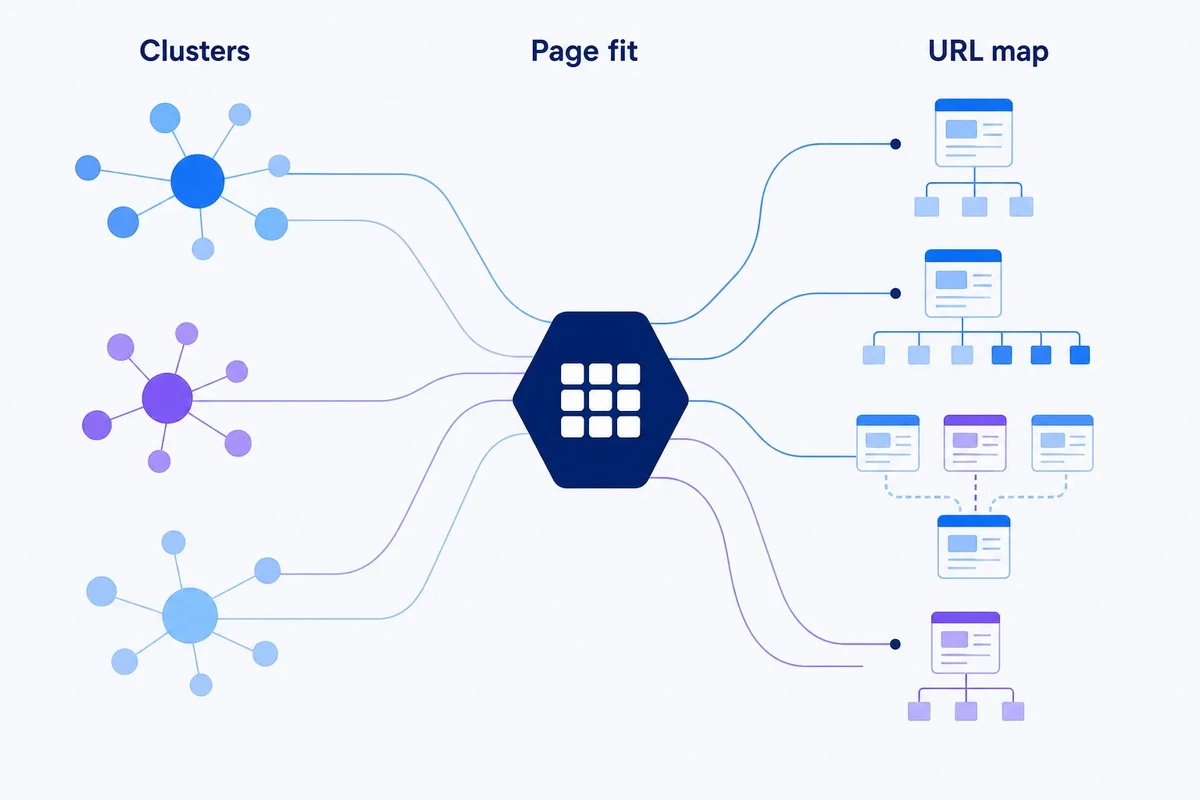
Keyword clustering vs topic clustering: what’s the difference?
Keyword clustering and topic clustering are often treated as interchangeable SEO methods. They are better understood as different levels of analysis: one groups observed search expressions, while the other describes the broader semantic or editorial structures those expressions may represent.

Farky Rafiq
Founder of ClusterIQ
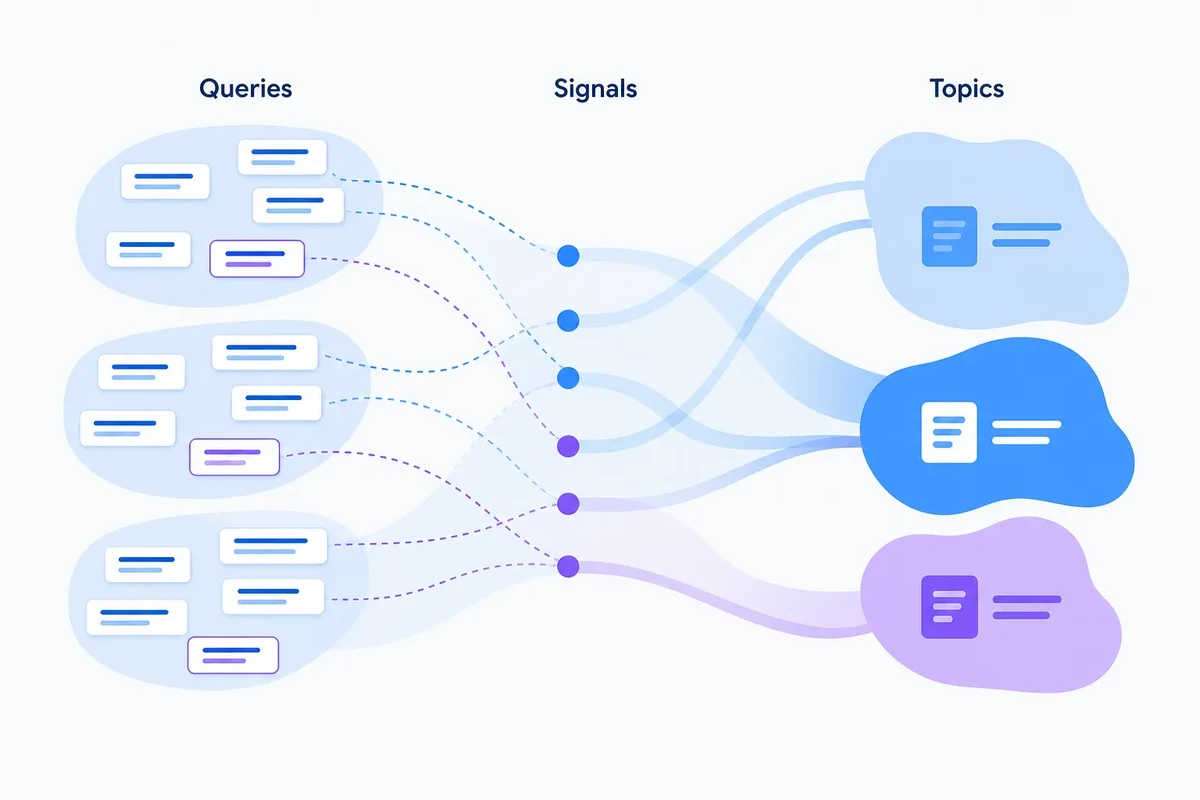
You have a spreadsheet of 1,500 keywords and need to turn it into something useful: page updates, content briefs or a clearer site structure. Should you use keyword clustering or topic clustering? The names are often used interchangeably, but the useful distinction is not necessarily the software, algorithm or chart. It is what you are grouping, how you judge the relationship and what you want to decide next.
Keyword clustering usually groups actual search-query strings. It can help you spot similar searches, reduce duplication in a keyword list and assess whether several phrases might belong on one page. Topic clustering takes a broader view. It looks for themes, concepts or editorial structures represented by a set of queries or documents.
This matters because a group can make mathematical sense without making a good page target, content hub or category in your site structure. Choose the method around the decision you need to make, rather than which label sounds more sophisticated.
The short version
Keyword clustering starts with search expressions as the main things being analysed. Topic clustering focuses on broader themes, underlying subjects or relationships between pieces of content.
- Keyword clustering: Which queries are closely enough related for the task at hand?
- Topic clustering: What broader subjects or meaning-based structures organise these queries or documents?
These questions overlap, but they are not the same. Searches for “running shoes for flat feet”, “best trainers for overpronation” and “stability shoes for beginners” may sit within a useful topic area around stability footwear. That does not automatically mean they should all target one URL, use the same page format or count as one commercial opportunity.
Both approaches can use word matching, embeddings, search-result overlap or statistical models. The main differences are the inputs, how broad a view you take and what you intend to do with the output.
What keyword clustering usually means
For this work, it helps to think of a keyword as a search-query string you have observed or selected, rather than a phrase with one guaranteed meaning or intent. Your inputs might come from Search Console, a keyword-research export or a list you have put together manually.
Keyword clustering groups those strings using a chosen relationship. Common signals include:
- shared words, word stems or modifiers;
- similarity in meaning between query embeddings, which are numerical representations of the queries;
- overlap between search results;
- shared entities, products or attributes;
- similarity in accompanying metadata, such as market or search volume.
Each signal answers a different question. Lexical similarity, or word-based similarity, asks whether the phrases look alike. Embedding similarity asks whether they are close within a particular model’s representation of language. Search engine results page (SERP) overlap asks whether they currently return similar observed results.
None of these signals proves on its own that two queries have identical intent or should share a URL. Short searches often leave a lot unsaid. For example, “apple watch battery” could mean battery life, replacement parts, charging problems or a product comparison, depending on the context and search environment.
Typical uses for keyword clusters
Keyword clustering is most useful when your next decision concerns individual queries or groups of queries. It can help you:
- remove duplicate or near-duplicate keyword variations;
- map related queries to existing pages for further investigation;
- identify possible page targets;
- organise a keyword dataset for briefs or reporting;
- flag queries for separate review when their relationships are unclear.
These uses are deliberately practical. A keyword cluster is not necessarily a topic, and it is not a finished content plan. It is a group of observed queries brought together under a particular set of assumptions.
What topic clustering can mean
“Topic clustering” has a less settled meaning. People use it to describe several different activities:
- statistical topic modelling, such as finding underlying patterns in how words are distributed across a collection of documents;
- embedding-based clustering of queries or documents, with the groups then interpreted as themes;
- exploring recurring subjects in a corpus, meaning a collection of text;
- planning an editorial structure that connects a broad subject to narrower subtopics and supporting content.
These activities are not interchangeable. A statistical topic model and a content-strategy map may both use the word “topic”, but they answer different questions and give you different kinds of output.
Topic modelling is not automatically content architecture
Latent Dirichlet allocation, usually shortened to LDA, is a useful example. LDA represents each document as a mixture of underlying topics. Each topic, in turn, is represented as a probability distribution over words: some words are more likely to appear within that topic than others. A document can therefore belong partly to several topics, rather than sitting exclusively in one category.
A model might identify a topic associated with “battery”, “charge”, “hours” and “power”. That tells you about a statistical pattern in the text collection. It does not tell your SEO team whether to create a category page, write an article, build a product-support section or add a set of internal links.
A model-generated topic is not automatically a taxonomy, content hub, page plan or URL-mapping recommendation. To turn it into any of those, you need to interpret and name it, then make a separate decision about your audience and site structure.
The same algorithm can support different levels of analysis
Keyword clustering versus topic clustering is not a choice between two distinct sets of algorithms. You can use the same technique at different levels.
For example, sentence embeddings can represent queries or documents as vectors, which are lists of numbers. Cosine similarity can estimate how close those vectors are, and a clustering method can group items within that numerical space. If you feed in individual queries and use the groups to investigate page targets, you are using the process for keyword clustering. If you feed in documents or interpreted groups of queries and use the output to describe broader themes, you may be using it for topic discovery.
The technique has not necessarily changed. What has changed is the thing being represented and the decision the analysis supports.
The same distinction applies when choosing clustering and visualisation techniques:
- K-means divides the items being analysed into a number of clusters that you choose. The result depends on how those items are represented and scaled, the algorithm’s starting conditions and the number of groups selected.
- HDBSCAN finds groups based on density and can leave some items unassigned as noise. An unassigned query is not necessarily unimportant. It may simply not fit the density structure selected by the method and its settings.
- UMAP can help you visualise representations that have many dimensions. However, reducing dimensions is a separate task from clustering. A two-dimensional chart is not a complete or neutral picture of every relationship in the original data.
More broadly, the result depends on what you group, how you represent it, the similarity or distance measure, the algorithm and its settings. Changing any of these can change the groups you get, without making either approach technically invalid.
Why semantic similarity is not the same as shared intent
Embedding-based methods can find relationships that straightforward word matching misses. For example, “how to improve website speed” and “ways to make a site load faster” use different wording, but a suitable model may recognise that they are close in meaning.
The catch is that phrases can share a subject while asking for different things. Their audience, buying stage or required content format may also differ. Consider these illustrative searches:
- “best project management software for agencies”;
- “how to manage projects for an agency”;
- “project management agency template”;
- “project management software pricing”.
They relate to the same broad subject, but they may need a comparison page, an educational guide, a downloadable template and a pricing page respectively. A topic-level grouping could reasonably put them together. If you are mapping queries to pages, you still need to look at the task behind each search.
Our practical view is to treat semantic similarity as a signal, not a replacement for search-intent analysis. A similarity score shows relatedness within a particular representation. It is not a universal cut-off for deciding that two searches need the same content.
What SERP-overlap clustering adds
Search-result overlap gives you a different kind of evidence. If two queries repeatedly return many of the same pages, they may be practically similar within the current search results. That can be useful when assessing whether they could share a page target.
Still, SERP overlap shows you an observed outcome, not a transparent account of what users want. Results can vary with location, language, device, time, personalisation, freshness and query context. Shared results may also reflect authority, ranking systems, site templates or a small set of pages that happen to dominate those searches.
Overlap therefore does not prove that the underlying intent is identical, or that the queries should always target the same page. It can inform your decision, especially alongside an interpretation of the queries and a review of page formats, but it should not become a fixed rule.
Search Console offers another useful connection between queries and pages, through performance data for a particular property. It can help you see which queries have appeared alongside which pages. However, it remains a partial view of search behaviour, not a complete picture of demand, users or competing results.
How to use the outputs differently
The distinction becomes much more useful when you connect it to what you need to decide next.
Use keyword clusters for query and page decisions
Keyword clusters can help you answer questions such as:
- Which query variations are close enough to review together?
- Which existing page appears to serve a group of related searches?
- Which terms might be duplicates, paraphrases or spelling variants?
- Where should the boundaries between possible page targets sit?
Usually, the output is a working set to investigate, not a final instruction. Before changing URLs or content plans, review what the queries mean, the current results, the audience, geography, freshness requirements and likely page format.
Use topic clusters for subject and editorial decisions
Topic-level groups can help you explore questions such as:
- What broad subjects keep appearing across the text collection?
- Which subtopics seem to belong within a wider area of knowledge?
- Where are the gaps between the organisation’s products, its audience’s questions and its existing content?
- How could a content programme or taxonomy organise the subject usefully for people?
A topic cluster can give you a starting point for discussing content hubs or information architecture, meaning how information is organised on your site. It is not a ready-made hub. You still need editorial decisions about audience, navigation, page purpose, ownership, maintenance and commercial relevance.
Why one cluster does not always equal one page
There is no general evidence-based rule that each keyword or semantic cluster should map to exactly one page. Whether a page is suitable depends on intent, audience, format, geography, freshness, commercial purpose and the constraints of the site.
A broad topic may need several pages to serve it well. Equally, one useful page may cover several closely related query variants. The right boundary comes from the search task and the site’s information architecture, not just the shape of an algorithm-generated group.
Pay particular attention to bridge terms: queries that plausibly connect two subjects or sit between informational and commercial tasks. Forcing one into an exclusive group may tidy up the spreadsheet while hiding genuine ambiguity.
How to evaluate a clustering result
Internal metrics can help you check how a clustering result behaves. For example, a silhouette score gives information about how closely items sit within their own groups and how separated those groups are, based on the chosen representation. A high score does not establish that the groups are useful for page mapping, content architecture or commercial segmentation.
A practical evaluation also needs to test the result against its intended job:
- Check the input. Are you grouping raw queries, normalised queries, documents, URLs or a mixture? Normalised queries have been standardised in some way before analysis.
- Inspect the representation. Which words, embeddings, metadata or search-result sets determine similarity?
- Review boundaries. Examine neighbouring groups, outliers and bridge terms, rather than only the most representative items in each cluster.
- Compare with the decision. Does the grouping help with normalisation, page targeting, taxonomy design or content planning?
- Test stability. Would a different collection date, location, model or parameter setting materially change the result?
- Record uncertainty. Keep ambiguous cases visible rather than presenting every assignment as definite.
Human review is particularly important before clusters drive changes to page mapping, site architecture or commercial segmentation. That is a practitioner judgement, not a guarantee of better outcomes. Review takes time and introduces subjectivity, so significant decisions benefit from documented criteria and, where appropriate, more than one reviewer.
A decision framework for SEO teams
Start by stating what you need to decide. Then choose the methods that can provide useful evidence.
- Need to clean or normalise a keyword list? Start with word-based rules and query-level clustering.
- Need to explore related language across a large text collection? Consider embeddings or topic-modelling methods, then inspect the themes they produce.
- Need to assess whether queries could share a page? Combine your interpretation of the queries with SERP evidence, existing-page data and page-format analysis.
- Need to plan a content hub? Use topic-level evidence as an input, then design the editorial structure separately.
- Need to build a taxonomy? Consider user language, product or service relationships, navigation and maintenance needs, rather than relying only on statistical similarity.
A combined approach can be useful because each signal answers a different question. Word-based similarity can pick up obvious variants. Embeddings can find paraphrases and broader relationships. SERP data can show which pages search engines currently return. None should be treated as the final authority in every situation.
ClusterIQ Conclusion
Keyword clustering and topic clustering work at different levels. Keyword clustering organises observed search expressions for a practical task. Topic clustering tries to describe the broader meaning-based, statistical or editorial structure suggested by those expressions and documents.
That distinction matters more than the label on the software. Embeddings, SERP overlap, LDA, K-means and HDBSCAN can contribute to different approaches, depending on what you group and which relationship you measure.
For SEO, treat a cluster as evidence for a decision, not the decision itself. Check it against intent, page format, search context and the purpose of the site. A technically coherent group becomes useful when it helps you make a better, clearly defined choice about your content or site structure.
Farky Rafiq
Founder of ClusterIQ
I've worked in digital marketing since 2005 and founded Liquid Silver in 2011. These articles are where I share the methods, experiments and practical SEO thinking behind ClusterIQ.
Put the idea into practice with your own keyword data
ClusterIQ helps turn raw SEO exports into clean, structured working datasets you can inspect, refine, report on and take into the next stage of your workflow.
Keep reading
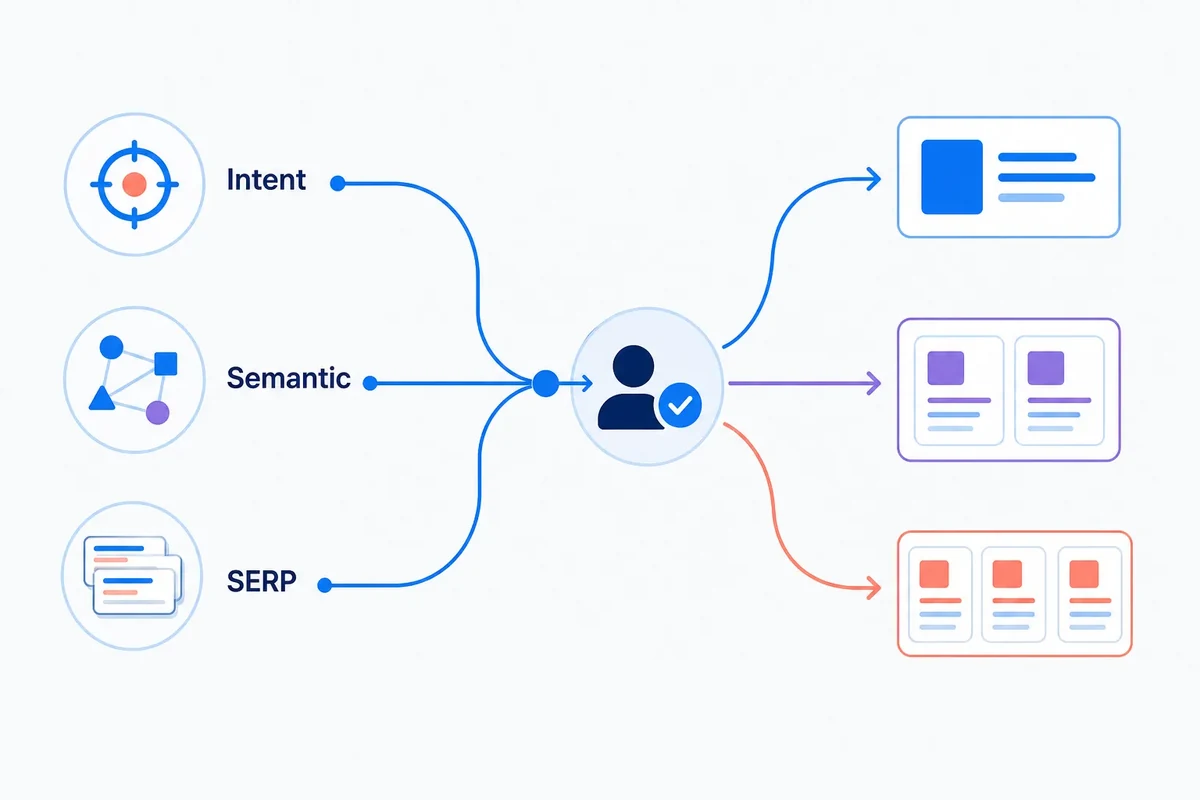
How to combine search intent, semantic similarity and SERP overlap for keyword clustering
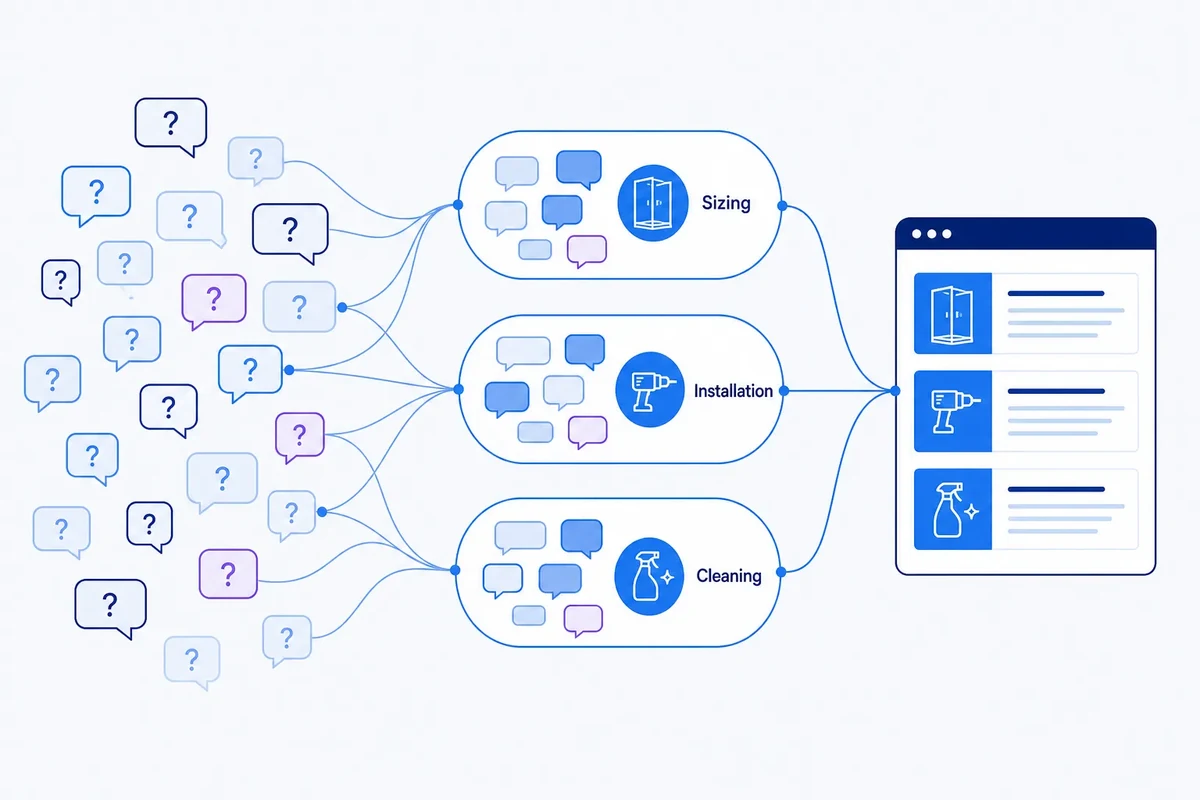
Clustering question keywords for SEO: turning hundreds of queries into useful answers instead of an FAQ factory