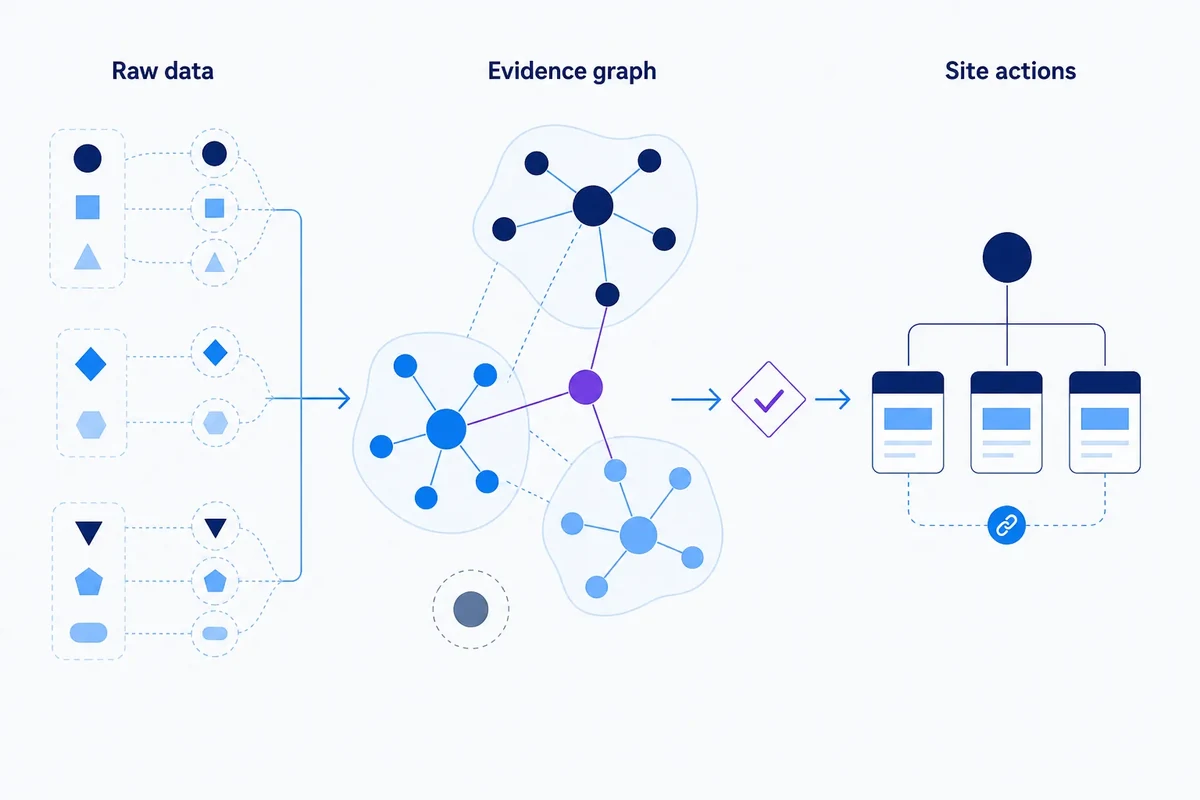
Clustering question keywords for SEO: turning hundreds of queries into useful answers instead of an FAQ factory
Question queries reveal recurring user needs, but every question does not deserve a new page or FAQ. Learn how ClusterIQ groups them into answerable themes and page decisions.

Farky Rafiq
Founder of ClusterIQ
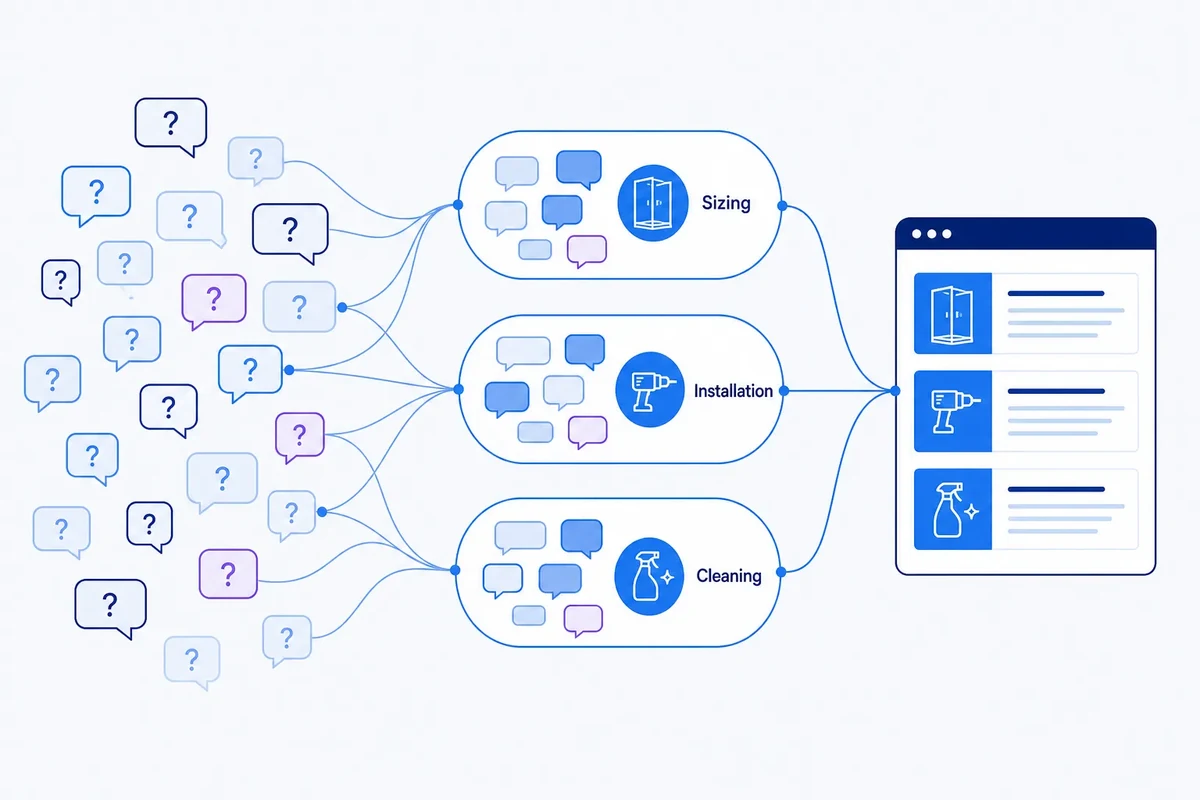
An export of 800 question keywords from Ahrefs, Semrush or Search Console can look like a ready-made content plan. But writing an FAQ answer for every “what”, “how” and “should” quickly creates repetition: many queries are paraphrases or steps within the same task.
ClusterIQ can group questions by meaning, task and answer scope before you decide where they belong. The useful deliverable is a clearer content plan, not a longer publishing queue.
Start by preserving the actual question
Do not automatically remove question words when cleaning an export. “How to install X” and “where to buy X” mention the same thing but describe completely different tasks. The question structure is evidence of what the searcher needs.
Group paraphrases first
These queries may all need the same answer:
- how does keyword clustering work;
- how does clustering keywords work;
- how are keywords clustered.
Semantic similarity, which compares meaning, and lexical features, which examine wording, can identify this paraphrase group before you make any content recommendation.
Then distinguish answer scope
Next, ask how much explanation would genuinely satisfy the question. It might need:
- one sentence;
- one section;
- a worked example;
- a full guide;
- a tool or calculator;
- product-specific support.
A large query cluster does not automatically justify a long article.
Worked example: one product topic
A shower-screen cluster contains:
- how to measure a shower screen;
- what size shower screen do I need;
- how wide should a shower screen be;
- how to install a shower screen;
- how to clean a shower screen.
Measurement and sizing form one coherent need. Installation and cleaning are separate tasks. ClusterIQ can recommend a sizing guide, an installation guide and a cleaning section or article, depending on how the existing site is organised.
Do not let question words define the cluster
“How to” queries about unrelated subjects do not belong in one SEO group. Start with the topic or entity, such as the product being discussed, then use question form as a secondary task signal.
Map questions to existing pages before creating content
A product or category page may already answer a question well. Check that before adding another URL to the plan.
Search Console shows which page currently receives impressions. Page embeddings, numerical representations of page meaning, can identify likely coverage. The right action may be “improve the existing section”, not “publish a new article”.
Question clusters can strengthen content briefs
Once the page decision is clear, ClusterIQ can use the cluster to specify which questions the content should answer. That gives writers evidence for headings and FAQs without making them squeeze exact-match keyword phrasing into every heading.
FAQ sections should be selective
FAQs work well for discrete questions with concise answers. They work less well when those questions are the substance of a guide and deserve full sections.
An accordion interface is not a reason to tuck dozens of repetitive answers out of sight.
Google's structured-data eligibility is separate
Useful FAQ content does not depend on eligibility for Google's FAQ rich results. That search treatment may be unavailable or inappropriate.
ClusterIQ should base content decisions on user need and page purpose, rather than expectations about schema-driven results.
Use question modifiers to understand task
Question wording offers useful clues:
- what is → definition;
- how to → procedure;
- why → explanation or troubleshooting;
- which/best → comparison;
- where → navigation or local intent;
- can/should → eligibility or recommendation.
These are signals to interpret alongside the topic, not absolute rules.
Track unanswered demand inside existing clusters
A topic page may start ranking for new question subclusters over time. ClusterIQ can flag recurring questions without a matching section on the current page, giving editors a targeted refresh task rather than another article assignment.
Avoid creating dozens of near-identical question pages
Google's current spam policies target scaled content that creates many low-value pages for search manipulation. Question clustering should help reduce duplication by showing which wording variations belong to one useful answer, rather than supplying excuses for more URLs.
Use business and support data too
Internal search, customer service conversations and support tickets can help validate whether a search query reflects a real user problem. Use that evidence to prioritise content that improves both organic discovery and the customer experience.
Measure the outcome by the parent need
After publishing or updating content, report on the whole cluster:
- query impressions;
- clicks;
- page ownership, meaning which page receives visibility;
- new question variants;
- support demand, where available.
Do not judge an individual FAQ item in isolation when it contributes to a broader answer need.
Use answer overlap to decide whether questions belong together
Different wording can lead to the same answer. ClusterIQ can compare query meaning alongside likely answer scope, entities and the page section that would satisfy each question. If several questions collapse into one concise explanation, they usually represent one content need.
The reverse matters too. “How much does X cost?” asks for pricing; “Why does X cost so much?” asks for an explanation. Shared vocabulary should not erase differences in expertise or page type.
For existing content, the system can map question groups to likely answering sections and flag gaps. This makes research a page-completeness check, not an instruction to manufacture FAQ rows.
Practitioner principle: cluster questions to identify the underlying answer need. Do not turn every interrogative variation into another URL.
ClusterIQ Conclusion
Question clustering helps ClusterIQ turn noisy long-tail research into useful editorial structure. The output might be a page, section, FAQ, support resource or no new content at all. The cluster identifies the recurring need; the practitioner decides the right experience.
Sources and further reading
Farky Rafiq
Founder of ClusterIQ
I've worked in digital marketing since 2005 and founded Liquid Silver in 2011. These articles are where I share the methods, experiments and practical SEO thinking behind ClusterIQ.
Put the idea into practice with your own keyword data
ClusterIQ helps turn raw SEO exports into clean, structured working datasets you can inspect, refine, report on and take into the next stage of your workflow.
Keep reading
Keyword clustering vs topic clustering: what’s the difference?
BERTopic for SEO: useful topic discovery, but not an automatic content plan