From raw keywords to site architecture: the ClusterIQ workflow
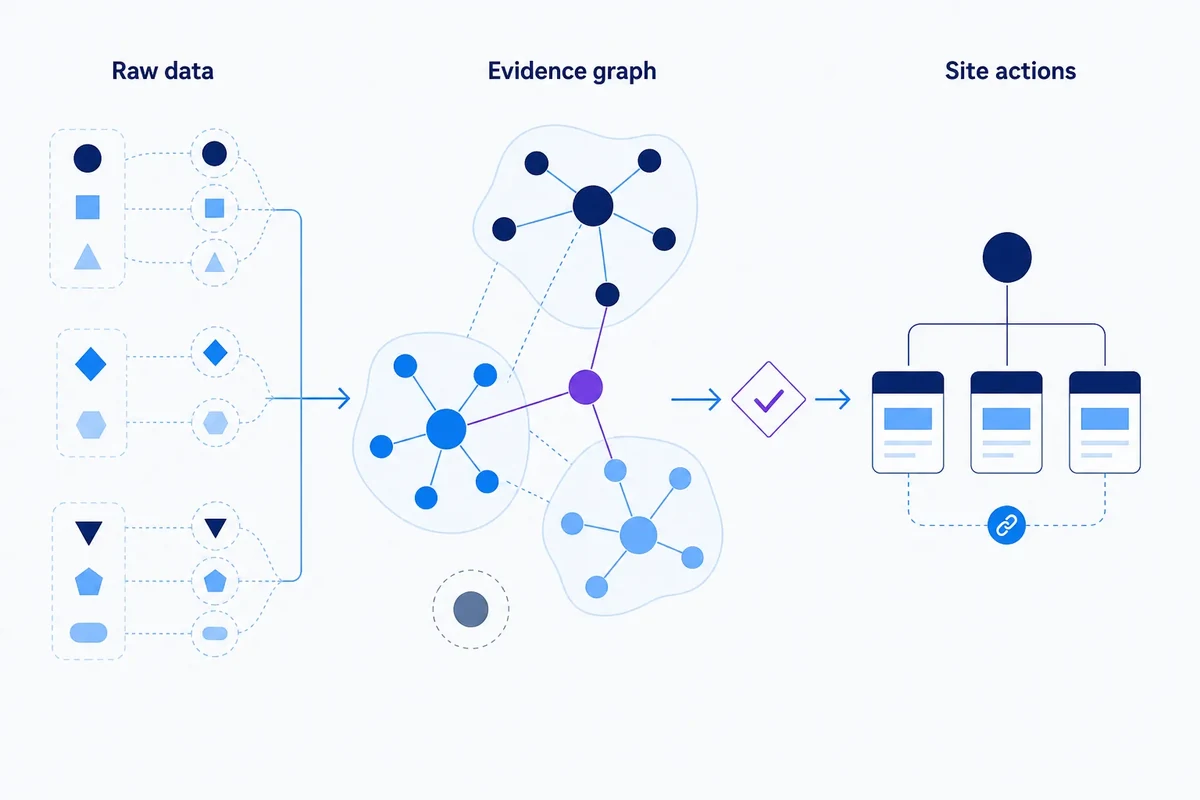
Keyword clustering becomes valuable when it connects raw search data to pages, taxonomy and implementation. This is the end-to-end ClusterIQ workflow from import to action.

Farky Rafiq
Founder of ClusterIQ
You have exported 700 keywords from Semrush, added a few hundred queries from Search Console and opened the combined spreadsheet. Now comes the difficult part: turning that collection into something you can use.
The finished research needs to answer practical questions. Which terms belong together? Which groups need their own page? Which existing pages should be improved? Where are two pages competing for the same topic? And how do you present the result to a client or manager without handing them another enormous CSV?
Keyword clustering helps with that job, but the coloured groups are not the final deliverable. The useful outcome is a clear plan for topics, pages, content briefs, internal links and priorities. ClusterIQ is designed around that journey from messy export to workable site plan, while keeping the evidence and the SEO practitioner in control.
Start by keeping the useful context
Keyword data rarely comes from one tidy source. You might have volume and difficulty from Ahrefs or Semrush, impressions and current landing pages from Search Console, plus an existing URL list from the website.
Before grouping anything, keep a record of where each row came from, its market and language, the date range, the source metrics and any ranking URL. This is called provenance, but the principle is straightforward: do not lose the label on the evidence.
A volume estimate from one provider is not necessarily comparable with a metric from another. Preserving the source stops unlike numbers being quietly blended into a misleading total. Combining keyword exports explains the risk in more detail.
Clean the spreadsheet without cleaning away meaning
Exports often contain extra spaces, case variations, encoding problems and repeated rows. Those technical inconsistencies should be tidied. Important words should not.
For example, “iPhone 17 case”, “iPhone 17 Pro case” and “iPhone 17 Pro Max case” look repetitive, but the model names change the product and probably the destination page. Locations, dimensions, brands and commercial modifiers can be equally important.
Exact duplicates can be combined so they do not inflate the evidence. Near-duplicates should stay available for analysis. These phrases are related, but not identical:
- keyword clustering software;
- keyword grouping tool;
- semantic keyword platform.
Deduplication removes repeated evidence; clustering models relationships between distinct evidence. Keeping the raw query alongside the cleaned version means every later decision can still be checked.
Find relationships using more than matching words
Once the data is tidy, the next job is to identify phrases that may belong together. Exact wording helps, but it is not enough. “Affordable running shoes” and “cheap running trainers” express a similar need despite using different words.
A useful analysis can retain several types of evidence:
- lexical features, meaning the actual words and word fragments;
- semantic embeddings, which are numerical representations designed to capture broader meaning;
- entities such as products, brands and places;
- modifiers that signal a task, audience or commercial need;
- market and language information.
This combination matters because each signal catches different mistakes. Semantic evidence can connect paraphrases. Lexical and entity evidence can stop a system from smoothing over a crucial model number, location or product attribute.
For a dataset of 500 or 2,000 keywords, the system can identify a manageable set of plausible neighbours for each phrase rather than treating every possible pair as equally useful. More demanding comparisons can then be reserved for uncertain cases. This is where Sentence Transformers, hybrid retrieval and cross-encoder reranking fit into the workflow.
Turn those relationships into useful groups
The relationship evidence can be organised in several ways. HDBSCAN is a method that looks for dense groups and can leave weakly connected phrases as noise. Graph community detection looks for neighbourhoods in a network of keyword relationships. Hierarchical clustering helps explore larger topics and their subtopics. Simpler centroid methods can provide a baseline.
You do not need to choose an algorithm because its name sounds impressive. The practical question is whether the groups help you make sensible page and content decisions.
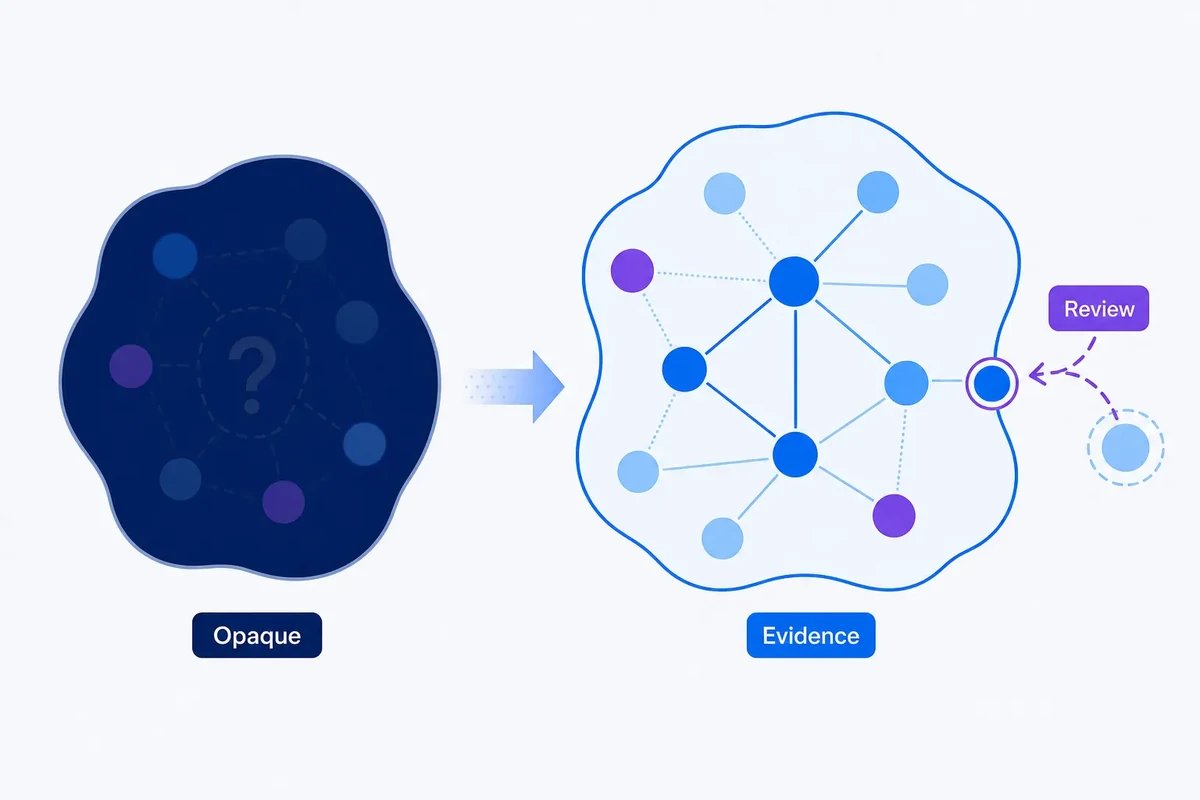
A strong group might contain a stable core of closely related terms. Other keywords may sit between two topics, fit several groups or remain outliers. That uncertainty should be visible. It gives the marketer a short review list instead of hiding awkward cases inside an apparently perfect answer.
Give each group a useful, editable name
A cluster label is there to help people work with the research. It can be based on representative queries, distinctive terms, entities and nearby groups, then edited into language that makes sense to the organisation or client.
The name should not be mistaken for the evidence itself. Changing “small business accounting software” to “SME accounting platforms” for a board presentation should not silently change which keywords belong to the group.
ClusterIQ can keep the model-generated name, representative queries and human-approved label separately. That gives the report clear language without losing the analytical trail.
Check the groups before building a plan
A tidy-looking cluster is not automatically a good one. Before using the result, check several things:
- do the keywords stay together when reasonable settings change?
- are important products, entities and modifiers consistent?
- do the terms share a search intent and likely page type?
- do known examples land in the groups an experienced SEO would expect?
- do boundary cases make sense when reviewed manually?
Technical measures such as silhouette scores can help assess how separated groups are, where appropriate, but no single score gives the whole answer. Cluster quality is multidimensional.
Compare the research with the pages you already have
This is where grouping starts to become a finished piece of SEO work. Take each cluster and compare it with the existing site.
Current rankings, page content, Search Console relationships, entities and page types can all help identify a likely page owner. The useful recommendation is not merely “cluster to URL”. It is a decision such as:
- keep the current page;
- improve it to cover the topic more fully;
- consolidate overlapping pages;
- create a page for an uncovered need;
- review the evidence before acting.
Search Console adds valuable first-party evidence. It may show one clear page owner, several legitimate pages, fragmented ownership, URLs switching in and out, or a topic with no convincing current page.
Search result evidence can add another check. Semantic similarity tells you that language appears related. SERP overlap tells you whether search engines currently return many of the same pages. A pair with strong semantic similarity but little result overlap is not automatically wrong. It is a sensible case for review.
Decide what kind of page the topic needs
A gap in the site does not automatically mean “write a blog post”. The cluster may call for a category page, product page, guide, comparison, pricing page, tool, location page or documentation.
That decision turns research into a brief somebody can implement. A content team can see the primary topic, related questions and likely format. A developer can see where a template or taxonomy change is needed. A client can understand why the recommendation exists.
The topic structure can also suggest useful relationships between pages: parents, children, relevant siblings, commercial destinations and genuine bridge pages. It should not turn every analytical connection into an internal link. Links still need to give the reader a useful next step.
Keep the practitioner in control
No model knows the product range, commercial priorities, legal constraints and internal language as well as the people responsible for the site.
A practical workflow therefore lets the user rename a group, move a keyword, merge or split clusters, approve a page mapping, reject a recommendation and record why. Practitioner overrides are part of the method, not an admission that the analysis failed.
This is especially important when the result will be shown to a boss or client. The final plan should be clear enough to discuss, but detailed enough that a challenged decision can be traced back to the original keywords and evidence.
Save enough detail to repeat the work
If you run the analysis again in three months, you should be able to explain why the output changed. A saved run can include the source dataset, cleaning rules, embedding model, similarity method, neighbour rules, clustering settings, quality measures and human edits.
That record makes comparison possible. It separates genuine changes in search demand or site coverage from changes caused by a different setting.
The work also continues after implementation. New long-tail queries can appear, page ownership can shift and the product inventory can change. A topic map is most useful when it becomes a maintained view of the site rather than a spreadsheet filed away after one presentation.
What the finished deliverable looks like
For a typical export of a few hundred or a few thousand keywords, the aim is not a 17-stage data-science report. It is a usable set of outputs:
- a reviewed topic and keyword map;
- recommended existing and new pages;
- clear page types and content briefs;
- gaps, overlaps and uncertain cases to discuss;
- internal-link and taxonomy opportunities;
- a record of the evidence behind each decision.
A bulk AI prompt may produce plausible categories quickly. It is less likely to preserve source context, show uncertainty, connect groups with current page ownership and retain an auditable record of practitioner decisions.
ClusterIQ is intended to sit between raw keyword tools and the SEO work that actually happens to a site. The same topic structure can support keyword research, content planning, URL mapping, internal linking, pruning, migration checks and reporting.
ClusterIQ principle: organise the evidence, expose the uncertainty and keep the practitioner in control of the decision.
ClusterIQ Conclusion
Turning a Semrush, Ahrefs or Search Console export into a site plan should not require the reader to become a data scientist. The technical methods matter because they help preserve meaning, spot relationships and expose uncertainty. Their value appears in the final decisions.
A useful workflow cleans the data carefully, groups related demand, checks the result against real pages and turns each topic into a practical recommendation. That is how a messy keyword export becomes research you can implement, brief to a team and confidently present.
Sources and further reading
Farky Rafiq
Founder of ClusterIQ
I've worked in digital marketing since 2005 and founded Liquid Silver in 2011. These articles are where I share the methods, experiments and practical SEO thinking behind ClusterIQ.
Put the idea into practice with your own keyword data
ClusterIQ helps turn raw SEO exports into clean, structured working datasets you can inspect, refine, report on and take into the next stage of your workflow.
Keep reading
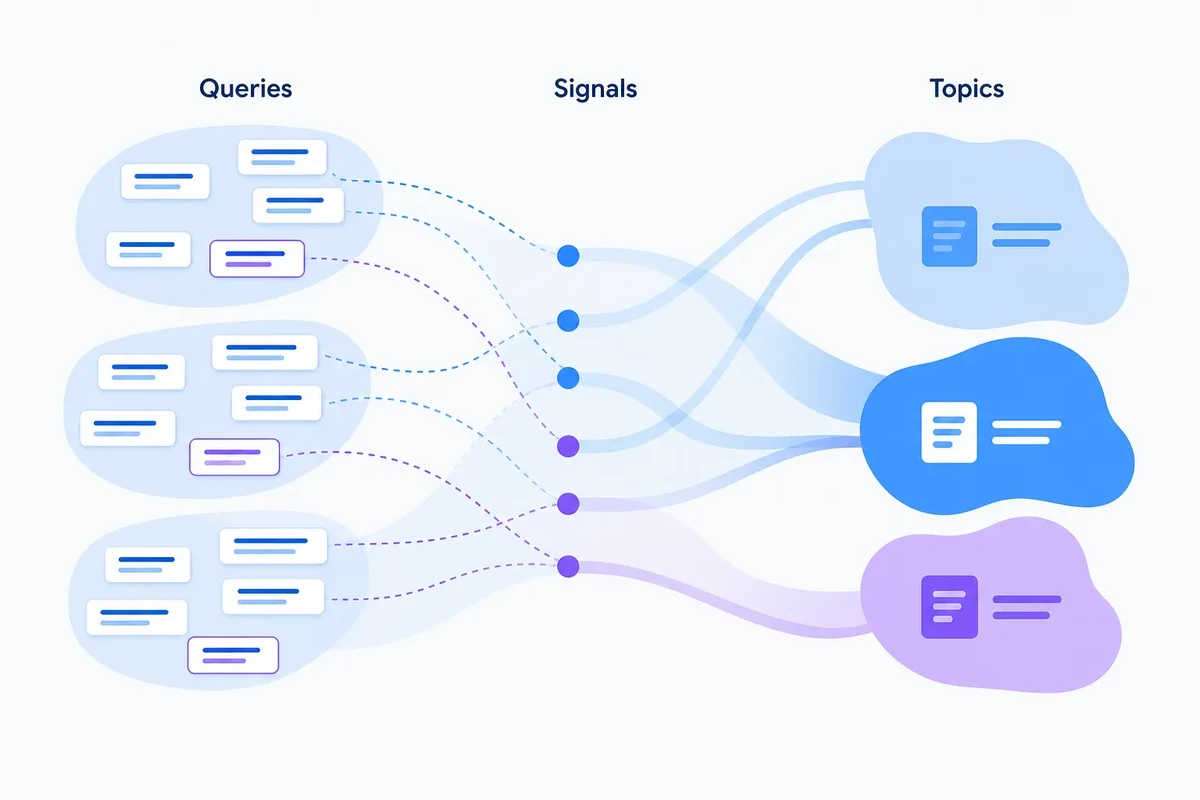
Keyword clustering vs topic clustering: what’s the difference?