Combining keyword exports without corrupting the clustering
Keyword exports from different tools can duplicate queries, use different metrics and mix markets or dates. Learn how to combine sources without corrupting the clustering input.

Farky Rafiq
Founder of ClusterIQ
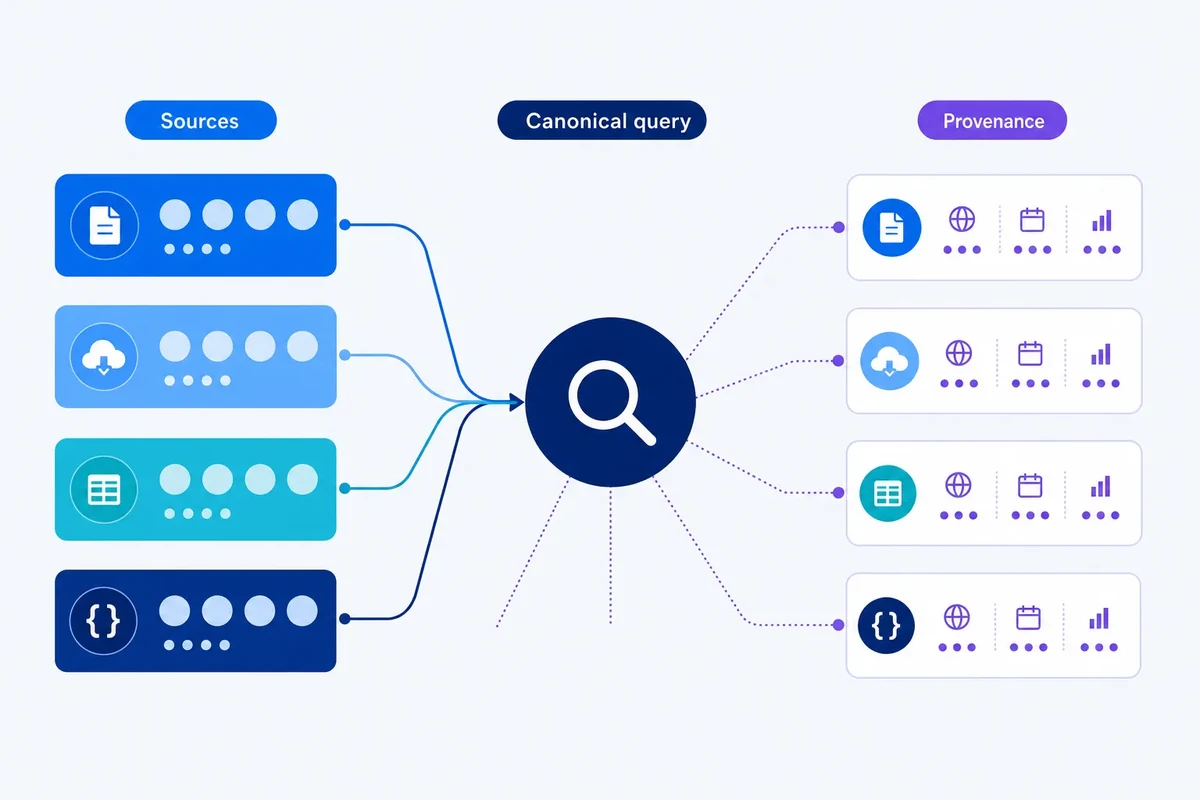
Merging keyword exports often feels like a simple spreadsheet task, but it quickly evolves into a complex data integrity challenge. When you are pulling data from Ahrefs, Semrush, and Google Search Console, you aren't just dealing with a list of words; you are managing different models of reality. One tool might estimate monthly volume based on a trailing average, while another uses a different market definition or refresh cycle. Search Console, meanwhile, provides actual first-party performance data rather than a market estimate.
If you simply append these rows and sum the columns, your dataset might look more impressive, but it becomes fundamentally less trustworthy. To maintain a high-quality clustering input, ClusterIQ ensures the origin of every row is preserved before the linguistic analysis begins.
Start with provenance
Every row you import needs to carry its own history. We refer to this as provenance. By retaining source metadata, you ensure that later reconciliation is possible without one generic volume column masking incompatible data points. Essential metadata includes:
- The specific source tool or dataset;
- The date of import;
- The target market and language;
- Device-specific segments where applicable;
- The date range for the metrics;
- The original, untouched query;
- Metrics unique to that specific source.
Do not sum duplicated search-volume estimates
It is a common mistake to assume that if a query appears in three different exports, adding those volumes together gives a more accurate picture of demand. In reality, this just triples the perceived value of a single keyword. These values often represent different refresh dates or modelling assumptions. A safer, more professional approach is to keep each provider's metrics in their own columns. You should only define a reconciliation rule if your specific workflow requires a single, combined estimate for reporting.
Search Console is a different kind of source
Google Search Console (GSC) impressions and clicks are observations of how your specific site performed under Google's unique reporting rules. They are not equivalent to third-party search volume estimates. ClusterIQ stores these first-party metrics alongside market estimates. This allows you to see, at a glance, whether a topic is theoretically large, already driving traffic to your site, or both. For a deeper look at these nuances, Search Console aggregation explains the limitations of first-party data in detail.
Create a conservative canonical query key
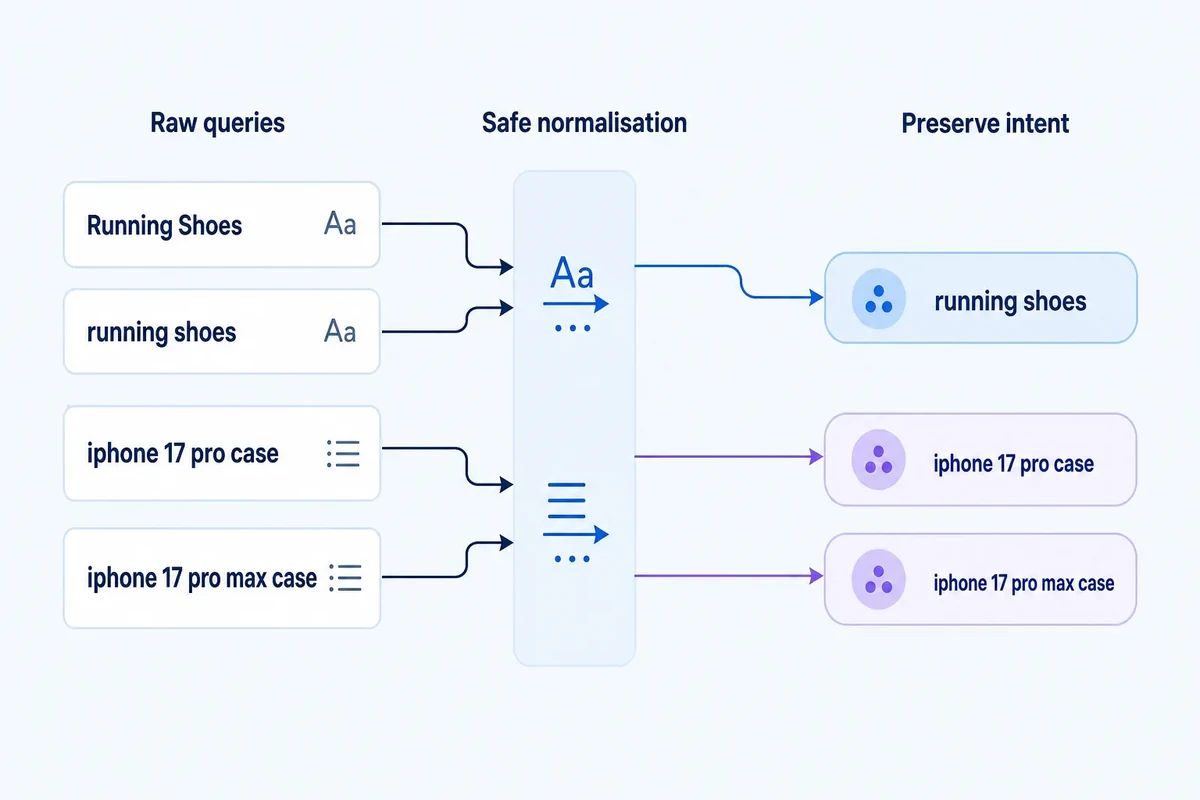
Before you can deduplicate your list, you need to normalise technical inconsistencies. This involves handling Unicode representations, removing trailing whitespace, and ensuring consistent casing. However, it is vital not to over-clean. You should never remove meaningful words, specific model numbers, or locations just to make more rows collapse together. ClusterIQ's preprocessing approach is designed to be conservative and entirely reversible, protecting the integrity of your data.
Exact duplicates and semantic duplicates remain different
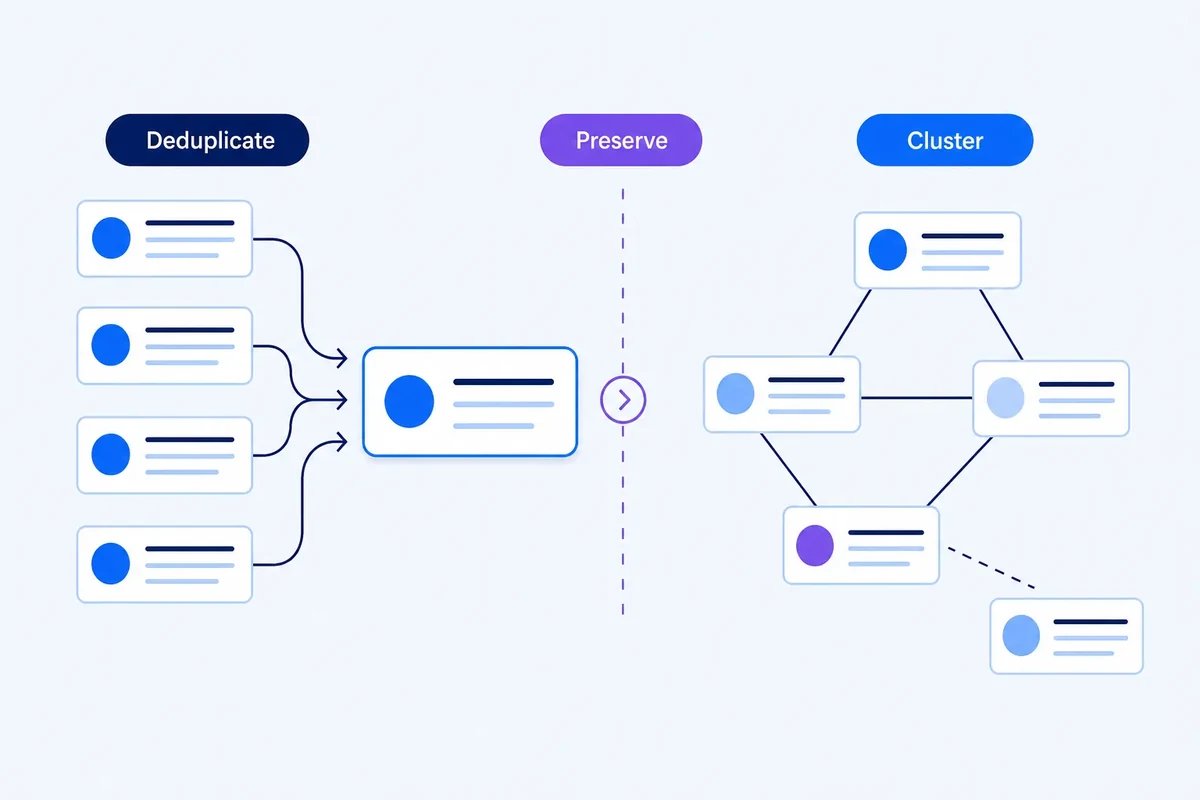
If the phrase "keyword clustering software" appears in three different files, it can usually be merged into one canonical observation supported by three source records. However, a related phrase like "keyword grouping tool" should remain a distinct query. Keeping this distinction between deduplication and clustering is essential for protecting the natural variations in how people search.
Worked example: four sources, one query
Imagine the query "keyword clustering tool" appears in four places:
- A commercial database showing 900 volume;
- A second database showing 1,200 volume;
- Search Console reporting 4,500 impressions over the last quarter;
- Internal site search showing 37 searches.
These figures answer different questions. ClusterIQ creates one canonical entity for the query and attaches all four observations. This avoids the trap of pretending that 900 + 1,200 + 4,500 + 37 represents a single, meaningful demand metric.
Market fields should not be silently merged
Demand for the same English query can vary wildly between the UK and the US. If your exports span multiple countries, you must retain the market as a distinct dimension. You can perform cross-market analysis later using shared topic IDs, which is a cornerstone of effective multilingual and international clustering.
Date ranges need attention
A 30-day snapshot from GSC and a 12-month average from a third-party tool describe different timeframes. By storing the time context, you can perform accurate trend and seasonality analysis. Even when combining historical files, deduplication shouldn't erase the fact that a query was observed at different points in time.
Preserve source-specific URL evidence
Many exports include valuable context like ranking URLs, competitor pages, or SERP features. While these don't necessarily change how a keyword is clustered semantically, they are incredibly useful for later stages of a project, such as URL mapping or competitive gap analysis.
Use a long-form source table underneath the canonical keyword table
A professional data architecture maintains two distinct layers. The Canonical keyword table holds the clean text, language, and extracted entities. Meanwhile, the Source observation table tracks every individual instance of that keyword, including the source, market, date, and specific metrics. This allows ClusterIQ to cluster a clean list while keeping every single data point fully auditable.
Do not let missing metrics remove useful keywords
Just because a third-party tool reports zero volume doesn't mean a keyword is worthless. It might have significant Search Console impressions or represent a brand-new product category. Metric availability should inform how you prioritise a cluster, but it shouldn't dictate whether the language is included in the model at all.
Source disagreements are useful information
When two providers report vastly different volumes, or your site has zero visibility for a high-volume term, that gap is a signal. It might suggest your site has weak coverage, there is a market mismatch, or the query is highly volatile. Don't hide these insights by averaging the data too early.
QA the combined corpus before embedding
Before moving to the clustering stage, always check your work. Review row counts by source, check the duplicate rate, and look for unexpected encoding issues or missing text. This prevents a messy import from turning into a confusing clustering result later on.
Where ClusterIQ adds value
We believe multi-source ingestion should feel controlled, not like a "black box" mystery. You should be able to see exactly how 100,000 imported rows were distilled into 72,000 canonical keywords, and which sources contributed to each. This transparency is a core part of our methodology, ensuring your SEO decisions are built on a solid foundation.
Practitioner principle: combine the language, preserve the provenance and never manufacture demand by summing metrics that do not mean the same thing.
ClusterIQ Conclusion
Clustering becomes significantly more powerful when you can draw from multiple data sources without losing clarity. By creating a clean canonical layer while preserving the underlying evidence, ClusterIQ provides a richer, more accurate foundation for your content plans and technical SEO strategies.
Sources and further reading
Farky Rafiq
Founder of ClusterIQ
I've worked in digital marketing since 2005 and founded Liquid Silver in 2011. These articles are where I share the methods, experiments and practical SEO thinking behind ClusterIQ.
Put the idea into practice with your own keyword data
ClusterIQ helps turn raw SEO exports into clean, structured working datasets you can inspect, refine, report on and take into the next stage of your workflow.
Keep reading
Keyword preprocessing before clustering: clean the data without erasing intent
Keyword deduplication vs clustering: why they should stay separate