Multilingual keyword clustering: finding shared topics without erasing local intent
Multilingual embeddings can connect equivalent concepts across markets, but shared meaning does not guarantee shared search behaviour. Learn how to preserve language and market context.

Farky Rafiq
Founder of ClusterIQ
Multilingual keyword clustering isn't just English clustering with a bigger model bolted on.
Once your dataset spans multiple markets and languages, the pipeline has to decide whether it's trying to find the same concepts across languages, preserve local search behaviour, or do both at once. Those are genuinely different objectives, and it's worth being clear about which one you're actually solving for.
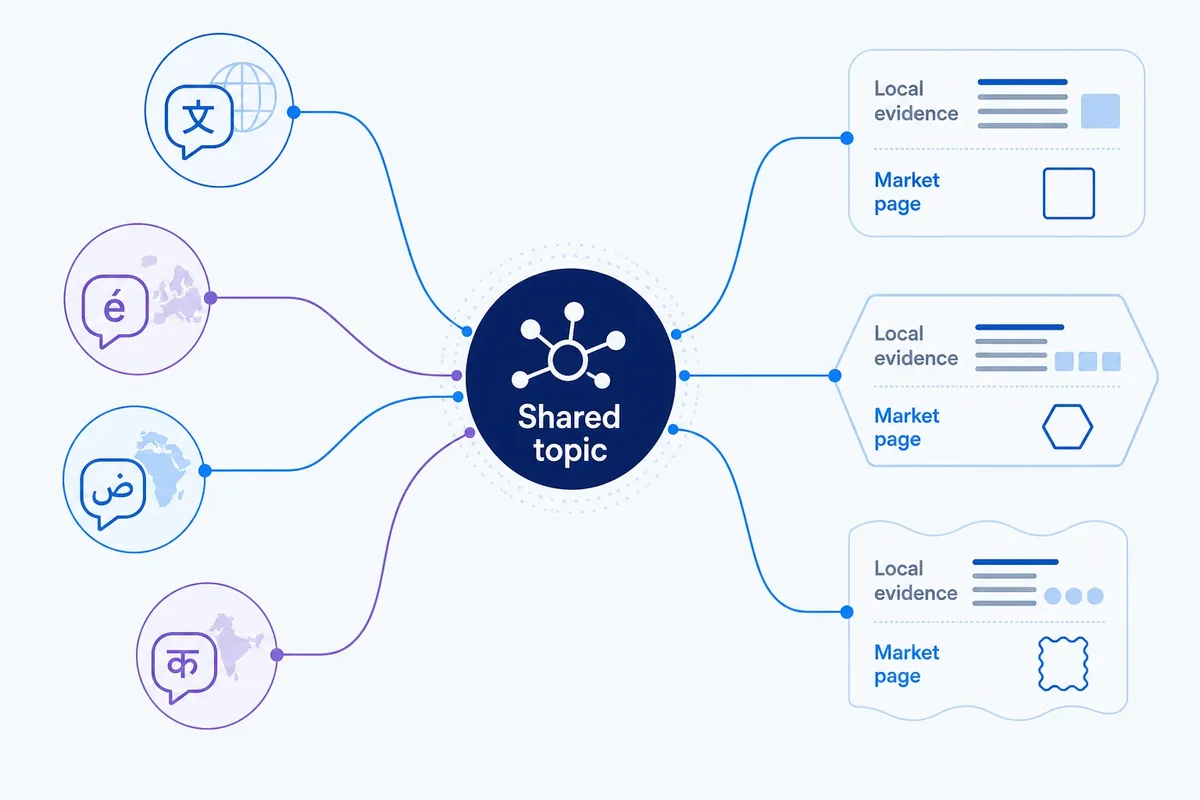
A multilingual embedding model can place semantically equivalent queries from different languages close together in a shared vector space. That's useful. It doesn't mean those queries should automatically share a page, a cluster label, or even the same content strategy.
The first decision is whether markets should be compared at all
Before you even pick a multilingual model, decide what your analytical unit actually is. There are at least three legitimate workflows:
- Within-language clustering: cluster each market or language separately, then compare the resulting structures afterwards.
- Cross-language clustering: put queries from several languages into one shared semantic space to spot equivalent or related concepts.
- Hybrid analysis: use a shared representation to connect markets while still treating language and country as explicit constraints.
The right choice depends entirely on what you're trying to learn. If the task is local URL mapping for a French site, mixing in English and German queries probably just adds complexity without helping. If the task is checking whether five international sites cover the same product topics, cross-language similarity becomes genuinely useful.
Multilingual embeddings create a shared semantic space
Sentence Transformers offers multilingual models built to produce similar embeddings for semantically related text across languages. Its pretrained-model documentation lists models trained across 50 or more languages, while LaBSE covers an even wider language set and is particularly strong for translation-pair retrieval.
Practically, this means:
- "running shoes";
- "chaussures de running";
- "Laufschuhe";
- "zapatillas para correr"
can end up represented close together without translating every query into English first. That matters because machine translation adds another transformation layer, and it can flatten wording that was locally meaningful.
Cross-language similarity is not cross-market equivalence
Two queries can express the same literal concept while carrying completely different commercial implications. Markets differ in:
- product availability;
- brand recognition;
- legal terminology;
- currency;
- local vocabulary;
- search-result composition;
- preferred page formats;
- seasonality.
A shared embedding space can tell you two phrases are linguistically related. It can't tell you whether their markets behave the same way, because that's simply not what it's measuring.
Language and country should be separate fields
Don't infer market from language alone. English queries can come from the UK, US, Ireland, Australia and plenty of other markets. Spanish spans Spain and much of Latin America. French spans France, Belgium, Canada and other regions.
A useful keyword record should retain at least:
- query text;
- language;
- country or market;
- source;
- currency or commercial context where relevant.
That way the clustering model can use shared semantics while the application layer still respects local boundaries.
Translation can still be useful as an audit layer
A multilingual model doesn't remove the need for translation entirely. For practitioners reviewing clusters across markets, a translated display column makes the data much easier to inspect. The important thing is that the translated text doesn't need to become the analytical source of truth.
You can keep hold of:
- original query;
- detected language;
- optional reviewer translation;
- multilingual embedding.
That preserves the actual search language while still making cross-market QA practical.
Watch for false friends and local terminology
Multilingual models can still trip up on short, ambiguous or specialist queries. Potential problem areas include:
- words that look similar across languages but mean different things;
- loan words used differently in local markets;
- brand names that overlap common nouns;
- technical abbreviations;
- very short queries with little context;
- regional product names.
These deserve the same boundary review you'd give ambiguous queries in a single-language dataset.
Entities become even more valuable across languages
Stable entities can bridge the gap when the surface language changes. A product model, brand ID, location ID or canonical category can stay constant even while the query text varies wildly. That makes the entity-aware approach described in our entity-aware clustering guide particularly useful for international SEO.
For example, a product model like "Bosch Series 6 SMS6ZCI49G" should keep the same identity whether the surrounding query is in English, German or French.
Don't evaluate multilingual quality only in English
A multilingual model can look brilliant if you only ever judge it against English examples. Build a judgement set that deliberately samples:
- each major language;
- cross-language equivalent pairs;
- locally distinct terms;
- brand and product language;
- ambiguous short queries;
- markets where the same language behaves differently.
Native or fluent review really matters for your high-value markets. An English-speaking reviewer can easily miss distinctions that are obvious to a local speaker.
One global threshold may not work
Similarity-score distributions can vary between languages and query types. A global threshold chosen from an English sample can end up over-connecting or under-connecting another language entirely.
The fix isn't necessarily a separate threshold for every market, but you should at least test whether the score distributions and error rates are actually comparable before assuming one value fits all. The calibration process in our similarity-threshold guide applies here too: inspect distributions, review boundary cases, and measure downstream behaviour.
Cross-language clusters can support content governance
International teams often struggle to answer questions like:
- Which markets cover this topic?
- Which market has the strongest existing page?
- Where are we duplicating research effort?
- Which local market has a genuinely different intent?
- Which content can be adapted, and which needs a full rewrite?
Cross-language clustering can help build that comparison layer. The cluster itself doesn't mean every market should publish an identical article. It just gives you a shared topic ID that local differences can be recorded against.
A practical international workflow
- Keep language and country metadata. Never reduce the dataset to text alone.
- Choose a multilingual representation. Test it on the languages that actually matter to the business.
- Generate cross-language candidate relationships. Use them to identify likely equivalent concepts.
- Add entity and product evidence. Stable IDs improve precision.
- Compare local SERPs separately. Similar wording doesn't guarantee similar retrieval behaviour.
- Review in-market exceptions. Route unstable or high-value cases to people who understand the local language and search context.
- Store a global topic ID plus local decisions. This keeps both international coherence and market autonomy intact.
International SEO principle: shared semantics can reveal the common topic. Local evidence still decides the local page.
ClusterIQ Conclusion
Multilingual keyword clustering works best when it keeps two questions separate: what's conceptually the same across languages, and what should actually be handled the same way in each market.
Multilingual embeddings are genuinely powerful for the first question. They're not enough on their own for the second.
Keep language and market metadata explicit, preserve the original queries, use entities wherever you can, and validate important clusters with real local search evidence. That gets you an international topic model, without pretending every market is just a translation of the English one.
Related ClusterIQ analysis
For multilingual preprocessing detail, see language detection and cross-script transliteration.
Sources and further reading
Farky Rafiq
Founder of ClusterIQ
I've worked in digital marketing since 2005 and founded Liquid Silver in 2011. These articles are where I share the methods, experiments and practical SEO thinking behind ClusterIQ.
Put the idea into practice with your own keyword data
ClusterIQ helps turn raw SEO exports into clean, structured working datasets you can inspect, refine, report on and take into the next stage of your workflow.
Keep reading
TF-IDF vs semantic embeddings for keyword clustering
International ecommerce keyword clustering: shared products, different markets and different pages