Transliteration and cross-script keyword clustering: connecting the same entity without rewriting local search language
Users search brands and places across Latin, Cyrillic, Arabic and other scripts. Learn how transliteration can support entity matching without replacing native query forms.

Farky Rafiq
Founder of ClusterIQ
You export 1,500 keywords from Search Console or Semrush and find what looks like several brands in the data. Some may actually be the same brand, written in different scripts. Recognising that can save duplicate research and make your content plan easier to organise.
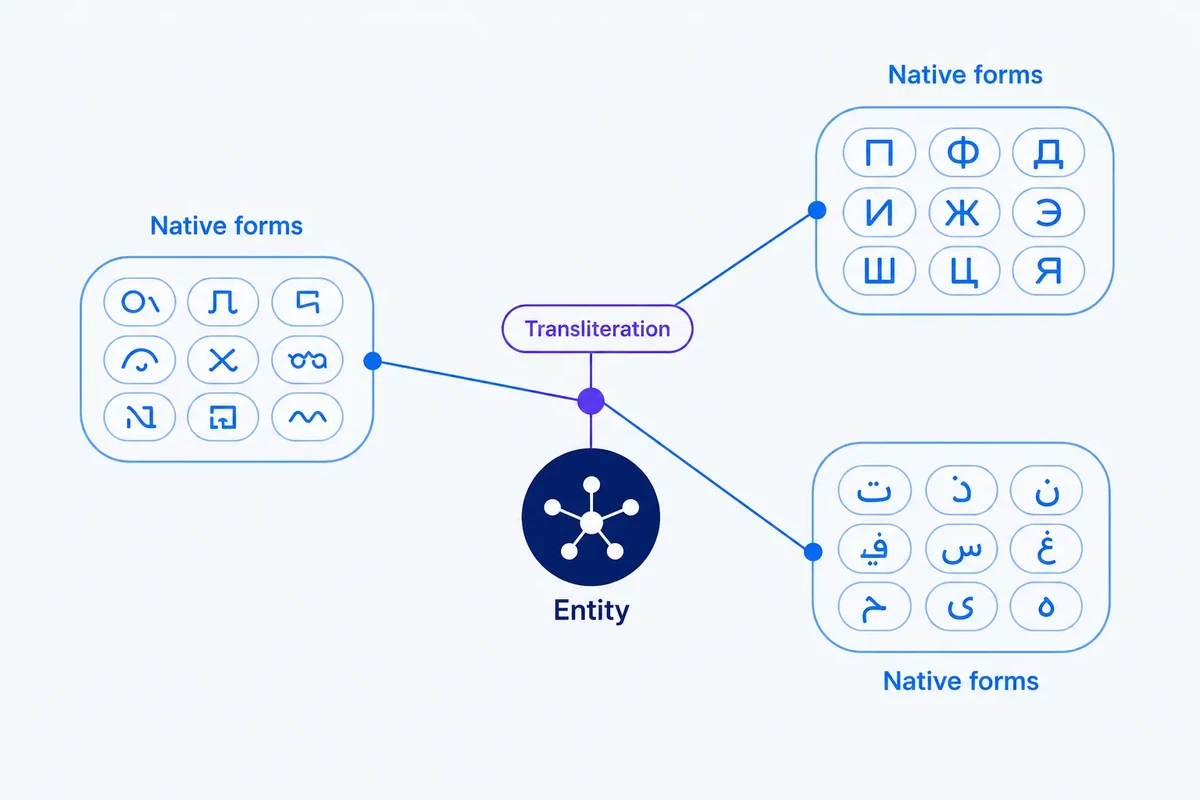
Brands can appear in Latin, Cyrillic or Arabic script. Place names may have several accepted Romanisations, while keyboard or platform constraints can lead people to type local-language words in Latin characters. Connecting these queries should not mean replacing their original wording.
Transliteration is not translation
Translation carries meaning between languages. Transliteration moves text between writing systems, aiming to preserve pronunciation or character correspondence.
A transliterated brand name can therefore refer to the same entity, meaning the same identifiable brand, without the language changing. That distinction matters when deciding which queries belong together.
Why exact string matching fails
Two versions of a place name can share no characters when written in different scripts. Matching based on the written text alone, often called lexical retrieval, treats them as unrelated unless an entity or transliteration layer connects them.
Worked example: one brand, two scripts
Suppose your keyword export contains a global brand in Latin script alongside its established local-script name. You want to connect both for analysis without losing the wording needed for local briefs and reporting.
ClusterIQ can store:
- the raw query;
- its script;
- a transliteration;
- the canonical brand entity;
- the market;
- the language.
The native query stays the primary observation. The entity and transliteration provide supporting evidence for matching, rather than becoming replacement query text.
Romanisation systems can disagree
A place name can have several accepted Latin spellings, so transliteration does not necessarily produce one universal “correct” string. Entity resolution, establishing which real-world thing a query refers to, is usually the stronger long-term anchor.
Use cross-script evidence as a layered identity check
Transliterated similarity helps retrieve likely matches. Before merging them, also check:
- the market;
- the brand or place entity;
- neighbouring queries;
- page ownership, meaning which page should serve those searches.
A match is more persuasive when these signals agree. If they conflict, preserve separate observations rather than forcing a merge. This keeps a convenient spelling match from turning into a misleading cluster or URL decision.
Do not transliterate every query before embeddings
Multilingual models are often designed to process native scripts directly. Replacing that text with transliteration before creating embeddings, numerical representations used for similarity matching, can remove information the model handles well.
A better ClusterIQ design keeps native and transliterated representations as separate evidence, allowing each to contribute without overwriting the other.
Mixed scripts and product codes need different treatment
A query may combine an English brand with local-script product modifiers, or the reverse. Script detection can therefore work at token or span level, checking individual pieces of text rather than assigning one script to the whole query.
An alphanumeric SKU can offer a useful shortcut: it often stays identical across markets. That shared code provides strong entity evidence even when every descriptive word uses a different script.
Keep the local wording in reporting
Search Console shows how people actually typed their searches. ClusterIQ should preserve that wording for reporting and local editorial work, using transliteration as an analytical helper.
Retaining a transliterated alias for searching or filtering gives analysts a shared reference without rewriting the evidence customers supplied.
Internal labels should be localisable
A global topic ID can carry an English analyst label, a local-language display label and approved business terminology. International teams can then share a structure for content plans and briefs without forcing one writing system into every workspace.
Keep local review in the loop
Short names deserve particular care. A transliterated two- or three-character string can collide with unrelated abbreviations, brands or locations. Market context, neighbouring queries and product or page evidence help resolve that ambiguity. If they cannot, keep the uncertainty visible.
For high-value entities, ask a native speaker or local-market practitioner whether a form is actually used by customers, merely technically possible, or associated with something else. ClusterIQ can store that approval as scoped evidence, not a global transliteration rule.
Benchmark entity recovery across scripts
Build test examples where known entities appear in several scripts, then check:
- candidate retrieval;
- entity resolution;
- cluster membership;
- URL mapping.
These tests show whether the workflow recovers the right entity and supports useful page decisions. String similarity alone cannot tell you that.
International SEO still needs local pages
Two queries referring to the same global entity do not automatically need identical page content or imply hreflang relationships. The entity match is only one part of the decision.
International ecommerce clustering keeps local inventory and page purpose separate.
Version transliteration rules
Libraries and alias dictionaries change. Save both the generated form and the method used so historical analysis remains reproducible. Otherwise, a later rules update could make an old match difficult to explain.
Practitioner principle: transliteration can connect the same entity across scripts. It should support native-language evidence, not replace it.
ClusterIQ Conclusion
Cross-script clustering needs more than ordinary text normalisation. Combining native queries, transliteration, script detection and entity resolution can connect equivalent concepts while preserving local search language. The useful outcome is clearer reporting, more reliable clusters and better-informed page decisions, not one spelling imposed on every market.
Sources and further reading
Farky Rafiq
Founder of ClusterIQ
I've worked in digital marketing since 2005 and founded Liquid Silver in 2011. These articles are where I share the methods, experiments and practical SEO thinking behind ClusterIQ.
Put the idea into practice with your own keyword data
ClusterIQ helps turn raw SEO exports into clean, structured working datasets you can inspect, refine, report on and take into the next stage of your workflow.
Keep reading
Acronyms in keyword clustering: when short forms hide several different topics
Brand aliases and entity resolution in SEO: keeping nicknames, legal names and product ranges connected