Brand aliases and entity resolution in SEO: keeping nicknames, legal names and product ranges connected
Brands appear as abbreviations, legal names, old names and product ranges. Learn how entity resolution connects those forms without flattening brand-specific search demand.

Farky Rafiq
Founder of ClusterIQ
If you have ever exported a few thousand rows from Search Console or Ahrefs, you know that brands rarely appear as a single, tidy string. People search for abbreviations, legal names, former brand identities, and product ranges. They also make plenty of typos. If you rely on basic string matching, your data fragments. If you are too aggressive with automated merging, you might accidentally collapse a distinct product line into a generic corporate bucket.
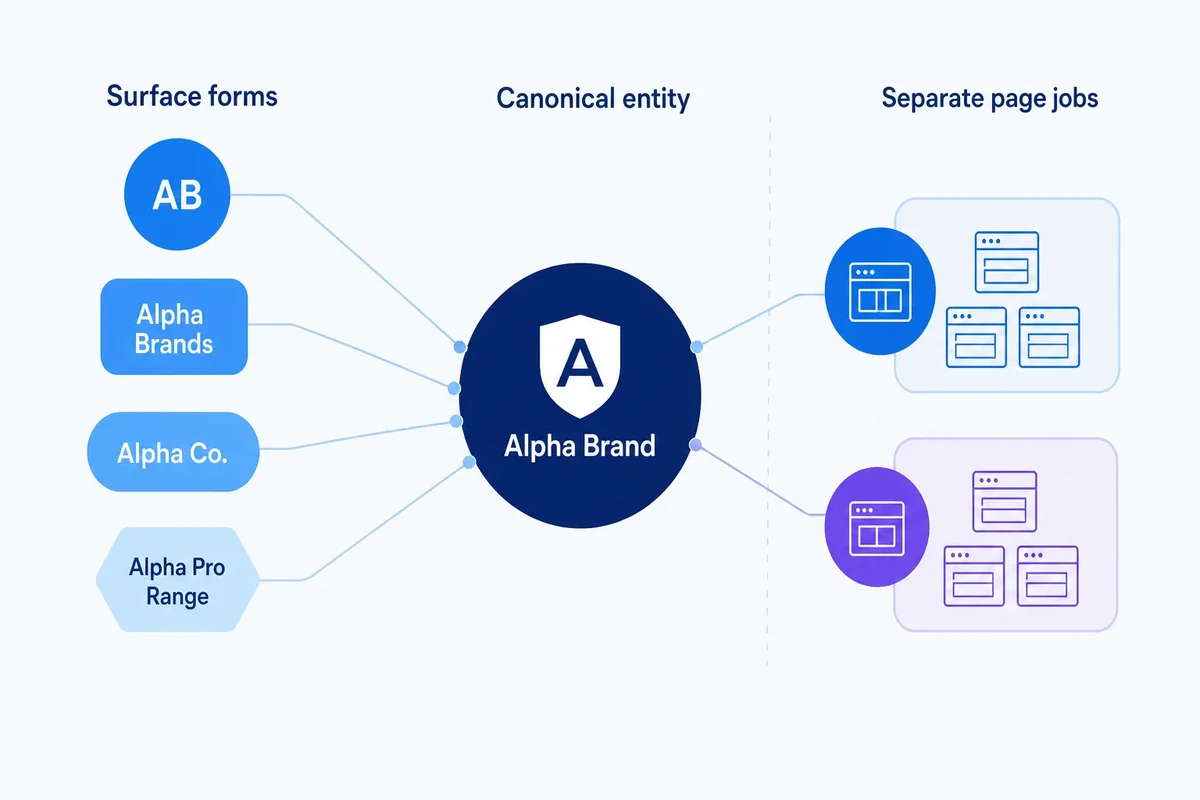
Entity resolution is how ClusterIQ bridges this gap. It allows us to connect various "surface forms" (what the user typed) to a stable identity (what the brand actually is) without losing the nuance of the original search query.
Separate surface form from canonical entity
Imagine a query containing the term "IBM". The canonical entity record identifies this as International Business Machines. In this setup, the raw query remains exactly as the user typed it, but the entity layer stores the stable identity behind it. This allows ClusterIQ to compare and group queries based on the entity they represent, without rewriting the history of how people actually search.
Alias types should be distinguished
Not every alias relationship implies that keywords should be treated identically for SEO purposes. It is helpful to categorise these connections into types such as:
- official short names;
- legal company names;
- previous brand names (pre-rebrand);
- common abbreviations;
- specific product ranges;
- subsidiary companies;
- frequent misspellings.
Distinguishing these ensures that a search for a specific product does not get buried under a generic corporate heading.
Worked example: parent brand versus product range
Consider a software house that sells several distinct tools under a corporate umbrella. Queries for the parent company usually need to connect to a high-level corporate entity graph. However, queries for a specific product range often require their own clusters and dedicated landing pages. Entity resolution should highlight the relationship between the two without forcing them into the same keyword bucket, which would ruin your content planning.
Old brand names need historical context
After a merger or a rebrand, users often continue to search for the old name for years. ClusterIQ can map these legacy names to the new entity while helping you track important metrics like current page ownership, legacy demand, and the effectiveness of migration redirects. This ensures your brand transition is visible in the data rather than just appearing as a loss of volume.
Do not erase branded versus non-branded demand
Just because we resolve "ClusterIQ" as a specific entity does not mean we should replace it with a generic topic like "keyword clustering software". The brand state must remain a separate field in your analysis. Our guide on branded versus non-branded clustering explains why keeping these distinct is vital for accurate reporting and strategy.
Entity IDs improve cross-source joins
One of the biggest headaches in SEO is merging data from different places. The same brand might be formatted differently in a CRM export, a product feed, and a competitor list. By using a stable entity ID, ClusterIQ can join these disparate data sources without needing the text to match perfectly. This makes your reporting much more robust when blending Search Console data with internal business intelligence.
Use deterministic aliases where possible
While modern models are great at inferring meaning, known brands and product ranges are usually better handled with controlled dictionaries. If you have an official catalogue or business data, that should always take precedence over free-form model inference. It is much safer to tell the system exactly what your products are than to let it guess.
Misspellings need a confidence rule
A search for "Adiddas" is almost certainly a search for Adidas. However, relying solely on "edit distance" (how many letters are different) can lead to false matches between two different brands with similar names. We combine spelling similarity with context and known alias evidence before we create a canonical link between a typo and a brand.
Entity conflicts can block cluster merges
Sometimes two queries look almost identical except for the brand name. Depending on your goal, you might want these grouped together (for a "best of" category page) or kept strictly separate (for brand-specific landing pages). ClusterIQ handles this by preserving the shared parent topic while maintaining separate operational groups for each brand.
Page mapping benefits from canonical entities
When mapping clusters to URLs, entities provide a vital safety check. If a cluster is clearly dominated by one brand, any candidate page that focuses on a competitor should be penalised, even if the generic product language is a match. This significantly strengthens the URL mapping confidence layer.
Entity resolution needs provenance
It is important to know where a mapping came from. We track whether an alias was identified by a business catalogue, a manual rule, model inference, or a practitioner override. A manually approved alias is treated with much higher confidence than one the system inferred on its own.
Keep alias changes versioned
Brands are not static; they merge, split, and change names. An alias table should include versions or effective dates. This prevents a rebrand today from silently rewriting your historical query analysis, ensuring your year-on-year reports remain accurate.
Use unresolved entities as a data-quality queue
When the system repeatedly finds unknown strings that look like brands, it flags them. These often represent new competitors, new product ranges, or gaps in your product catalogue. Instead of losing this data in the "noise" of a large keyword set, ClusterIQ surfaces them for your review.
Entity resolution can strengthen labels
By resolving multiple aliases to one entity, your cluster labels become much cleaner. You can use the official, business-approved name for your reports while still retaining the messy, real-world search variants for your SEO implementation. This makes your deliverables look professional without losing the underlying search data.
Practitioner principle: resolve identity without flattening intent. Two strings can refer to the same brand and still belong to different SEO page jobs.
ClusterIQ Conclusion
Brand alias resolution provides a stable foundation for dealing with messy search data. By separating raw wording from canonical entities, ClusterIQ allows you to connect nicknames and legacy names without sacrificing the branded distinctions that drive SEO performance.
Turning this evidence into an SEO decision
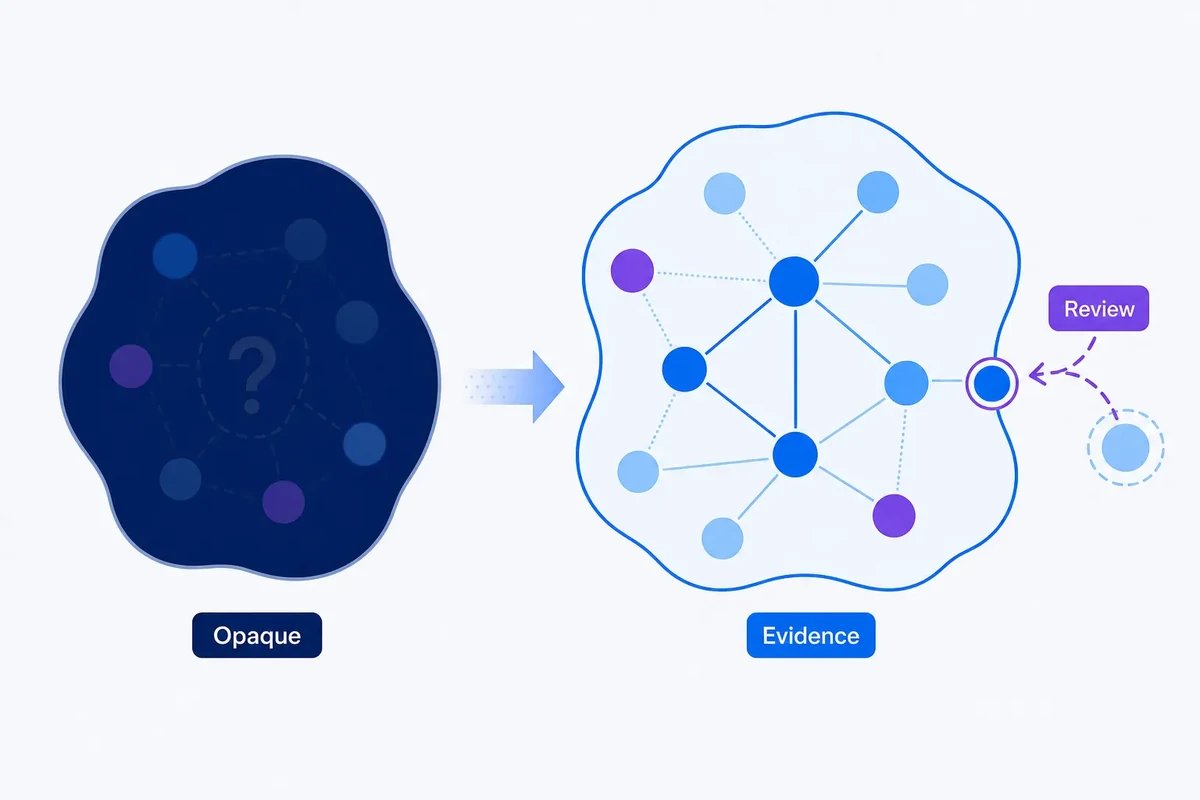
In ClusterIQ, an analytical result is a starting point, not an automated instruction. Before taking action, you need to understand what changed and how confident the evidence is. A strong signal might suggest an automatic page suggestion, while a weak or conflicting signal should trigger a manual review.
A practical review involves looking at representative queries, the entities involved, and existing URL ownership. Your action might be to approve a new cluster, consolidate overlapping pages, or simply leave the site as it is. By keeping the analysis separate from the action, we ensure the practitioner stays in control.
Finally, we store these decisions. By recording the proposed action, the final decision, and the reason for any override, we create a feedback loop. Over time, this helps you identify where the methodology is most reliable and where specific business context is most important.
Sources and further reading
Farky Rafiq
Founder of ClusterIQ
I've worked in digital marketing since 2005 and founded Liquid Silver in 2011. These articles are where I share the methods, experiments and practical SEO thinking behind ClusterIQ.
Put the idea into practice with your own keyword data
ClusterIQ helps turn raw SEO exports into clean, structured working datasets you can inspect, refine, report on and take into the next stage of your workflow.
Keep reading
Acronyms in keyword clustering: when short forms hide several different topics
Keyword clustering vs topic clustering: what’s the difference?