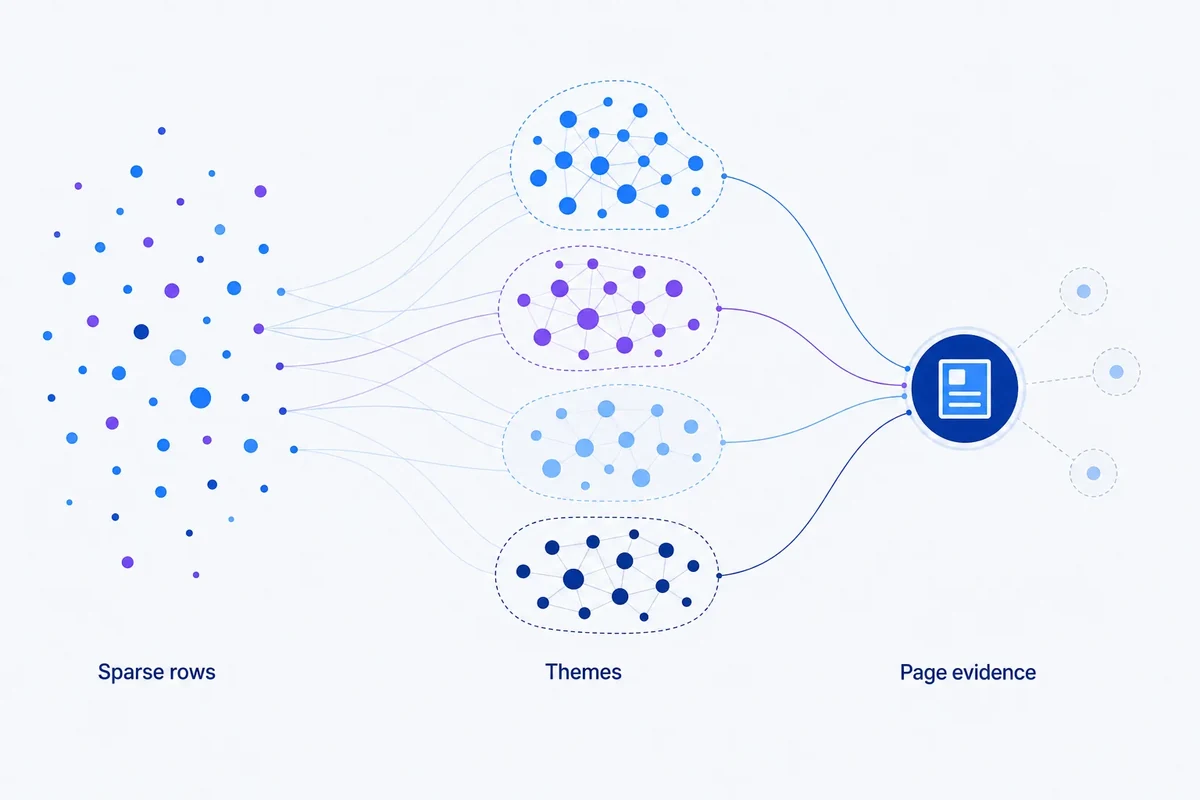
Branded vs non-branded keyword clustering: separate demand without splitting the topic
Brand signals can change intent, competition and page ownership. Learn how to keep branded and non-branded evidence visible without breaking one topic into artificial silos.

Farky Rafiq
Founder of ClusterIQ
You are sorting a few hundred keywords into content topics, and “running shoes” appears alongside “Nike running shoes”. Should they sit together, or do they need separate groups?
They share a topic, but the brand name changes the competitive, commercial and potentially navigational context. Someone searching for a known brand may need a different page from someone exploring the wider category.
A useful keyword clustering system preserves both facts: the queries belong to the same subject, and the brand modifier may change the page or analysis they need.
Do not remove brand terms during preprocessing
When you clean a keyword list before clustering it, repeated brand names can look like clutter. Removing them to simplify the text loses one of the most important distinctions in commercial search.
Instead, identify the brand as an explicit entity: a named brand recorded separately from the rest of the query. Keep the brand in the original keyword too.
Branded is not the same as navigational
A brand name does not automatically mean someone is trying to reach that brand’s website. A branded query can still be:
- informational, looking for an answer;
- commercial comparison, weighing up options;
- transactional, looking to buy or sign up;
- support-oriented, looking for help;
- navigational, trying to reach a particular site or page.
“Nike return policy” and “Nike running shoes reviews” both mention Nike, but they serve very different tasks.
Use brand as a dimension, not the whole cluster label
Within a broad product topic, you may have:
- generic queries with no brand name;
- queries mentioning your brand;
- queries mentioning competitor brands;
- queries comparing multiple brands.
Keeping those distinctions within the topic is often more useful than splitting branded and non-branded keywords into completely separate topic maps.
Search Console now supports branded analysis
Google’s Search Console documentation describes branded and non-branded filtering in Performance reporting for eligible properties.
For sites with access, this can provide first-party evidence of how branded search demand differs from generic demand on your site.
Competitor brands need separate governance
Clustering by meaning can naturally bring competitor products into the same group.
That is useful for market analysis and comparison content, but the legal, commercial and editorial rules may differ from those for ordinary category pages.
Keep competitor-brand membership visible in your data. A broad cluster label should not hide which competitors appear within it.
Branded modifiers can change page ownership
Consider these four queries:
- “crm software”;
- “hubspot crm”;
- “salesforce crm”;
- “hubspot vs salesforce”.
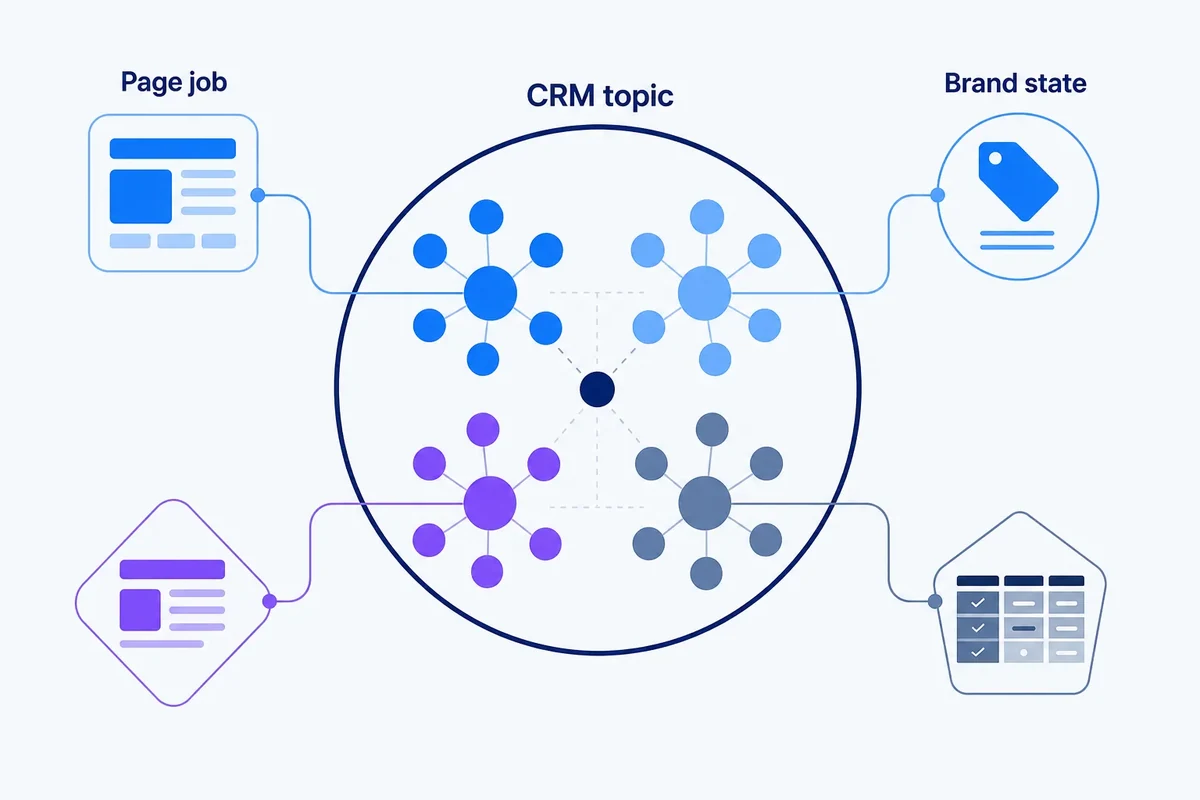
They all belong to the broad topic of CRM software. Yet the most appropriate pages may be a category page, two brand-specific pages and a comparison page.
One cluster based on shared meaning can therefore contain several distinct jobs for different URLs. Shared subject matter does not automatically mean one page should target every query.
Brand share can be measured inside a cluster
For each cluster, record the share of queries that fall into these groups:
- generic queries;
- own-brand queries;
- competitor-brand queries;
- multi-brand comparison queries.
This can help you spot categories where people tend to search by brand, rather than using generic descriptions of what they need.
Do not let brand volume dominate the topic name
A popular brand can appear so frequently that it makes a broad topic look brand-specific, especially if you generate cluster labels from the most common terms.
Name the cluster after its underlying topic unless the group is genuinely organised around that brand.
Use different intent and page-type checks inside the same topic
Brand analysis becomes more useful when you combine it with:
- search intent, or what the person wants to achieve;
- page type, such as a category, review or support page;
- entities, including the brands and products mentioned;
- Search Console page ownership, showing which URLs receive visibility for those queries;
- search engine results page (SERP) evidence, showing what currently ranks.
These checks keep the topic map coherent without treating commercially different searches as if they all need the same response.
Practitioner principle: branded and non-branded queries can belong to the same topic while requiring different pages, metrics and competitive interpretation.
ClusterIQ Conclusion
Record brand explicitly in keyword clustering. Do not strip it out, but do not let it split the whole topic map into separate brand groups by default either.
Keep the shared topic, then use brand status as another way to analyse demand and page purpose. This gives you a more useful view of how people move between generic needs, familiar brands and comparisons.
Worked example: own brand, competitor and generic demand
Imagine a CRM provider analysing a cluster of 600 keywords. Generic queries include “best CRM for agencies”. Own-brand queries ask about pricing and integrations. Competitor queries compare Salesforce, HubSpot and other vendors.
Putting each group into a separate top-level topic map would hide the market they share. Treating every query as identical would hide the competitive differences. A better approach keeps one CRM topic while recording the brand relationship separately.
Use branded share as context, not success
A high proportion of branded clicks can reflect strong brand demand, limited non-brand reach or both. When reporting cluster performance, show branded and non-branded behaviour separately. Otherwise, strong branded performance can mask weak visibility for generic searches.
Brand segmentation can improve forecasting
Generic and branded demand often behave differently. Brand growth can increase impressions without the site becoming more visible across the wider category. A gain in non-brand visibility, meanwhile, can put the site in front of people who do not already know the company.
Forecasting and reporting become clearer when each cluster retains both its shared topic and the brand status of its queries.
Keep brand aliases canonical
Misspellings, abbreviations and product-family names can split branded data across several labels. Map these variants to one consistent, canonical brand entity, while keeping the original query so you can check and analyse it later.
Brand relationships can form their own graph
Within a topic, you can map connections between brands that appear together in queries. These co-occurrences, particularly in comparison searches, can reveal which competitors people naturally consider alongside one another. That can guide comparison research without changing the main topic clusters.
Keep this relationship graph as a secondary layer of analysis, so competitive connections do not distort your core topic structure.
Review brand-heavy clusters against the page architecture
If brand modifiers repeatedly point to distinct page needs, build that distinction deliberately into your URL map. Decide which pages should serve those queries rather than leaving rankings to determine the split by accident.
Sources and further reading
Farky Rafiq
Founder of ClusterIQ
I've worked in digital marketing since 2005 and founded Liquid Silver in 2011. These articles are where I share the methods, experiments and practical SEO thinking behind ClusterIQ.
Put the idea into practice with your own keyword data
ClusterIQ helps turn raw SEO exports into clean, structured working datasets you can inspect, refine, report on and take into the next stage of your workflow.
Keep reading
Turning keyword clusters into content briefs without writing the article twice
Seasonal keyword clustering: separating recurring demand from temporary noise