Language detection before keyword clustering: why short queries make the obvious step unreliable
Language detection sounds simple until the input is a two-word brand, product or place query. Learn how ClusterIQ can detect language conservatively before multilingual clustering.

Farky Rafiq
Founder of ClusterIQ
When you are managing multilingual keyword research, the first logical step is identifying which language each query belongs to. However, search queries are notoriously difficult for standard language detection tools. Unlike a full paragraph of text, a two-word phrase might just be a brand name, a specific location, or a term shared across several European languages. In some cases, like product codes, the query contains no traditional language at all.
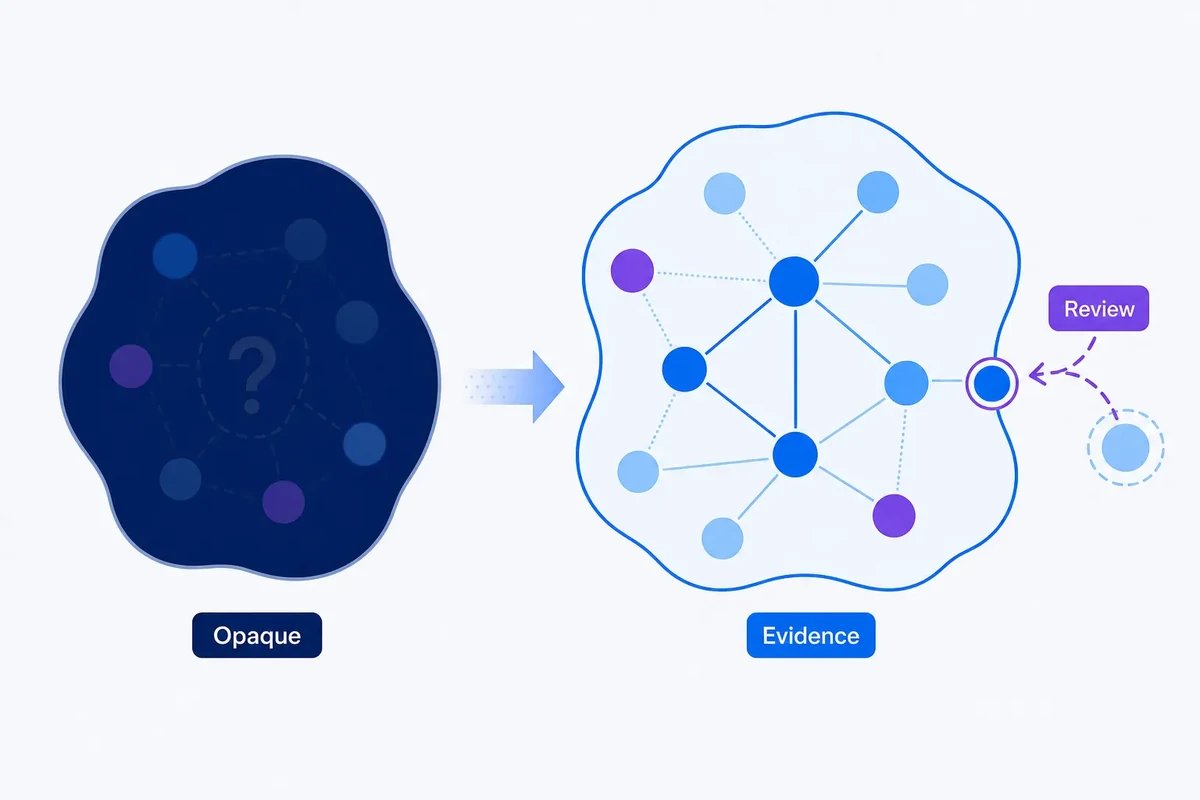
For these reasons, ClusterIQ treats language detection as a piece of evidence with varying levels of confidence, rather than assuming every row in a spreadsheet can be perfectly labelled from the start.
Why short text is difficult
Most language detectors rely on the statistical distribution of characters and words across longer passages. When you feed them queries like "hotel roma", "apple support", or a specific serial number, there is very little evidence for the algorithm to work with. Forcing a definitive language label in these instances can actually be more damaging to your clustering results than simply leaving the case as uncertain.
Market context is strong supporting evidence
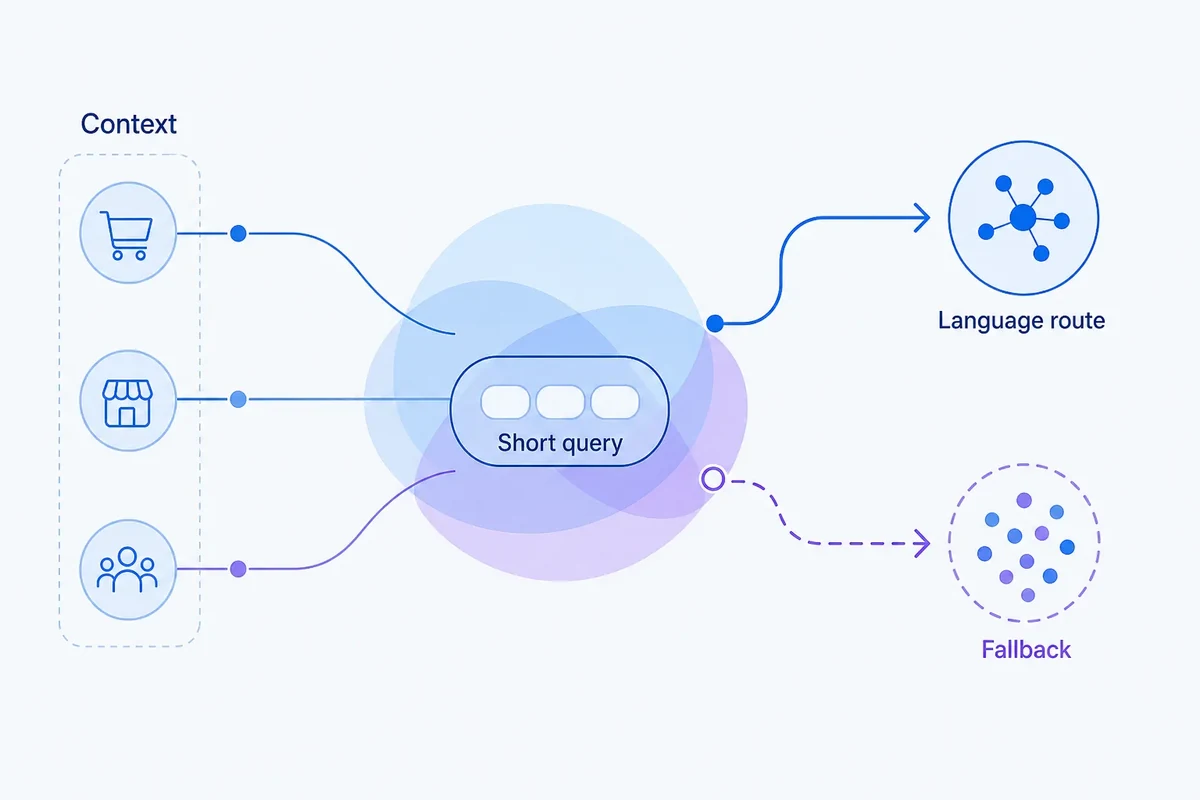
We can improve accuracy by looking at where the data originated. If a keyword is pulled from a France-specific export, the probability of it being French increases significantly. Similarly, if the data comes from a UK Search Console property, English is a sensible starting assumption, though not a total guarantee. ClusterIQ combines this source market data with detector confidence scores instead of treating the keyword in total isolation.
Brands and product codes may be language-neutral
A term like "Dyson V15" does not necessarily need a confident English label to be useful. In a practical SEO workflow, it is often better to have a state where the language is marked as unknown or neutral, but the entity is resolved and the market is known. This prevents the system from inventing linguistic evidence where none exists, ensuring your product-led clusters remain clean.
Worked example: "casa design"
Consider the phrase "casa design". This could be Italian, Spanish-influenced branding in an English market, or a specific company name. A basic detector might return a high confidence score for one language based purely on the word "casa".
ClusterIQ approaches this by checking if the phrase is a known entity and looking at neighbouring queries in the set. If the surrounding keywords are all about interior design in London, that context helps clarify how the query should be handled before it is sent to an embedding model.
Use confidence thresholds and fallbacks
A smart way to handle thousands of keywords from Ahrefs or Semrush is to define clear thresholds:
- High confidence: Proceed with the detected language.
- Moderate confidence: Combine the detection with market data and neighbouring keyword context.
- Low confidence: Use a multilingual representation and keep the specific language unresolved.
These thresholds should be calibrated against actual keyword data rather than the long-form text benchmarks often used in academic papers.
Do not translate solely because the detector says so
Relying on automatic translation can introduce unnecessary errors into your content plan. If a multilingual embedding model can represent the raw text accurately, translation might not even be required. Multilingual keyword clustering should aim to preserve the local wording and intent wherever possible.
Language can be cluster-level evidence
Context is everything. If one ambiguous query is sitting amongst 200 keywords that are confidently identified as German and share the same search intent, that cluster context is highly informative. We use that collective evidence to inform the group rather than forcing a potentially wrong label on the individual keyword.
Mixed-language queries are legitimate
In many markets, users naturally mix languages. You will often see:
- English product names paired with local-language modifiers.
- Global brand names used alongside translated category terms.
- Technical English acronyms embedded within other languages.
A single language field often fails to capture the reality of how people search globally.
Code-switching should not become an error
Rather than forcing a choice between two languages, ClusterIQ can store a dominant language alongside mixed-language indicators. This is particularly valuable for international ecommerce and technical sectors where English terminology is the industry standard regardless of the local tongue.
Language labels affect model routing
The technical stakes are high because these labels often dictate which machine learning model processes the data. If a query is mislabelled, it might be sent into the wrong vector space, leading to nonsensical clusters. When detection confidence is low, routing the query to a robust multilingual model is the safer, more accurate path.
Benchmark by query length
To maintain quality, we measure detector accuracy across different categories:
- Single tokens.
- Short phrases (two to three words).
- Long-tail queries (four or more words).
- Brand-heavy and product-code queries.
Success on a long sentence does not guarantee that a tool will work for a list of 5,000 keywords from Search Console.
Language and country remain separate
It is a mistake to equate language with geography. English queries appear in dozens of different markets, and French queries are common far beyond the borders of France. By storing these as separate fields, your international reporting stays accurate and nuanced.
Use practitioner corrections as local evidence
If you find yourself repeatedly correcting a specific regional term or brand name in your workspace, that should be saved as a local rule. This allows the system to learn from your expertise rather than relying on global assumptions that might not apply to your specific niche.
Keep the uncertain set visible
It is better to have a small, visible queue of unresolved queries than to let them silently contaminate your language-specific analysis. ClusterIQ highlights these uncertain cases so you can see if they materially affect your topic map or if they can be safely ignored.
Practitioner principle: short queries often do not contain enough linguistic evidence for certainty. Use market, entity and neighbour context rather than forcing a label.
ClusterIQ Conclusion
Language detection is a vital but often overlooked part of the SEO preprocessing chain. Because keyword data is so brief and ambiguous, ClusterIQ combines detector confidence with market data and multilingual fallbacks. This ensures that your clustering is built on a foundation of evidence rather than guesswork.
Failure modes are part of the feature, not an appendix
A useful implementation surfaces where the logic might struggle. Ambiguous phrases, rare entities, and multilingual data should be a deliberate part of your QA process. These "edge cases" often determine whether a content strategy actually works when it hits a real-world site.
When evidence is weak, preserving an uncertain state is the professional choice. This might mean leaving a query unassigned or asking for a quick manual review. A visible state of uncertainty is always safer than a precise-looking report based on flawed assumptions. By identifying whether a problem stems from the initial data processing or the final clustering, we can ensure that improvements are made where they actually matter.
Sources and further reading
Farky Rafiq
Founder of ClusterIQ
I've worked in digital marketing since 2005 and founded Liquid Silver in 2011. These articles are where I share the methods, experiments and practical SEO thinking behind ClusterIQ.
Put the idea into practice with your own keyword data
ClusterIQ helps turn raw SEO exports into clean, structured working datasets you can inspect, refine, report on and take into the next stage of your workflow.
Keep reading
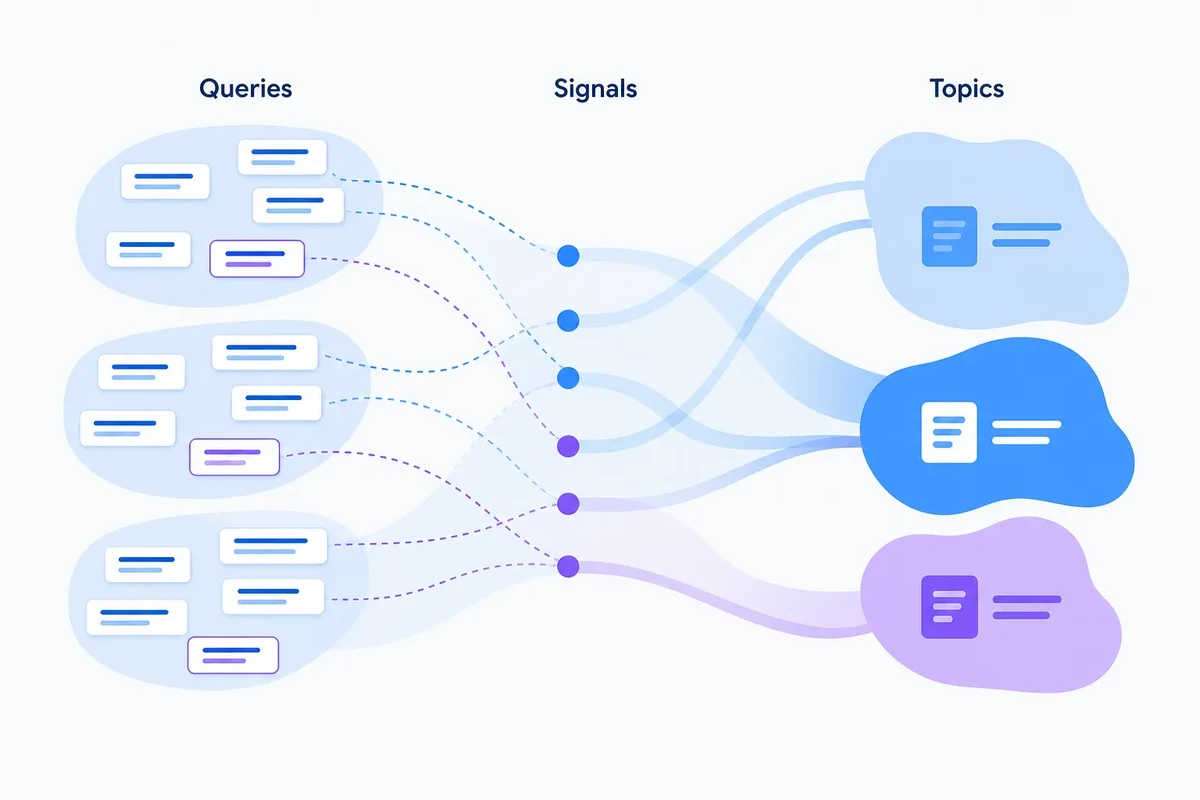
Keyword clustering vs topic clustering: what’s the difference?