Why practitioner overrides matter in keyword clustering
A clustering model can surface strong evidence and still miss business context. Learn why practitioner overrides should be preserved as explicit, auditable decisions rather than hidden corrections.

Farky Rafiq
Founder of ClusterIQ
A keyword clustering system actually becomes less trustworthy, not more, when users are unable to correct its output. While modern models operate on complex representations and testable parameters, they lack the specific context that a practitioner brings to the table. As an SEO, you know how a site is organised, which products genuinely differ in the real world, which pages serve specific commercial roles, and where local or regulated distinctions prevent certain terms from being merged safely.
ClusterIQ is designed to treat practitioner overrides as first-class data. These are not just inconvenient edits to a final output; they are essential inputs that refine the strategy.
The model output is a proposal
It is entirely possible for a clustering result to be statistically strong but operationally wrong. You might see two product queries that are semantically almost identical, yet the business intentionally manages them through separate categories. Similarly, a location-specific query might sit naturally inside a national service cluster according to an algorithm, but your strategy requires a dedicated local landing page. A comparison query might share a topic with a guide but require a completely different page type to convert.
The model should expose its evidence, but the practitioner must retain the authority to decide what happens next in the content plan.
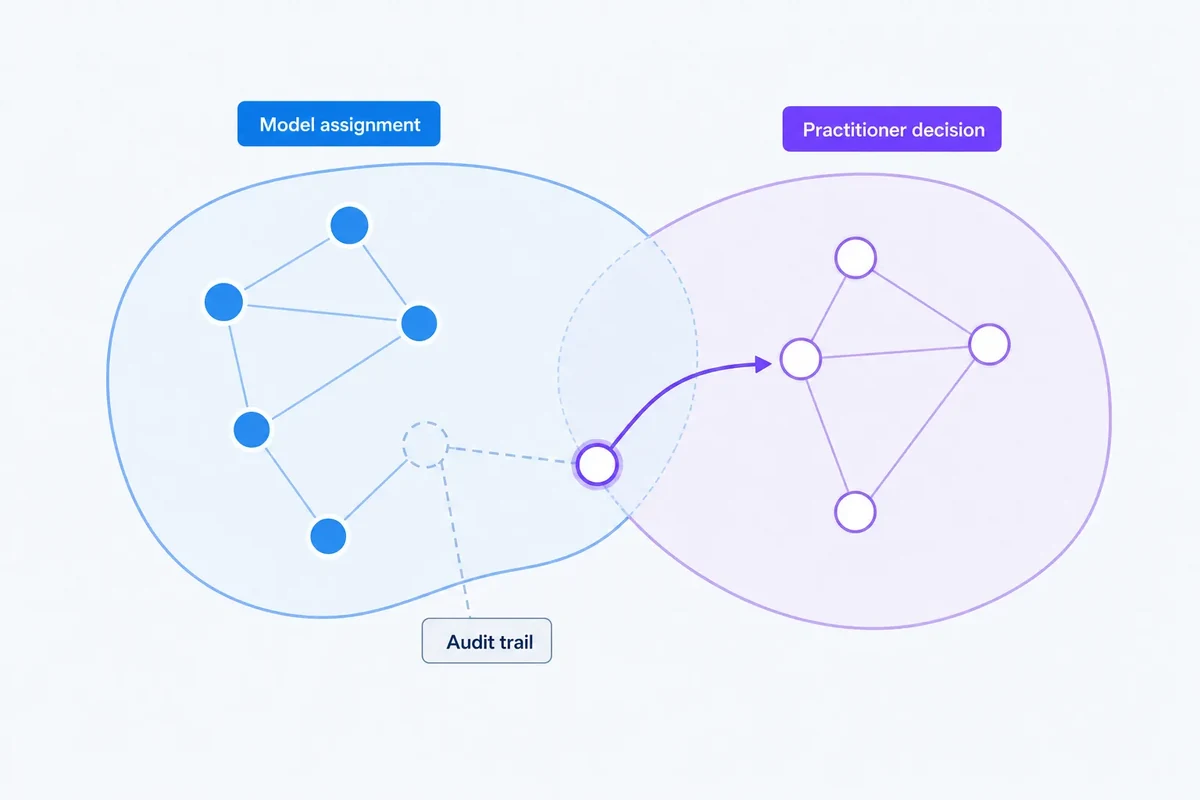
Keep model assignment and human assignment separately
When you move a keyword from one cluster to another, the original model state should never be overwritten. To maintain a clear audit trail and improve future analysis, ClusterIQ stores several layers of data:
- The original model-assigned cluster
- Model confidence scores or membership evidence
- The human-approved cluster
- The specific reason for the change
- The reviewer and a timestamp
- The model and run version used
This approach preserves the analytical history, making later evaluation of the model much more useful for the team.
Overrides are especially valuable at the boundaries
In most datasets involving thousands of keywords from Ahrefs or Semrush, the core members of a stable cluster rarely need manual intervention. The most informative corrections usually happen at the edges, involving:
- Low-confidence queries that could sit in multiple groups
- Bridge terms that link two distinct topics
- Groups with mixed search intent
- Entity conflicts or local-market distinctions
- High-value queries where the cost of a wrong assignment is significant
By using soft clustering and confidence scores, ClusterIQ can route these specific cases for human review rather than asking you to inspect every single row in a massive spreadsheet.
Worked example: one modifier changes the page
Imagine a cluster containing "commercial boiler service", "commercial boiler installation", and "commercial boiler repair". A semantic model will likely group these tightly because the industry context and entities are identical. However, an experienced SEO knows the client has distinct service teams, different conversion journeys, and unique landing-page templates for installation versus repair. Moving these queries into separate operational groups isn't "correcting the maths". It is adding vital business evidence that the initial embedding simply did not contain.
Reasons should be structured where possible
While free-text notes are helpful for specific edge cases, repeated override reasons are easier to analyse when they fall into structured categories. Within ClusterIQ, you might categorise a change based on:
- Different search intent
- Different page type requirements
- Entity mismatches or product attribute differences
- Location-based distinctions
- Specific business rules or data-cleaning issues
This structure allows you to see patterns across thousands of keywords, helping you justify strategy changes to clients or stakeholders.
Overrides become benchmark data
Repeated human corrections are a goldmine for product feedback. If users consistently separate pricing queries from broad informational groups, we can add those examples to a human benchmark set. This allows us to test whether future configurations handle these nuances better out of the box. The benchmark should evolve from real disagreements encountered during practical work, not just theoretical examples chosen before the project starts.
Do not learn blindly from every override
A human change is not automatically the absolute "ground truth" for every scenario. Different practitioners apply different business assumptions. One client might want all product variants grouped together, while another deliberately separates them for SEO reasons. A naming convention that works in the UK might not generalise to a US market. Before turning overrides into global rules, ClusterIQ evaluates whether a pattern is specific to a dataset, a workspace, or an industry. This protects the system from treating one customer's unique taxonomy as universal SEO logic.
Bulk overrides need guardrails
When managing large-scale content plans, you may need to move a whole subgroup or merge clusters involving hundreds of keywords. ClusterIQ supports these actions while providing clear visibility on how many rows will change, which high-confidence assignments are being affected, and whether page mappings will be altered. Crucially, these bulk actions remain reversible, giving you the freedom to experiment without breaking the underlying data.
Manual labels should also be preserved
Sometimes the clustering is perfect, but the name isn't. You might keep the model membership but rename the cluster to match your organisation's preferred terminology. By storing the generated label and the approved display label separately, we follow the same logic found in ClusterIQ's cluster-labelling workflow.
Overrides improve explainability
If a junior SEO or a client asks why a specific query appears in a certain group, the system provides a clear answer: "The model placed this query in Cluster 18, but it was moved to Cluster 22 because the product model requires a separate category." This transparency is far more trustworthy than a "black box" that pretends every decision came from an algorithm.
Reproducibility requires human decisions too
A clustering run is not truly reproducible if you only save the model settings but lose the human refinements. ClusterIQ's reproducibility model treats overrides, merges, and approved labels as an integral part of the run history, ensuring you can recreate the exact state of a project months later.
Human control is not a fallback
Practitioner control exists because SEO decisions require a combination of mathematical evidence and organisational context. It is not a way to fix a weak product, but a way to empower experts. ClusterIQ automates the heavy lifting while keeping judgement visible where the evidence is incomplete or the stakes are high.
Measure override patterns
We track metrics like the percentage of assignments overridden and the most common reasons for changes. A falling override rate in well-defined cases suggests the model is improving. Conversely, a zero override rate often suggests that users simply lack the tools to exercise control. A trustworthy system preserves both the model's evidence and the practitioner's decision without forcing one to erase the other.
ClusterIQ Conclusion
Practitioner overrides transform keyword clustering from a static output into an accountable, living system. By preserving original assignments and recording the logic behind changes, ClusterIQ gives you agency while making the tool smarter in a controlled way. This process also helps identify missing features; if you are constantly moving queries due to local-market boundaries, it signals a need for better filters or views. Ultimately, overrides turn analysis into discovery, helping you express decisions that no automated model could safely infer alone.
Sources and further reading
Farky Rafiq
Founder of ClusterIQ
I've worked in digital marketing since 2005 and founded Liquid Silver in 2011. These articles are where I share the methods, experiments and practical SEO thinking behind ClusterIQ.
Put the idea into practice with your own keyword data
ClusterIQ helps turn raw SEO exports into clean, structured working datasets you can inspect, refine, report on and take into the next stage of your workflow.
Keep reading
Soft clustering and confidence scores: handling ambiguous keywords honestly
Building a human benchmark set for keyword clustering