When not to trust a keyword cluster: a practitioner checklist before you change the site
Clustering is evidence, not permission. Use this checklist to identify mixed intent, weak representations, unstable groups and business conflicts before clusters drive pages or taxonomy.

Farky Rafiq
Founder of ClusterIQ
A cluster label can make uncertain evidence look final. Once you see 300 queries from Ahrefs or Search Console coloured the same way in a dashboard, that group starts to feel like a real, tangible object. Sometimes it is. Other times, it is simply the result of a weak threshold, an inappropriate data representation, or a business distinction the model never actually saw.
Before a cluster is allowed to change your URLs, site taxonomy, or content plans, it should have to earn that influence.
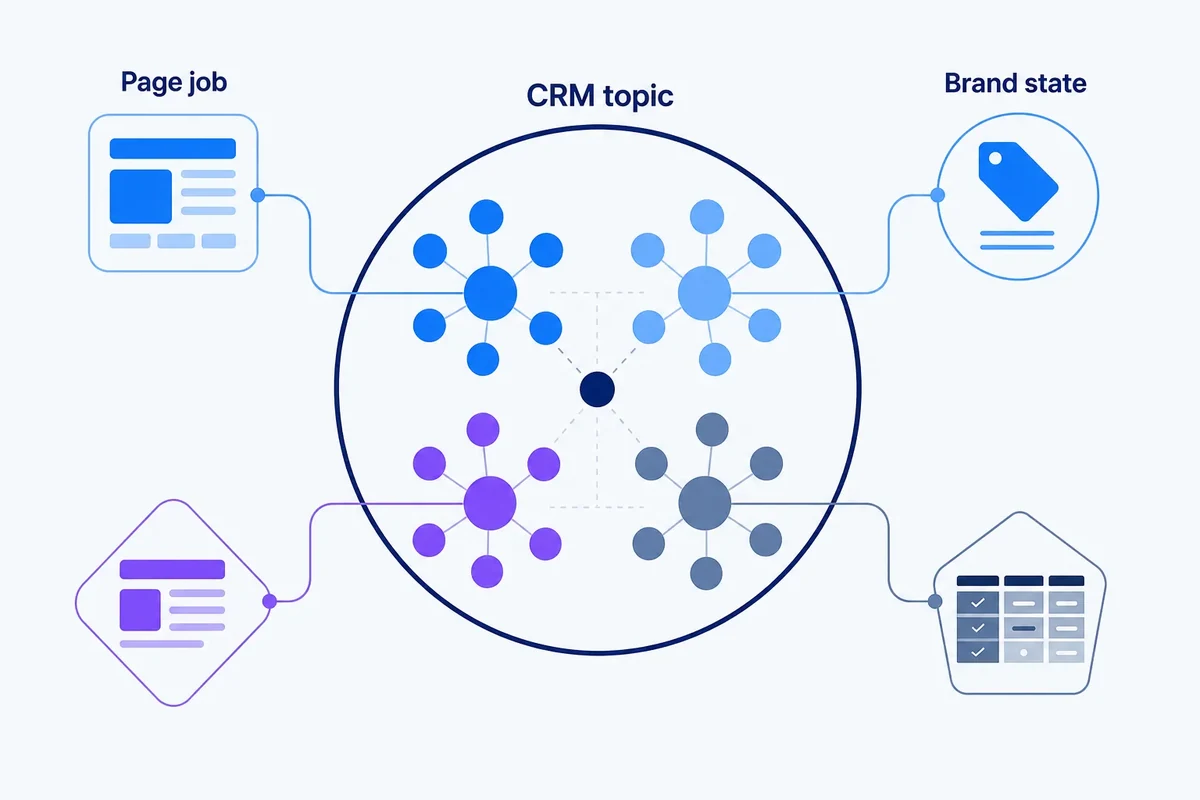
Do not trust the cluster if the representation missed the important distinction
Ask yourself what information the model actually processed. If specific product models, locations, languages, brands, or page types are vital to your business but were not represented explicitly in the data, semantic similarity may have merged queries that you need to keep separate.
Do not trust it if the intent is mixed and the decision is page-level
A broad topic can legitimately contain several different tasks. If a single cluster mixes queries related to learning, comparing, buying, troubleshooting, and locating, it might be a useful topic cluster for a category overview, but it is a poor target for a single page.
Do not trust it if small parameter changes destroy it
Try running the data with slightly different thresholds, seeds, or resolutions. If the group repeatedly splits apart, merges into others, or loses most of its members, you should treat it as fragile. You can find a more detailed workflow on cluster stability for SEO to help identify these weak spots.
Do not trust it if the label sounds better than the members
Open the cluster and look at the actual keywords. Read the core members, the boundary members, the outliers, and your important high-volume queries. A polished, AI-generated label can easily hide a messy, incoherent group of terms.
Do not trust it if Search Console strongly disagrees
If queries that the model claims are equivalent consistently map to different page types or different stable URLs in your actual performance data, investigate why. The clustering model might be too broad for the specific site-level decisions you are trying to make.
Do not trust it if entities conflict
Different products, markets, regulated classes, or locations often represent hard boundaries. A high semantic similarity score should not be allowed to override a critical mismatch in the underlying entities.
Do not trust it if the graph depends on weak bridges
A few generic queries can act as bridges that connect otherwise distinct communities. Inspect these bridge terms and their "betweenness" rather than assuming that one connected component automatically represents one single topic.
Do not trust it if the business cannot explain the page job
Before creating a new URL based on a cluster, complete this sentence: This page exists so that a user can... If the answer is vague or simply duplicates the purpose of another page, the cluster has not justified the creation of a new asset.
Do not trust it if the only justification is search volume
High demand can help you prioritise a valid page idea, but it cannot make an invalid page idea useful. You must also consider whether there is a distinct task, enough content or inventory depth, business relevance, maintenance capacity, and a clear place in the site hierarchy.
Do not trust a 2D chart more than the original data
Visualisations like UMAP are excellent for exploration. However, visible islands and distances on a 2D map are not a substitute for high-dimensional relationships or proper cluster diagnostics.
Do not trust a single metric
Metrics like silhouette, modularity, centrality, and confidence scores all describe different properties. No one metric proves a cluster is useful for SEO. You should combine these internal metrics with stability tests and manual, task-based reviews.
Do not trust the model when the humans consistently override the same pattern
Repeated manual corrections are valuable product feedback. If your team is always separating pricing queries, protecting specific product models, or moving local terms, you should encode that evidence into the next version of your model rather than asking people to fix the same error forever.
A pre-action checklist
Before a cluster drives a material decision on your site, confirm the following:
- The input data is clean and representative;
- Important entities are preserved;
- The representation suits the specific task;
- The cluster has a stable core;
- Intent and page type are compatible;
- Search Console or SERP evidence does not contradict the mapping;
- Neighbouring clusters are genuinely distinct;
- The page or taxonomy action has a clear user purpose;
- The decision can be reversed or audited;
- A practitioner has reviewed high-consequence cases.
Practitioner principle: clustering is valuable because it reduces a huge dataset into something people can reason about. It becomes dangerous when the simplification is mistaken for certainty.
ClusterIQ Conclusion
A strong keyword-clustering system should help practitioners make better decisions, not remove them from the process entirely. Trust grows when the method exposes its evidence, limitations, and uncertainty. Use clusters to organise your investigation, prioritise review, and reveal structure. Before the result changes the site, test whether that structure still makes sense in the real world.
Use consequence to set the review threshold
Not every cluster needs the same level of scrutiny. A low-volume reporting group can tolerate more uncertainty than a cluster being used to delete URLs or restructure a revenue-driving category. Define your review depth according to the consequence of the action. The more irreversible the change, the stronger the evidence and human sign-off should be.
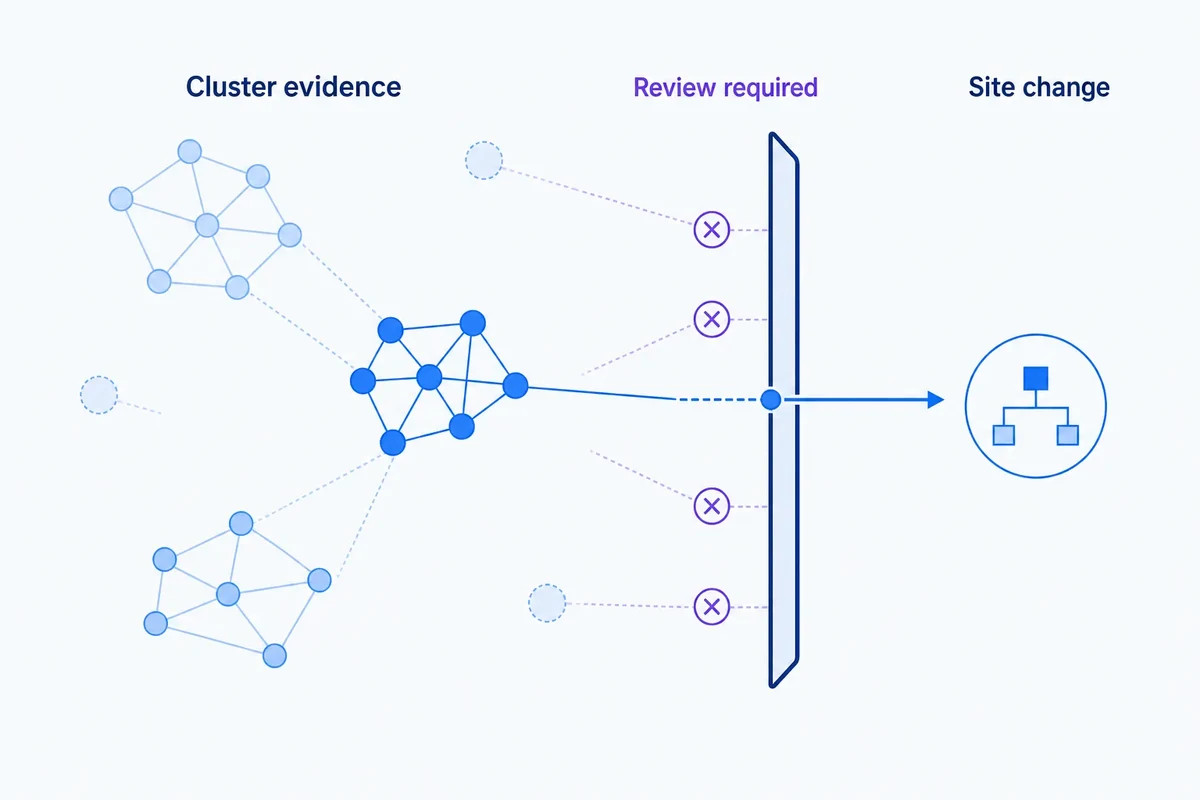
Make “review required” a valid product state
A trustworthy clustering tool should be allowed to stop short of a recommendation. When signals conflict, the correct output can be "review required" with the reasons attached. Forcing a clean answer in every row makes the interface simpler but makes the resulting decisions less reliable.
Sources and further reading
Farky Rafiq
Founder of ClusterIQ
I've worked in digital marketing since 2005 and founded Liquid Silver in 2011. These articles are where I share the methods, experiments and practical SEO thinking behind ClusterIQ.
Put the idea into practice with your own keyword data
ClusterIQ helps turn raw SEO exports into clean, structured working datasets you can inspect, refine, report on and take into the next stage of your workflow.
Keep reading
Turning keyword clusters into content briefs without writing the article twice
Local keyword clustering: when location modifiers change the page you need