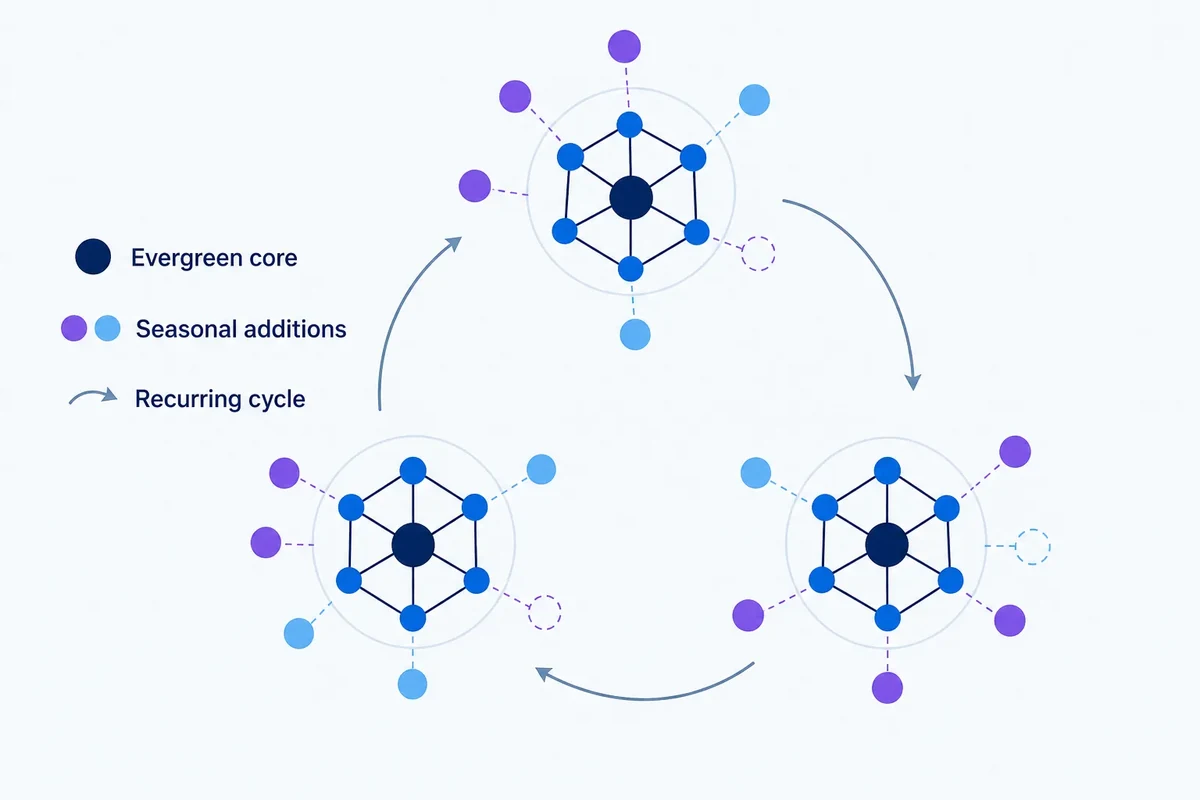
Local keyword clustering: when location modifiers change the page you need
Location modifiers can represent meaningful local intent or superficial wording differences. Learn how to cluster local queries without creating duplicate city pages by default.

Farky Rafiq
Founder of ClusterIQ
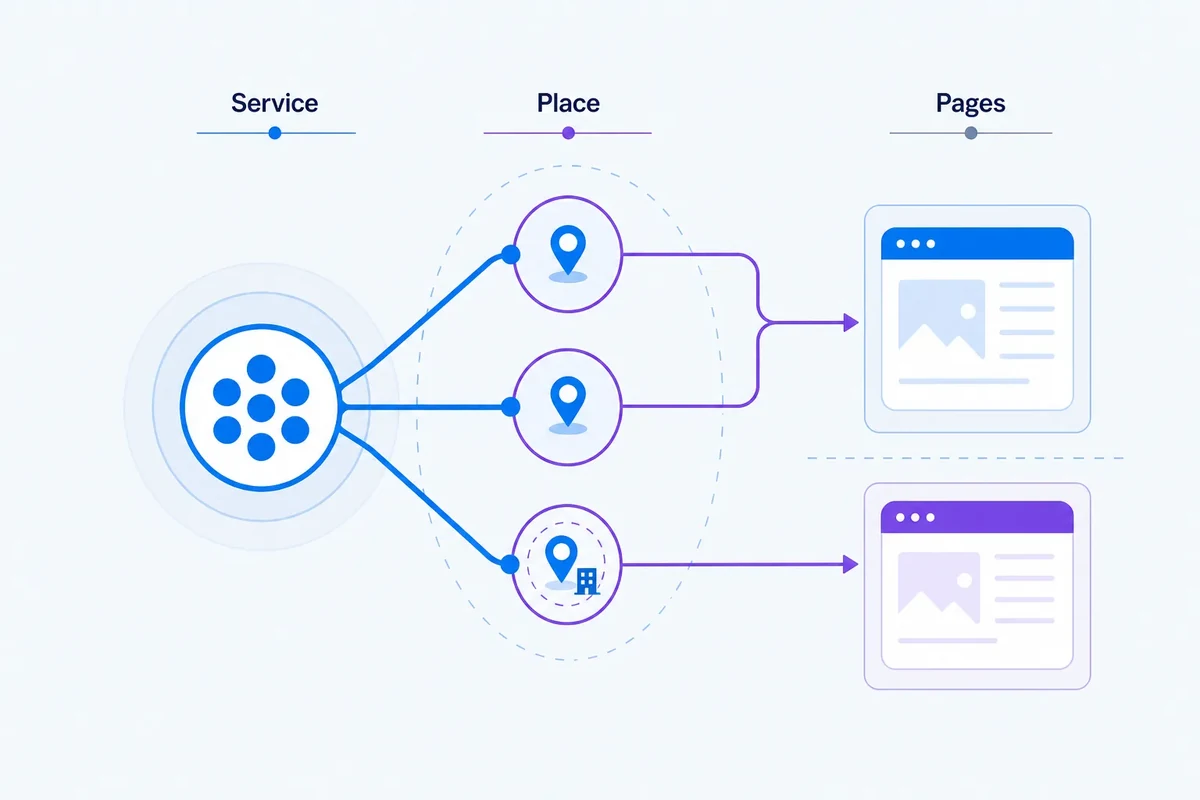
Local keyword clustering has an extra variable that broad semantic models can quietly smooth over: place.
"SEO consultant Salisbury" and "SEO consultant Southampton" are semantically almost identical. But from a local search and business perspective, the location difference may well be the most important part of the query.
Treat location as an explicit entity
Don't rely on an embedding model to preserve local boundaries by itself.
Extract:
- city;
- town;
- postcode area;
- county or region;
- "near me" modifier;
- landmark or neighbourhood, where relevant.
Store a canonical location ID wherever you can.
Same service, different city doesn't always mean a different page
A service-area business may genuinely need separate pages for different offices or markets.
It can also be tempted to churn out hundreds of near-identical city pages for places where the offering doesn't actually differ at all.
Clustering can reveal the location demand. It can't justify a thin location page all by itself.
Separate service intent from place intent
Represent the query along at least two dimensions:
- service or topic;
- location.
This lets you see whether the same service cluster shows up across several places, and whether each place has enough distinct business relevance to warrant separate treatment.
"Near me" is not a city
Queries containing "near me" are context-dependent. The user's location supplies part of the meaning.
Don't map every "near me" variation onto a literal page slug.
Instead, treat it as strong local intent and think about how your site's location architecture and local business presence actually serve that need.
Local SERPs deserve local collection
Search results can vary by location.
If SERP overlap forms part of your clustering evidence, collect results using the target market rather than assuming a national result set represents every city.
Google itself documents that location and context can affect results.
Entity hierarchy helps you avoid duplicate geography
Locations have containment relationships:
- neighbourhood → city;
- city → county;
- county → region;
- region → country.
A query for a neighbourhood may reasonably be served by a city page, if the business and the user's task line up well enough.
Hierarchical geographic entities can therefore prevent needless page fragmentation.
Use business reality as a hard constraint
A local landing page should reflect something real, such as:
- an office or service coverage;
- local inventory;
- local staff;
- a delivery area;
- local regulations;
- distinct local content or evidence.
If nothing changes except the place name, the page may offer very little additional value.
Cluster across locations, then review within location
A useful workflow works in two stages:
- group by service or topic across the full dataset;
- within each service cluster, analyse location variants and local demand.
This preserves the shared service concept while still making geographic differences visible.
Existing local pages provide training evidence
Search Console and analytics can show you which location pages already attract relevant queries, and whether nearby locations converge on one URL.
Use that evidence to test whether your proposed geographic boundaries actually match real site behaviour.
Local clusters can inform internal linking
Useful links might connect:
- a service page to the locations it serves;
- a location page to relevant services;
- a regional page to real local branches.
Avoid artificial city-link blocks whose only real purpose is multiplying anchor text.
Practitioner principle: location modifiers deserve explicit modelling because they can change the commercial meaning of an otherwise identical query. They do not automatically deserve a new URL.
ClusterIQ Conclusion
Local keyword clustering works best when you treat place as structured evidence rather than just another token in the sentence.
Separate service from geography, preserve location hierarchy, and validate page decisions against real business coverage and local search behaviour. That gives you useful local architecture, without turning every place name into a duplicated landing page.
Worked example: one service area, several place names
A business based in Salisbury may receive searches containing Salisbury, Amesbury, Wilton and nearby postcode areas. The service is the same, but the geography varies.
If there's one real office and one service proposition, the right architecture may be a strong location page plus clear service-area information, rather than a near-duplicate page for every town. If different branches, staff or inventory genuinely exist, separate local pages become much easier to justify.
Use geographic distance only as supporting evidence
Physical proximity can help you interpret local clusters, but the nearest place isn't always the same search market. Transport links, administrative boundaries and user language can matter more than straight-line distance.
Measure local page ownership separately
A national query and a city-modified query can belong to one service topic while mapping to different pages. In Search Console, compare local clusters by location entity and URL, so national visibility doesn't hide weak local ownership.
Where several nearby place names consistently converge on one strong page, that's useful evidence that the architecture may not need a separate page for every modifier.
Keep local evidence current
Service areas, branches and local inventory change over time. Revalidate location clusters periodically so old business geography doesn't stay baked into the content architecture long after the real-world service model has moved on.
Sources and further reading
Farky Rafiq
Founder of ClusterIQ
I've worked in digital marketing since 2005 and founded Liquid Silver in 2011. These articles are where I share the methods, experiments and practical SEO thinking behind ClusterIQ.
Put the idea into practice with your own keyword data
ClusterIQ helps turn raw SEO exports into clean, structured working datasets you can inspect, refine, report on and take into the next stage of your workflow.
Keep reading
Turning keyword clusters into content briefs without writing the article twice
Branded vs non-branded keyword clustering: separate demand without splitting the topic