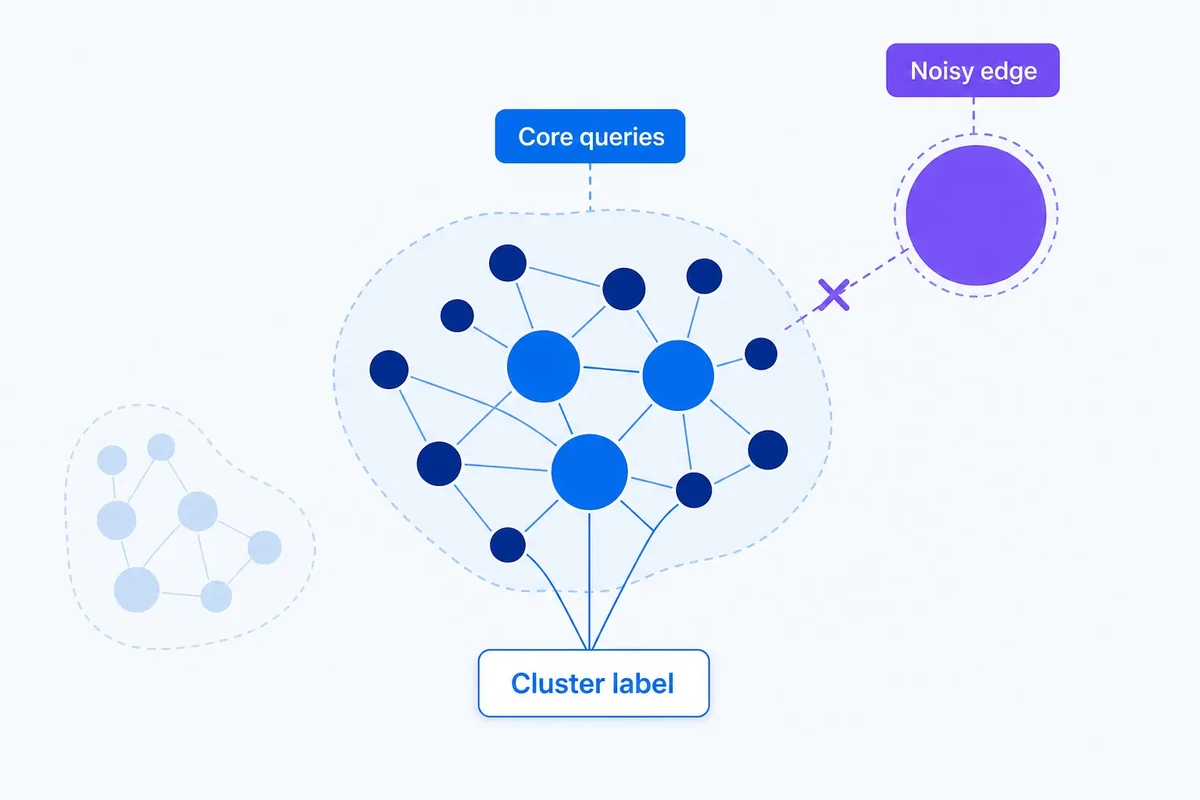
Hybrid lexical and semantic retrieval for SEO: why exact words still matter
Semantic embeddings find paraphrases; lexical retrieval protects exact terminology. Learn how hybrid retrieval combines both signals for keyword and page matching.

Farky Rafiq
Founder of ClusterIQ
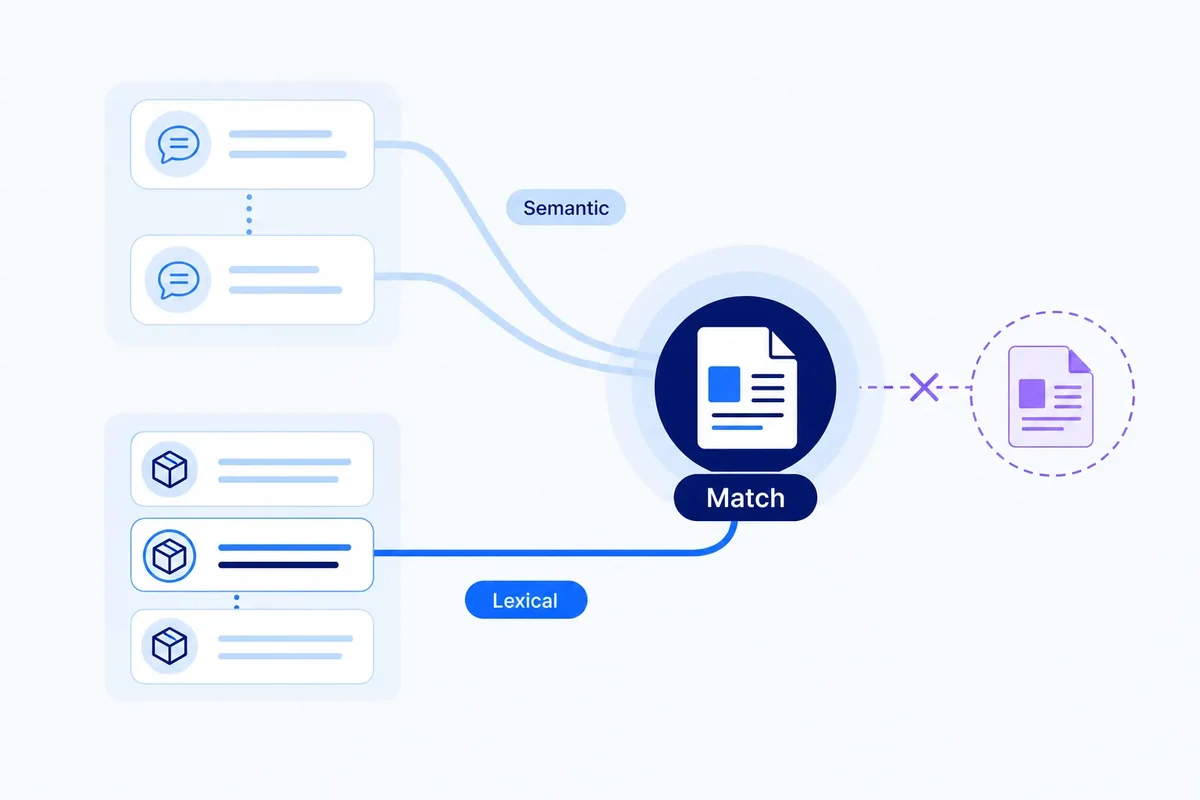
Semantic retrieval is a brilliant tool because it finds connections between ideas even when the words used are completely different. It allows us to see that two phrases are talking about the same thing without needing a literal match.
However, that same flexibility can be a problem when a specific word or number carries all the commercial weight. Product models, dimensions, locations, and brand names might be semantically similar, but in the real world, they are distinct. Hybrid retrieval solves this by combining lexical and semantic signals. This ensures ClusterIQ can spot a paraphrase without ignoring the exact terminology that defines a searcher's intent.
Lexical retrieval rewards shared text
Traditional methods like TF-IDF look for exact matches or character sequences. These are fantastic when specific terms are non-negotiable. Because these features are human-readable, it is easy to see exactly why a tool has made a connection.
The downside is that these systems are often blind to paraphrasing. If the wording changes significantly, a purely lexical system might miss the relationship entirely.
Semantic retrieval rewards represented meaning
Modern embeddings can easily link "affordable running trainers" to "cheap running shoes" despite the lack of shared words. This makes them perfect for handling natural language variations, synonyms, and broad conceptual themes.
The risk here is that a purely semantic model might "smooth over" vital details. It might struggle to distinguish between two different model numbers or specific task modifiers because they appear in similar contexts.
Hybrid retrieval keeps both signals
Rather than picking one side, a hybrid approach uses both. By scoring or gathering candidates from both methods, we get a more complete picture. Common ways to build this include:
- Gathering candidates from both methods separately and merging the lists.
- Combining scores from both lexical and semantic models after normalising them.
- Using lexical rules as a "safety net" or hard constraint for semantic results.
- Using a cross-encoder to rerank a combined set of potential matches.
The best setup usually depends on the specific task and the size of the keyword set you are working with.
Exact product language is a strong use case
Think about these three searches:
- "bosch series 6 dishwasher"
- "bosch series 8 dishwasher"
- "best bosch dishwasher"
A semantic system should correctly identify that these all belong to the same product family. However, lexical and entity-based evidence is needed to ensure the Series 6 and Series 8 stay in their own lanes. This is exactly why entity-aware clustering is such a natural partner for hybrid retrieval.
Character n-grams can protect messy wording
Looking at sequences of characters rather than just whole words helps with several common SEO headaches:
- Typos and misspellings.
- Technical model codes.
- Variations in hyphenation.
- Compound words.
- Different grammatical forms of the same root word.
While not "semantic" in the traditional sense, these features provide a sturdy lexical signal where standard word-based systems often fail.
Do not simply add raw scores
It is important to remember that a cosine similarity score from an embedding model and a TF-IDF score do not mean the same thing. You cannot just add them together.
When ClusterIQ combines these, the signals must be calibrated or scaled first. We also need to keep these components visible. A formula like "60% semantic and 40% lexical" is just another black box unless you can test those weights against real-world SEO decisions.
Worked example: matching a cluster to a page
Suppose you have a cluster of a few hundred keywords around "600mm wall hung vanity units".
A broad category page for "wall hung vanity units" will be a very close semantic match. Meanwhile, a different category for "600mm vanity units" might share the exact dimension but focus on floor-standing models. A hybrid score looks for the convergence of all signals:
- Semantic agreement on the product type.
- Exact lexical agreement on the "600mm" dimension.
- Entity agreement on the "wall hung" construction.
The right URL is the one where all these different signals align.
Hybrid retrieval is useful before clustering
We can generate potential "neighbour" keywords using both methods. The relationship between two keywords becomes much stronger when both signals agree. If they disagree, it flags a case that might need a manual review. This is far more flexible than trying to force a single embedding model to understand every tiny nuance on its own.
It is also useful after clustering
Once your keyword groups are formed, lexical data remains useful for:
- Generating accurate cluster names.
- Finding the most representative phrase for a group.
- Spotting entity mismatches within a topic.
- Explaining the logic behind why a specific keyword was included.
In fact, ClusterIQ's cluster naming workflow already relies on this kind of lexical distinctiveness to produce better results.
Use disagreement as information
When semantic similarity is high but lexical overlap is low, you have likely found a great paraphrase. Conversely, if lexical overlap is high but semantic similarity is low, you might have found an ambiguity or a subtle change in meaning that a simple tool would miss. ClusterIQ aims to make these discrepancies visible rather than just averaging them out.
Retrieval and clustering are different layers
It is helpful to view hybrid retrieval as the process of finding plausible relationships. The clustering or graph method then organises those relationships into a larger map. The first few neighbours you find aren't the final topic map; they are just the evidence used to build it.
A practical hybrid pipeline
- Generate semantic embeddings for your keywords.
- Extract lexical features and character patterns.
- Retrieve potential matches using both methods.
- Normalise the signals so they can be compared fairly.
- Apply entity and search intent constraints.
- Construct a weighted graph of the relationships.
- Evaluate the resulting communities and check the edge cases.
Practitioner principle: semantic retrieval helps ClusterIQ see beyond exact words. Lexical retrieval helps it remember when the exact words matter.
ClusterIQ Conclusion
Hybrid retrieval is a sensible, practical way to balance the broad understanding of AI with the precision of exact matching. It is especially vital for e-commerce and technical SEO, where a single model number or attribute changes everything. By using both signals transparently, ClusterIQ helps you understand whether a keyword relationship is based on meaning, wording, or both.
Evaluate hybrid retrieval by failure type
Instead of just looking for a single "better" score, we should look at the specific errors each method fixes. We want to see how often lexical data saves a product code and how often semantic data catches a paraphrase that a keyword tool would have missed.
ClusterIQ can report on these separately. If a hybrid approach fixes one problem but creates a dozen weak links elsewhere, the balance isn't right yet. The goal is to have complementary evidence that makes your content plans and reporting more robust.
Sources and further reading
Farky Rafiq
Founder of ClusterIQ
I've worked in digital marketing since 2005 and founded Liquid Silver in 2011. These articles are where I share the methods, experiments and practical SEO thinking behind ClusterIQ.
Put the idea into practice with your own keyword data
ClusterIQ helps turn raw SEO exports into clean, structured working datasets you can inspect, refine, report on and take into the next stage of your workflow.
Keep reading
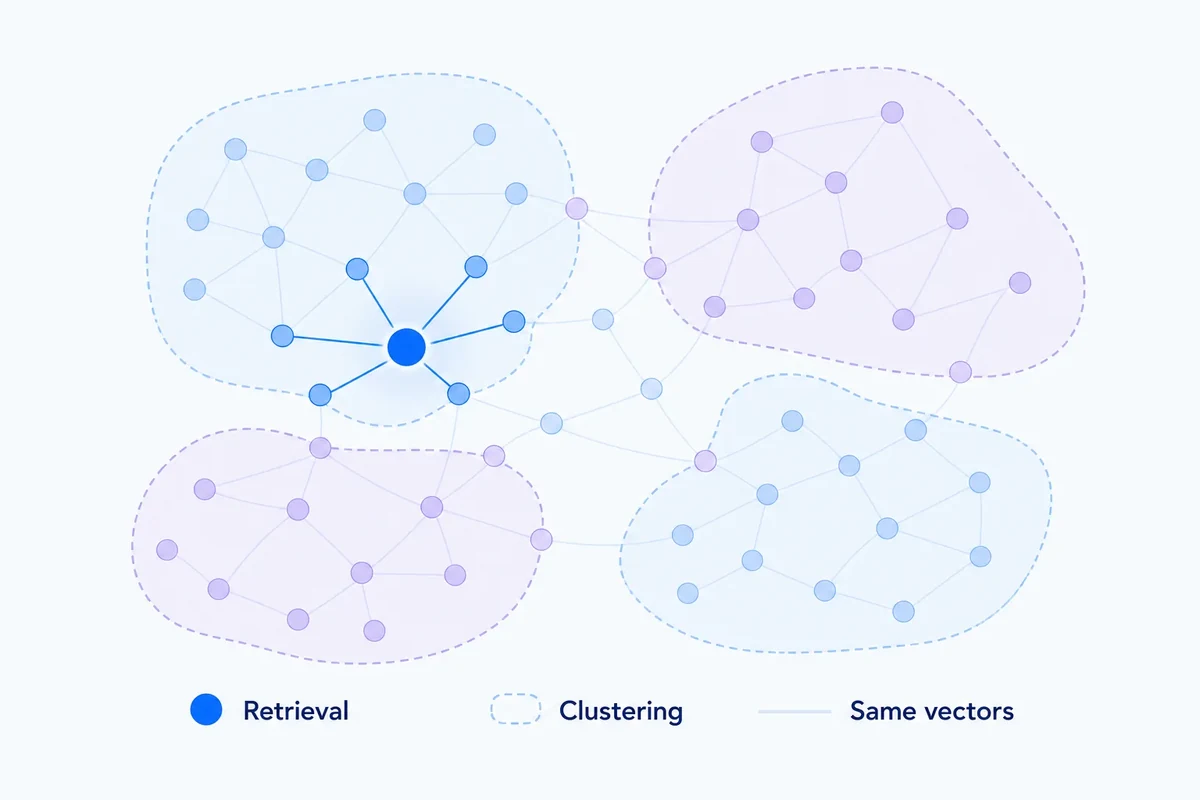
Semantic search vs keyword clustering: retrieval and grouping solve different problems
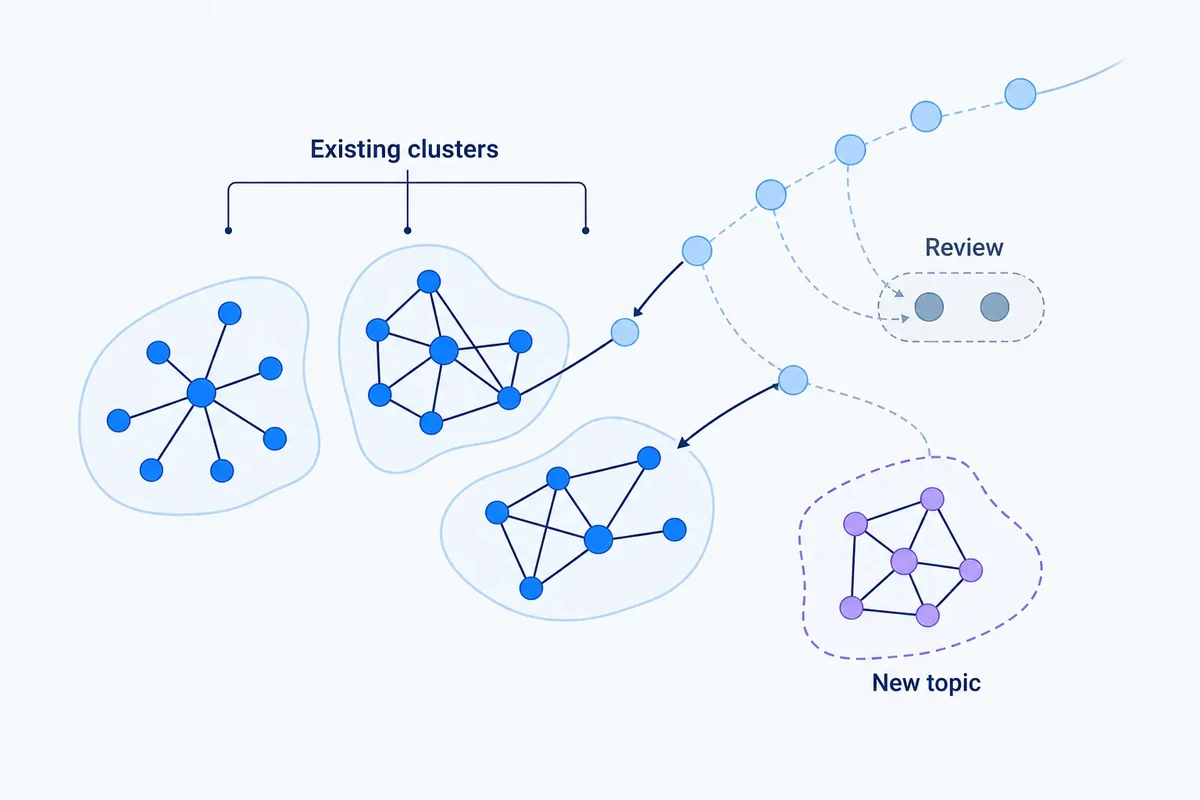
Adding new keywords to existing clusters without rebuilding everything