Semantic search vs keyword clustering: retrieval and grouping solve different problems
Semantic search finds the best matches for a query. Keyword clustering organises a whole dataset into useful structure. Learn why the same embeddings can support both.

Farky Rafiq
Founder of ClusterIQ
If you have ever spent an afternoon staring at a spreadsheet of three thousand keywords from Ahrefs or Search Console, you have likely felt the tension between finding something specific and trying to make sense of the whole mess. While semantic search and keyword clustering often share the same technical DNA, they actually solve two very different problems for your content strategy.
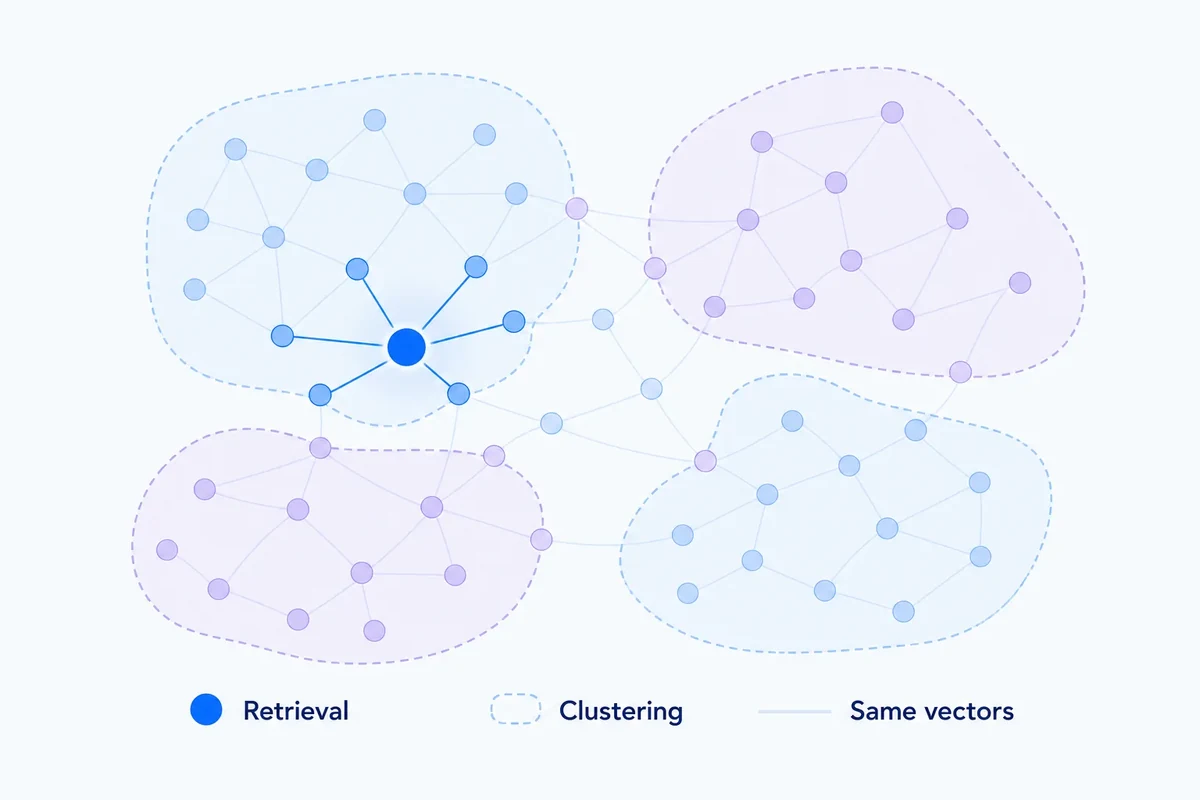
Think of semantic search as a retrieval tool. It asks: out of all these rows, which ones are most relevant to this specific query? Keyword clustering, on the other hand, is a structural tool. It asks: how should this entire dataset be organised into logical groups that a writer can actually use?
Confusing these two can lead to a messy content plan where you find related terms easily but fail to build a coherent site architecture.
Semantic search is a retrieval problem
A semantic search system takes a query and scans a collection of text to find the best matches. It returns a ranked list of results that are locally relevant to whatever you searched for. It is brilliant for exploration, but it does not care about the bigger picture of your data.
Clustering is a structure problem
Clustering looks at every relationship across your entire keyword list. It tries to organise those thousands of rows into communities, hierarchies, and distinct topics. This process gives you cluster labels, identifies outliers that do not fit, and shows how different topics connect.
ClusterIQ uses retrieval as a starting point, but it does not treat a list of nearest neighbours as the final answer for your content plan.
Good neighbours do not guarantee good clusters
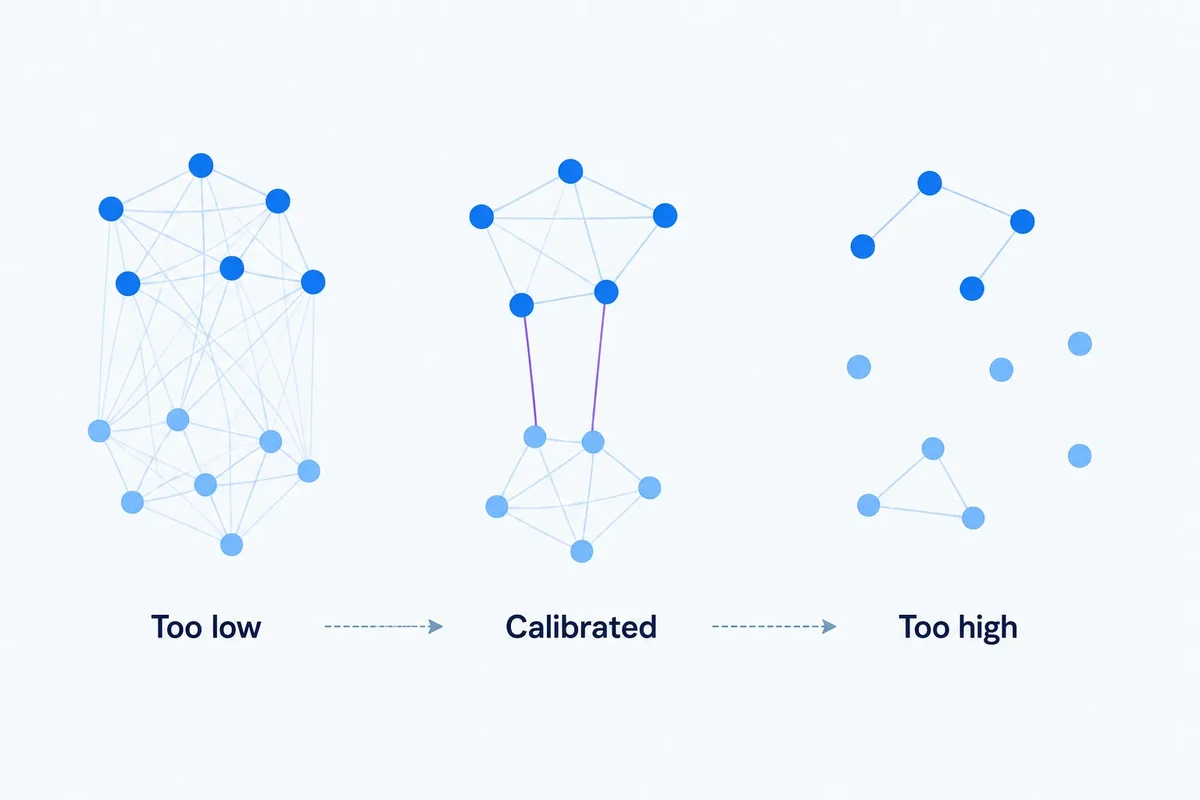
Just because every keyword has a few sensible neighbours does not mean you have a good cluster. If you only look at local relationships, you might end up with one giant, unhelpful group, or strange chains where a topic about "running shoes" slowly drifts into "wedding shoes" through a series of small, logical steps. The clustering stage needs to look at the geometry of the data on a much larger scale to prevent these overlaps.
Semantic search can generate graph candidates
In a practical ClusterIQ workflow, we use semantic retrieval to find potential neighbours for every keyword in your export. We then filter these pairs using lexical evidence, search intent, and SERP overlap. The relationships that survive this vetting process become the edges of a graph, which serves as the foundation for the final groups.
Retrieval optimises ranking, clustering optimises grouping
When you are retrieving data, you only care if the right answer appears at the top of the list. When you are clustering for an SEO project, you care about how stable those groups are and whether they make sense for a URL structure. A model might be excellent at finding related terms but terrible at drawing the boundaries needed for a clean content brief.
Worked example: matching keywords to pages
Imagine you need to map a fresh batch of keywords to your existing URLs. Semantic search can quickly find the five pages on your site that are most similar to a specific keyword cluster. That is a retrieval task. However, deciding if that cluster deserves its own new page or if the intent is already covered elsewhere is an information architecture task. One finds the candidates; the other makes the executive decision.
Cross-encoders make the distinction clearer
Advanced pipelines often use a two step process: a fast search to find candidates, followed by a more precise "cross-encoder" to score how closely they actually relate. Even the most accurate scoring system is still just comparing two things at a time. It does not automatically know how to partition a list of five thousand keywords into a sensible site map.
You can read more about cross-encoder reranking for SEO to see how this works in practice.
Clustering can feed semantic search too
This relationship is a two way street. If you are looking at a specific cluster in ClusterIQ, semantic search can help you find similar unassigned queries or suggest internal linking opportunities from existing pages. It helps you explore the edges of your clusters without breaking the underlying structure you have built.
Keep the two evaluation layers separate
It is helpful to be able to say that your retrieval quality is high even if your clusters feel too messy. If you lump everything into one "quality score," you will never know if you need to fix your data matching or your grouping logic. Keeping these layers separate makes it much easier to troubleshoot a content plan that feels slightly off.
Semantic search is useful for exploration
When you are first digging into a new niche, you just want to see what is related to what. Nearest neighbour search is perfect for this kind of quick interaction. It helps you understand why the system thinks two terms belong together before you commit to a final structure.
Clustering needs global context
A keyword might sit right at the intersection of two different topics. Locally, it looks like it could belong to either. Only by looking at the entire network can you see which community it truly serves. This is where ClusterIQ's graph approach provides much more value than a simple search ever could.
Keep the product architecture layered
A professional SEO workflow should be modular. You have layers for representing the data, retrieving matches, scoring relationships, and finally, making the SEO decision. Each layer can fail in its own way. By testing them individually, you ensure that your final page mapping is based on solid evidence rather than just a lucky guess by an algorithm.
Use the right benchmark for the right question
If your keyword groups are coming back too broad, changing how you search for neighbours won't help. You need to adjust the community detection settings. By exposing these layers, ClusterIQ ensures that when something changes in your reporting, you know exactly which part of the engine to tune.
Practitioner principle: semantic search is for finding related items. Clustering is for deciding how those items should be structured. They use the same data, but they answer different questions.
ClusterIQ Conclusion
Semantic search and keyword clustering are two sides of the same coin. While they live in the same technical world, they serve different masters. By using semantic retrieval for discovery and graph analysis for structure, you can build a content architecture that is both technically sound and practically useful for your team.
Sources and further reading
Farky Rafiq
Founder of ClusterIQ
I've worked in digital marketing since 2005 and founded Liquid Silver in 2011. These articles are where I share the methods, experiments and practical SEO thinking behind ClusterIQ.
Put the idea into practice with your own keyword data
ClusterIQ helps turn raw SEO exports into clean, structured working datasets you can inspect, refine, report on and take into the next stage of your workflow.
Keep reading
Adding new keywords to existing clusters without rebuilding everything
HDBSCAN for keyword clustering: density, noise and uncertain queries