Vector normalisation for SEO embeddings: why unit length changes similarity and search infrastructure
L2 normalisation changes how vector length affects similarity and can make cosine and inner-product rankings equivalent. Learn what that means for SEO embeddings and thresholds.

Farky Rafiq
Founder of ClusterIQ
Vector normalisation is one of those technical choices that can quietly change every similarity score in an embedding workflow. If you have ever exported a few thousand keywords from Ahrefs or Search Console and wondered why two terms that look identical to a human end up in different clusters, the way your vectors are scaled might be the culprit.
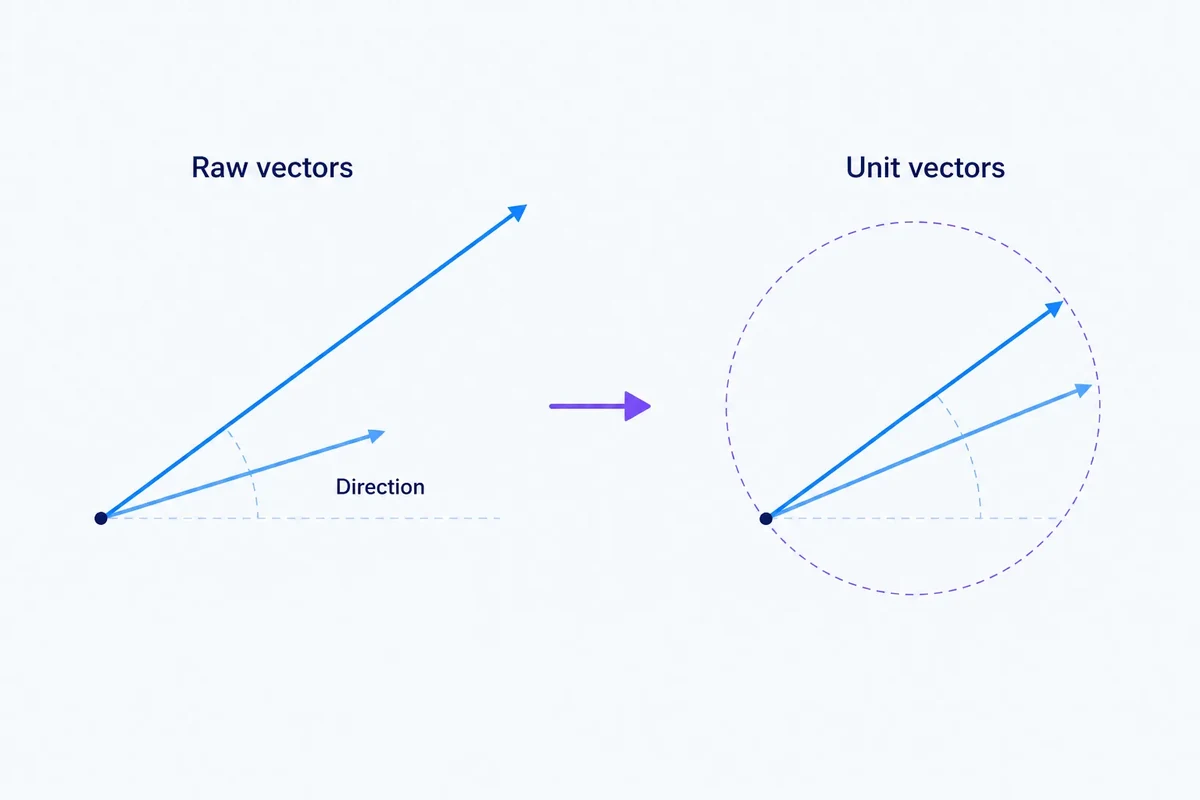
In the context of L2 normalisation, each vector is scaled to a unit length. Its direction remains exactly the same, but its magnitude becomes one. For ClusterIQ, this matters because the way we calculate similarity, set thresholds, and build search indexes can behave differently depending on whether these vectors have been normalised.
What L2 normalisation does
To normalise a vector, you divide each of its components by its Euclidean norm. The result is a vector with a length of exactly one. It is helpful to think of this as moving every data point onto the surface of a sphere. The transformation does not change the direction the vector points in the embedding space; it simply removes magnitude as a factor in later comparisons. In practical SEO terms, this ensures that the "strength" or length of a keyword's representation doesn't skew how it relates to others.
Why cosine and dot product can become equivalent
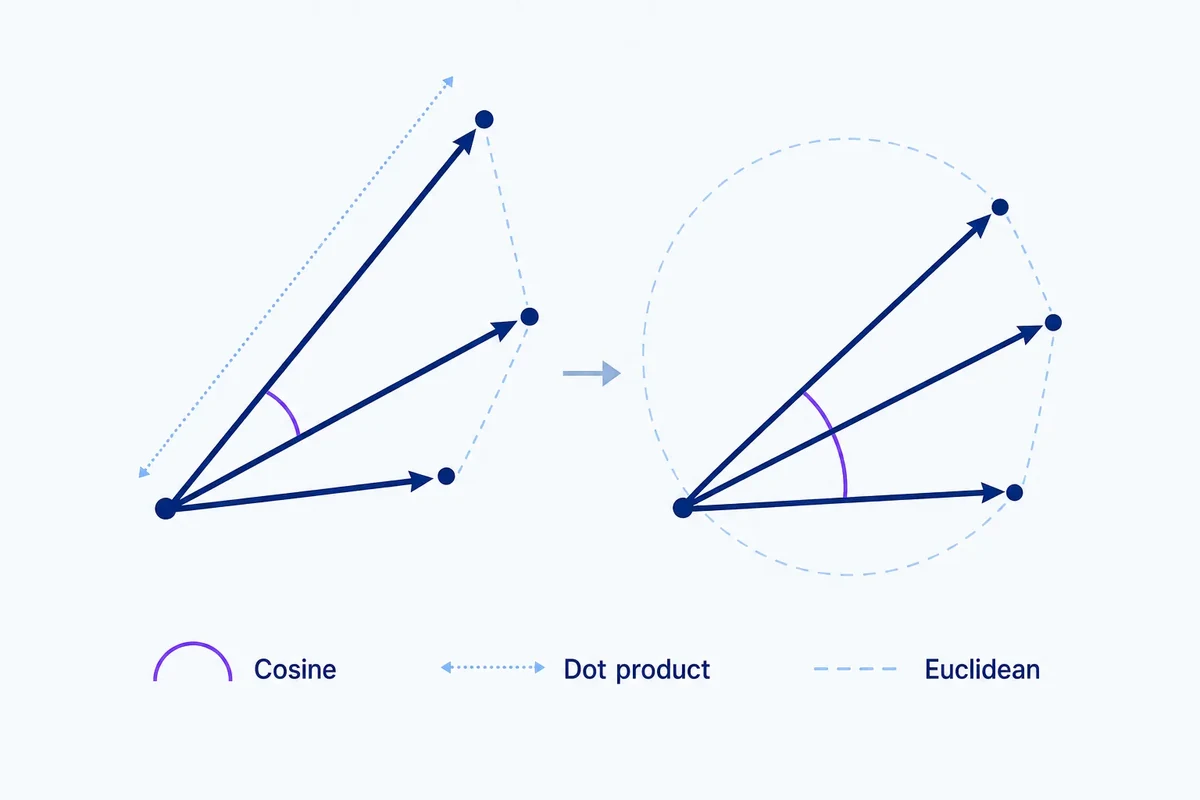
When we compare two keywords, we often use cosine similarity, which involves dividing the dot product by the lengths of the two vectors. If both vectors already have a length of one, that denominator becomes one. Consequently, cosine similarity becomes identical to the dot product.
This can significantly simplify vector search infrastructure. An inner product index, which is often faster to compute, can reproduce cosine rankings perfectly when vectors are unit normalised. For a junior SEO building a custom tool, this means less computational overhead when processing a content plan involving thousands of URLs.
Do not assume magnitude is meaningless
It is tempting to normalise everything by default, but some models or tasks actually encode useful information in vector magnitude. Normalising removes that signal entirely. You should always consult the model documentation and run a validation benchmark rather than applying normalisation automatically just because cosine similarity feels familiar. If the model uses magnitude to signal the "importance" or "certainty" of a keyword, you might be throwing away the very data you need for accurate clustering.
Worked example: same direction, different magnitude
Imagine you are comparing two document vectors that point in nearly the same direction but have very different norms. Cosine similarity sees them as very close because it focuses purely on direction. However, a raw dot product might heavily favour the larger vector. If ClusterIQ's semantic interpretation is intended to depend on the topic (direction) rather than the length or intensity of the text (magnitude), normalisation makes that comparison explicit and fair.
Thresholds change when normalisation changes
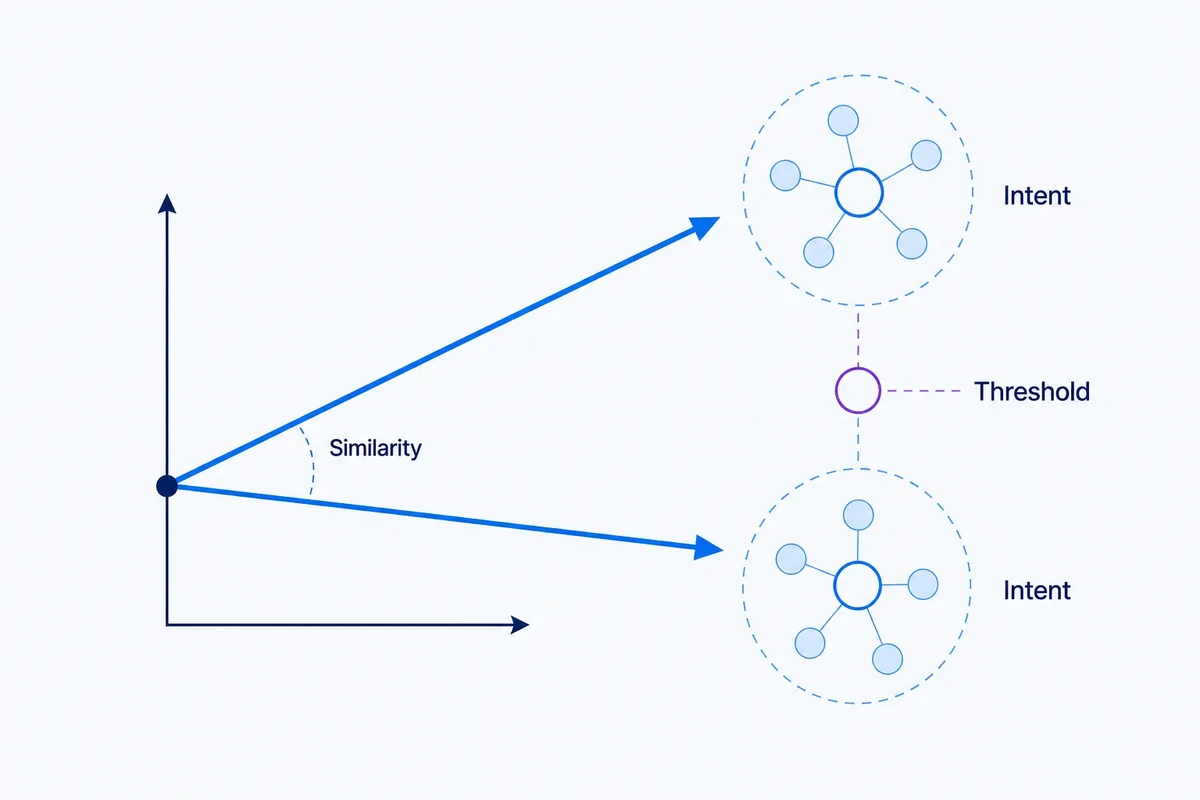
If you have spent time calibrating a similarity threshold on raw dot products, you cannot simply reuse that number after unit normalisation. The entire score distribution shifts because magnitude no longer contributes to the result. ClusterIQ's threshold calibration should be rerun whenever the normalisation strategy changes to ensure your keyword groups remain tight and relevant.
Normalise consistently across corpus and queries
Consistency is vital. If your corpus vectors are normalised but your query vectors are not, the scoring logic no longer matches the intended cosine equivalence. ClusterIQ treats vector preprocessing as a core part of the model pipeline, applying it consistently at both the encoding stage and at search time. Mixing the two is a quick way to get nonsensical results in your reporting.
Stored vectors need a version
If a database contains a mixture of normalised and unnormalised embeddings, your nearest neighbour results become impossible to interpret. To maintain reproducibility, you must store:
- The embedding model used;
- The specific model revision;
- The normalisation state;
- The vector dimension;
- The similarity function applied.
Without these details, an SEO audit performed today might not match the results you get next month.
Approximate indexes inherit the metric choice
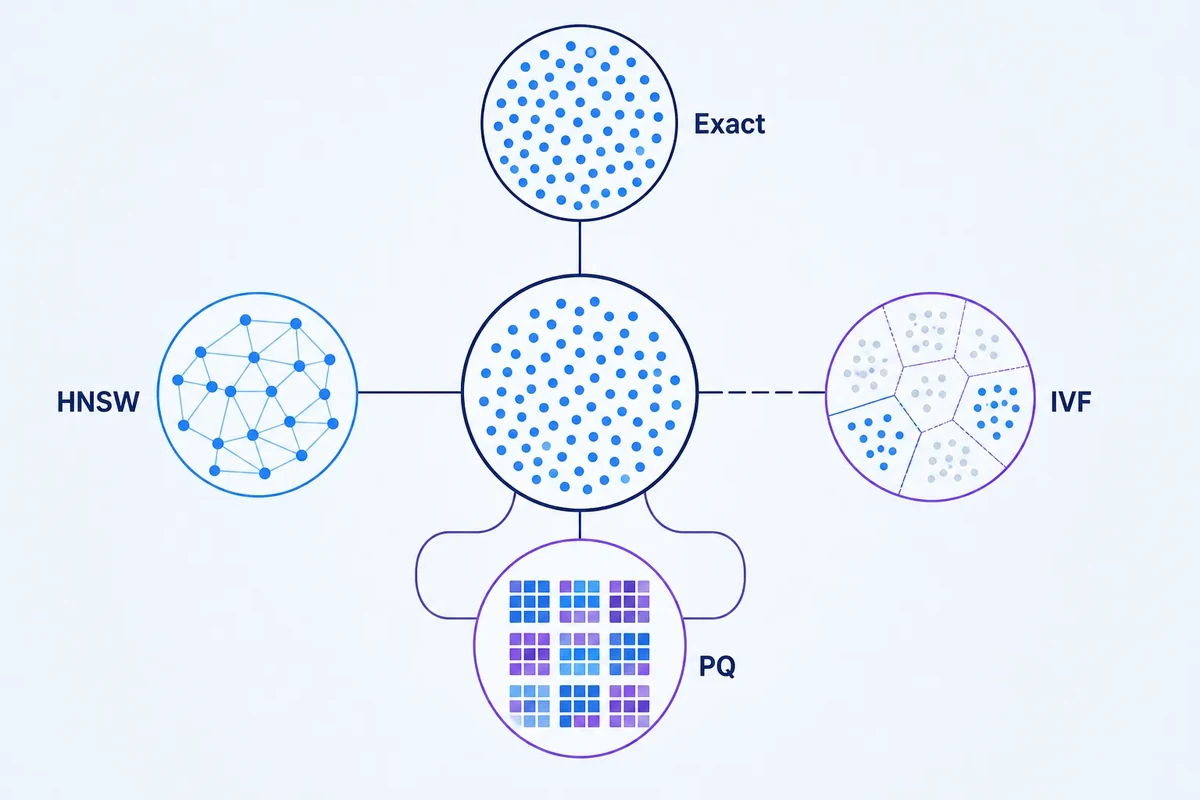
Tools like HNSW and Faiss indexes must be configured around the specific metric you intend to use. A shift from Euclidean distance to a normalised inner product often requires rebuilding or revalidating the entire index. Choosing a Faiss index should therefore be considered alongside your vector preprocessing strategy to avoid performance bottlenecks.
Normalisation can improve numerical consistency
Unit vectors place all observations on a common scale, which can make score distributions easier to compare across different batches of keywords. However, this does not guarantee semantic calibration across different models or languages. Two different embedding models can produce very different cosine distributions even when both are unit normalised.
Do not confuse normalisation with dimensionality reduction
It is important to distinguish between these two processes. Normalisation changes the vector length, whereas PCA, Matryoshka truncation, or other reduction methods change the number or composition of the dimensions themselves. These are distinct transformations and should be evaluated as separate steps in your SEO data pipeline.
Normalisation can affect clustering algorithms differently
Running K-means with Euclidean distance on normalised vectors behaves quite differently from running it on raw vectors. Because the distance distribution changes, your density thresholds for forming clusters will also need adjustment. ClusterIQ treats normalisation as a primary experimental factor when comparing the quality of keyword clusters.
Inspect nearest-neighbour changes directly
A useful way to check your work is to compare the top neighbours for a keyword before and after normalisation. Pay close attention to:
- Ambiguous short queries;
- Specific product codes;
- Very short versus very long snippets of text;
- Cross-language examples;
- Known benchmark pairs you have used previously.
Page embeddings may behave differently from keyword embeddings
Long page representations and short query representations often have different norm distributions. While normalisation can make cross-type comparisons easier, your retrieval benchmark should still test actual query to page matches. Do not simply assume the transformation solves all issues related to text length differences.
Keep the setting out of the user's way, but not out of the audit trail
Most marketers do not need a "normalise vectors" toggle in their daily workflow. ClusterIQ chooses a validated default for each model while recording that choice in the run manifest. This keeps the interface clean for junior users while exposing the advanced methodology for senior SEOs who need to perform a deep audit.
Practitioner principle: normalisation changes what vector magnitude is allowed to mean. Treat it as a fundamental part of the data representation, not just a harmless formatting step.
ClusterIQ Conclusion
Vector normalisation is a small implementation choice that carries significant downstream effects. ClusterIQ keeps this process consistent, versioned, and benchmarked because it fundamentally alters similarity scores, index behaviour, and the geometry of your clusters across the entire semantic pipeline.
How ClusterIQ would validate this before production use
The real test is not whether a method produces a plausible output once, but how it performs across thousands of instances. ClusterIQ maintains a frozen set of representative queries and pages. We apply the current configuration alongside the proposed change and compare the actual decisions that result. This review covers obvious examples, difficult boundary cases, and high-value page mappings.
Our acceptance evidence remains layered: we look at the underlying score, the resulting cluster membership, and the final SEO action. If a change improves a technical metric but moves a high-value query to a less sensible page, it is not an improvement. By preserving these before and after examples with the run version, we ensure the methodology is a regression-tested system rather than a collection of settings that just happened to look good on the latest dataset.
Sources and further reading
Farky Rafiq
Founder of ClusterIQ
I've worked in digital marketing since 2005 and founded Liquid Silver in 2011. These articles are where I share the methods, experiments and practical SEO thinking behind ClusterIQ.
Put the idea into practice with your own keyword data
ClusterIQ helps turn raw SEO exports into clean, structured working datasets you can inspect, refine, report on and take into the next stage of your workflow.
Keep reading
Cosine, dot product or Euclidean distance: choosing a similarity measure for keyword embeddings
Cosine similarity for keyword clustering: what the score really means