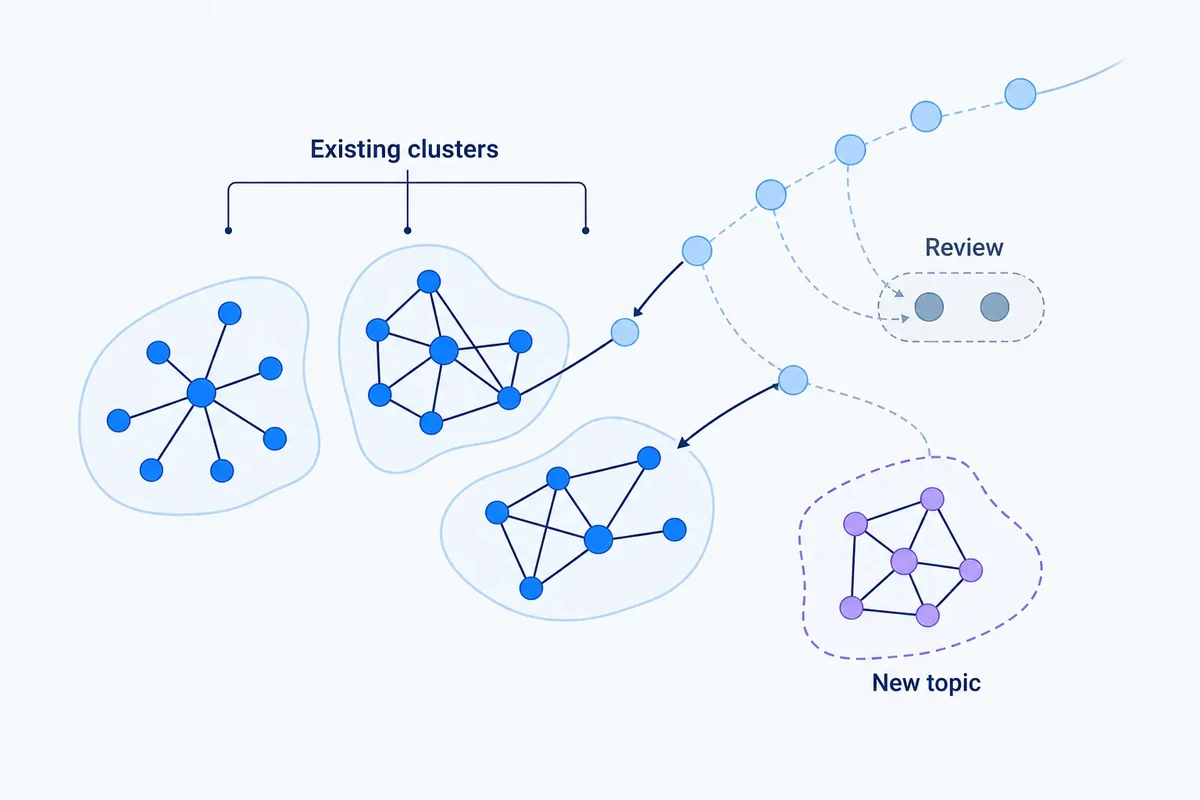
Choosing an embedding model for keyword clustering: accuracy is only one part of the decision
Embedding models differ in language coverage, training objective, dimensionality, speed and domain behaviour. Learn how to choose one for keyword clustering without chasing a leaderboard.

Farky Rafiq
Founder of ClusterIQ
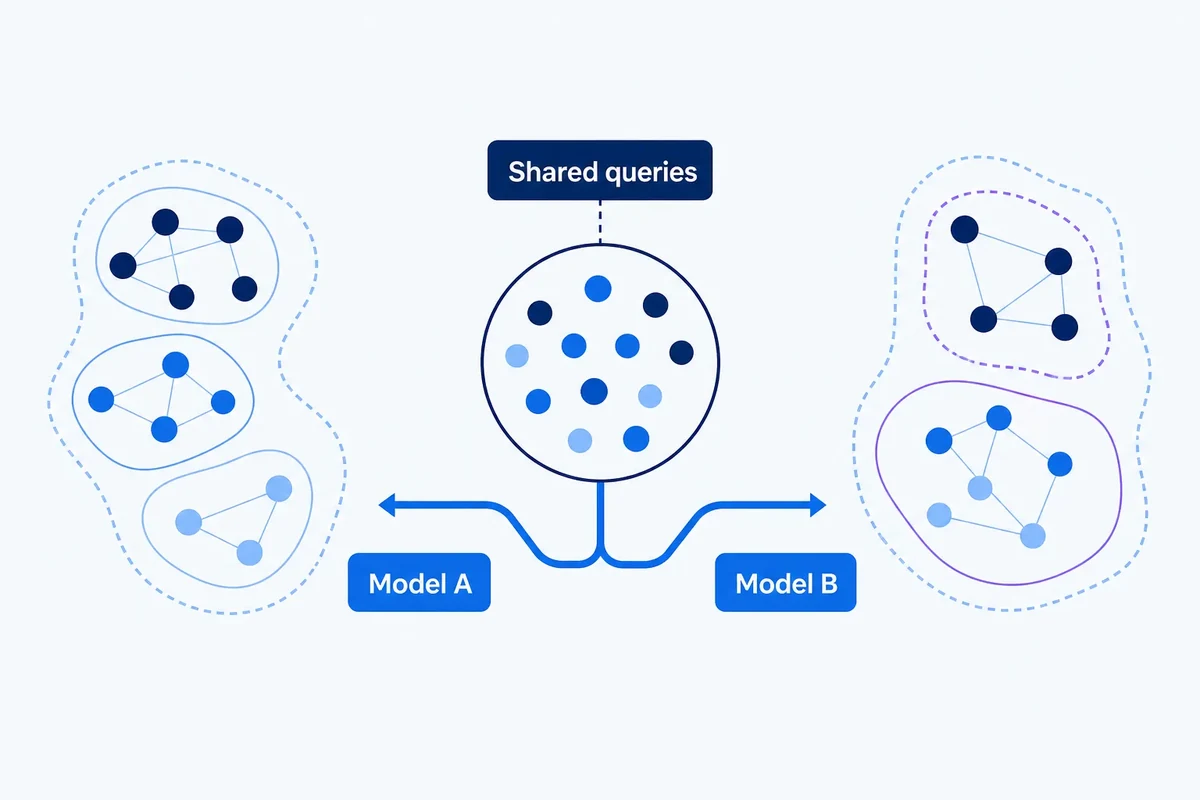
The embedding model is the engine that decides how keywords relate to one another. It defines the semantic space where similarity is measured. If you swap the model, you change everything: which keywords are considered neighbours, where cluster boundaries fall, and how outliers are handled, even if your other settings remain identical.
For ClusterIQ, choosing a model is a fundamental strategic decision rather than a minor technical detail.
Start with the task, not the leaderboard
Public benchmarks are helpful, but a model that excels at comparing long paragraphs or general sentences might struggle with the specific quirks of SEO data. Keyword lists often contain very short phrases, product codes, commercial modifiers, and ambiguous terms. Your evaluation should focus on how a model handles these specific elements, not just its general score.
Training objective matters
Not all sentence embedding models are built for the same purpose. Some are trained for retrieval (finding a needle in a haystack), while others are built for similarity or classification. A model designed for retrieval might be brilliant at matching a user query to a relevant blog post, but it might behave unexpectedly when asked to group two short, similar search terms together. Always check the model documentation rather than assuming all vectors are equal.
Language coverage needs explicit testing
If you are using ClusterIQ to process keywords in French, German, or Spanish, a model trained only on English will fail you. While multilingual models can map related terms from different languages into the same space, cross-language clustering requires careful validation in each specific market. Never assume a model works well in Italian just because it performs perfectly in English.
Dimensionality affects storage and speed
Higher-dimensional vectors can capture more nuance, but they come at a cost. They require more memory and slow down the process of finding nearest neighbours. If you are clustering a few thousand keywords from Ahrefs or Search Console, this is negligible. However, when you scale to hundreds of thousands of rows, vector size becomes a significant engineering factor. ClusterIQ tracks these dimensions to ensure every experiment can be replicated exactly.
Model size affects throughput
Larger models are often more accurate but can be significantly slower to run. If a model makes your workflow feel sluggish, it might not be the right choice for production, regardless of its benchmark score. You need to weigh up encoding speed, memory usage, and whether the quality gain justifies the extra time or hardware requirements.
Domain language can expose weaknesses
Standard models often trip up on niche data, such as:
- Technical product model numbers;
- Industry-specific jargon;
- Medical or legal terms;
- Specific local geography;
- Unique brand names.
If a model fails here, you do not always need to jump to complex fine-tuning. Sometimes using business dictionaries or lexical features is a more transparent way to fix the issue.
Worked example: two good models, different mistakes
Consider Model A, which is great at understanding synonyms but tends to ignore small differences in product versions. Model B is the opposite: it spots technical differences perfectly but misses natural language variations. For a broad content plan, Model A is likely better. For a complex ecommerce site where "iPhone 14" and "iPhone 15" must stay separate, Model B is the winner. The right choice depends on whether you fear accidental merges or unnecessary separations more.
Use a human benchmark set
The best way to avoid chasing meaningless metrics is to use ClusterIQ's human benchmark workflow. Test your models against a curated list of:
- Clear synonyms;
- Terms with the same topic but different intent;
- Brand vs non-brand variations;
- Location-based queries;
- Ambiguous short-tail terms.
Look at the actual clusters produced, not just a single correlation percentage.
Inspect score distributions before reusing thresholds
Never copy a similarity threshold from one model to another. Each model has its own way of distributing scores. If you change models, you must recalibrate your thresholds and check your graph diagnostics. This is why model versioning is a standard part of every ClusterIQ project.
Compare downstream decisions
Instead of asking which model is "smarter", ask how it affects your work. Did the high-value keywords move to more logical groups? Are the page-mapping suggestions easier to explain to a client? Has the number of nonsensical outliers decreased? The best model is the one that makes your final SEO recommendations more defensible.
Do not swap models silently
Changing a model after you have already started labelling or overriding clusters can break your analysis. ClusterIQ treats a model change as a new version of the project, preserving the history of your data so you don't lose the logic behind your previous decisions.
A practical selection process
- Shortlist models based on your required languages.
- Review the technical specs and recommended settings.
- Test the models against a fixed benchmark dataset.
- Check how they handle your most important keyword pairs.
- Run a full test on a representative sample of your data.
- Evaluate the results based on speed, accuracy, and logic.
- Choose the model that balances quality with practical performance.
Practitioner principle: the best embedding model is the one that preserves the distinctions your SEO decisions depend on, at a cost and speed the product can sustain.
ClusterIQ Conclusion
The embedding model you choose dictates the entire logic of your keyword groups. Use benchmarks to narrow your search, but always validate with real-world SEO scenarios. A stable, well-understood model that handles your specific niche is far more valuable than a "top-rated" model that you cannot control or explain.
Sources and further reading
Farky Rafiq
Founder of ClusterIQ
I've worked in digital marketing since 2005 and founded Liquid Silver in 2011. These articles are where I share the methods, experiments and practical SEO thinking behind ClusterIQ.
Put the idea into practice with your own keyword data
ClusterIQ helps turn raw SEO exports into clean, structured working datasets you can inspect, refine, report on and take into the next stage of your workflow.
Keep reading
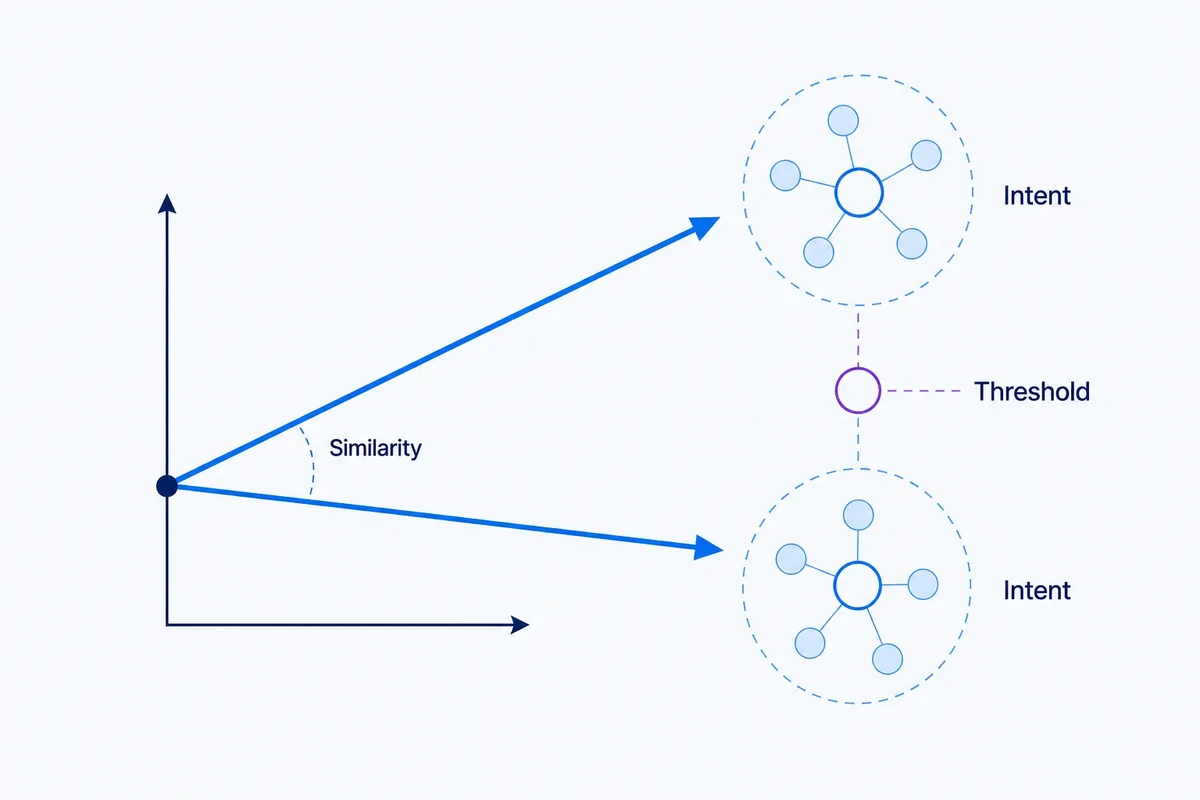
Cosine similarity for keyword clustering: what the score really means
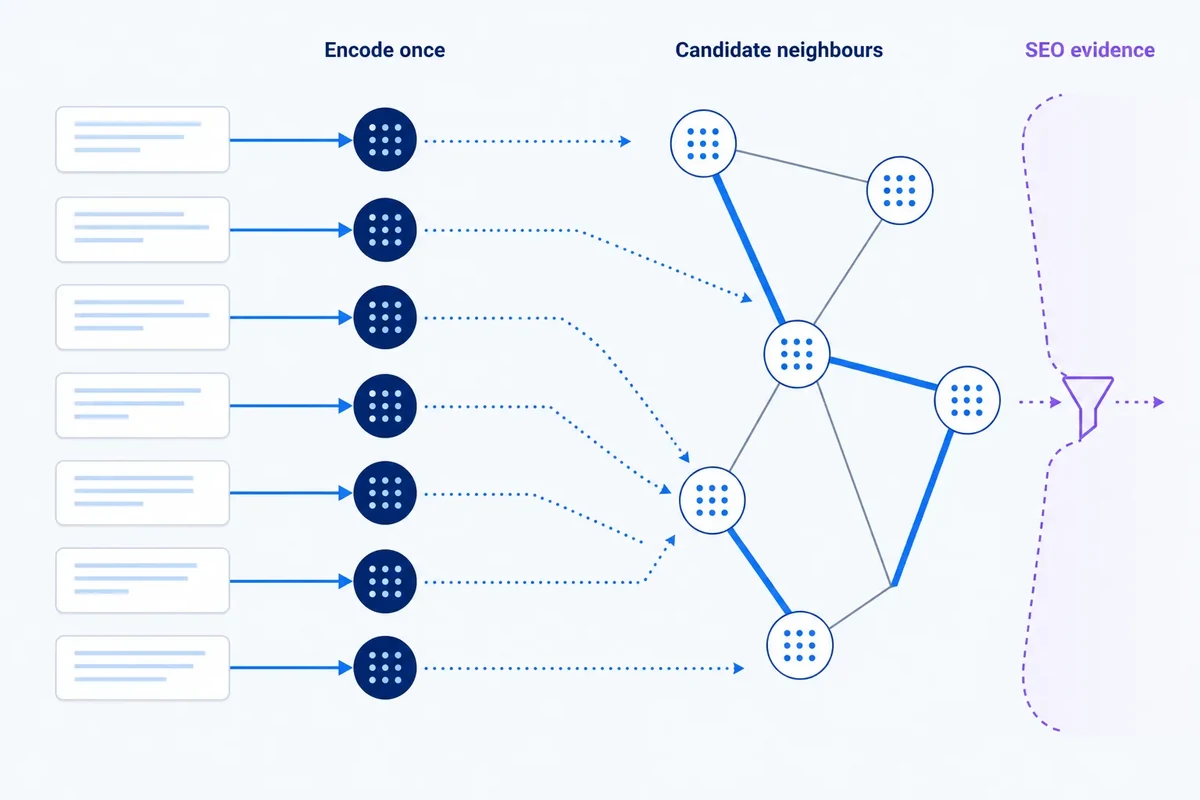
Sentence Transformers for SEO: what bi-encoders actually add to keyword analysis